
Roofers in Yorkley
Roofs between Pillowell and Oldcroft, from cottages recorded in the 1780s and ironworkers' rebuilding of the 1800s to the council estate begun on Yorkley Slade in 1930.
Yorkley at a glance
- Distance
- 28.1 road miles west of Stroud
- Council
- Forest of Dean District Council
- Setting
- Forest of Dean village near Lydney, with Yorkley Slade to the east
- Nearby conservation area
- Pillowell, within about 400 m
Yorkley's roofs between Pillowell and Oldcroft
Yorkley lies in the Forest of Dean between Pillowell and Oldcroft, near Lydney, with Yorkley Slade to its east. It is 28.1 road miles west of Stroud, and the council is Forest of Dean District Council. Where other villages in our area have a church or a market square to anchor their story, Yorkley's history is told through work and housing.
Cottages are recorded in both Yorkley and Yorkley Slade in the 1780s. Much rebuilding and new building took place in the middle of the nineteenth century, some of it by employees of the Parkend Ironworks. From 1930 a large estate of council houses was formed on the north side of Yorkley Slade. Mining was once a major local employer, and an opencast coal mine operated at Yorkley as recently as 1960.
That gives the village four layers of building that a roofer should keep apart: eighteenth-century cottages, rebuilding from the 1800s, the Slade estate, and whatever has been added since. Houses of four periods carry different coverings, so we do not guess from the street. The survey identifies the covering on each house, and the quote is written for that covering. The Pillowell Conservation Area, designated on 18 September 1999, lies within about 400 m of the centre of Yorkley, which sits outside it. Whether a particular address near the boundary falls inside it is a question for Forest of Dean District Council, and we suggest asking before any change of material.

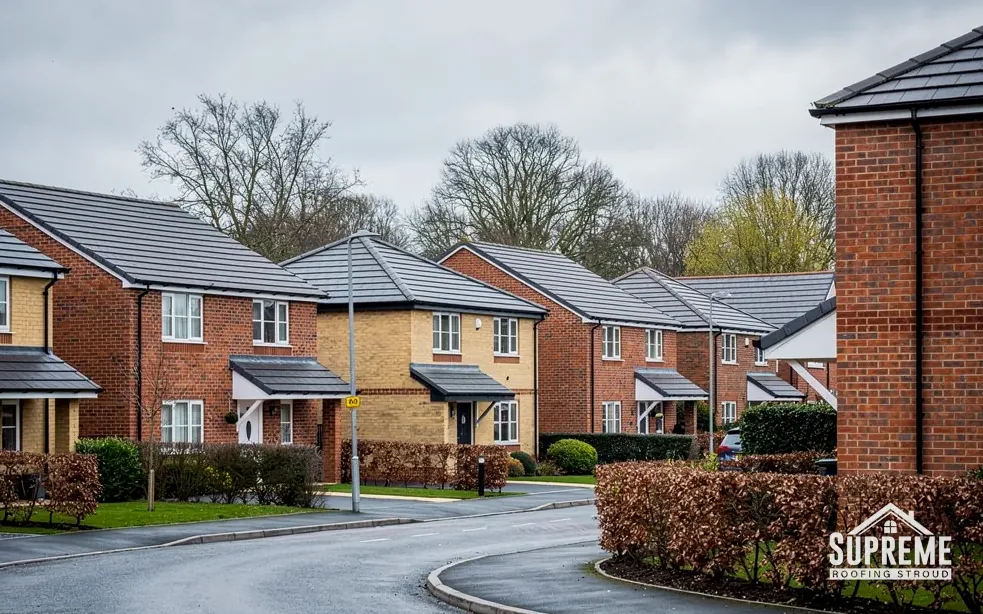
Row of stone cottages with mossy clay tile roofs along a quiet lane 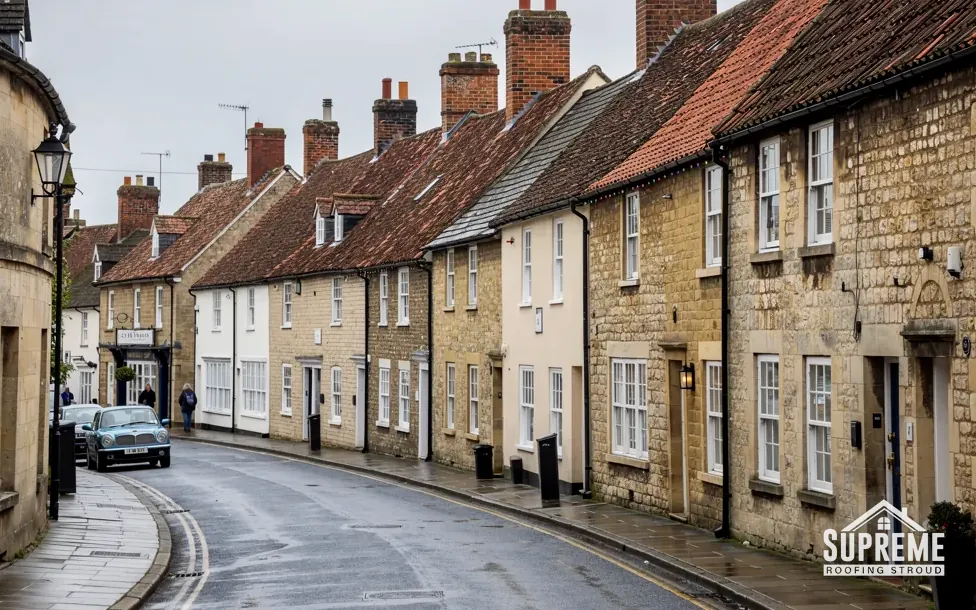
Curving street of stone and rendered terraced houses with tiled roofs
Chapter 01
The 1930 council estate on the north side of Yorkley Slade
A large estate begun in 1930 means a long row of roofs of the same age, and a different way to plan.
Chapter 01In this chapter
Work on a large council estate along the north side of Yorkley Slade began in 1930, and the houses went up in numbers rather than one at a time. An estate that size puts many roofs of the same age on the same hillside, and by now the oldest of them are nearly a century old. That does not make them failing roofs. It makes them roofs at an age where it pays to look closely at the parts that wear out before the covering does.
The parts we look at first on a roof of that age are the ones that were never meant to last as long as the tiles or slates: the nails and clips, the felt or underlay beneath, the lead at the chimneys and abutments, and the mortar at the ridge. A covering can be in good order while the underlay below it has turned brittle, and the first anyone knows of it is a stain on the bedroom ceiling. A survey that goes into the loft as well as onto the roof finds these faults early, which is when the repair costs least.
Neighbours and shared work
On an estate, the question of what a neighbour will do matters more than it would on a detached house. Roofs in a run often share a party wall and a ridge line, and a repair at the junction involves the next house's roof as well as yours. Where two or three neighbours need work at the same time, scaffold can often be shared, which spreads its cost. We are happy to survey several houses in a row and give each owner their own written quote.
Why we go into the loft
Looking at a roof from the lane tells you about the covering and little else. Inside, daylight at the ridge shows a gap, a dark stain on a rafter shows a past leak, and underlay hanging in a loop shows where a nail has let go. We take photographs of what we find and add them to the report, so you can see the same things we did. If the loft is full of stored belongings, tell us before the visit, as a clear path to the eaves makes the inspection more thorough.

Matching the street
When one house in a row is re-roofed in a covering that differs in colour or profile, it is noticeable from the end of the lane. The aim is a close match with what is already there. Should the original tile no longer be made, we name the nearest alternative and explain the choice. Our ridge, verge and dry-fix page explains how ridge and verge lines are rebuilt so that they match without relying on mortar alone.
On a roof of this age, the covering is rarely the first thing to go.
Myth: A roof from 1930 that is not leaking must be in good order.
Fact: The covering may be sound while the underlay, nails and flashings beneath it have aged, which is why a survey includes the loft.
Chapter 02
Cottages of the 1780s and the rebuilding linked to Parkend Ironworks
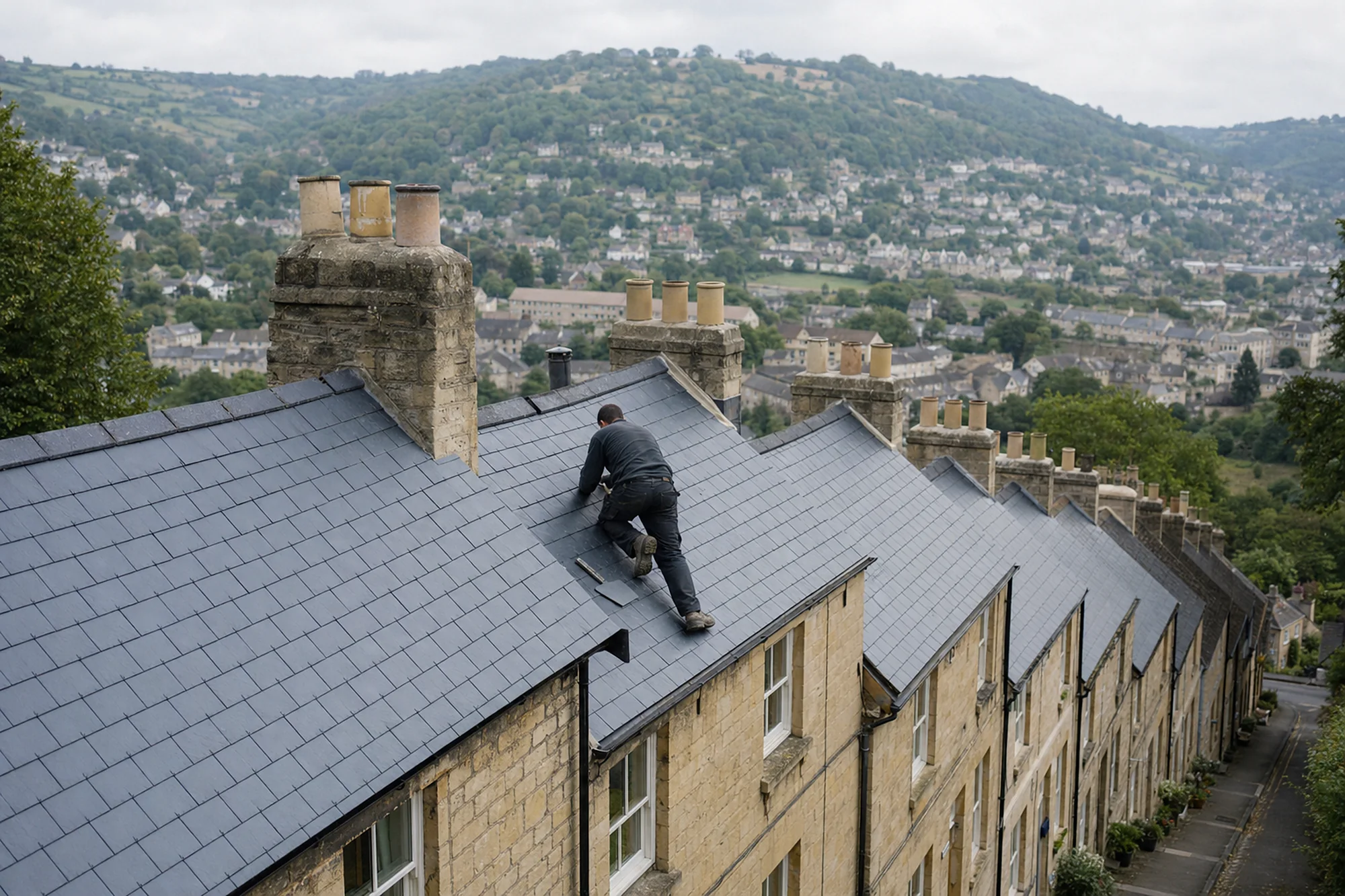
Roofs from the 1780s to the 1800s have been repaired many times, and the joins show it.
Chapter 02In this chapter
Cottages are recorded in both Yorkley and Yorkley Slade in the 1780s, and the middle of the nineteenth century brought much rebuilding and new building, some of it by employees of the Parkend Ironworks. Buildings of those dates are now between about 150 and 250 years old, and almost none have escaped repair. A roof like that is not a single piece of work but a record of every previous repair, laid one over another. Each generation of repair used what was to hand, so battens, nails and tile sizes can differ across a single slope, and a new covering has to be planned around those differences.
In this chapter
The first challenge is simply working out what has happened. A slope might have been recovered in the twentieth century on battens that were fitted to the old rafters, a chimney might have been rebuilt after a fire or a collapse, and a rear extension might have been tied into the main roof at a different height. The survey reads these changes from the outside and, if the loft can be entered safely, from within it. The aim is to find where the roof's weight is carried and where water is crossing from one build into another. Rafters that have dipped between supports, a ridge that no longer runs straight and a chimney that leans slightly are all recorded with photographs, along with notes on whether each is old and settled or recent and moving. Settled movement is usually left alone. New movement is traced to its cause before any covering goes on.
Joins between old and new
A join between two phases of building is a weak point at any age. The old and new walls settle at different rates, the flashing between them is stretched, and mortar fillets crack. The cottages in Yorkley and Yorkley Slade are the kind of buildings that are likely to have such joins, and the table below sets out where we look and why.
| Period | What it suggests about the roof | What the survey looks at |
|---|---|---|
| 1780s cottages | Long history of repair and patching | Timbers, wall plate, joins between old and new work |
| Mid-nineteenth-century rebuilding | Buildings put up or rebuilt in one go, then altered | Chimney lead, abutments and any later recovering |
| 1930 estate | Many roofs of the same age | Underlay, fixings and ridge |
| After the estate | Extensions, porches and flat roofs | Wall junctions and drainage |
Extensions deserve a note of their own. A flat-roofed kitchen or porch added to an older house is often the first part to leak, since the junction with the original wall takes the most strain. Our flat roofing page describes the coverings used when one needs replacing and what their typical national costs are.
Chapter 03
Mining at Yorkley and reading a roof by its age
A working village leaves homes of many ages, and the age is the best guide to the first question to ask.
Chapter 03In this chapter
Mining was once a major employer in Yorkley, and an opencast coal mine operated there as recently as 1960. That history says nothing about any one roof. What it does tell us is that homes here were added in stages, over a long period, so ages sit side by side.
In this chapter
The practical answer is to treat age as the guide. A house built or rebuilt in the 1780s to the 1800s has a different set of risks from one on the Slade estate, and both differ from a house that went up after the mine closed. We ask when the house was built, when it was last re-roofed, and whether you know of anything done to the roof since. Few owners know the full history, and the survey fills the gaps. If you have old invoices, photographs or a surveyor's report from when you bought the house, send them over, because even a vague note about a past re-roof helps us read what we find on the day. Records are not required, and we never hold a quote back for want of them.
Repair or replace
The decision is rarely obvious from the ground. A roof can be repaired when the timbers are sound, the covering can be matched and the faults are local. It should be replaced when the battens are failing across the slope, the covering is shedding in many places or the repairs would cost nearly as much as a new roof. We give the reasons for our recommendation in the report, with photographs, and where the case is close we price both routes so that you can compare them. Our roof repairs page explains how leaks are made safe first.
The conservation area next door
The Pillowell Conservation Area lies within about 400 m of Yorkley's centre. If your house is near its edge, put the question to the district council's planning team before swapping a covering. Like-for-like repair is a simpler conversation than a change of material.

Map showing Yorkley and the Stroud service radius, with nearby towns we also cover.
Near Yorkley
Roof work we do here
Pillowell, Yorkley Slade and the 1930 estate
My Yorkley Slade house dates from the 1930 estate. What wears out first on a roof that age?
Usually the parts beneath and around the covering: nails and clips, underlay, flashings and ridge mortar. The covering can be sound while these have aged, so we survey the loft as well as the roof and report on each part with photographs.
How do you work out what an old Yorkley roof is made of?
We read it from the roof itself. The survey identifies the covering, the battens and the underlay, and the quote is written for what is there. We do not assume a material from the street.
Is my Yorkley house inside the Pillowell Conservation Area?
The centre of Yorkley lies outside it, about 400 m away, but Forest of Dean District Council can confirm the boundary for any address near its edge. Ask the planning team before changing a covering. Repairs in the same material are a simpler conversation than a switch.
A neighbour on my row also needs roof work. Can we share anything?
Often the scaffold, which spreads its cost, and sometimes the skip. Each owner still gets their own written quote and a written 10-year workmanship guarantee. Call 01453 933613 or message us on WhatsApp to arrange a joint survey.