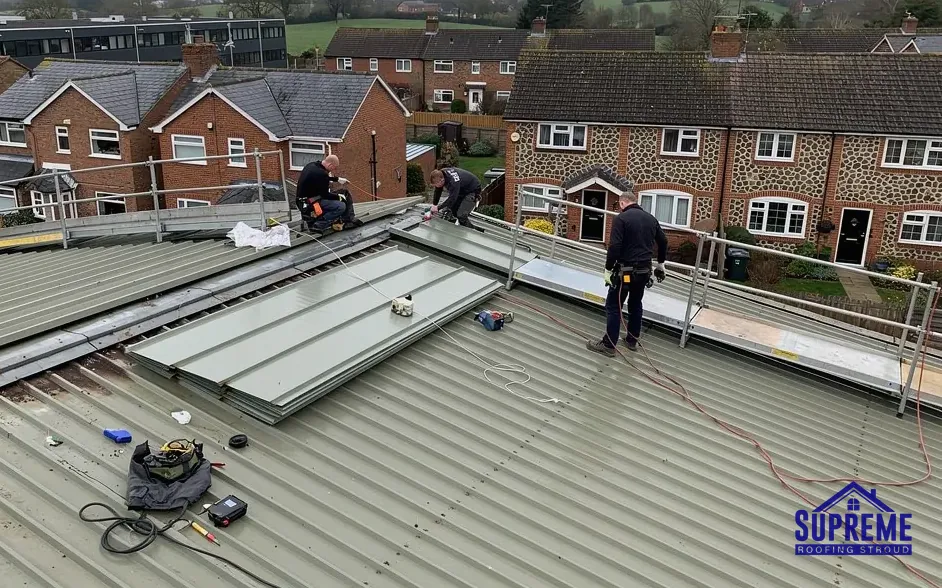
Commercial roofing in Stroud
Membranes, felt and metal sheets on units, mills and offices, with the access planned before the first sheet moves. Typical prices are shown below, then a written quote follows the survey.
Typical commercial roofing costs
National flat roof figures give a starting point for a unit or an office roof. Size, height, access and the condition of the deck all move the final number, so ours comes from the survey.
| Work | Typical price |
|---|---|
| Bitumen felt flat roof, supply and lay | £70 to £100 per m² |
| EPDM single-ply membrane | £90 to £130 per m² |
| PVC single-ply membrane | £95 to £140 per m² |
| Roof survey with photographs | £150 to £500 |
| Metal sheet re-coat or re-sheet | priced on survey |
| Fall-through protection and edge safety | priced on survey |
A written quote follows the survey and covers scaffold or access equipment, strip, deck repair, covering, flashings, labour and waste, so a landlord or managing agent can check the scope.
Sources: MyBuilder flat roof cost guide and roof inspection cost guide, both updated August 2026 (national figures, not specific to commercial premises).
Roofs for working buildings
A commercial roof has to keep a business dry and keep the people who maintain it safe. The covering matters, but so do access, drainage and a plan for the next inspection.
-
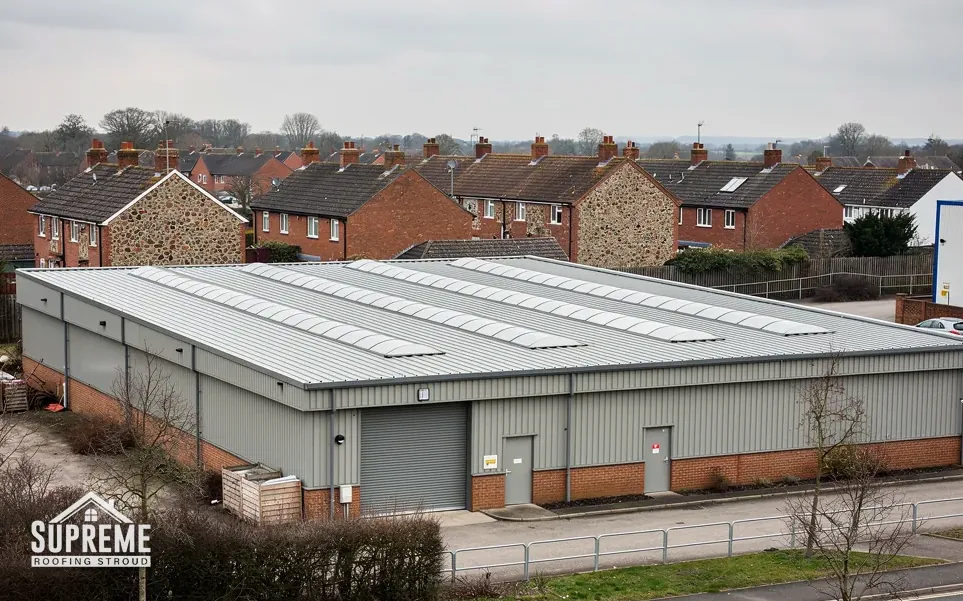
Flat and low-pitched coverings
Single-ply membranes, built-up felt and liquid-applied systems laid to falls, with outlets, upstands and edge trims detailed so water leaves the roof.
-
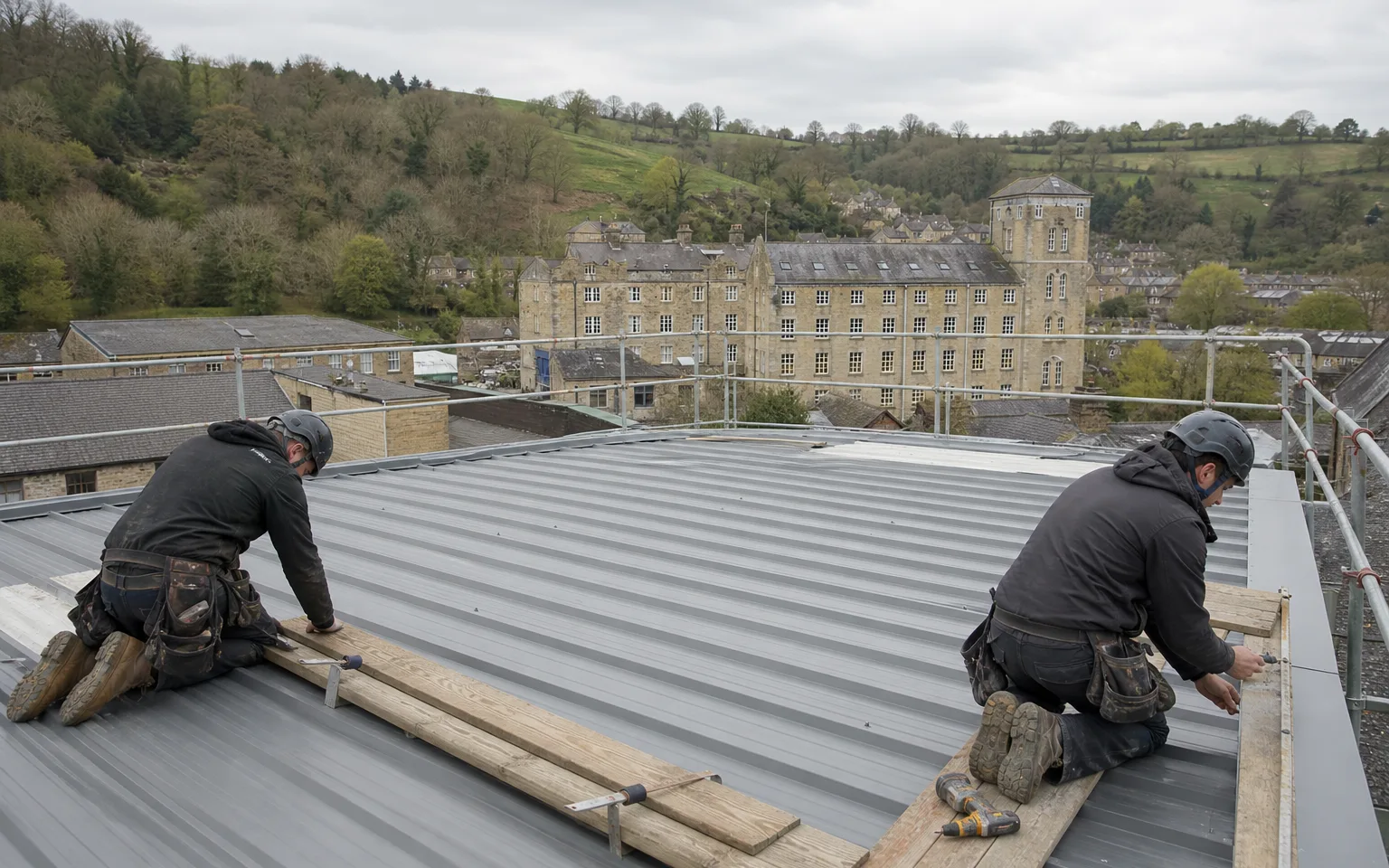
Profiled metal sheets
Steel and aluminium sheet roofs refixed, re-sealed and treated at the laps, or re-sheeted where the sheets have gone past saving.
-
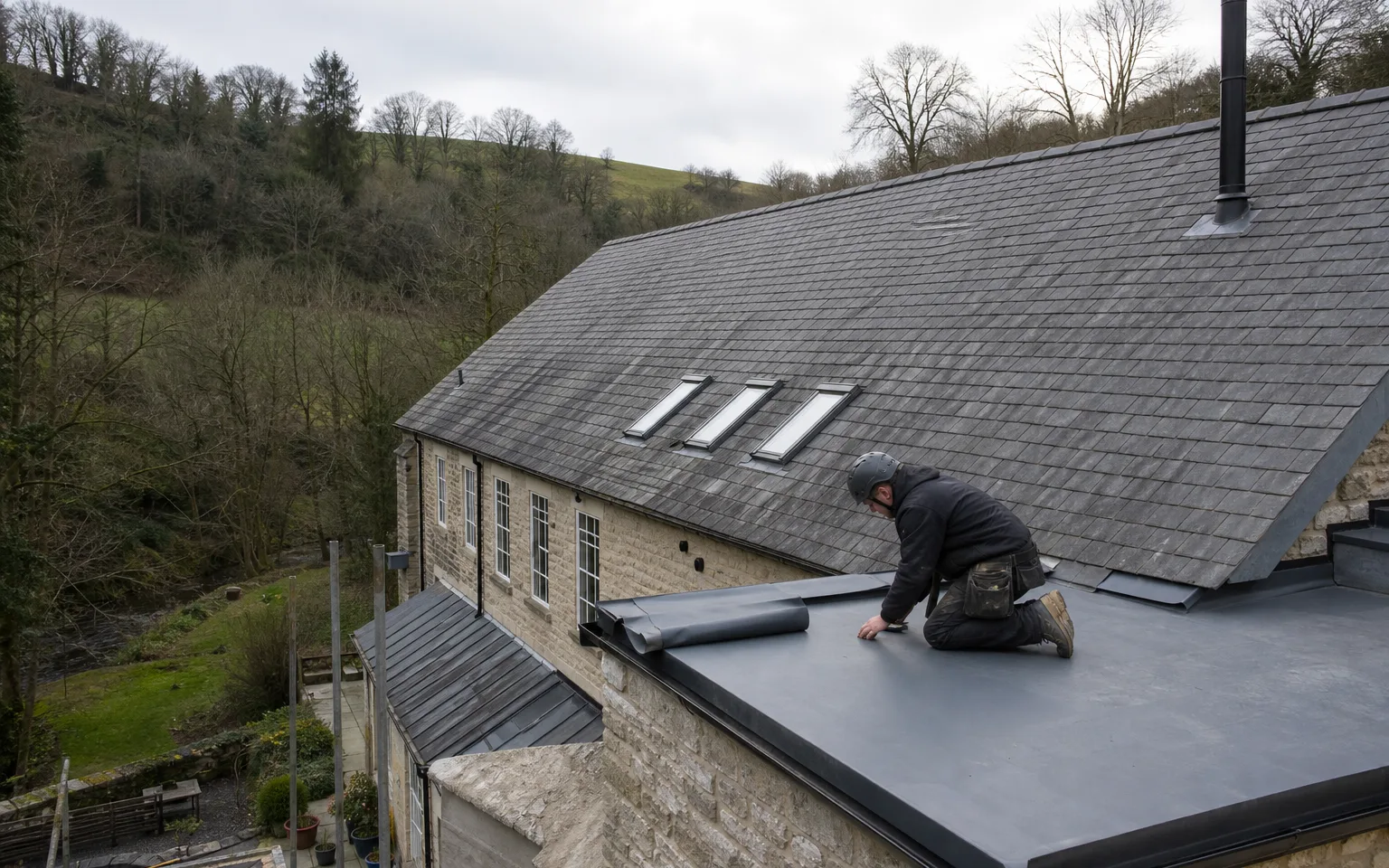
Safe access and planned upkeep
Covers over fragile panels, edge protection, walkways and a written inspection routine for landlords and managing agents.
Signs a commercial roof needs attention
- Stains on ceiling tiles or the underside of the sheets after rain
- Standing water on a flat roof that is still there two days later
- Rust weeping from the laps and edges of a metal sheet roof
- Rooflights that look chalky, cracked or sagging between their frames
- Blocked outlets or a box gutter that overflows into the building
How a commercial roofing job runs
- 1Survey and photographsWe walk the roof where it is safe to do so, photograph defects, check outlets and rooflights, and note how tenants and deliveries use the site.
- 2Written quoteAccess, strip, deck repair, covering, edge details and waste each get a line, and anything hidden under the covering is marked provisional.
- 3Works around the buildingSections are opened and closed within the working day, with the weather in mind, and routes below the roof are protected.
- 4HandoverPhotographs of the finished detail, notes for the roof file, and our 10-year workmanship guarantee in writing.
The commercial roof guide
Commercial roofs around Stroud, explained
Membranes, felt, metal sheets, safe access, upkeep and the mill buildings of the valleys.
Chapter 01
Single-ply membranes on units and offices
PVC, TPO and EPDM suit large flat areas, and the differences are in the joints and the edges.
Chapter 01In this chapter
A single-ply membrane is a factory-made sheet of synthetic material laid across the roof in one layer, in place of the several layers of felt it replaced. The big roll widths mean fewer joins than a felt roof, which is why single-ply became the standard choice for new flat roofs on offices and light industrial units. Three materials dominate: PVC, TPO and EPDM.
In this chapter
EPDM
EPDM is a synthetic rubber, supplied in large sheets. GreenSpec gives a life of 20 to 30 years, the Building Centre gives in excess of 25 years (published 2017), and other guides run higher, so a safe working figure is 20 to 30 years or more, never a promise. EPDM is usually glued or ballasted, and the weak points are the seams and the corners rather than the sheet.
PVC and TPO
PVC and TPO sheets are joined with hot air, which fuses the overlaps into one membrane. GreenSpec puts PVC at 20 to 30 years, the Building Centre at 20 to 40, and TPO in excess of 35 years. Those spreads are wide because the products, the details and the upkeep differ. Hot-air welding means the joints can be tested with a probe and repaired by welding a patch over a puncture, which suits roofs that see foot traffic from plant servicing.
What decides the choice
On a commercial roof the covering has to cope with what sits on it. Air handling units, solar mounting frames, aerials and the people who service them all need a protected route. The building matters too: the existing deck, whether the insulation under the old covering is dry, how many penetrations there are, and how the roof drains. We look at all of that before naming a system.
Falls and drainage
A single-ply roof still needs a fall to its outlets. IKO and Rockwool, citing BS 6229:2018, say a flat roof should be designed with a fall of 1:40 to achieve finished falls of 1:80. Where the old deck is dead flat, tapered insulation can create the fall without touching the structure. Ponding that lasts days is a sign to examine, not something to accept. It adds weight, it speeds the ageing of seams, and it can point to a deck that has deflected or an outlet set too high.
Edges, upstands and penetrations
On a large membrane roof the field of the sheet rarely causes trouble. Trouble starts where the sheet turns up a parapet, runs round a vent pipe or meets a rooflight kerb. Each of those is a detail built by hand, with its own preformed corners, trims and sealant, and each is photographed before it is covered over so you hold a record of what is under the surface.
Costs
MyBuilder's national flat roof guide puts EPDM at £90 to £130 per m², PVC single-ply at £95 to £140 and bitumen felt at £70 to £100. Large commercial areas, awkward access and rooflights change those figures, so we treat them as a way to compare systems rather than a quote.
On a flat commercial roof the joints and edges fail before the sheet does.
| Covering | Typical life | Typical supply and lay |
|---|---|---|
| EPDM | 20 to 30 years or more | £90 to £130 per m² |
| PVC single-ply | 20 to 30 years (GreenSpec), 20 to 40 (Building Centre) | £95 to £140 per m² |
| TPO single-ply | In excess of 35 years (Building Centre) | priced on survey |
| Bitumen felt | 10 to 20 years (Less) | £70 to £100 per m² |
Our guide to single-ply membranes: PVC, TPO and EPDM goes through the joints and fixings, and commercial roof systems for Stroud buildings compares them with the alternatives.
Chapter 02
Built-up felt: repair it, overlay it or replace it
A common older covering with a wide spread of lifespans, which depends on how it was laid.
Built-up felt is a roof of several stuck-together layers of bitumen-based sheet, traditionally torched on, and many older commercial flat roofs are covered in it. A good felt roof is a reliable thing. Less says a good job can last 20 years and a poor one can fail in under 10, while CORC puts a well-maintained felt roof at 30 years or more. The spread is a reminder that workmanship and upkeep count for as much as the material.
In this chapter
Where felt roofs fail
Felt fails at its details more often than in the middle of the sheet. We look at the laps, the upstands against walls, the felt around outlets and rooflight kerbs, and the edge trims. Blistering, splits along the line of the deck boards and a crazed, brittle surface are all signs of age. Standing water speeds the process, because it sits on the felt through every freeze and thaw.
Repair or overlay
If the felt is sound underneath and the problem is local, a patch repair is the lowest-cost option. MyBuilder gives £100 to £300 for a minor roof repair on a house, and Checkatrade gives £100 to £140 per m² for repairing bitumen flat roof, ex VAT. Where the surface has worn out but the deck and insulation are dry, a new membrane laid over the old can avoid a strip. That decision hangs on whether the old layers are dry, which is why we take core samples or moisture readings before suggesting an overlay.
Myth: A flat roof can be laid dead level because the membrane is waterproof.
Fact: BS 6229 design guidance, as quoted by IKO and Rockwool, aims for a 1:40 fall so that finished falls reach 1:80.
Full replacement
When water has got into the insulation or the deck, covering it up buries the problem. The roof is stripped back to the deck, boards are replaced where needed, insulation is renewed and a new covering is fitted with proper falls. This is more disruptive, but it is the right answer for a roof that has leaked on and off for years. Our guide to overlaying a Stroud commercial roof instead of stripping it explains how to decide.
Insulation under the covering
When the old covering comes off, the insulation below it is judged separately. Dry, undamaged boards can stay. Wet or crushed insulation is replaced, because it carries water and no longer does its job. We record which is which in the photographs, which also tells a landlord whether an earlier leak did damage that is only now showing.
Fire and torch work
Hot-work on a roof above a stock room or an old timber deck needs thought. We discuss the alternatives, such as cold-applied or mechanically fixed systems, when the survey shows combustible material below the work, and the quote shows which method is proposed.
For more on the felt itself, see built-up felt roofs on commercial buildings, and flat roofing covers the same coverings on smaller roofs.
Chapter 03
Metal sheet roofs and cut-edge corrosion
Profiled steel keeps a large span dry cheaply, until the cut edges start to rust.
Chapter 03In this chapter
Most industrial units and many warehouses are roofed in profiled metal sheet: steel, sometimes aluminium, usually painted or coated on both faces. Sheets lap side to side and end to end, and they are held to purlins by fixings that pass through the sheet. Every one of those details is a place where water can get in if the sealing wears out.
In this chapter
Cut-edge corrosion
Coated steel is protected by its zinc and paint layers. Where the sheet has been cut, drilled or sheared, the steel core is exposed at the edge. Moisture sits in the laps and at the cut edges, and rust creeps under the coating from there. You see it as orange weeping at the laps, bubbling paint and, in the worst cases, holes. Catching it early makes a difference: cleaning, treating and over-coating a sheet is a fraction of the work of replacing it. Our guide to cut-edge corrosion on metal roofs explains the process.
Fixings and laps
Fixings loosen as the roof moves with temperature. Washers perish, sealant dries out, and the head of a screw starts to rust. Re-fixing and re-sealing along the laps is regular work on a metal roof, and a survey of the screws and sealant often finds the cause of a leak that looked like a sheet fault. The sealant tape inside a lap is out of sight, so we also look at the stain pattern on the underside of the sheets, which usually traces the water back to its entry point.
Rooflights and gutters
Many unit roofs have translucent rooflight sheets built into the same profile. These age differently from the steel and are often the weakest and most fragile part of the roof. Box gutters between bays collect leaves and silt, overflow into the building and corrode from the inside. The condition of both is part of every metal roof survey.
Re-sheet or over-clad
When the sheets are past saving, there are two main routes. Re-sheeting strips them and starts again. Over-cladding fixes new sheets above the old ones on spacer bars, which keeps the building weathertight during the work, so it suits premises that cannot stop trading. Both options appear in the quote with a price. In each case the insulation follows whatever building control says applies, and a thicker build-up can change the heights at the rooflights, the flashings and the eaves, so those are measured at the survey.
Asbestos cement
Some older sheet roofs are asbestos cement. HSE guidance treats removal of such sheeting as non-licensed work when it is carefully handled without breaking, and notifiable non-licensed work where the material has been substantially damaged or is broken up. If your roof might be asbestos cement, do not disturb it; ask for an assessment first.
See metal roof sheets for commercial units in Stroud for sheet types and profiles, and asbestos cement roofs on commercial units for the options.
Chapter 04
Fragile roofs and getting onto them safely
The most dangerous part of an old industrial roof is often the part nobody has looked at.
A fall through a roof is among the worst things that can happen on a working site, and a fragile roof is how it happens. A fragile roof is one that will not safely carry the weight of a person. Old asbestos cement sheets, rusted metal sheets, aged rooflights and wired-glass lights all qualify. Some look sound from below and give way without warning.
In this chapter
Treat every roof as fragile first
Our starting position is simple: no one walks on a commercial roof until it has been checked, and that includes our own team. We look at the sheets, the fixings, the rooflights and the structure below from inside the building and from a safe position outside, using a cherry picker, tower or ladder where that works. Where we do need to cross a roof, we plan the route in advance with crawling boards or other load-spreading cover.
Rooflights are the trap
Plastic rooflights lose strength in sunlight over the years and can become brittle and discoloured, and they are often painted over or hidden by moss and dirt. Someone walking across what looks like a sheet of roof can step onto a light. Covers or guards over each light, and clear marking, are part of making a roof safe to work on, and are worth keeping in place afterwards for whoever maintains the roof next.
Edges and openings
Open edges, gutters, parapets and openings for plant need edge protection while work is under way. Where the roof is going to need regular access, such as to service air handling units, permanent guard rails or a walkway can be added at the same time, which is far cheaper than a scaffold hired for each visit.
The people below
A working building has people under the roof. We agree where the work will take place, which areas below are closed off, how deliveries and fire exits are kept clear and who the contact on site is. Hot work, noise and dust are discussed beforehand, and the working day is planned around the building rather than the other way round.
Equipment on the roof
Plant, ductwork and solar frames add routes, loads and penetrations. Before we start, we note where they sit so that the new covering is lapped and sealed round each one, and so that service engineers have a protected path to them afterwards.
Paperwork
Landlords and managing agents often ask for a risk assessment and method statement before work starts. We prepare these as part of the job, and they cover the access method, the edge protection, the fragile areas and the order of work. Photographs of each fragile area form part of the handover.
Read fragile roofs and safe access on Stroud commercial sites for the checks we make before anyone steps on a roof, and replacing rooflights on an industrial roof for the lights themselves.
Chapter 05
Planned maintenance for landlords and managing agents
A short inspection schedule costs far less than an emergency during a wet week.
A commercial roof that is looked at on a schedule seldom needs to be replaced early. Most leaks start from something small: a blocked outlet, a cracked sealant joint, a lifted flashing, a slipped sheet. Leave it, and the water spreads along the deck, soaks the insulation and shows up at the opposite side of the building from where it came in.
In this chapter
What a visit covers
A planned visit looks at outlets and gutters, box gutters, flashings and upstands, laps and fixings, rooflights, plant platforms and anywhere that has been repaired before. Debris is cleared, minor defects are fixed on the spot where they are quick, and larger ones go into a report with photographs, a priority and a price. After the visit the property manager has a dated record to attach to the building file.
How often
The frequency depends on the roof. A roof near trees needs gutters cleared more often, and an older covering needs a closer eye than a new one. A common pattern is a visit in the autumn, before the wet months, and another after severe weather. We agree the pattern with you in writing.
Who pays for what
On a leased unit, repair obligations depend on the wording of the lease, which can leave the landlord, the tenant or a service charge responsible. We do not give legal advice, but we can describe the defect clearly and cost it, so those responsible can settle who pays. Our answer on who repairs the roof on a leased unit explains the usual questions to ask.
Surveys and cost
MyBuilder's national roof inspection guide gives £150 to £500 for a roof survey: £150 to £250 for a standard one, £200 to £400 with a drone and £300 to £500 for a thermal survey. A large roof is likely to sit higher in that range. We tell you which survey method we would use before booking it.
Storm damage in between
Between visits, a severe gale can lift sheets or strip a flashing. Report it to us with a photograph and a note of where water is coming in. We prioritise leaks and storm damage, make the roof safe first, and then price the proper repair in a written quote.
Insurance and records
When a claim follows storm damage, an insurer will often ask for evidence of the roof's condition beforehand. Dated photographs and maintenance records help. We do not comment on any policy, but our reports are written so they can be passed to an insurer or a loss adjuster.
- Standard survey£150 to £250
- Drone survey£200 to £400
- Thermal survey£300 to £500
Our guide to planned roof maintenance for Stroud landlords and agents includes a checklist you can adapt, and roof inspections and surveys explains each survey method.
Chapter 06
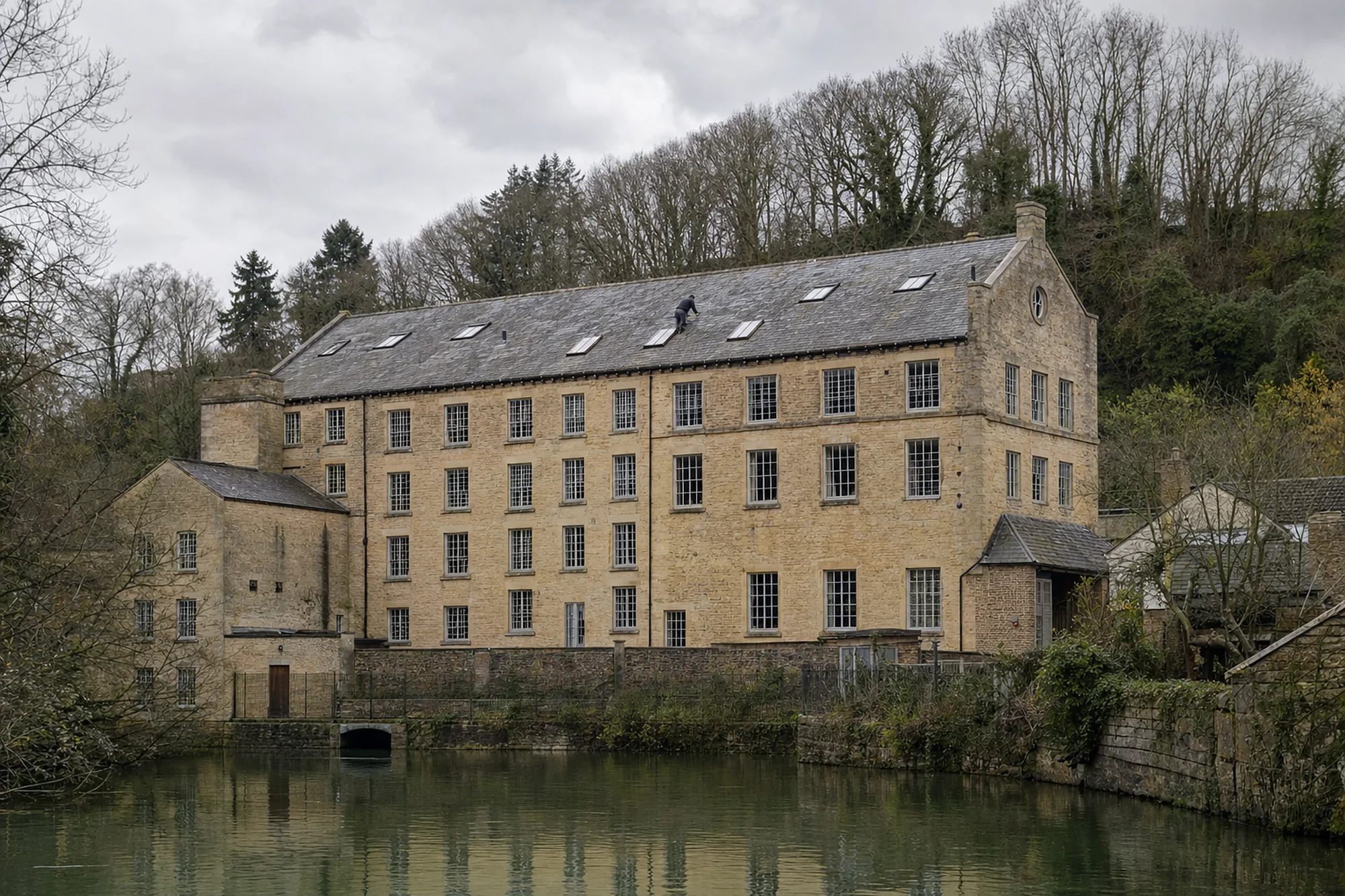
Mill buildings and older commercial roofs in the valleys
Stroud's industrial heritage means many commercial roofs sit inside protected areas.
Stroud's valleys carry the legacy of the cloth industry, and many of the old mill buildings are still in use as offices, workshops, studios and flats. Stroud District Council lists its Stroud Industrial Heritage conservation area, and several mill complexes, including Dunkirk Mills, Ebley Mills, Longfords Mills and Stanley Mills, appear as separate conservation area entries. A mill roof is therefore often both a working commercial roof and a protected one.
In this chapter
Different ranges, different roofs
A large mill complex tends to be built in stages, so one site can have several roofs of different ages and materials: a pitched range over one wing, a flat roof on a later extension, a patched section nobody can date. Each part needs its own assessment, and a repair that suits one range can be wrong for another. We number the ranges on a plan, photograph each one and cover every range in the quote, so an owner can phase the work over more than one budget year if that suits.
Listed and conservation area buildings
Listing protects the whole of a building at any grade, according to the council. A listed mill needs listed building consent for work that alters its special character. Elsewhere in a conservation area, a repair that puts back the same material is not normally development, yet a change of material or appearance is a question for the council's planning team. The council does not say whether its Article 4 Directions cover roofs, so ask.
- 41conservation areas within Stroud District
- 5conservation areas with Article 4 Directions
- 4mill complexes named as their own entries: Dunkirk, Ebley, Longfords and Stanley
Old structures, new loads
Mill floors and roofs were designed for different loads than modern uses put on them. Before fitting plant, solar frames or a heavier covering, a structural check is sensible. The Planning Portal notes that a covering 15 per cent or more heavier needs Building Regulations approval, and for any change in covering or insulation we confirm the position with building control, which for Stroud District is the Gloucestershire Building Control Partnership.
Keeping a mill in use
Where a mill has several occupiers, a roof job has to fit around tenants with different hours. We plan the sequence, protect shared routes and keep the building's owner informed with photographs. See roofing Stroud's historic mill buildings for more on the process, and commercial roof works: Building Regulations and Part L for the rules.
Churches, schools and halls raise similar questions, and our answer on roofs on Stroud church halls, schools and community buildings covers them.
Commercial roofing guides and answers
Costs, systems, corrosion, safe access and maintenance, written for owners, landlords and agents of commercial buildings around Stroud.
Guides
- Commercial roof costs in Stroud: repairs to replacementA price per square metre is only the starting point. What sits inside a published figure, what sits…Read the guide
- The best roof systems for Stroud commercial buildingsNo single system suits every unit, office or mill. This guide sets five families side by side and…Read the guide
- Single-ply membranes: PVC, TPO and EPDM explainedSingle-ply is one sheet, laid in rolls and joined on site into a continuous waterproof layer. Three materials…Read the guide
- Metal roof sheets for commercial units in StroudSteel or aluminium, plastisol or polyester, crown-fixed or trough-fixed: the choices that decide how a profiled metal roof…Read the guide
- Cut-edge corrosion on metal roofs: treatmentRust that starts where a coated sheet was cut, drilled or lapped is one of the most common…Read the guide
- Fragile roofs and safe access on Stroud commercial sitesA fragile roof gives way under a person without warning, and it often looks perfectly solid. This guide…Read the guide
- Built-up felt roofs on commercial buildingsBuilt-up felt has covered flat commercial roofs for generations and is still laid today. This guide explains how…Read the guide
- Planned roof maintenance for Stroud landlords and agentsRoofs inspected to a calendar cost less to keep than roofs only seen once water comes through. This…Read the guide
- Roofing Stroud's historic mill buildingsThe cloth mills along the valley floors carry some of the biggest and oldest roofs in the district.…Read the guide
- Overlaying a Stroud commercial roof instead of stripping itAn overlay keeps the old roof in place and lays a new waterproof layer on top. It can…Read the guide
- Commercial roof works: Building Regulations and Part LA like-for-like patch on a unit roof is one thing; a new covering across most of a building…Read the guide
- Commercial roof damage, insurance and dilapidationsWhen a commercial roof is damaged, or a lease is ending, the roofing evidence often decides the money.…Read the guide
Quick answers
- What is the longest-lasting commercial flat roof?
- Can a commercial roof be repaired while we trade?
- What does a commercial roof survey cover in Stroud?
- Asbestos cement roof on a commercial unit: options
- Replacing rooflights on an industrial roof
- Commercial box gutters: leaks and linings
- Can commercial roofs be replaced in winter?
- Are liquid roof coatings worth it for commercial roofs?
- How long does a commercial re-roof take?
- Is VAT charged on commercial roofing?
- Who repairs the roof on a leased unit?
- Composite insulated roof panels: pros and cons
- Ponding on a commercial flat roof: is it a problem?
- Roofs on Stroud church halls, schools and community buildings
- Farm building and barn roof sheets
- Can an old commercial roof take solar panels?
- What to do when a Stroud commercial roof leaks
- Roof repairs above shops in Stroud town centre
- What guarantee comes with a commercial roof?
- Why is our metal roof noisy?
Commercial roofs: specific questions
Can a metal sheet roof with rusty laps be treated rather than replaced?
Often, if the rust is at the laps and cut edges and has not eaten through the sheet. The surface is cleaned, treated, sealed and over-coated. Once holes have formed, the affected sheets are replaced.
How do I know if the insulation under my old felt roof is wet?
Moisture readings and core samples tell us. If the insulation is dry, an overlay may be possible; if it is wet, covering it up hides the problem, so the old layers come off.
Do rooflights have to be covered before anyone walks on the roof?
Treat them as fragile whatever they look like. Plastic lights lose strength over time, so we fit covers or guards before anyone crosses the roof, and the route is planned in advance.
Can you work on the roof while our tenants stay in the building?
Usually, yes, with the sequence planned around them. We agree working areas, protect routes below and tell tenants what is happening, and where hot work is involved you hear about it beforehand.
What does a managing agent get after a roof visit?
A dated report with photographs of defects, a priority for each and a price where work is needed, written so it can go on the building file or be passed to an insurer.
Does a flat commercial roof need Building Regulations approval to be re-covered?
It depends on how much of the roof and building envelope the work affects, and on any thermal upgrade. We check the position with building control before starting, and your quote shows what applies.
Send us the roof details
Send the address, a photograph of the roof from the best angle you have and a note of any leaks or stains inside. Tell us who holds the lease and who should receive the report, and we will book a survey and check the access first.