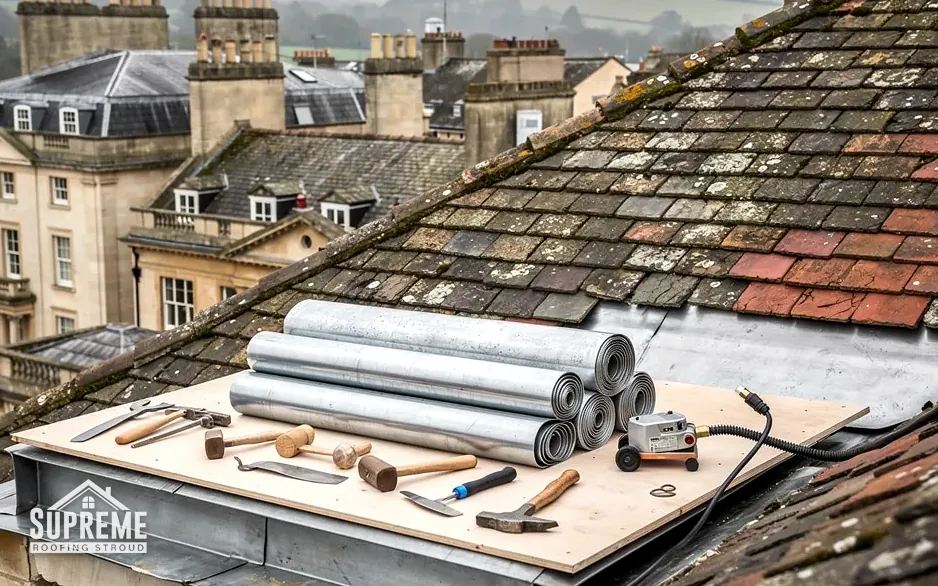
Lead roofing and leadwork in Stroud
Flashings, soakers, valleys, bays, porches and lead flat roofs on period houses, cut to the right code and fitted to move. National cost ranges first, then a written quote once we have surveyed.
Typical leadwork costs
The figures below come from published cost guides and describe the country as a whole. Lead jobs differ in length, access and code of lead, so treat them as a starting point for your own budget.
| Work | Typical price |
|---|---|
| Lead flashing repair | £50 to £70 per m |
| Stepped lead flashing | £80 to £120 per m |
| Lead flashing patch at a chimney | £150 to £250 |
| Full chimney flashing replacement | £350 to £920 |
| Lead flat roof covering | £150 to £200 and above per m² |
| Valleys, bays, porches and dormers | priced on survey |
With the survey finished, the written quote covers access, stripping, lead by code and length, fixings, labour and waste.
Drawn from the Checkatrade roof repair cost guide, October 2026 (Code 5, excluding VAT); MyJobQuote replacing leadwork on a chimney, September 2026 (full replacement £350 to £460 without scaffold, £700 to £920 with); MyBuilder flat roof cost guide, August 2026.
Lead where roofs change direction
Lead is the metal that seals the awkward places on a roof: junctions, abutments, gutters and valleys. It is soft enough to dress by hand into any shape and lasts for generations if it is cut and fixed correctly.
-
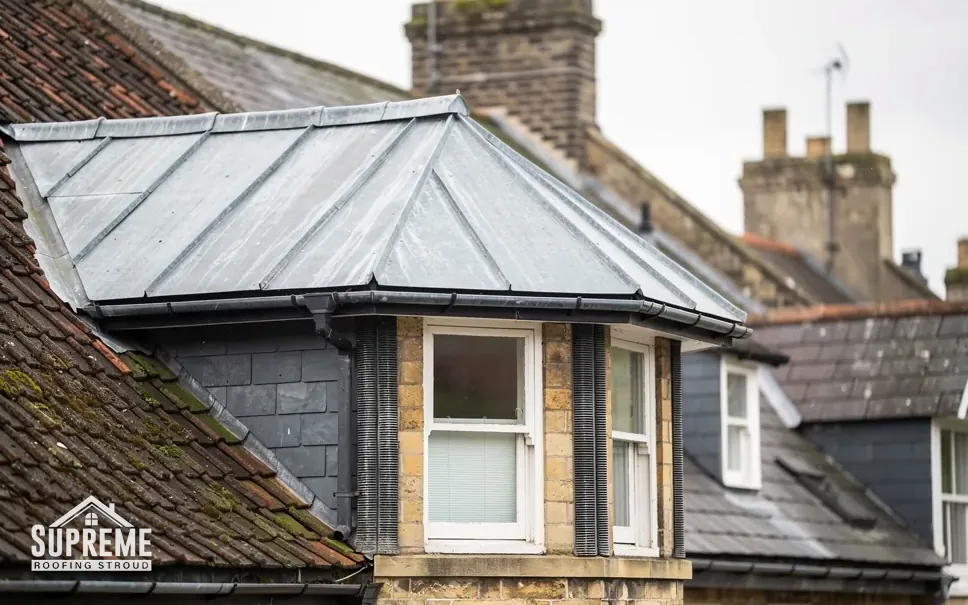
Flashings and soakers
Lead renewed or repaired where roofs meet walls, chimneys and rooflights, with a soaker laid beneath the covering along each side.
-
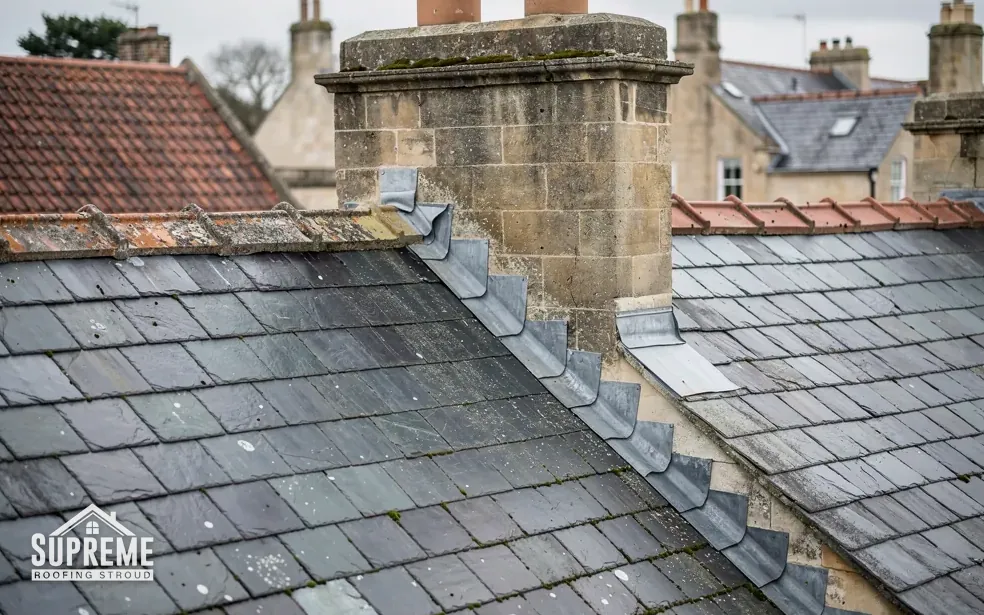
Valleys, bays and porches
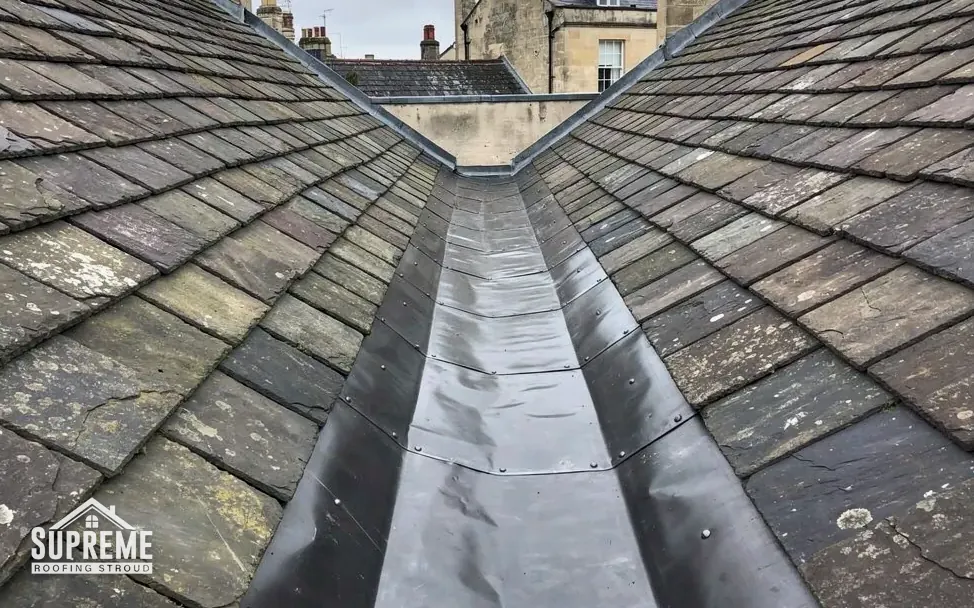
Valley gutters, bay window roofs and porch tops relaid in the right code, with falls, drips and rolls formed to shed water.
-
Lead flat roofs and dormers
Period flat roofs, parapet gutters and dormer cheeks re-covered in lead, or in the nearest correct match where lead is no longer wise.
Signs the lead is failing
- Splits or fine cracks along the folds and rolls
- A flashing curling away from the wall, or sagging out of its joint
- Damp stains on the ceiling directly below a valley, bay or abutment
- White powdery streaks running down slates or stone from untreated lead
- Patches of sealant or bitumen tape where someone has tried to stop a drip
How a lead job runs
- 1Survey of every junctionWe trace the lead from loft to ridge, noting each length, joint and fixing, and photograph splits, lifted edges and old patches.
- 2Written quoteThe code of lead, the length of each piece and the access needed are all stated so the figures can be checked.
- 3Cut, dress and fixEach piece is cut to a length that allows for movement, dressed tight to the surface and secured with clips and wedges rather than relying on sealant.
- 4HandoverPhotographs of the finished leadwork, a guarantee against workmanship faults valid for 10 years and given in writing, and the site cleared.
The leadwork guide
Leadwork, explained
Codes and thicknesses, flashings, valleys, bays and porches, lead flat roofs, and what to do about theft and listed buildings.
Chapter 01
Lead codes, thickness and how long lead lasts
A number stamped on the roll tells you how thick the sheet is and where it belongs on the roof.
Chapter 01In this chapter
Lead for roofing is sold as milled or cast sheet in numbered codes, and the number decides everything that follows. A higher code is a thicker, heavier sheet. Lead that is too thin for its position stretches, splits and fails early, while lead that is far too thick for a small flashing is hard to dress and costs more than it needs to. Choosing the code is the first design decision on any leadwork job, and the quote should tell you which one has been chosen.
The common codes
Leadworx and Royston Lead publish the standard sheet data, summarised in the table below. Code 3 is the thinnest, used for soakers. Leadworx describes Code 4 as the usual pick when flashing is the whole job. Code 5 and Code 6 are used for larger flashings, pitched valley gutters and dormers, and the heavier Codes 7 and 8 for gutters and flat roof work where the lead carries more water and takes more wear. Royston notes that its figures apply to cast sheet. The colour marks, such as blue for Code 4 and red for Code 5, are stamped on the roll so that the code can be checked on site.
Length matters as much as thickness
Lead expands and contracts with temperature, more than most roofing materials. A long piece fixed along its whole length cannot move, so it works against its fixings until it cracks along a fold. That is why lengths are kept short: MyJobQuote gives flashing in lengths of around 1.5 metres. Where a run is longer, it is made in lapped sections, each free to move a little. Our answer on lead sheet lengths covers laps and fixings.
How long it lasts
According to MyJobQuote (September 2026), flashing fitted well can serve for over 80 years, and over 100 on the higher codes. Less puts lead flat roofs at 50 to 100 years. Those are national guide figures, not promises, and they assume the lead is the right thickness, in the right length and fixed so that it can move. Our guide to lead codes goes through each code in more detail.
Patination
New lead is bright and reacts with the air. Over the first few months it forms a grey oxide layer that protects the metal underneath. Until that finishes, rain running off new lead can leave white streaks on stone and slate below. A patination oil applied to the new surface slows that and keeps the run-off clean. Our guide to lead patination explains how the oil is applied and why white staining appears on lead that has not been treated.
When we survey, we measure the length of each piece and note its thickness where the edge is visible, so that the replacement is specified from evidence rather than guesswork.
The code is chosen for where the lead sits on the roof.
| Code | Thickness | Weight per m² | Typical use |
|---|---|---|---|
| 3 | 1.32 mm | 14.97 kg | Soakers |
| 4 | 1.80 mm | 20.41 kg | General flashings |
| 5 | 2.24 mm | 25.40 kg | Larger flashings, valleys, dormers |
| 6 | 2.65 mm | 30.10 kg | Larger roofs, gutters |
| 7 | 3.15 mm | 35.72 kg | Heavy-duty gutters and flats |
| 8 | 3.55 mm | 40.26 kg | Heavy-duty gutters and flats |
Weights are from Leadworx's sheet data, and use follows Leadworx and Royston Lead. The right code for your job is confirmed at the survey.
Chapter 02
Flashings, soakers and what holds them in place
Most leadwork repairs are at a wall or chimney, where a single strip of lead separates the roof from the masonry.
Chapter 02In this chapter
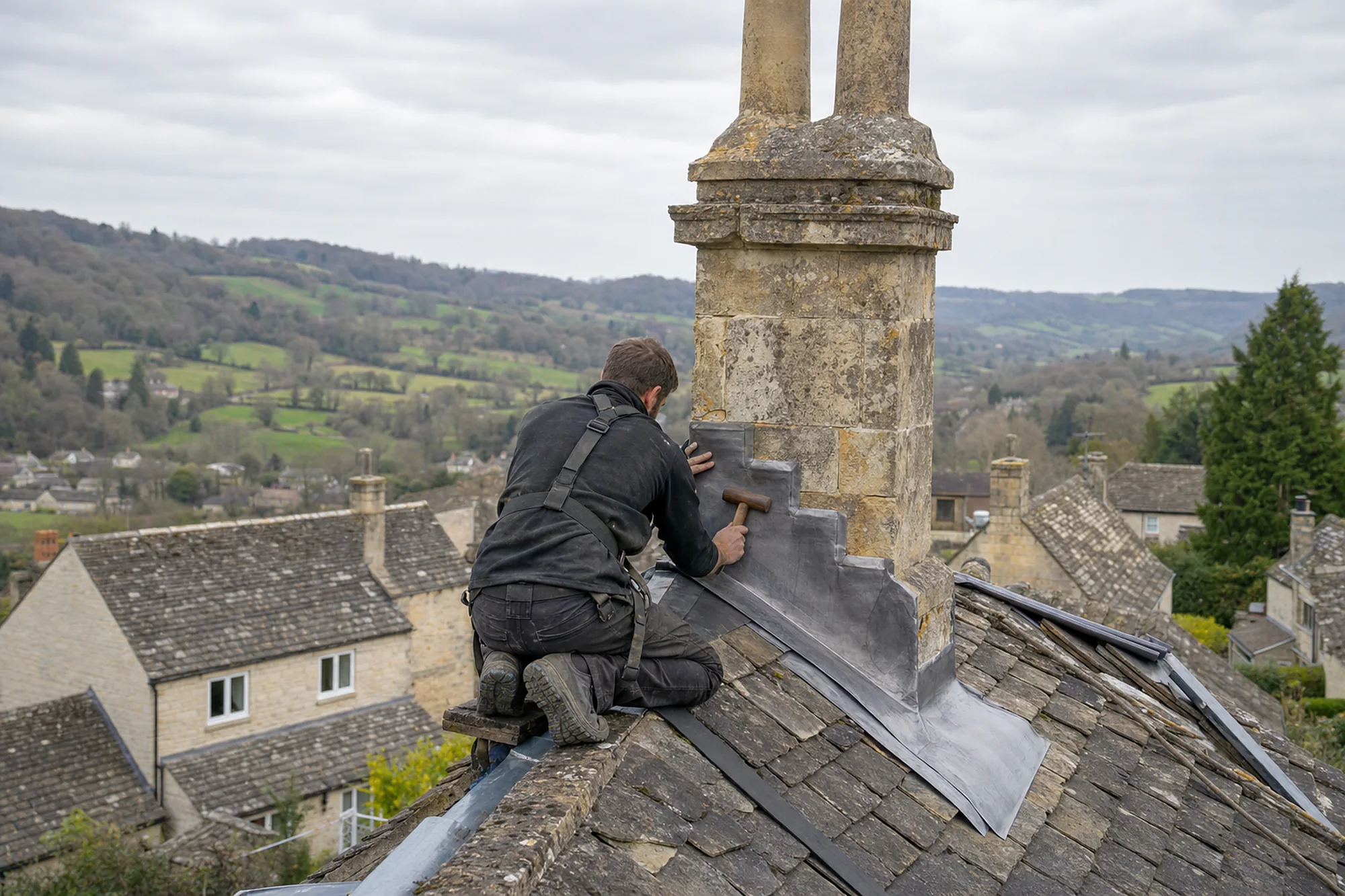
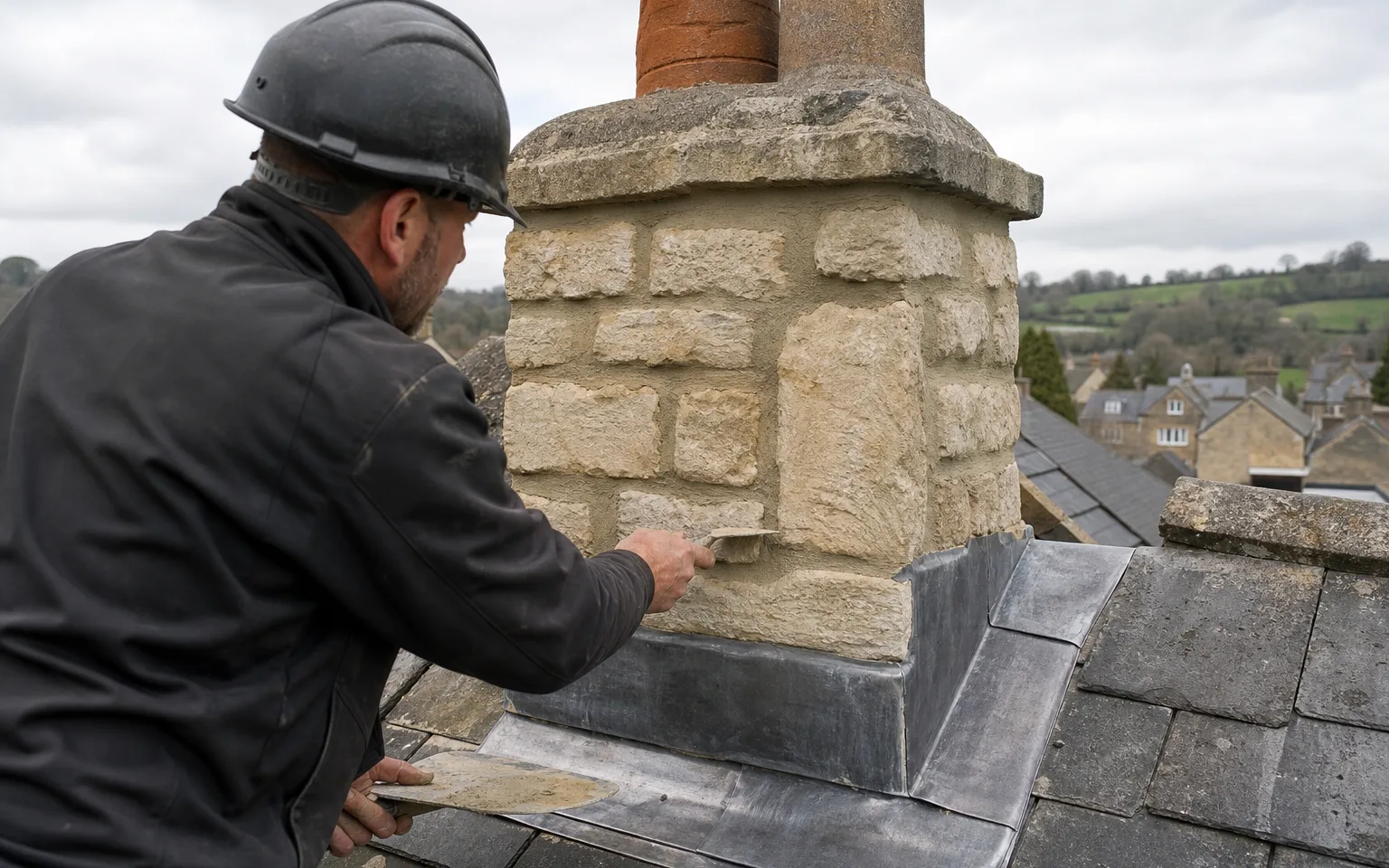
A flashing is a length of lead laid over the seam between a roof and whatever rises through or against it: a chimney, a gable wall, a dormer cheek, a roof window. Leadwork at a wall is usually two things working together. The flashing itself hangs down over the roof covering and is turned into a joint in the wall, and the soaker is a small bent piece of lead, one beneath each slate or tile course at the wall, turned up against it. Soakers send water that creeps in beneath the covering back out on top, while the stepped flashing above shuts the join to the masonry. Our answer on lead soakers shows how the two overlap.
In this chapter
Fixing into the masonry
The top edge of the flashing is tucked into a groove cut into a mortar joint, or into a chase in the stone, and held with lead wedges. Wedges or clips keep the lead in place while the groove is pointed, and they do not rely on the mortar to carry the load. The pointing seals the gap and keeps water out of the groove. Some roofers use a sealant bead instead of mortar. It is quick, and it is a stop-gap: the sealant dries and splits long before the lead does. We point flashings in mortar of a colour and strength that suits the wall.
Why flashings fail
Four causes recur. The lead is too long and has cracked as it moved. The groove mortar has weathered and let the lead drop out. The lead was too thin for the position. Or the wall has moved and pulled the lead with it. Nails through the face of a flashing are another fault, because every hole is a leak waiting to open. The fix depends on which cause it is, so we find out first. Our lead flashing repairs page lists the faults and how each is mended.
Repair or replace
A short split in a flashing that is otherwise sound can be repaired by lead welding or by letting in a patch. If the flashing is tired along its length, thin, or has been patched several times, a new one costs little more than the repairs and lasts decades. National figures help with that decision. Checkatrade, in its October 2026 repair guide, gives £50 to £70 a metre to repair lead flashing and £80 to £120 a metre for Code 5 stepped flashing, excluding VAT. MyJobQuote puts a patch at a chimney at £150 to £250 and a full replacement at around £570 on average.
Your quote shows VAT. Where scaffold is needed to reach the flashing, it is allowed for in the quote, because that is often where the difference lies between two quotes for the same work.
- Flashing repair£50 to £70 per m
- Stepped flashing, Code 5£80 to £120 per m
- Patch at a chimney£150 to £250
- Chimney flashing, with scaffold£700 to £920
The detail of mortar against sealant is in our answers on pointing lead flashings and lead flashing wedges.
Chapter 03
Valleys and box gutters in lead
A valley carries the water from two slopes at once. It works hard and fails where it is overloaded or too stiff to move.
Chapter 03In this chapter
The valley is the line where two slopes meet in an inward corner, and rain from both of them runs down it. A lead valley is a gutter lined with sheet lead, laid on boards, with the roof covering lapped over its edges. A box gutter is the flat-bottomed version behind a parapet or between two roofs. The lead in either carries a larger volume of water than a flashing and needs a heavier code, laid to a fall and with the right overlap between lengths.
In this chapter
How a valley is built
The lead is laid in lengths with a lap, usually secured with clips at the edges rather than nails through the face, so that it can slide as it warms and cools. The slates or tiles on either side are cut to follow the line and sit over the edges of the lead, leaving a channel of exposed metal. The width of the channel and the pitch of the roof decide how fast the water runs, and both are measured at the survey. Our guide to lead valleys covers how a valley is formed and renewed.
Why valleys split
The reasons are the same as for flashings, only greater in scale. Long, thin pieces crack along the folds. Debris, such as moss, leaves and slate fragments, collects in the channel and holds water against the metal. Foot traffic from earlier repairs can dent the lead. And a valley laid with a poor fall leaves water standing in the bottom, which in time works through the laps. When a valley is leaking, the damp stain usually shows directly below it, or down the line of the rafters.
Myth: A strip of bitumen tape or a bead of sealant is a lasting repair for a split lead valley.
Fact: Tape and sealant only cover the split, and they do nothing about the movement that opened it.
Repair or renew
A pinhole or a short split can be mended by lead welding, which fuses the metal rather than covering it. A valley with many splits, or lead of the wrong thickness, needs renewing, which means lifting the covering along both sides, replacing the lead and re-laying the covering. This is why valley work is priced on survey: the cost depends on length, covering and access.
Stone slate roofs
On a Cotswold stone roof the traditional alternative is the swept valley, built from specially cut stone slates. Cotswold District Council's technical guidance says that close-mitred and open lead valleys are cheaper to construct but neither appears as satisfactory as the traditional valley and both are best avoided. Where a stone roof has a swept valley, the guidance suggests keeping it. Where it has lead, the lead needs the same care as any other. Our Cotswold stone roofing page covers the roof around it.
Sealant on a valley
Bitumen tape or sealant over a split valley seals the hole for a short time, and then hides the lead from view while the damage continues underneath. We cut it out and treat the cause.
For gutters behind parapets, read our answer on lead box gutters.
Chapter 04
Bay windows, porches and dormers
Small roofs on older houses are often wholly lead, and they leak at the edges where lead meets wall.
Chapter 04In this chapter
Many older houses in the Stroud valleys have lead on their smaller roofs: the tops of bay windows, porches over front doors, and the cheeks and roofs of dormers. These roofs are too small and too shaped to be covered easily in anything else. Lead can be dressed into the corners and over the curves of a bay, and into the tight angles of a dormer, where sheet products cannot be bent without joints.
In this chapter
Bay roofs
A bay roof is a small mono-pitch or flat roof over a bay window, with three or more sides. The lead goes over the top and is dressed up against the main wall at the back, where a flashing finishes it, and over the fascia at the front. The back abutment is where a bay leaks most often, because water runs down the wall and meets the lead at its weakest line. Cracked mortar in the wall groove and a flashing too short to throw water clear are the usual faults. Our lead bay and porch roofs page describes the faults and the renewal in full.
Porch roofs
A porch roof of lead is laid in the same way, with falls to the front and a roll at the joins. The porch is the part of the house people stand under, so a leak shows quickly as a drip at the door. Because porch roofs are small, a failed one is often renewed as a whole rather than patched. The cost is mostly labour and access, with a modest amount of lead.
Dormers
The cheeks, or sides, of a dormer are clad in lead, usually dressed over a timber frame and tucked up under the roof covering at the top. The flat top of a dormer is laid in lead with rolls over timber battens and drips down the fall. The sides move less than the top, but the corners between cheek and top are where lead tends to split. When we re-lead a dormer, the old lead comes off in sections so that the framing underneath can be inspected before it is covered up again. Our lead dormers page goes through the work from cheek to ridge.
Doing small roofs properly
Small roofs are not simple roofs. They have more edges for their size than a main roof, and each edge is a place to keep water out. Bay, porch and dormer jobs are priced on survey, with the lead code, the access and any carpentry underneath covered in the quote.
If the bay or porch belongs to a listed building, or the house stands within a conservation area, ask us to check the status first, because the lead is part of what is protected.
A patched bay that keeps leaking is covered in lead flat roofs, which looks at the same method on a larger scale.
Chapter 05
Lead flat roofs on period houses
Lead is the traditional answer for a flat roof on an old house, and still one of the longest-lasting.
Chapter 05In this chapter
Period houses often have a flat section: over a rear extension, a bay, a stair turret or behind a parapet. Lead was the material used for these roofs for centuries, because it can be dressed to any shape, is waterproof when fixed to move, and does not rot. A lead flat roof is built from sheets laid in bays, each running down the fall, with a standing roll at the joint between bays and a drip at the end of each sheet to step the water down onto the next.
In this chapter
How it is built
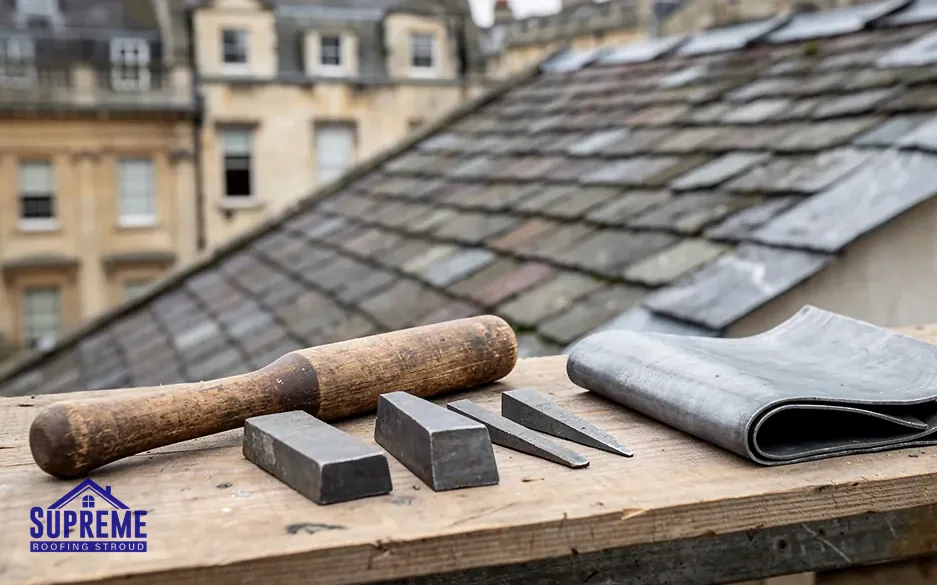
The deck underneath is boards, or plywood on modern work, laid to a fall. Under the lead goes a separating layer that stops the metal from sticking to the deck and lets it move. Rolls run with the fall and are formed over timber battens, while drips cross the fall where one length ends and another begins, each one stepped to throw the water forward. Lead of a heavier code is used here than on a flashing, since the roof is walked on and carries more water.
Falls
Water has to run off, so falls matter. IKO recommends a finished fall of at least 1:80 and a design fall of 1:40, the gap being there for tolerances and for deck deviation and deflection. Rockwool, citing BS 6229:2018, gives the same pairing. On an old house the existing deck may have sagged, and part of the work is to correct it with new firrings before the lead goes on.
- 50 to 100 yearstypical life of a lead flat roof
- 1:40fall a flat roof is designed to
- 1:80minimum finished fall after allowing for movement
Life and cost
Less gives the life of a lead flat roof as 50 to 100 years, among the longest of any flat covering. MyBuilder's 2026 flat roof guide puts lead at £150 to £200 or more per square metre, against £70 to £100 for bitumen felt and £90 to £130 for EPDM, a single-ply rubber membrane. The extra cost is paid back in life, and on a period house in a conservation area, lead may be the only covering that is acceptable.
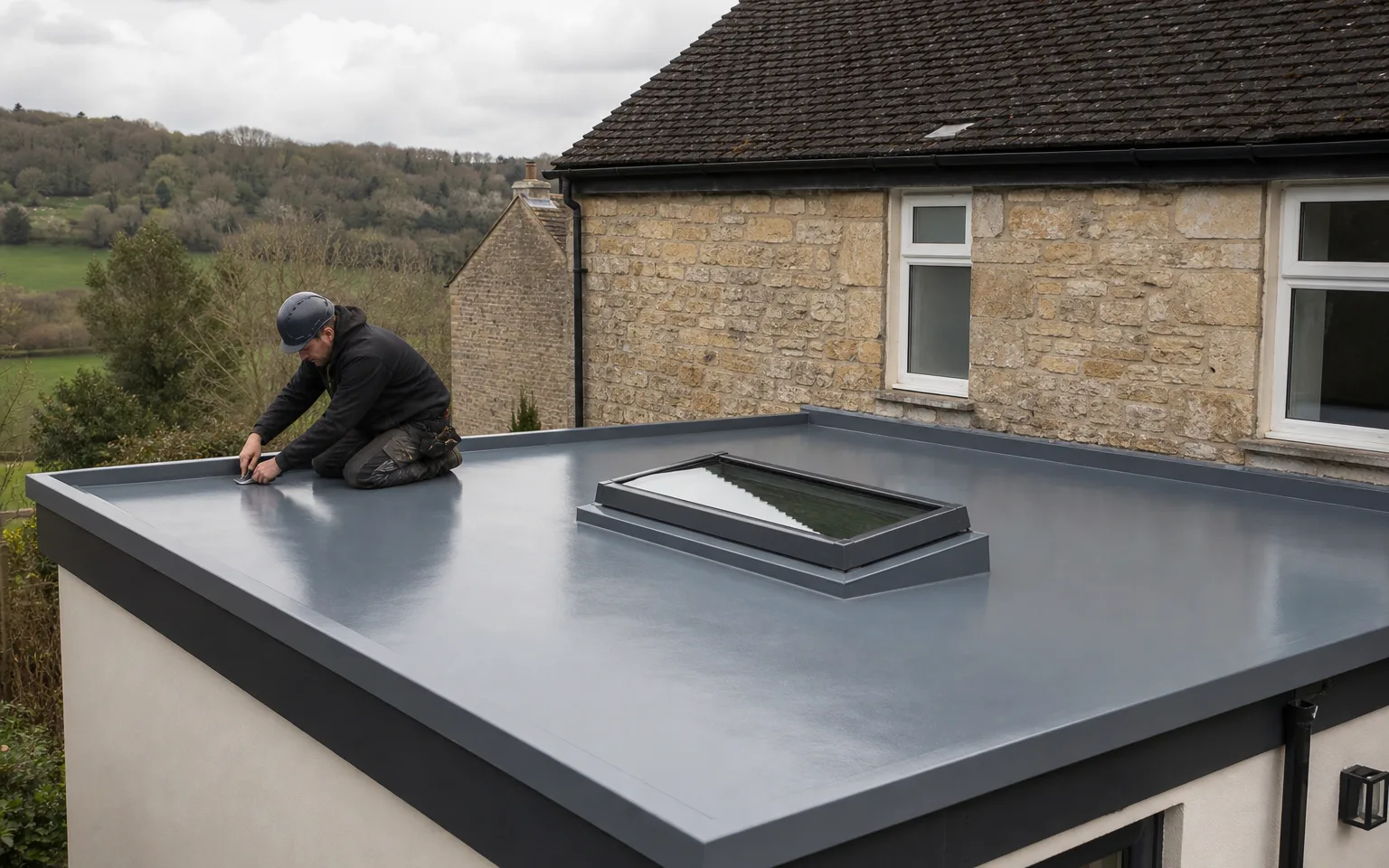
Repairs
A small split or a pinhole can be repaired by lead welding, where molten lead is built up to fuse the metal. Lead sealed with a coating is a temporary measure. If the roof is leaking at many places, or the lead is cracked where it crosses rolls, a new covering is usually the better value. Our guide to lead flat roofs on period houses covers a full renewal, and our answer on repairing a lead flat roof helps with the decision between patching and renewing.
For flat roofs in other materials, our flat roofing page sets out the alternatives and their costs.
Falls are measured at the survey with a level, and the quote states whether the deck needs correcting before lead is laid.
Chapter 06
Theft, alternatives and protected buildings
Lead has a scrap value, and that shapes how older roofs are protected and replaced.
Chapter 06In this chapter
Lead is valuable as scrap, which makes it a target. Roofs of churches, schools and large houses are the best known victims, but a flashing on a quiet barn or a garage can be stripped as easily. The first sign is often a leak after rain, because the lead has gone and nothing now seals the join.
Reducing the risk
No measure makes lead theft impossible, but several make it harder. Visibility matters: lead that can be seen from a lit road is stolen less often than lead behind a hedge. Marking the lead with a permanent identifier makes it harder to sell. A roof alarm or a camera aimed at the vulnerable section adds a deterrent. And an inspection soon after any incident prevents a stolen flashing from turning into a wet ceiling. Our guide to lead theft covers what to do straight after a theft, including contacting the police and your insurer. Check your policy for how it treats stolen roof lead.
Alternatives to lead
Where theft is a real risk, or where cost is the barrier, other metals and products can do the same job. Zinc is one: VMZINC, a manufacturer, states a life of more than 100 years, while HomeBuilding, quoting a contractor, gives 60 to 100. Copper and purpose-made flashing products are others. Each has its own look and its own behaviour with the roof covering, and none is exactly like lead. Our answer on lead against zinc compares the two, and the guide to lead alternatives covers the wider range and where each is accepted.
Listed buildings and conservation areas
On a listed building, the whole structure is protected, and the covering of the roof is part of its character. Alterations that touch a listed building's special interest need consent, whatever the material. Stroud District has 41 conservation areas, and its planning team can tell you whether swapping lead for another metal would be accepted. Where lead is stolen from a protected building, the same question applies to the replacement. Like for like is the safe starting point, and we raise it with the officer before we order a single sheet. Our guide to leadwork on listed buildings sets out how the process goes.
Old lead
When a roof is stripped, the old lead has a scrap value, and on our quotes it appears as a credit against the cost of the new. You see the weight taken off and the figure applied, so nothing is hidden in the total.
For the practical steps afterwards, see our answer on stolen lead and insurance.
Leadwork guides and answers
Lead codes, costs, flashings, valleys, flat roofs, theft and patination, plus shorter answers, for people with lead on their roofs around Stroud.
Guides
- What is leadwork, and where is it on your Stroud roof?Lead is the waterproofing at every awkward joint on a roof. Each place it turns up has its…Read the guide
- Lead flashing costs in Stroud: chimneys, walls and baysLead flashing prices swing with access and length. These are the published national ranges for a chimney patch,…Read the guide
- Lead sheet codes 3 to 8 explained for Stroud homeownersA lead code is a number that tells you how thick and heavy a sheet is, and so…Read the guide
- Lead flat roofs on Stroud's period housesA lead flat roof is a patchwork of long sheets, each free to move, laid in bays between…Read the guide
- Lead valleys in Stroud: how they fail and are renewedA valley is the channel where two roof slopes meet, and a lead one carries the water from…Read the guide
- Lead flashing repairs in Stroud: stepped, cover and apronWhere a roof runs into a wall or a chimney, a strip of lead is all that keeps…Read the guide
- Lead theft from Stroud roofs: prevention and replacementRoof lead is heavy, easy to cut and worth money as scrap, which is why churches, outbuildings and…Read the guide
- Lead alternatives: GRP, synthetic flashing and zincLead is the benchmark for waterproofing joints and small roofs, but it is not the only choice. Some…Read the guide
- Lead-clad dormers in Stroud: cheeks, tops and repairsEvery face of a dormer has to shed water, and lead is the metal that joins those faces…Read the guide
- Leadwork on listed and conservation buildings in StroudOn a protected building, lead is not just a waterproof layer. It is part of what the law…Read the guide
- Lead bay window and porch roofs on Stroud homesThe little lead roof over a bay window or front porch is one of the most exposed pieces…Read the guide
- Patination oil and why new lead is treatedFresh lead looks like polished pewter, and within weeks of rain it can start to streak. A thin…Read the guide
Quick answers
- How long does a lead roof last?
- Can a lead roof crack, and why?
- Is lead roofing safe?
- What lead code is used for flashing?
- What are lead soakers?
- Should lead flashing be pointed with mortar or sealant?
- Why must lead be fitted in short lengths?
- Is stolen roof lead covered by insurance?
- Why is my lead leaving white streaks?
- Can a lead flat roof be patched?
- Lead or zinc for a period roof?
- What is lead welding on roofs?
- Can I replace lead flashing myself?
- How is lead flashing held in place?
- Can leadwork be done in winter?
- What are lead parapet and box gutters?
- What happens to old roof lead?
- What is a lead slate around a pipe?
- Will sealant fix a leaking lead joint?
- Copper or lead flashing: how they compare
Leadwork: common questions
What lead code do I need for flashings on a stone cottage?
Code 4 is the usual weight for ordinary flashing; larger or more exposed pieces step up to Code 5, and soakers drop to Code 3. We measure the existing lead and the wall at the survey and state the code in the quote.
Why has my new lead turned white and left marks on the slates?
Fresh lead forms a pale carbonate on its surface as it weathers, and rain carries it onto what is below. Patination oil applied to new lead slows this, and the staining fades once the protective layer has formed.
Can a split in a lead valley be mended, or does it need relaying?
A short split in lead that is otherwise sound can be welded. A valley with several splits, or one that was patched before, is more reliably renewed.
Is a lead flat roof still sensible on a period house?
Yes, where the building suits it. Lead can last 50 to 100 years according to Less, and it is often the covering a conservation officer expects on an older flat roof.
What can I use on a listed building if the lead has been stolen?
Speak to the conservation officer before ordering anything, because consent covers the replacement. Like-for-like lead is the usual starting point, and alternatives need to be agreed first.
Is sealant a proper fix for a lead flashing that has lifted?
No. Sealant covers the gap for a short time, but the flashing has lifted because the groove has failed or the lead has moved. We re-fix it with wedges and mortar, or renew it.
Get your leadwork looked at
Send a photograph of the lead that worries you, from the ground if you can, with a note on whether the house is listed. The survey traces each flashing, valley and gutter, and the written quote that follows names the code for every piece.