
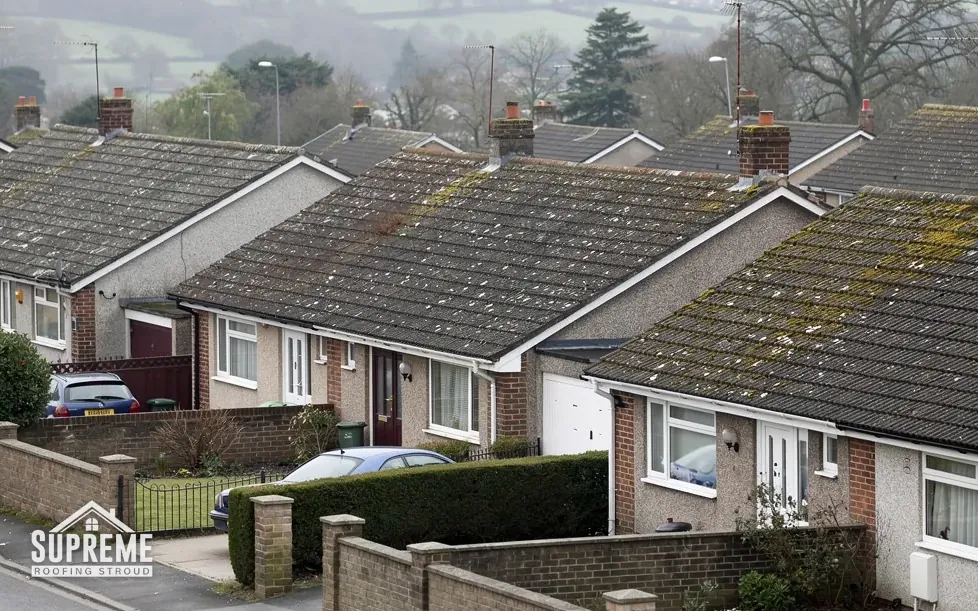
Roof cleaning and moss removal in Stroud
Moss and lichen taken off tile, slate and stone roofs by hand scraping or low-pressure treatment, with the gutters cleared below. Typical costs are below, before a visit.
Typical roof cleaning costs
National ranges for moss removal, by roof type and by method. A shaded, steep or high roof sits at the upper end.
| Work | Typical price |
|---|---|
| Pitched roof clean | £450 to £850 |
| Tile roof clean | £400 to £750 |
| Slate roof clean | £500 to £1,000 |
| Hand scraping | £5 to £10 per m² |
| Soft wash with biocide | £15 to £20 per m² |
We survey the slopes and gutters first, then send a written quote that covers access, the method for each slope, gutter clearing and waste.
Source: MyBuilder roof cleaning cost guide, updated August 2026 (national figures for comparison).
What a roof clean involves
The aim is to take growth off the covering without harming the covering. The method depends on the material, the pitch and how much is there.
-
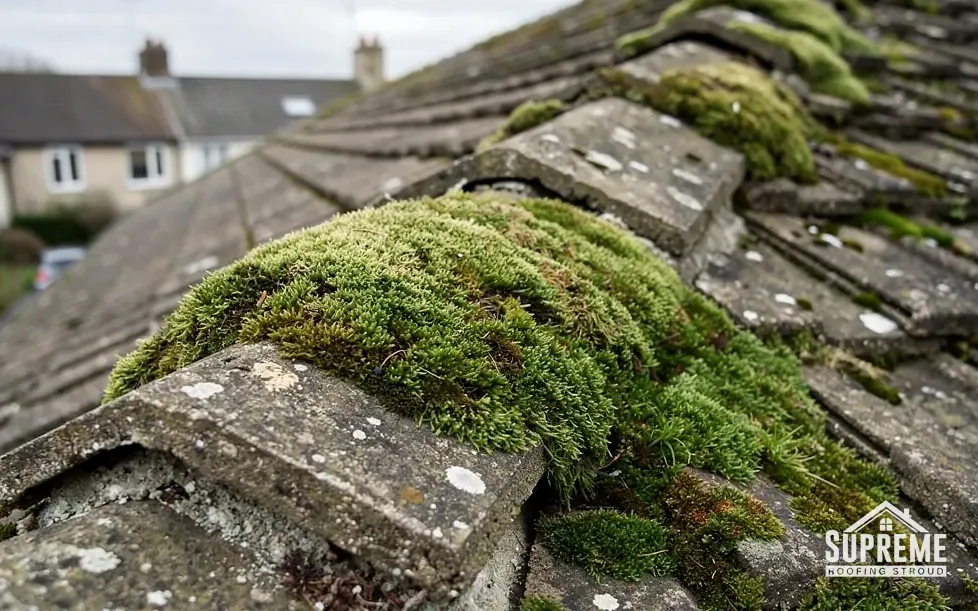
Hand scraping and brushing
Moss lifted from tiles, slates and stone by hand tools, working with the laps so that nothing is forced up under the covering.
-
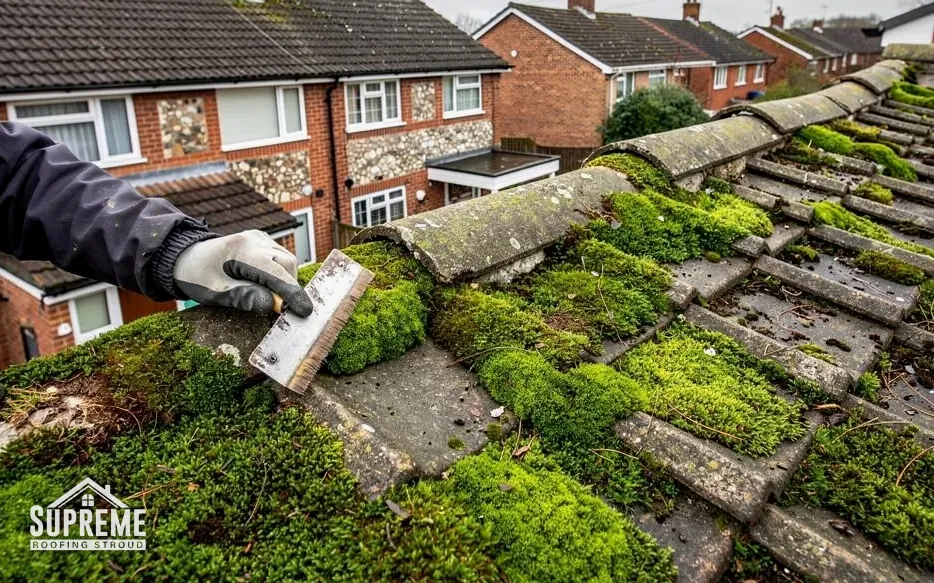
Soft wash and biocide
A low-pressure treatment that kills moss, lichen and algae at the root, so that the growth dies back and can be brushed away.
-
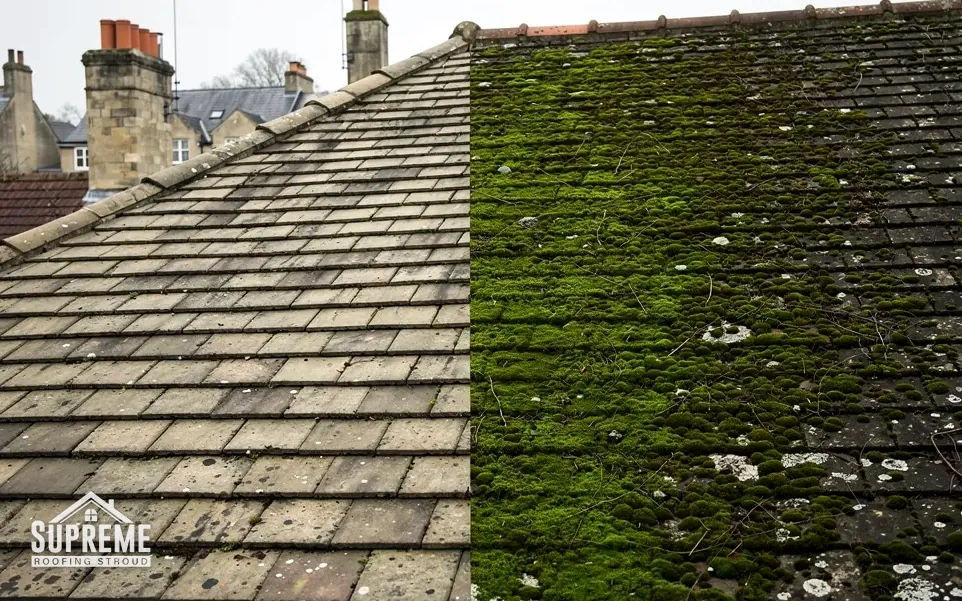
Gutters and a quick roof check
The moss debris cleared from gutters and downpipes, and any slipped or cracked pieces noted while we are up there.
Signs the roof needs cleaning
- Green or brown cushions of moss lining the gaps between tiles or slates
- Grey or orange crusty patches of lichen on the covering
- A shaded slope, or one under trees, that stays damp long after rain has stopped
- Moss and grit washed into the gutter, with water spilling over the edge
- Dark streaks across the roof, with green growth building at the ridge
How a roof clean runs
- 1Survey of slopes and guttersWe look at how much growth there is, what the covering is made of, how steep it is and whether trees drop debris onto it.
- 2Method chosen slope by slopeHand scraping for stone and fragile slate, low-pressure treatment where it suits the covering, never a high-pressure jet.
- 3Clean, then clear the rooflineThe loosened moss is taken down and bagged rather than washed into the gutters, and the gutters and downpipes are cleared and run with water.
- 4Photographs and next-visit adviceBefore-and-after pictures, a note of anything cracked or slipped, and when the shaded slopes are likely to need another look.
The roof cleaning guide
Moss, lichen and the right way to remove them
Why growth takes hold, how each method works, what pressure washing does to a roof, and how to keep the gutters clear afterwards.
- 01Why moss settles under trees and on the shaded slope
- 02Hand scraping: slow, gentle and kind to old coverings
- 03Soft wash and biocide: killing growth at the root
- 04Why a pressure washer is the wrong tool for a roof
- 05Gutters, coatings and keeping the roof clear
- 06Stone, slate and listed roofs in the Stroud valleys
Chapter 01
Why moss settles under trees and on the shaded slope
Moss needs damp and shade more than it needs age.
Moss is a plant that takes its water from rain, mist and the air, with no need for deep roots. It settles wherever a surface stays damp for long periods and gets little drying sun. That describes a good many roofs in a hilly, wooded area.
In this chapter
Shade and slope
The shaded face of a roof dries slowly. A slope that faces away from the midday sun, or one that sits in the lee of a hill, a house or a tall hedge, stays wet longer after every shower, and moss follows the damp. This is why growth is often heavy on one side of a roof and light on the other. Our answer on why moss grows under trees and in shade goes through the pattern.
Trees
Overhanging branches do two jobs for moss. They cast shade, and they drop leaves, needles, twigs and seed. That litter gathers in valleys, behind chimneys and along the lower courses, holds water against the covering and gives moss a bed to root in. A roof under a mature tree needs attention earlier and more often than one in the open. Cutting a branch back can help more than any treatment, though the trees may not be yours to cut and some are protected, so that is a conversation for the owner and the council.

The surface itself
Rough surfaces hold spores and moisture. Concrete tiles, aged clay and stone slates have texture, so growth can grip. Smooth, newer slate stays cleaner for longer. Where a roof is flat or at a very low pitch, water lingers, and growth forms in the pools.
Moss, lichen and algae
These are different things. Moss stands up from the surface in green or brown tufts and holds water against the covering. Lichen forms flat crusts in grey, yellow or orange, and sticks tightly. Algae shows as dark or green streaking. The distinction matters because moss does the most harm, lichen sits tightly and often does very little, and algae is mostly cosmetic. Treatment is chosen to suit what is there.
Which slopes to worry about
Not every slope needs the same attention. On most houses it is the north-facing and tree-shaded slopes that grow moss first, and the lowest courses, where water and debris gather, tend to hold the thickest growth. A south-facing slope often stays nearly clean for years. Because of this, a roof clean can be quoted slope by slope: you pay for the faces that need it and not for the whole house.
What growth does to a roof
A thick cushion of moss holds water against tiles and slates and keeps it there. In a hard frost the trapped water expands and can split a weak slate or flake a tile surface. Moss packed into the laps can also push at the edge of a tile, and its debris rolls into the gutter and blocks the outlet. None of this makes a roof fail overnight, but it adds up over years.
Moss follows the damp, and the damp follows the shade.
Myth: Moss only grows on old, neglected roofs.
Fact: It needs damp and shade more than age, so a younger roof under a tree can carry as much as an older one in the open.
Not every patch of green needs removing straight away. Lichen on a sound roof often does little, while moss packed into laps and valleys deserves action. We tell you which is which on the survey and photograph both, so you can judge for yourself. Our page on moss removal methods compared shows how each choice is made.
Chapter 02
Hand scraping: slow, gentle and kind to old coverings
Where a roof is fragile or old, the plainest method is often the safest.
Hand scraping is exactly what it sounds like. A roofer works across the slope with a scraper and a stiff brush, lifting moss away from the surface and from the laps between the tiles. It is slow, which is why it costs what it does, but it puts almost no force on the covering and leaves nothing to run off into the garden.
In this chapter
Working with the laps
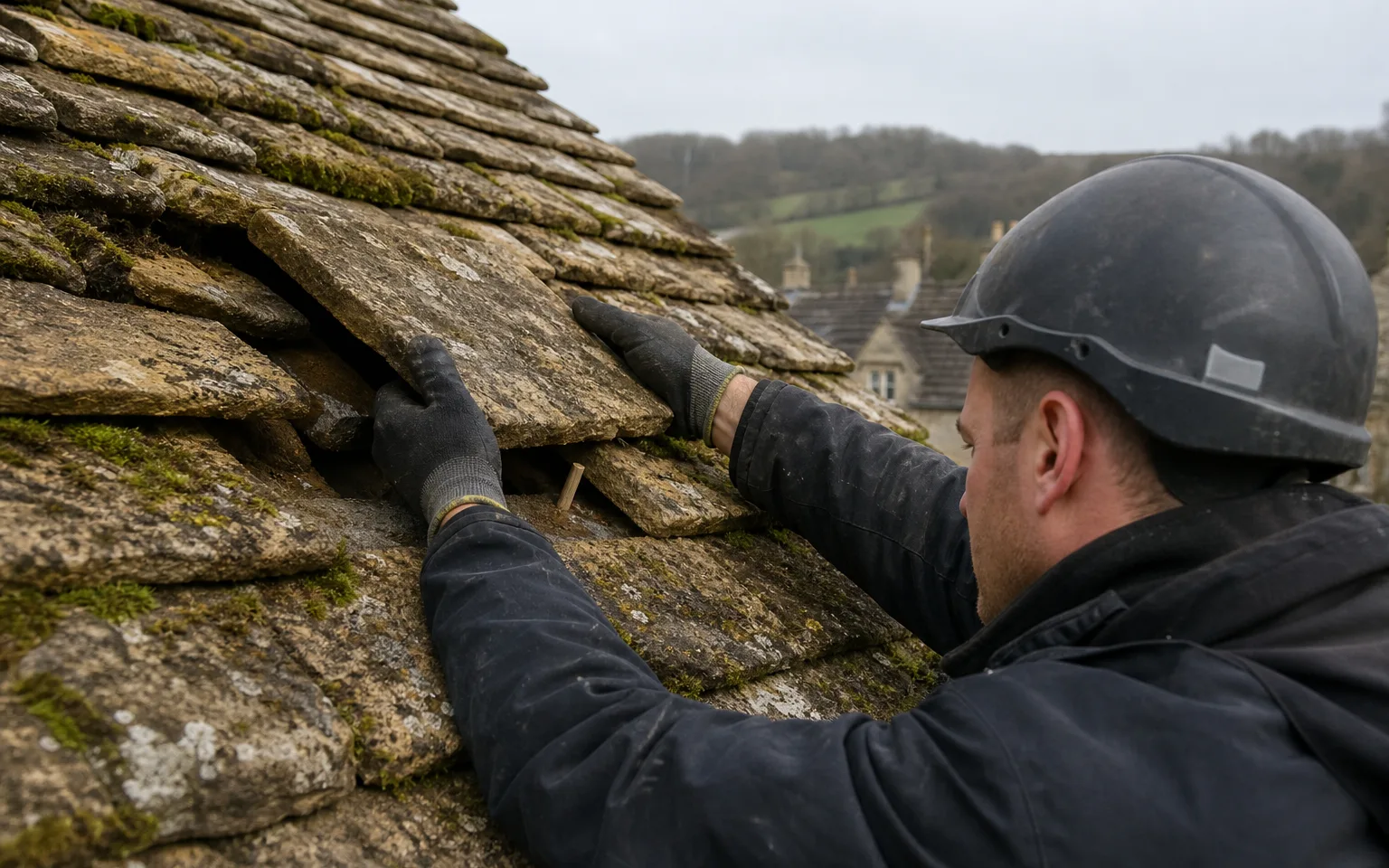
Tiles and slates overlap, with each course lapping the one below. Scraping is done in the direction that does not catch under the edge of a tile, so we work down the slope rather than up it. Pushing upwards risks lifting a tile edge or snapping a nib, the small projection that hangs a tile from its batten. On slate, the tool is chosen with care, because a hard blade can score the face.
Where it is the best choice
For stone slates, hand scraping is the standard method. The council's 2000 note on stone slate roofing says a stone roof scraped once a year could last twice as long, which is a strong argument for regular light attention rather than a rare heavy clean. Old clay tiles, handmade tiles with an uneven face, and roofs with a soft or sandy surface are also better scraped than blasted. Listed buildings and conservation-area roofs nearly always call for it, as covered on the page about cleaning Cotswold stone and slate roofs.
What it costs
National cost guides put manual scraping at about £5 to £10 per m², which is the lowest of the three main methods per square metre but the slowest to carry out. On a roof with steep pitches, narrow access or a lot of valleys, the time and the scaffolding or access equipment dominate the cost, not the scraping itself.
Working on a steep or awkward roof
Roofs above a street that falls away, or with a garden that rises to the eaves, need the access planned before the day. We decide whether a tower, a ladder stay or a roof ladder is needed, and the quote allows for it. Where scaffold is needed, it is listed and priced; it is not folded into the cleaning rate.
Collecting the debris
Scraped moss is raked down, caught and bagged, so it does not wash into the gutters and block the downpipes. A tarp or boards below the eaves catch the pieces. This is slow, but it is much easier than unblocking a drainpipe afterwards.
What scraping leaves behind
Scraping removes the bulk of the moss but leaves root-like threads and spores in the surface. On its own it gives a clean roof that will begin to regrow over the next few seasons, particularly on shaded slopes. Many owners accept that, treating the roof as a regular small job. Others add a biocide treatment, which slows regrowth.
For a worked step-by-step on a typical clean, from access to final photographs, see what happens on a roof clean. Hand scraping suits small slopes and old coverings, while a larger roof with thick growth may suit a combination of methods.
Chapter 03
Soft wash and biocide: killing growth at the root
A low-pressure treatment that works over weeks rather than minutes.
A soft wash applies a cleaning solution to the roof with low-pressure spray, usually from the ground or a platform. The solution contains a biocide, a substance that kills moss, lichen and algae. The aim is to treat the growth rather than blast it off, so the covering is not stressed.
In this chapter
How it works
The solution is sprayed on, left to work, and in many cases not rinsed hard. The dead growth turns brown or grey over the following weeks and loosens, then washes away with rain or is brushed off. The roof does not look clean the same day; it improves gradually. For owners who want an instant result, that can feel slow, but it leaves the covering undamaged.
What it costs
MyBuilder's roof cleaning guide puts soft wash at about £15 to £20 per m², above hand scraping per square metre, because the chemicals and the spraying equipment add to the labour. Because a treated surface can stay clean for longer, the yearly cost of a treated roof may come out lower, though that depends on the roof and the shade.
Runoff, plants and pets
What goes onto the roof will run down it. Gutters, downpipes, flowerbeds, ponds and gardens below are protected, and the product label is followed on dilution, drying time and what it is safe near. Rain after treatment dilutes what reaches the ground. If you keep fish, chickens or edible plants near a downpipe, tell us before the day, so the plan can cover the water route. Our page on soft washing and biocide treatments lists what to ask any contractor about the product.
Which roofs suit it
Soft wash suits concrete and clay tiles with a heavy but even covering of growth. On natural slate it works well, because slate is dense. On stone slates and very old tiles we prefer hand scraping first, and apply a treatment only if the roof will take it. Where a listed building or a conservation area is involved and you are unsure about a treatment, the council's conservation officers can advise.
Timing and weather
Treatment works best on a dry day, with no rain forecast for long enough for the product to take. We avoid frost and strong wind, which blow spray where it is not wanted. If the weather turns, the visit moves. A roof clean is easy to rearrange, and a rushed one in poor conditions is not worth having.
What it cannot do
A biocide does not repair anything. It will not re-seat a slipped tile or fix cracked pointing. And it does not make a damp, shaded roof dry, so regrowth is slowed, not stopped. For a roof under heavy trees, the honest plan is a clean every few years and a cut-back where the branches allow.
| Method | Typical cost | Best suited to |
|---|---|---|
| Hand scraping | £5 to £10 per m² | Stone, old clay, fragile or listed roofs |
| Soft wash with biocide | £15 to £20 per m² | Concrete tile, clay tile and natural slate with even growth |
| Pressure wash | £10 to £15 per m² | Rarely suitable, as the next chapter explains |
Source of the figures above: MyBuilder roof cleaning cost guide, August 2026. They are national ranges, so your own quote will differ with access and the amount of growth, and it is written after we have surveyed the roof.
Chapter 04
Why a pressure washer is the wrong tool for a roof
It cleans quickly and it can do lasting harm, and the harm often shows up later.
A pressure washer is the tool most people think of for roof cleaning. It is also the one that roofers are most wary of. MyBuilder's cost guide lists pressure washing at £10 to £15 per m² and adds that it may damage delicate tiles. That sentence understates what can go wrong.
In this chapter
Water driven under the laps
A roof is built to shed water downwards. Tiles and slates overlap so that rain running down the slope cannot get under the next course. A jet pointed at a slope from the side or from below sends water upwards and sideways, under the laps, onto the battens and the underlay. The roof then wets from inside, where it cannot dry quickly. On a roof with no underlay, such as an old stone roof, the water goes straight into the loft.
Surface damage
Concrete tiles carry a surface finish that gives them their colour. A strong jet can strip some of it, leaving a pale, rough, more porous face that grows moss faster than before. Old clay tiles can lose their glaze or surface skin. Natural slate can flake along its layers. Pointing at the ridge and verges, which is already soft mortar on many older roofs, can wash out.
Loosening and breaking
Tiles and slates are held by nibs, nails or pegs, and a strong jet can shift them. On stone roofs, where each slate hangs on an oak peg, one hard blast can knock out slates that were just holding. Where a slate was already cracked underneath, the jet finishes the job. Broken pieces then go down the roof into the gutters.
Mess and runoff
Pressure washing throws moss, grit and old pointing across the roof and into the gutters in a wet slurry. Drains block and fascias are stained. The result looks clean from the lane for a while, but the roof is more porous and more prone to regrowth than it was.
The same logic applies to your own ladder
If you are tempted to hire a pressure washer and do it yourself, the added risk is the climb, and a wet roof is slippery. We cover this on the page about why pressure washing can damage a roof.
If a previous contractor has already pressure washed the roof, a survey can show whether the surface has been stripped, whether the underlay has been wetted and whether any tiles have shifted. Photographs of the damaged areas help if you need to raise it with them.
Chapter 05
Gutters, coatings and keeping the roof clear
A clean roof pours its debris into the gutter, so the job is not done until the roofline is clear.
Every moss clean leaves something behind: crumbs of moss, grit from the tiles and a layer of old leaf mould. Most of it ends up in the gutters. If the gutter is left full, the next heavy shower brims over the front edge and runs down the wall, and the roof you have just cleaned is blamed for it.
In this chapter
Clearing the roofline
After a clean we clear the gutters by hand, flush the downpipes with water and check that the water runs to the outlet. Gutters are laid to a slight slope towards the outlet, roughly 1:600 to 1:350 depending on the make, so a run that holds a pool of water mid-length may have sagged or lost a bracket. We note it rather than ignore it. Our page on moss, gutters and downpipes covers the whole roofline, and the gutters, soffits and fascias page covers repairs.
Looking while we are up there
A clean puts a roofer on every part of the roof. We note cracked or slipped tiles, lifted ridge pieces, failed pointing and lead that has pulled away from a chimney, and photograph each one. None of it is repaired without your say, but it is far cheaper to know now than after the next storm.
Coatings and sealers
Some firms offer a sealer or coating after a clean, to repel moss and refresh colour. A coating is a cosmetic choice, not a repair. It is worth asking what the product is, how it is applied, how long it is expected to last and whether it suits your covering. Breathable surfaces such as stone should not be sealed with a film that traps moisture.
Zinc and copper strips
Metal strips fixed under the ridge release trace metal ions when it rains, and these discourage growth on the slope below. They are a partial help on some roofs rather than a cure, and their effect fades as the strip weathers.
Reducing the cause
The best prevention is to reduce the damp. Trim branches that overhang, clear leaf litter off the roof and out of the valleys, and keep gutters flowing. A roof that dries quickly grows less.
- Flat roof clean£300 to £600
- Tile roof clean£400 to £750
- Pitched roof clean£450 to £850
- Slate roof clean£500 to £1,000
Cleaning is normally standard-rated for VAT, and your quote shows it. Gutter repair, if the clean reveals a sagging run, is quoted as its own item so you can accept the clean and decide on the repair afterwards.
Chapter 06
Stone, slate and listed roofs in the Stroud valleys
Older roofs ask for lighter methods and a check of the rules first.
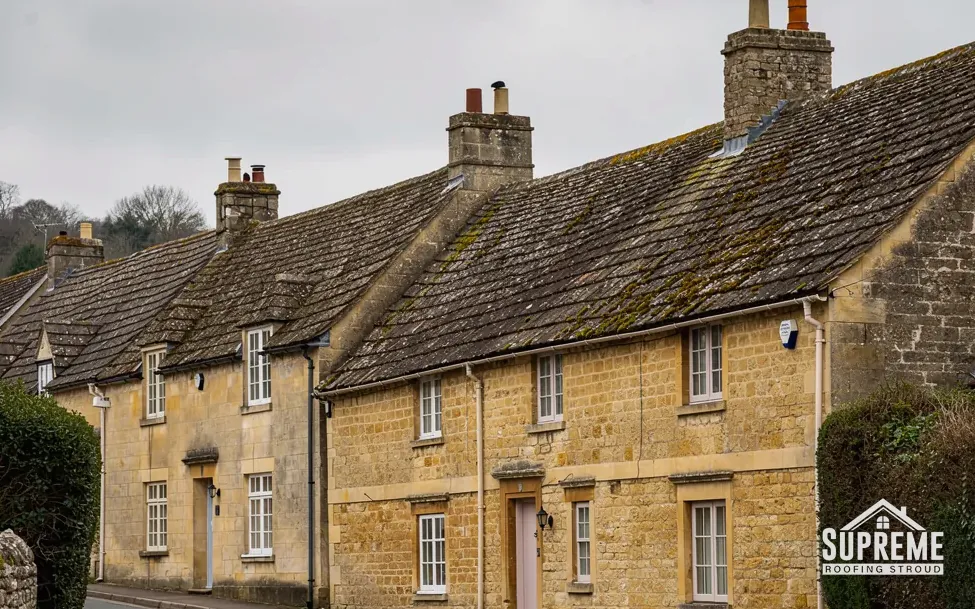
The roofs around Stroud include stone slates on Cotswold-edge cottages, natural slate on mills and terraces, and old clay tiles. All of them are cleaned more gently than a modern concrete roof, and the oldest are sometimes protected by law.
In this chapter
Stone slates
In its 2000 note on stone slate, Cotswold District Council reckons a well-kept stone roof can pass 100 years, and might reach 200 or 300 with regular care. The same note puts the weight at about 1,000 kg for every 10 m² of roof. Heavy moss adds weight, but the larger risk is water held against the stone and the oak pegs. A light annual scrape does more good than a heavy occasional clean. Our Cotswold stone roofing page covers repairs.
Natural slate
Slate is dense and takes soft wash well, but old slates are thin and brittle at the edges, and nails that have rusted give little hold. We work from a roof ladder to spread weight and avoid stepping on slate. The slate roofing page describes repair and replacement.
- twice as longlife Cotswold District Council suggests for a stone roof scraped once a year
- about 1,000 kgweight of each 10 m² of stone slate roof
- 41conservation areas in Stroud District
Listed buildings and conservation areas
Stroud District Council lists 41 conservation areas, and points out that a listed building is protected as a whole, whatever its grade. Cleaning a roof is maintenance rather than alteration, but a method that strips or stains the surface may count as harm. For a listed house, or one inside a conservation area, ask the council's planning or conservation team before any treatment is chosen. The page on cleaning roofs on listed and conservation buildings covers questions to ask.
Mill buildings and large roofs
Larger old mill buildings and farm barns have long slopes, high eaves and awkward access. A survey sets out the access equipment and the method for each slope, and these are covered in the written quote.
Fragile sheets on outbuildings
Some outbuilding roofs, such as fragile sheets and asbestos cement panels, should not be walked on or scraped. If we find one, we tell you and leave it alone; careful removal is a separate, specific job.
For stone and slate roofs our standard advice is to book a light clean at regular intervals, with a survey every few years, rather than wait for a thick covering of moss to build up. A dated set of photographs makes it clear how fast growth returns on each slope.
Roof cleaning guides and answers
The methods, costs, materials and timing behind moss removal, written for homeowners with shaded or tree-covered roofs around Stroud.
Guides
- Roof cleaning and moss removal costs in StroudPublished national ranges for cleaning a flat, tiled or slate roof, the per-m² rate for each method, and…Read the guide
- Roof moss removal methods for Stroud homes comparedFour ways to get moss off a roof, set side by side: what each does to the surface,…Read the guide
- Why pressure washing can damage your roofA pressure washer cleans a patio in minutes. On a roof the same jet can wear tiles, force…Read the guide
- Soft washing and biocide treatments explainedA biocide treatment kills the moss, lichen and algae living on a roof instead of blasting them off.…Read the guide
- Why moss grows on Stroud roofs under trees and shadeMoss does not need an old roof or a neglected one. It needs a surface that stays wet,…Read the guide
- Cleaning Cotswold stone and slate roofs in Stroud safelyA stone roof is heavy, uneven and held up by pegs that have been in place for generations.…Read the guide
- Lichen on roof tiles: harmful or harmless?The grey, yellow and orange crusts on an old roof are not moss and not mould. They grow…Read the guide
- Roof coatings after cleaning: do you need them?A coating is sold as the last step of a roof clean: a paint-like layer that restores colour…Read the guide
- Moss, gutters and downpipes: cleaning the whole rooflineMoss does not stay on the tiles. It slides, sheds and washes down into the gutter, and a…Read the guide
- Cleaning roofs on Stroud's listed and conservation buildingsA protected roof is cleaned slowly, by hand, with as little water and chemistry as the growth allows,…Read the guide
- The best time of year to remove roof moss in StroudNo one month wins. The right window is a run of dry, mild days after the growth has…Read the guide
- What happens on a Stroud roof clean, step by stepA roof clean follows a fixed order: get up safely, protect what is below, take the growth off,…Read the guide
Quick answers
- Should moss be removed from your Stroud roof?
- Will insurance pay for moss damage?
- How quickly does roof moss grow back?
- Can I remove roof moss myself safely?
- Are roof moss killers safe for plants and pets?
- Cleaning concrete tiles: what's safe
- Can a flat roof be cleaned?
- How long does a roof clean take?
- Black streaks on a roof: what are they?
- Cleaning a conservatory roof
- Does roof cleaning need scaffolding?
- Can moss lift roof tiles?
- Do zinc or copper strips stop moss?
- Is a roof clean worth it before selling?
- Why is moss only on one side of my roof?
- Green algae on a roof: does it matter?
- What a roof cleaning quote should include
- Removing moss from a shed or garage roof
- Should the roof be checked during cleaning?
- Overhanging trees and roof moss in Stroud: cut back?
Roof cleaning: specific questions
Does moss really harm a roof, or just look untidy?
A thick cushion of moss holds water against the covering and can contribute to frost damage in slates and tiles. Moss also sends debris into the gutters. Light lichen on a sound roof usually does much less harm.
Will you use a pressure washer on my roof?
No. We hand scrape or use a low-pressure treatment, because a jet can drive water under the laps and strip the surface of tiles and slate.
How do I know whether my stone roof can take a biocide?
Stone is porous and old slates can be fragile, so we scrape first and test a small area. For a listed house, or one inside a conservation area, ask the council before any treatment goes on.
What happens to the moss that comes off?
It is raked down, bagged and taken away with the waste, so it does not wash into your gutters and downpipes.
Should the gutters be cleared at the same visit?
Yes. Cleaning drops moss and grit into the gutters, so we clear them and run water through the downpipes before we leave.
Will cutting back a tree help my roof?
Often more than any treatment, because less shade and less leaf litter mean the roof dries faster. Check who owns the tree and whether it is protected before anyone cuts.
Get your roof cleaned
Send a picture of the mossiest slope, tell us what the roof is made of and whether trees overhang it, and we will survey the roof and gutters and send a written quote.