
Roofers in Gloucester
From the slate-roofed warehouses of Gloucester Docks to the streets inside the city's fourteen conservation areas, we survey and price roofs 9.6 road miles from our base in Stroud.
Gloucester at a glance
- Distance
- 9.6 road miles north of Stroud
- Council
- Gloucester City Council
- Conservation areas
- 14 across the city
- Listed landmark
- Gloucester Cathedral, Grade I
Gloucester's roofs, from Roman ground to the canal basin
Gloucester stands on the eastern bank of the River Severn in the Severn Vale. Wikipedia describes the city as sheltered by the Cotswolds to the east, with the Forest of Dean to the west and the Malvern Hills to the north. For a roofer who works the steep sides of the Five Valleys, the city is a change of ground, and it is also a change of council: roof work here answers to Gloucester City Council rather than to Stroud District.
The written record gives three clear reference points for the buildings. The Roman town of Glevum was established around AD 48 and became a colony in AD 97. Gloucester Cathedral, a Grade I listed building, had its nave begun in 1089. And a canal from the city to Sharpness was opened in 1827, with the first of the dock warehouses beside it. A city with that much recorded history carries a wide spread of roof ages, and the sensible starting point is always the individual building in front of us, not an assumption about the street.
The city also holds a lot of designated land. The national planning data service records 14 conservation areas for Gloucester City Council, so a good share of survey visits begin with a quick check on whether the address sits inside one. Where it does, the written quote notes it and flags anything that needs a conversation with the planning team first, as against straightforward like-for-like repairs.

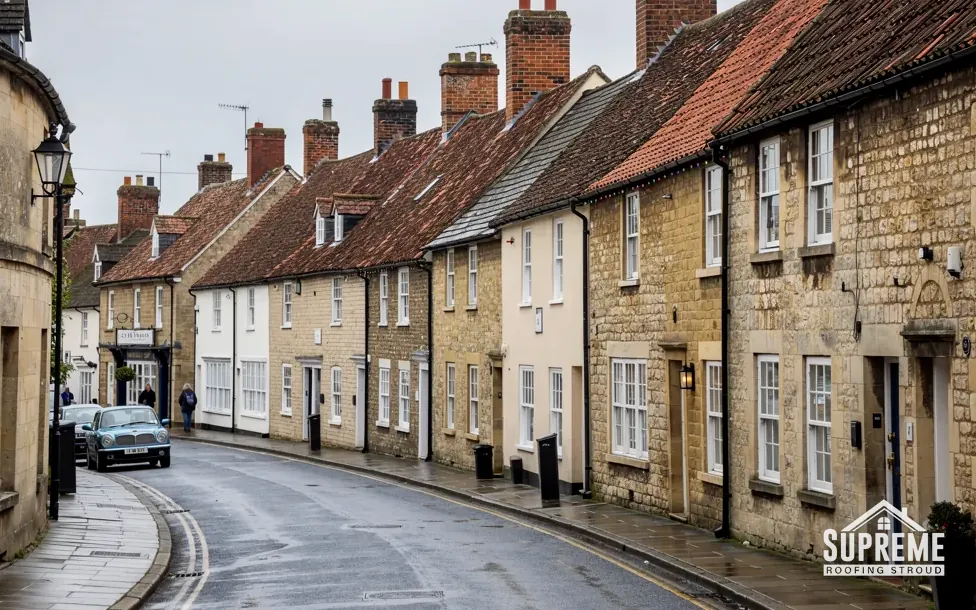
Victorian terraced houses with slate roofs and chimneys on a hillside 
Flint and brick cottage with a clay tile roof beside a road
Chapter 01
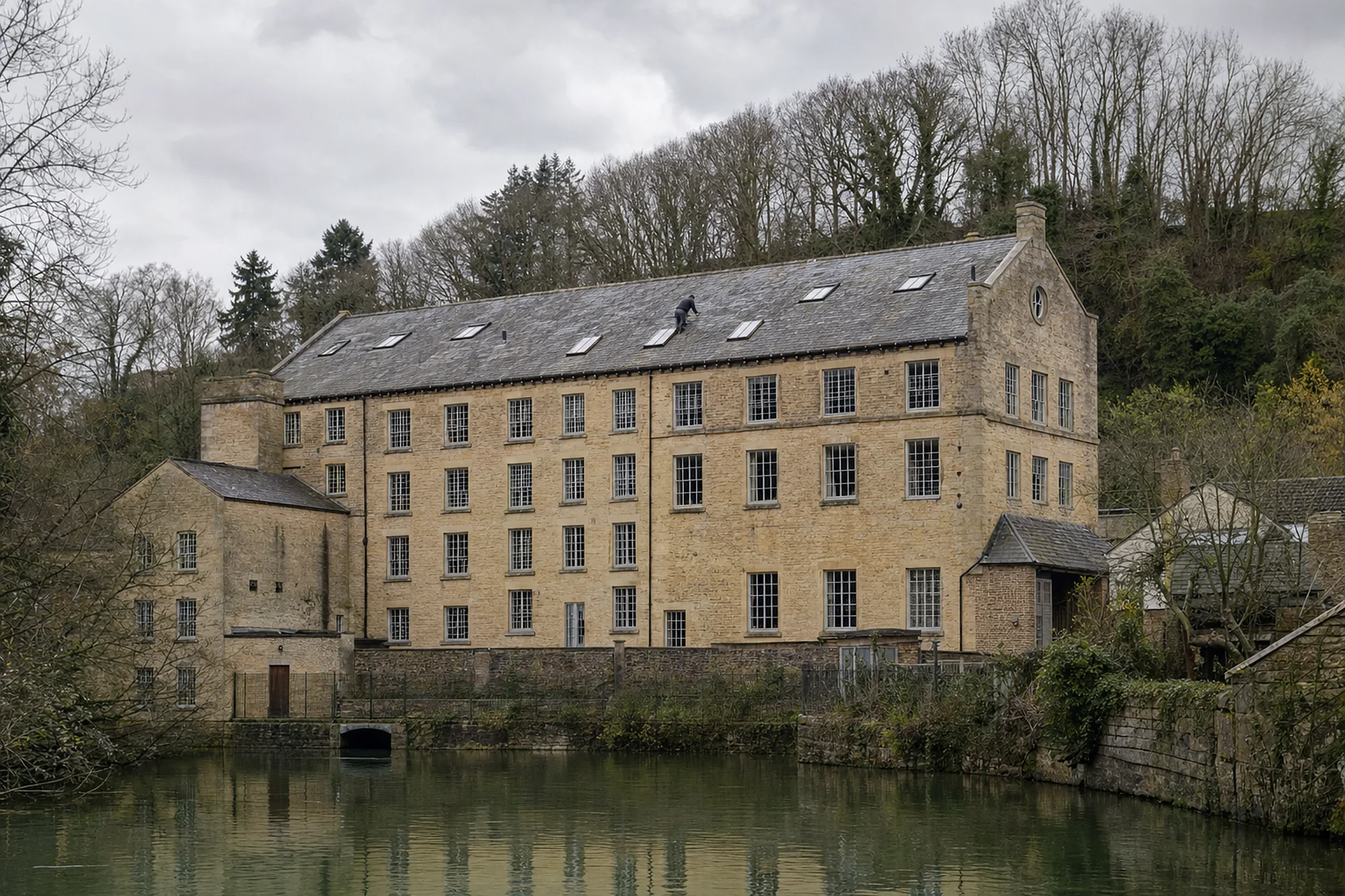
Slate over red brick: the warehouses at Gloucester Docks
The canal basin went up in stages between 1827 and 1873, and its roofs show what a big slate roof asks of a roofer.
Chapter 01In this chapter
The first warehouse at the docks was the North Warehouse of 1827, a four-storey building of red brick under a slate roof, according to Wikipedia's account of Gloucester Docks. Fourteen more grain warehouses followed up to 1873. That is a long run of tall, plain buildings, and on each of them the slate roof is the first thing a roofer reads.
A warehouse roof is not a cottage roof made larger. The slopes are long, so a slipped slate near the ridge is a long way from anyone's ladder, and the valleys and parapet gutters gather rain from a wide area. The lead lining those channels takes more wear than anything else on the building. Lead sheet is sold by code, from 3 to 8. Code 4 is the usual choice for ordinary flashings, while Royston Lead's brochure lists the heavier codes, 5 and upward, for parapet and box gutters. When we survey a roof of this kind we look at the gutters and outlets before the slates, because water that a blocked channel fails to carry will reach the brick and timber beneath long before the slate gives up. Our lead roofing page explains codes and lengths in more detail.
Slates themselves can usually be dealt with in sections. A cracked or slipped slate is replaced individually, and a typical UK price for a single slate is £60 to £120 (MyBuilder, 2026). Where a whole slope has lost its fixings, the better course is to strip and re-lay that slope, keeping the existing slate where it is sound and matching what is missing. Slate stays slate; we do not swap a Victorian slate roof for a concrete tile to save on the quote. The slate roofing hub covers the repair and re-roof options.
Brick under slate also makes a particular demand at the wall head. Where a parapet or gable wall meets the roof, the junction depends on flashings tucked into the brickwork, and the mortar joints that hold them are as old as the building. We check whether that mortar is sound before relying on it, because a flashing fixed into crumbling joints will not stay watertight however good the lead is.
Working beside a basin and a quay changes the access plan. What can stand where, how materials arrive and who must be told are all questions to settle at the survey. On a building used as offices, flats or a business, the commercial roofing approach applies: a written quote that allows for access, so nothing about the scaffold is a surprise once the lorry has arrived. Waste from a large roof is substantial, so the skip position and the route to it are planned in advance, and every load of old slate and timber leaves with us when the last ridge is on.
On a long slate slope, the gutter tells you more than the slate does.
Chapter 02
A Grade I cathedral and what listing means for a roof
Gloucester Cathedral's nave was begun in 1089. Listed roofs across the city follow the same principle of protection.
Chapter 02In this chapter
Grade I is the highest category on the national list, and Gloucester Cathedral is the city's best-known example. Listing is not only for landmarks, though. Streets of ordinary houses carry Grade II status, and the legal position is the same whatever the grade. The 1990 listed buildings Act makes it an offence to alter a listed building in a way that affects its special interest without authorisation. Stroud District Council states plainly that the whole of a listed building has full legal protection, inside and out, and that applies in the same way in Gloucester.
For a roof, that means the covering, the ridge, the chimney and the lead are all part of what is protected. Changing slate to another material, altering the pitch or adding rooflights is not a repair, and it is not our decision to make: it goes to the council's conservation officers. A like-for-like repair, using matching slate, lead and fixings, is a different conversation, and we would still expect to confirm it with the city's planning team before starting.
Two further points come up on listed work. The first concerns churches, which come up often in a city of this age. A church still used for worship sits outside the council's listed building consent system, and roof work on it goes to the diocese for a faculty. Once a church is redundant, or has become a home or a hall, the council's consent route normally applies. The second concerns insulation. RICS's consumer guide treats sprayed foam as impossible to undo and says consent for it on a listed building is unlikely, which matters to anyone planning to insulate the underside of a listed roof.
Our survey for a listed property records the covering, its condition and the fixings in photographs of your own roof, then sets out what a conservation-minded repair would involve. The written quote is clear enough for the conservation officer and the owner to read from the same page. For wider options, the slate roofing page sets out how like-for-like re-roofing is priced.
Chapter 03
Fourteen conservation areas inside one city boundary
A designated address changes the questions you ask first, though not every roof job.
Chapter 03In this chapter
Planning Data records 14 conservation areas across Gloucester, and the list takes in the city centre and other historic districts. A roof in one of them is not frozen. The Town and Country Planning Act treats works that do not materially affect a building's external appearance as outside the definition of development, so replacing a covering with the same material will not usually call for a planning application. The caution is that a conservation area can carry an Article 4 direction, which withdraws specific permitted development rights, and only the city's planning team can tell you whether one covers your street.
Other rules are firmer. Dormers fall under Class B, and Class B does not apply on land in a conservation area, so a loft dormer there needs a planning application. If a roof window is what you have in mind, our roof window planning page covers that route in full.
Building Regulations are the same inside and outside designated areas. Re-roofing does not normally need approval where less than 25 per cent of the building envelope and less than 50 per cent of the roof is affected. Go beyond that, or use a covering that is 15 per cent or more heavier, and an application follows, with a possible thermal upgrade under Part L. In Gloucester the building control route runs through the Gloucestershire Building Control Partnership, which Gloucester City Council shares with Stroud District Council, with a registered building control approver as the private alternative. Which one applies is explained at the survey, and we deal with the notification itself when the job requires one.
One practical result of that arrangement is that the partnership's address for building control enquiries is Ebley Mill in Stroud, a short distance from our own base. A Gloucester homeowner and a Stroud one are therefore dealing with the same service, which makes the paperwork easier to follow. Gloucester's range of building ages also affects what we find in the loft. Older roofs may have no underlay at all, with the slate or tile sitting straight on battens, while later repairs may have added felt in patches. We photograph what is there, because the choice between patching and re-laying often turns on that evidence. The written quote names the route that applies to your address, and the pitched roof options are laid out on the slate roofing page for anyone choosing between coverings.
Map showing Gloucester and the Stroud service radius, with nearby towns we also cover.
Near Gloucester
Roof work we do here
Dock warehouses and fourteen conservation areas in Gloucester
My Gloucester building has a slate roof like the dock warehouses. What does a survey check first?
The gutters, outlets and valley linings come first. Next we check the fixings on each slope, and last the slates themselves, looking for cracks, slips and open joints along the ridge and verge. Long slopes funnel water into a few channels, so a blocked outlet is a bigger risk than one cracked slate. Photographs of your own roof go with the written quote.
Who handles building control for roof work in Gloucester?
Gloucester City Council delivers it through the Gloucestershire Building Control Partnership, a service it shares with Stroud District Council, and a registered building control approver is the private alternative. Neither is needed for every roof job, since small like-for-like repairs usually fall below the thresholds. Where your work is notifiable, we explain the route and handle the notification.
Is there a quick way to check if my Gloucester street is designated?
The council's planning team holds the designations, and Planning Data records 14 for the city. Put the question to them early, because the answer decides what can be changed. We note whatever you learn on the quote.
Does working near the canal basin change how the scaffold is planned?
It can. Quayside and waterside sites limit where a scaffold or skip can stand and how materials arrive. We walk the approach during the survey, and the cost of getting to the roof is allowed for in the written quote.