
Roofers in Longlevens
Edwardian houses at the crossroads, a 1930s estate and postwar council streets: Longlevens grew in stages, and its roofs reflect them. We reach it from Stroud in 10.9 road miles.
Longlevens at a glance
- Distance
- 10.9 road miles north of Stroud
- Council
- Gloucester City Council
- Listed church
- Holy Trinity, 1934, Grade II
- Setting
- North-eastern suburb beside Horsbere Brook
Longlevens roofs: a farmstead that became a suburb
Longlevens is a north-eastern suburb of Gloucester, with Horsbere Brook skirting its eastern edge. According to Wikipedia it developed from a farmstead during the twentieth century and was first recorded in 1750 as part of the Gloucester Cathedral estate. Orcharding and market gardening were important locally, which is a useful reminder that a good deal of this suburb stands on land that was open ground not so long ago.
That recent growth shows in the roofs. Housing at the Longlevens crossroads began in the Edwardian period, and the builders R & S Halls put up many houses between the 1920s and the 1950s. The Wellsprings estate was begun in 1933 and completed by 1938. Council housing at The Triangle was added from 1948, with houses finished around 1951. Holy Trinity Church, built in 1934 on Church Road, is the suburb's listed church, at Grade II.
None of that tells us what any one roof is made of, and we do not guess. It does tell us how the work arrives. A suburb built in four or five distinct campaigns has streets of near-identical houses, laid out and roofed within a few years of each other, and the ages of those roofs fall into clusters. When one house on a street needs its ridge or its gutters attending to, the next may well be heading the same way, and the cost of scaffold can be shared sensibly if neighbours talk to each other first. We quote each house separately, with photographs of its own roof, and nothing on the quote assumes your neighbour is doing the same work.
Gloucester City Council is the local authority for planning here, and it is the right place to ask about any designation on your address.

Row of stone cottages with mossy clay tile roofs along a quiet lane 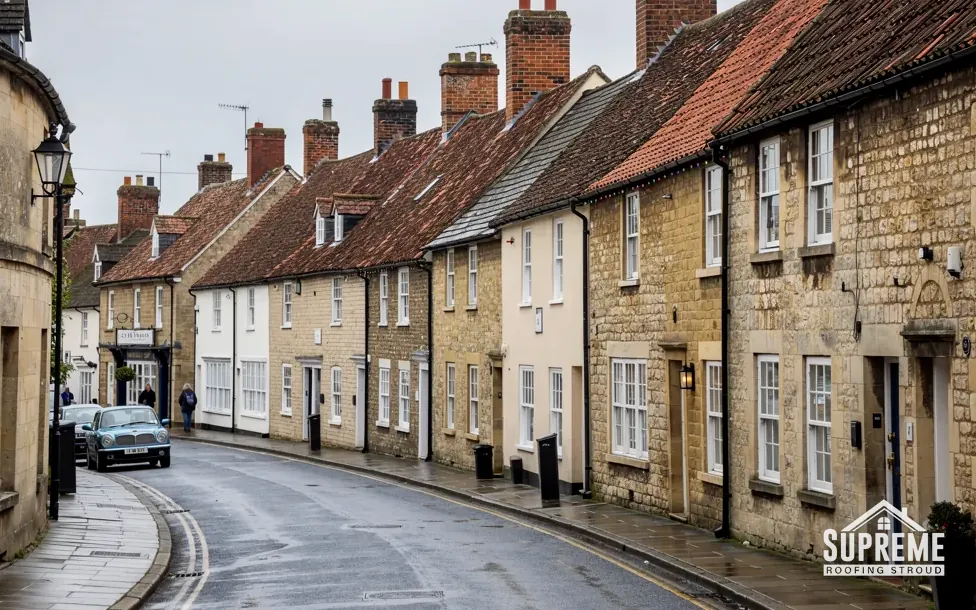
Curving street of stone and rendered terraced houses with tiled roofs
Chapter 01
One builder, many roofs: R & S Halls and the Edwardian core
Houses put up by the same hands in the same decades tend to fail in the same places, which helps with a diagnosis.
Chapter 01In this chapter
Wikipedia's account of Longlevens says housing at the crossroads began in the Edwardian period and that R & S Halls built many houses between the 1920s and the 1950s. For a roofer, the interesting part is the second half. One firm building across thirty years develops a repeating set of details: the same pitch, the same junction between the main roof and a bay, the same way of finishing the eaves. When one of those details wears out on a house, it is a fair prompt to look at the same detail on the next.
A neighbour's repair is worth asking about. Which part of the roof was it, what caused the failure, and was the cause fixed or only covered over? A good answer lets us go to your roof knowing where to look first, and it costs the survey nothing.
Edwardian roofs, at the older end of this range, bring their own checks. If the original gutters survive, they may be cast iron, which lasts well but cracks at joints and rusts at the back where it cannot be seen. Pointing around chimneys and along party walls has had a century to weather, and the mortar is the first thing to give. Timber fascias and the ends of rafters at the eaves are the places where a slow leak does its damage unseen, so we inspect them with a probe at the survey and report soft timber in the written findings, with photographs.
The 1920s to 1950s houses are a different problem. A roof of that age may have had its covering replaced once already, and the replacement may have been done on the original battens. That is not a fault in itself, but it matters when someone proposes a re-roof now, because battens that have been through two coverings are often worth renewing. If the covering is going on again, the job is covered on our roof replacement page, where the typical national cost of a full re-roof is shown with its source.
Early houses also tend to have more complicated roofs than later ones: bays, returns, small gables over a front window and a lean-to at the back, all of them joined by valleys and abutments. Each junction is a place where lead or a mortar fillet has to do its job for decades. On a survey we count the junctions as well as the slopes, because the number of them is what drives both the time the work takes and the amount of lead in the quote.
For smaller faults, our roof repairs hub explains what a repair involves and when it stops being the sensible answer.
Chapter 02
Wellsprings and The Triangle: estates built in two campaigns
Private houses from 1933 to 1938, then council housing from 1948, each now at an age where re‑roofing is on the table.
Chapter 02In this chapter
Two building campaigns sit side by side here: Wellsprings in the 1930s, then the council streets of The Triangle after the war. Those dates matter because they put a large number of roofs at roughly the same age, and that age is the point where a first covering, or its first replacement, can be nearing the end of what it can reasonably be asked to do.
Lifespan figures are typical ranges, never promises. Clay tiles are put at 40 to 60 years by MyBuilder, though other sources, including the Building Conservation Directory, argue that well-kept roofs go much longer. Concrete tiles are put at 30 to 50 years by MyBuilder. A roof on a Wellsprings house is now older than either range, which tells you the covering has already outlasted what a cost guide would predict and may have been repaired in the meantime. That is not an argument for replacement. It is an argument for surveying before deciding, and for looking at the underlay, battens and fixings as well as the surface.
When a re-roof is the right answer, the rules are plain enough. Small jobs sit below the Building Regulations thresholds, which the Planning Portal sets at less than 25 per cent of the building envelope and less than 50 per cent of the roof. A complete re-roof is above both, so an application follows, and with it a possible thermal upgrade under Part L. If the new covering would weigh 15 per cent or more above the old, approval and a structural check come into play as well. We go through these points at the survey and take care of the notification, so the thresholds do not become your problem.
Typical UK costs give a sense of scale. For scale, MyBuilder (2026) gives £5,000 to £12,000 for a full re-roof: £5,000 to £8,000 for a gable-ended house and £8,000 to £12,000 for a hipped one. Those are national figures. What you would pay follows the survey, covering every cost from scaffold to waste disposal.
Streets of matching houses have one practical advantage: scaffold. Where neighbours agree to roof at the same time, the access is easier to plan, though each house is still quoted on its own survey. The guttering, soffits and fascias page covers the eaves work that usually goes with a re-roof.

Chapter 03
Horsbere Brook, old orchard ground and two Grade II churches
Trees, damp and gutters on one side; faculty rules on the other.
Chapter 03In this chapter
Horsbere Brook runs along the eastern edge of Longlevens, and the area's past as orchard and market-garden land means gardens here have often been planted generously. We do not know what any single garden holds, but trees close to a house are a common cause of roof problems: leaves fill gutters, branches rub the covering, and shade keeps moss alive. The moss itself is not decoration. Wet moss sits against the tile or slate for weeks, and a thick growth can block a gutter outlet.
Cleaning is a choice with consequences. MyBuilder's 2026 guide gives manual scraping at £5 to £10 per square metre and soft washing at £15 to £20, and warns that pressure washing at £10 to £15 may damage delicate tiles. We favour the gentler methods where a covering is old, and we look at the gutters at the same visit. Where the gutter run is failing, the guttering, soffits and fascias hub shows typical UK prices for replacement.
Holy Trinity, an Anglican church of 1934, was listed Grade II by Historic England in 2014, and St Catharine's on London Road, built between 1912 and 1915 just outside Longlevens in the Wotton area, is Grade II as well. The principle is the same for both. Where a church is in regular use for worship, roof work is outside the council's listed building consent and goes to the diocese as a faculty application. Once a church has been declared redundant, or a chapel has been turned into a home, that route closes and the council's consent normally applies.
The same distinction affects anyone who lives next to a church or owns a former one. Check the building's status with Gloucester City Council before work is planned, because the answer tells you who gives the permission and how long to allow. Our survey for a church or chapel conversion records the covering and the lead in photographs, so the paperwork has evidence behind it. If you own a house near a listed church and your roof is an ordinary domestic one, none of this applies to you, and a repair is just a repair.
Myth: Moss on a roof is only a cosmetic problem.
Fact: Wet moss keeps the covering damp and its debris can clog gutters, so it is worth clearing, using the gentlest method the roof will tolerate.
Map showing Longlevens and the Stroud service radius, with nearby towns we also cover.
Near Longlevens
Roof work we do here
Holy Trinity, the crossroads and 1930s streets
If my Longlevens neighbour has just had a ridge repaired, is mine likely to fail too?
It might. Houses built by the same firm in the same decade share details, so a neighbour's repair is a prompt to look at your own ridge rather than proof that it is failing. We survey, photograph it and tell you what we find.
Can a whole street of 1930s houses be re-roofed at the same time?
Yes, and neighbours who agree a timetable can make scaffold access simpler. Each house is still surveyed and quoted separately, because the condition of the battens, underlay and chimneys differs from one roof to the next.
Does a Grade II church nearby change the rules for my own roof?
No. A listing covers the building named, not the houses around it. Your own rules change only if your property is itself listed or inside a designated area, and the city council's planning team can confirm which applies at your address.
Do trees near Horsbere Brook mean I should clean my roof more often?
Trees mean more leaves in gutters and more shade for moss, whatever the distance to the brook. We check gutter outlets and moss growth at the survey and explain which cleaning method suits your covering.