
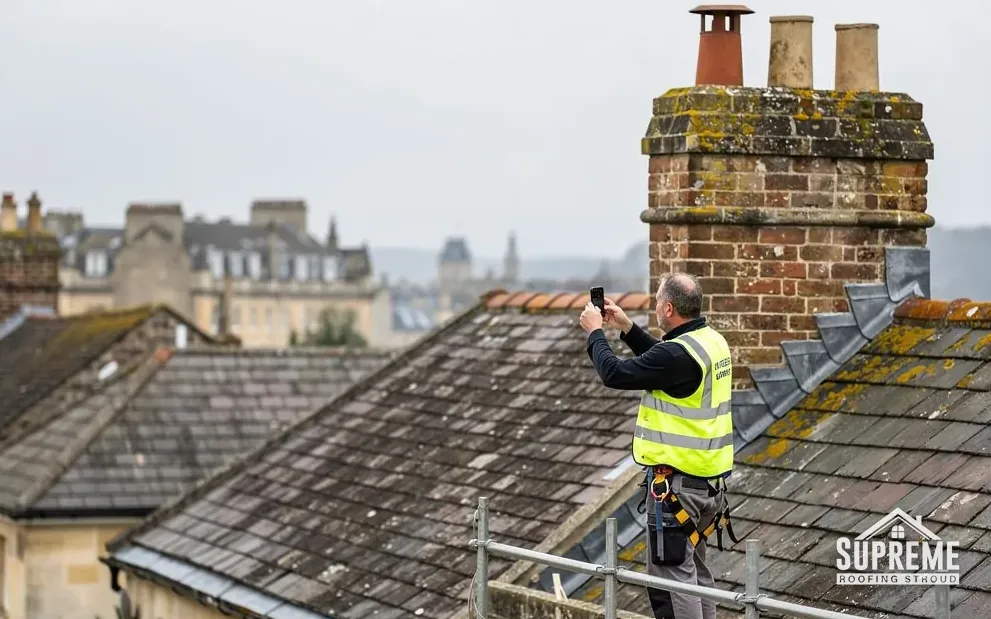
Roof inspections and surveys in Stroud
A look at the whole roof, inside and out, written up with photographs of your own roof. Typical survey costs are below, before anyone visits.
Typical roof survey costs
These are national ranges for a survey on its own. What any repairs would cost depends on what the survey finds.
| Work | Typical price |
|---|---|
| Roof survey, all methods | £150 to £500 |
| Standard survey on foot or by ladder | £150 to £250 |
| Drone survey | £200 to £400 |
| Thermal imaging survey | £300 to £500 |
| Repairs found by the survey | priced on survey |
Repairs are not folded into the survey figure. If the report points to work, you get a separate written quote covering access, materials, labour and waste.
Source: MyBuilder roof inspection cost guide, updated August 2026 (national typical ranges, not Supreme prices).
What a roof survey gives you
A survey is a record of what the roof is doing today, set out so that someone who has never seen it can follow it. It is not a sales pitch, and it is not a promise about next winter.
-
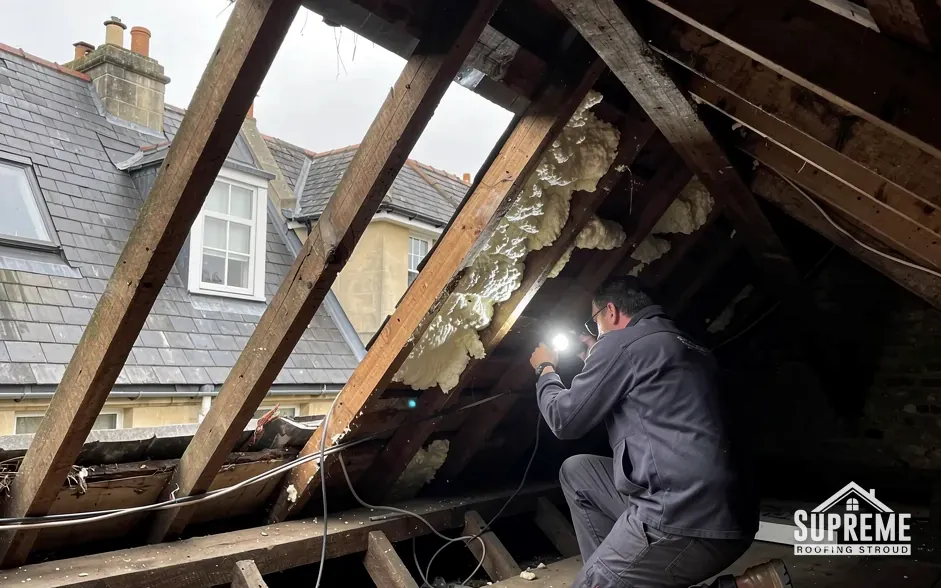
A photographed survey
Pictures of the actual defects on your roof, each tied to a location, so you can see what we are describing.
-
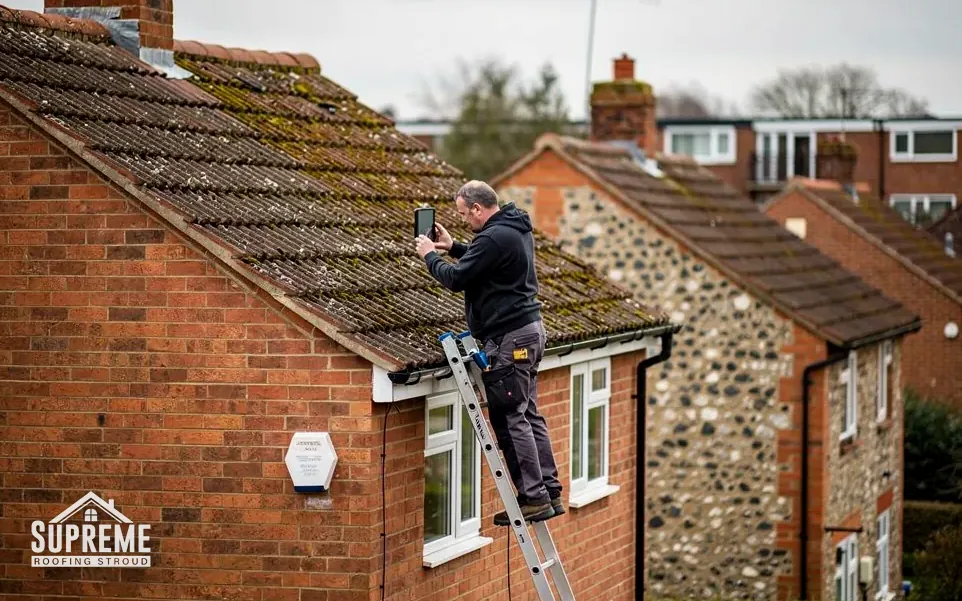
Camera and drone checks
A pole camera or drone covers slopes, valleys and gutters that are awkward to reach, and the pictures go into the report.
-

Follow-ups for buyers, landlords and insurers
A focused look at the items a homebuyer report flagged, or a dated record a landlord or insurer can file.
Reasons to book a roof inspection
- A homebuyer report that mentions the roof or asks for a specialist to look
- A ceiling stain that appears after heavy rain and fades when it dries
- Broken pieces of slate or tile found in the gutter or on the lawn after a gale
- A rear slope you cannot see from the ground, perhaps above a steep garden
- A landlord, agent or insurer asking for proof of the roof condition
How a roof survey runs
- 1Brief and accessYou tell us why you want the survey, and we check how the roof can be reached, whether from a ladder, the loft hatch or the air.
- 2Survey, outside and inWe work through the covering, ridge, valleys and flashings, then go into the loft to see the underside for daylight, staining and damp timber.
- 3Written findingsA report with a photograph for each defect, sorted into what is leaking now, what will fail and what only needs watching.
- 4Written quote if work is neededEach repair or replacement is covered in the quote, and our 10-year workmanship guarantee, in writing, covers any work we then carry out.
The survey guide
How roofs are surveyed, and what you do with the result
The methods, the limits, the paperwork, and the moments when a survey earns its fee.
Chapter 01
Ladder, pole camera, drone and loft hatch
Each way of looking at a roof sees something the others miss.
Chapter 01In this chapter
No single method gives the full picture of a roof. A sound survey chooses the order in which to use them, starting with whatever answers the biggest question about the house in front of us.
From the ground
Binoculars and a long camera lens cost nothing and show a good deal: a dipped ridge line, a slipped tile, a flashing lifting at the edge of a chimney, a gutter with a sapling growing in it. They also show the overall shape of the roof, which tells us where to look harder. What they cannot show is a tile face on a slope that falls away from you, or anything hidden behind a parapet or a neighbour's gable.
Ladder and roof access
Where it is safe, hands and eyes on the roof are hard to beat. At the eaves, or on a properly set roof ladder, we can lift a tile to look at its fixing, press a ridge piece to see whether it moves, check a lead flashing for splits and examine the mortar at a verge (the edge of the roof at a gable). Many houses around Stroud sit on terraced slopes, where a ladder that goes up easily at the front may have nowhere to stand at the back. We ask about access when you book and plan for it, rather than finding out on the day.
Pole cameras
A pole camera is a small camera on an extending pole, with a screen at the bottom. It lets us look along a gutter, over the edge of a flat roof or down a valley without climbing. The images are close and sharp, but the field of view is narrow, so it answers a specific question well and surveys a whole slope badly.
Drones
A drone gives a view from above that no ladder can, covering a full slope in minutes and producing pictures that are easy to place in a report. The limits are genuine. Photographs from a distance can hide fine cracks, and a drone cannot lift a tile, press a ridge or see what is going on beneath the covering. Wind, poor light, trees and overhead cables can all decide whether it can fly at all. We use drone images to see what is up there, and follow up in person on anything that looks doubtful. The page on drone roof surveys goes into what the pictures can and cannot show.
Working safely
Not every roof can be walked on. Some are too steep, some have fragile rooflights or asbestos cement sheets, and some have slates so old that a boot would break them. When walking is not safe, we survey from a ladder at the eaves, from a platform, or by camera, and the report records which method was used. A survey that avoids breaking more slates than it finds is a better survey.
The loft
The underside of a roof tells you what the top cannot. Pin-pricks of daylight through the covering, a tide-mark on a rafter, dark patches on the underlay and damp insulation all show up from inside. A roof that looks perfect from the lane can have a rotten batten end that only the loft reveals.
A roof can look perfect from the lane and still show its fault from the loft.
| Method | Good at | Cannot do |
|---|---|---|
| Ground and binoculars | Roof shape, ridge line, obvious gaps | Judge tile faces or flashing detail |
| Ladder and roof access | Lifting, pressing and testing parts | Reach roofs with no safe footing |
| Pole camera | Gutters, valleys, flat roof edges | Cover a whole slope quickly |
| Drone | Whole slopes and chimneys at a glance | Lift, press or look beneath anything |
| Loft inspection | Daylight, staining, damp timber | See the outer faces of the covering |
For a side-by-side look at the tools, see ladders, pole cameras and drones compared.
Chapter 02
What a roof survey covers, and where it stops
A survey follows water from the ridge to the gutter and then looks at the timbers underneath.
A roof survey follows the route water takes, and checks every junction it meets. We start at the top and work down, then go inside.
In this chapter
The covering
Slipped, cracked and missing tiles or slates, nibs that have snapped, stone slates with failed pegs, and moss that is holding water against the surface. We look at whether the faults are scattered or concentrated, because a single slipped slate is a repair and a whole slope of them is a different conversation.
Ridge, hip and verge
These are the parts of a roof where the covering ends and the weather gets in. BS 5534 was revised in 2014, and mortar by itself no longer counts as a sound fixing for ridge and hip tiles; they are clipped or screwed down as well. On older roofs we look for cracked bedding, loose ridge pieces and verge pointing that has been let go. A fixing that has rusted through shows in the way a ridge piece sits.
Valleys, flashings and chimneys
A valley is the internal angle where two slopes meet, and a flashing is the strip of lead or other metal that seals a roof against a wall or chimney. Both are places where water concentrates. We look for lifted lead, splits at bends, mortar fillets that have cracked away and flaunching (the mortar cap that holds a chimney pot) that has crazed. Our page on what a roof survey covers lists each item.
Flat roofs
On a flat roof we look at ponding, upstands, laps in the membrane, outlets and the finish at the edges. BS 6229 sets a design fall of 1:40, so that the finished roof still achieves a minimum of 1:80 after tolerances. Standing water on a roof that was meant to drain is evidence worth photographing.
Rainwater route
Gutters, hoppers and downpipes show where water has overflowed, because a green streak down a wall or a stained brick below an eaves joint tells its own story. Overflowing gutters also soak the fascia and the rafter ends behind it, so the survey notes where water has been running over rather than through the outlet.

Roofline and loft
Gutters, fascias and soffits get a quick look, since a roof is only as good as its water route to the drain. In the loft we check the underlay, the timbers, any insulation lying against the underside, and ventilation at the eaves.
Where it stops
A roof survey is not a structural survey of the walls, and it cannot see beneath a covering we have not lifted. It records condition on the day, so it cannot promise what the roof will do next winter. If a sheet might be asbestos cement, we flag it and leave it undisturbed. Anything we could not reach or see is written down as a limit in the report, so it never reads as a clean bill of health.
A roof-only visit and a full building survey answer different questions, and the two are often used together. If a building survey has already been done, send it to us: the roof section tells us which items to check first, and our report picks up from there without repeating work you have paid for. Our pages on roof repairs and roof replacement cover what follows when a survey finds faults.
Chapter 03
Reading a roof condition report
Photographs, locations and an order of urgency, so a defect is something you can see rather than take on trust.
A report is only useful if you can act on it. The one we write is built around photographs of your own roof, with each defect given its location and a plain description, so it can be handed to a surveyor, a solicitor or a builder without us in the room.
In this chapter
What each entry says
Every finding has the same shape: where it is (north slope, third course up from the eaves, left of the chimney), what we can see, the probable cause, and what is proposed. If a cause is only our best guess, the report words it that way. A damp patch on a ceiling has several possible sources, and a good report lists the likely ones rather than blaming the nearest slate.
Sorting by urgency
We group findings by what they mean for you. Some faults are letting water in now, and they come first. Others are not leaking but will, such as a ridge fixing that has failed or a lead flashing with a split. A third group needs only watching, such as early moss, a hairline crack in pointing or a gutter that holds a little water. That sorting is what lets you spend money in the right order. Our page on reading roof condition reports shows the layout.
Condition is not a price
The report records the roof; it does not price the work. That keeps the findings clear of any pressure to sell. If repairs are needed, the written quote follows as a separate document, covering access equipment, materials, labour, waste disposal and making good. You can take the report and get a second opinion on the quote without losing anything.
Photographs you keep
The photographs belong in your records. Some owners file them next to the house deeds. Others send them to an insurer, a letting agent or a solicitor. A dated set also gives you a before-and-after comparison, which is useful if the same slope fails again, or if a neighbour's work causes damage.
Limits are written down
If a section of roof could not be reached, or a loft was boarded out and could not be seen, the report says so. A limitation recorded honestly is worth more than a confident sentence about something nobody saw.
Myth: If a roof looks fine from the road, it is in fine condition.
Fact: Failed underlay, rotted batten ends and damp insulation only show from the loft or when a tile is lifted.
Ask for the photographs in full resolution if you plan to forward them. Each one in our report is labelled with the slope, the position and the date, so a surveyor, solicitor or builder can match a picture to a place on the roof without a visit. A short written caption underneath says what the picture shows and why it matters.
Chapter 04
When a homebuyer report mentions the roof
A line in a buyer survey is a prompt to look closer, ideally before contracts are exchanged.
Chapter 04In this chapter
A surveyor producing a homebuyer report often has limited access to the roof. They may look from the ground or from a ladder, or use binoculars, and where they cannot see something, they say so. The wording to watch for is a recommendation that a roofing specialist look at the covering, the chimney or the flashings before you commit.
In this chapter
What to do with the line
First, get the actual wording from the report rather than a summary. "Further investigation advised" and "roof near the end of its life" are very different statements, and the second one can change what you offer for the house. Then arrange for a roofer to look at the specific items. If you send us the page, we will begin with those points and add a general check around them.
Timing
The useful moment is between the buyer survey and exchange of contracts. After exchange, a roof fault is yours to fix. Before it, the same fault is a matter for negotiation. If the sale is moving fast, tell us the deadline when you ask for a visit, so the access and photographs are arranged around it. Our page on homebuyer roof follow-ups sets out what to ask for.
Turning findings into figures
A buyer needs two things from a roofer: what is wrong, and what putting it right would plausibly cost. The survey answers the first. For the second, a written quote shows what the work involves, so you can offer to share the cost with the seller, ask them to do the work, or agree a lower price. We keep the quote clear enough for a solicitor to read.
Auctions and short windows
Buying at auction compresses everything into a few weeks. If you can arrange a viewing of the roof or loft before the sale date, a photographed look is the safest way to learn about hidden faults.
Selling
Sellers sometimes commission a survey first, so that a buyer's report does not raise a surprise during the sale. A dated set of photographs with the repairs already done can shorten a negotiation. It also shows you the roof as a buyer's surveyor will see it.
Not every purchase needs a specialist. When the buyer survey gave the roof a clean description and the covering is modern, a roofer's visit may add little. When the report is vague or the roof is old, the visit is a cheap safeguard against an expensive surprise, and the photographs make a useful record whichever way the sale goes.
Chapter 05
Roof inspections for insurers, landlords and letting agents
A dated record of the roof, written for someone who has to rely on it without visiting.
Some inspections are not for the person who owns the house at all. A landlord needs a record that the roof is sound before a new let. An insurer wants to see what a storm did. A managing agent holds a block's roof to a maintenance plan. In each case, the reader will never climb a ladder, so the report has to stand in for the visit.
In this chapter
After a storm or a claim
If wind has taken tiles or slates, photographs of the damage, the location and the date are what your insurer will look at first. Insurers generally treat sudden damage differently from long-term wear, so a record that separates fresh breaks from old deterioration helps your claim. We write what we see and avoid stating what the policy will pay, since that depends on your cover. Check the wording of your policy or ask your insurer. Our page on roof inspections for insurance claims explains the evidence insurers tend to want.
Making a leaking roof safe
If water is coming in, we prioritise it and make the roof safe first, with temporary protection, then the full survey can be done once it is dry. The photographs taken during that visit go into the claim evidence.
Landlords and agents
For a landlord, a regular look at the roof avoids the worst surprise of ownership, a tenant's ceiling coming down. A periodic inspection, with dated photographs, also shows that you maintain the property. For agents holding several properties, one report format across the portfolio makes it easier to compare roofs and set a maintenance budget. We suggest a check after the autumn leaf fall and after any severe storm; the seasonal pattern is on the page for seasonal roof inspections.
Records that stand up later
A report is only as persuasive as its detail. We record the date, the weather on the day, the method used and any areas that could not be seen. Where a fault is still developing, a second set of pictures taken a few months on shows the change, and that comparison is far stronger than a single opinion.
Tenants and access
Where tenants live in the property, we arrange loft access through the agent and keep disruption short. Written notice and a named time make it easier for everyone.
What it costs
National guides put a roof survey between £150 and £500, depending on the method and the size of the building. A repeat inspection of a roof we have already recorded can be quicker, since the earlier photographs show what to compare.
A dated photograph is the nearest thing a roof has to a witness.
- Standard survey£150 to £250
- Drone survey£200 to £400
- Thermal imaging£300 to £500
For a block or a small portfolio, ask for the same report layout each time, so findings can be compared from one property to the next. Agents often want one summary page on top, with the detail and photographs behind it, and we can set the report up that way. Wear and tear, storm damage and tenant-reported leaks are logged under separate headings.

Chapter 06
Surveying stone, slate and listed roofs around Stroud
Older roofs need a surveyor who knows what the original construction should look like.
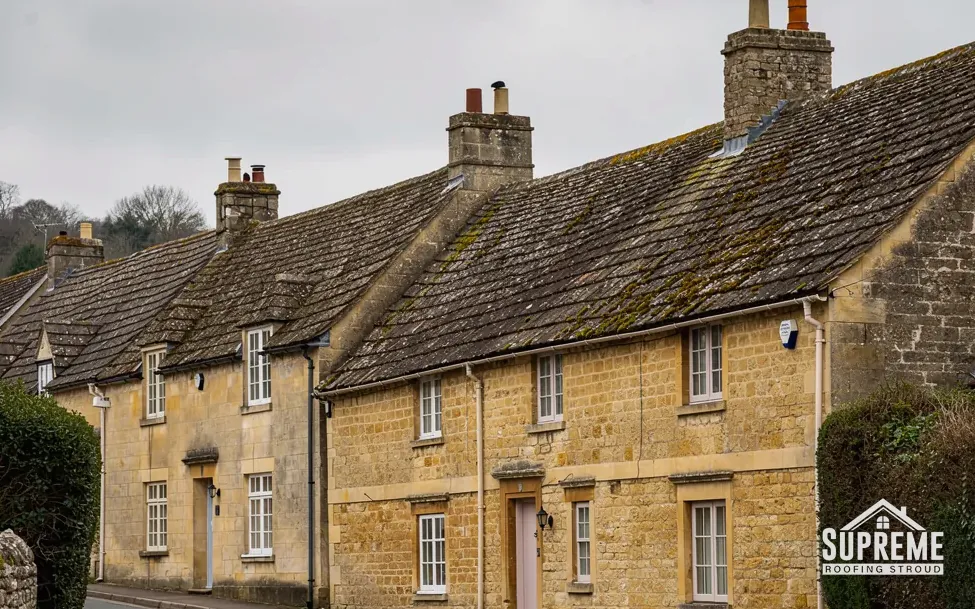
The Stroud valleys have a wealth of older roofs: stone slates on cottages towards the Cotswold edge, natural slate on Victorian terraces and mill buildings, clay tile on later houses. Surveying them means knowing how they were meant to be built, because a feature that looks odd may be original and one that looks neat may be a poor repair.
In this chapter
Stone slate roofs
Cotswold District Council's technical guidance describes a traditional stone roof as pitched at about 47° to 55°, with the largest slates at the eaves and the smallest at the top. We check the courses for waves and dropped sections, and the pegs that hold each slate, which are often the first part to fail. The guidance also says stone slate roofing is very heavy, at about 1,000 kg for every 10 m², so sagging in the rafters under a stone slope is a point to look at from the loft. Our Cotswold stone roofing page goes into the repair side.
Natural slate
On slate, we look for slipped or cracked slates, rusted nails, delaminating faces and lead soakers (the small bent pieces of lead that seal slate against a wall) that have failed. A slate roof that has lost many slates may still have sound ones worth saving, so the survey notes which slopes are worth repairing and which would be a re-lay. The slate roofing page covers that side.
- 47° to 55°traditional pitch of a straight Cotswold stone roof
- about 1,000 kgweight of each 10 m² of stone slate roof
- 41conservation areas in Stroud District
Listed buildings and conservation areas
A survey on its own does not alter anything, so it needs no consent. Repairs are different. Stroud District Council lists 41 conservation areas and says every listed building has legal protection, inside and out, regardless of its grade. Work that affects a listed building's character needs listed building consent. When we survey a protected building, we photograph the courses, ridge and valley details before anything moves, so the conservation officer can see what is being matched. If your house falls in a conservation area, we recommend checking with the council's planning team before a repair that changes how the roof looks.
Thermal imaging on older roofs
Thermal imaging shows differences in surface temperature. Under suitable conditions it can point to heat loss or to wet insulation. It does not replace a hands-on check, and results depend on the weather and the heating in the building. Treat the images as a pointer to where to look, not as a finding in themselves.
Outbuildings and extensions
Barns, outbuildings and extensions on older houses often have a different roof from the main house: a corrugated sheet, a felt flat roof, a newer tile on a shallower pitch. We survey each roof on its own terms. A flat extension roof joined to a stone wall has its own weak points, such as the upstand and the lead where the two meet, and a survey that covers only the main slopes misses them.
The survey as a baseline
For a period house, the first survey becomes the baseline. Later visits compare the same slopes, and a slow change in the courses or ridge is easy to see against the earlier pictures.
Older roofs reward a slow look. We allow more time on site for a stone or slate roof, take wider pictures of the courses before close-ups of the defects, and record the sizes and colours of what is on the roof, so that any repair can be matched to it later.
Roof survey guides and answers
The methods, costs, reports and special cases behind roof inspections, written for homeowners, buyers and landlords around Stroud.
Guides
- How much does a roof survey cost in Stroud?A paid roof survey in England typically costs between £150 and £500, and the type of survey does…Read the guide
- What a Stroud roof survey covers, and what it doesn'tA roofer's survey walks the whole roof from covering to loft and ends with photographs and a written…Read the guide
- Drone roof surveys in Stroud: what they show and their limitsA drone gets a camera over a roof that is too steep, too high or too fragile to…Read the guide
- Homebuyer survey flagged the roof? Next steps in StroudThe report is in and it says something about the roof. Before you panic or renegotiate, you need…Read the guide
- Roof condition reports in Stroud: reading the findingsSome lines in a condition report need action now and some can wait a season. This guide shows…Read the guide
- Roof inspections for Stroud landlords and letting agentsOne tenant reports a stain, and you are choosing between a ladder visit and a full scaffold with…Read the guide
- Roof inspections for insurance claimsWhen a claim depends on the state of your roof, the written report carries weight. This guide sets…Read the guide
- Ladders, pole cameras and drones: inspection methods comparedNo single method sees a whole roof. Each one is good at certain faults and blind to others,…Read the guide
- Surveying listed and stone roofs around StroudA listed building roof survey is slower and more careful than a standard roof check. On stone and…Read the guide
- Thermal imaging roof surveys: what they findAn infrared camera cannot see leaks, only differences in surface temperature. Used well, those differences point to missing…Read the guide
- Seasonal roof inspections in Stroud: autumn and post-stormA roof is easiest to look after when the checks follow the calendar. This guide lays out a…Read the guide
- The survey before a re-roof: scoping the jobA re-roof is priced on what is found, so the survey comes first. This guide follows a scoping…Read the guide
Quick answers
- How often should a roof be inspected?
- Roof survey or full building survey?
- How long does a roof inspection take?
- Do I need a roof survey when buying in Stroud?
- Will a mortgage lender ask for a roof report?
- Will I get photos of my roof after an inspection?
- What a roofer looks for in your loft
- Are free roof inspections worth having?
- Should I get a roof inspection after a Stroud storm?
- Should I get a roof survey before selling?
- Can a survey find hidden roof damp?
- How is a flat roof inspected?
- Does a roof survey include the chimney?
- Do roofers need to go on the roof to inspect it?
- Can a roofer tell how old my roof is?
- Roof survey or quote visit: what's the difference?
- Should a new-build roof be inspected?
- Roof photos: what the common faults look like
- Can a survey tell if roof underlay has failed?
- Buying at auction: checking the roof in time
Roof inspections: specific questions
Can a roof survey be done without anyone climbing onto the roof?
Often, yes. A pole camera, a drone and the loft can answer many questions without a ladder. Where something looks doubtful, we go up to lift and test it, and the report says which parts were seen by camera only.
What should I send you after a homebuyer report flags the roof?
Send the page of the report that mentions the roof and the sale deadline, if there is one. We start with the items it names and add a general check around them.
Will a survey tell me how old my roof is?
It gives an informed estimate from the covering, the fixings and the timbers. It is not a date stamp, and the report presents it as an estimate.
Does an inspection include the chimney?
Yes. We look at the stack, pointing, flaunching, pots and flashings from the roof or by camera, and note anything that needs a closer look.
How soon after a storm should the roof be checked?
As soon as it is dry and safe. A slipped slate caught early is a small repair, and dated photographs help if you make an insurance claim.
Will a roof survey be accepted by my mortgage lender or insurer?
That is their decision, and policies differ. A photographed report from the survey gives them a clear record of condition, and we suggest asking them what format they want before booking.
Book a survey of your roof
Email or WhatsApp a picture of the roof taken from the street, say why you want it inspected, and mention any sale or claim deadline. We will confirm how the roof can be reached, then survey it and send the photographed findings.