
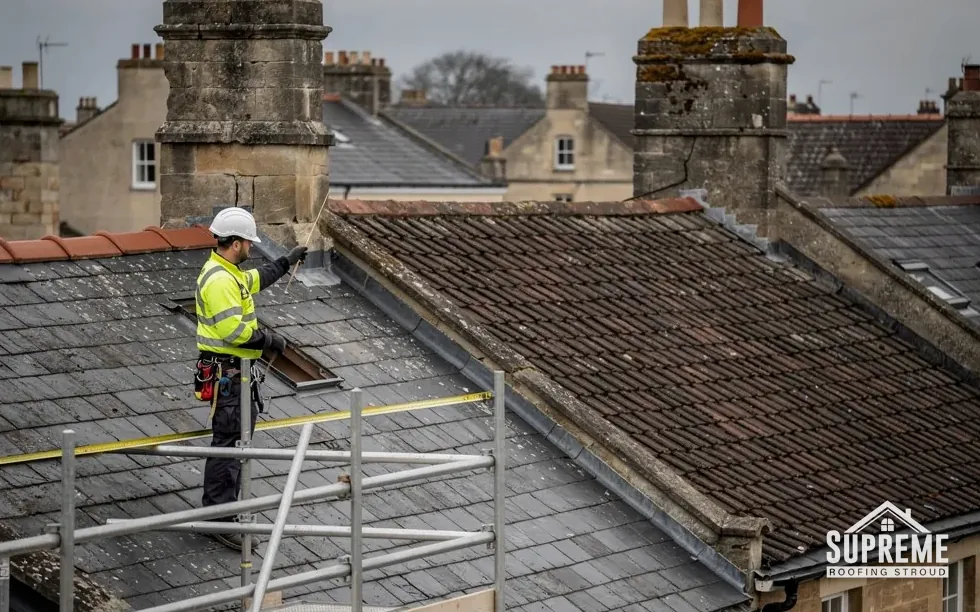
Slate roofing in Stroud
Re-slating, repairs and new slate roofs, in Welsh, Spanish or fibre cement slate. Typical prices are below; a written quote follows once we have surveyed your roof.
Typical slate roof costs
Published national guides give the ranges below, which lets you weigh any quote against them. Your own figure turns on pitch, access and how much of the existing slate is sound.
| Work | Typical price |
|---|---|
| Single slate replaced | £60 to £120 |
| Five to ten slates replaced | £150 to £350 |
| Slate roof repair, by area | £150 to £220 per m² |
| Welsh slate re-roof, installed | £140 to £180 per m² |
| Spanish slate re-roof, installed | £100 to £130 per m² |
| Fibre cement slate re-roof | priced on survey |
Once the survey is done, the written quote covers scaffold, stripping, new slate, battens and underlay, labour and waste.
Sources: MyBuilder slate roof cost guide, updated August 2026; Checkatrade roof repair cost guide, June 2026. National ranges, not Supreme Roofing prices.
Slate stays slate
A slate roof is repaired with slate, fixed the way the rest of the roof is fixed. That keeps the laps watertight and the roofline looking as it always has.
-
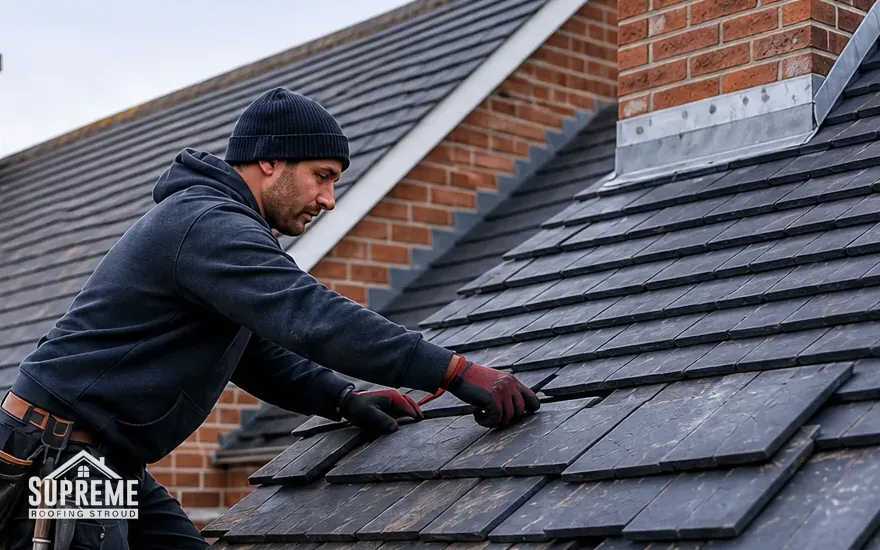
Slipped slates and tingles
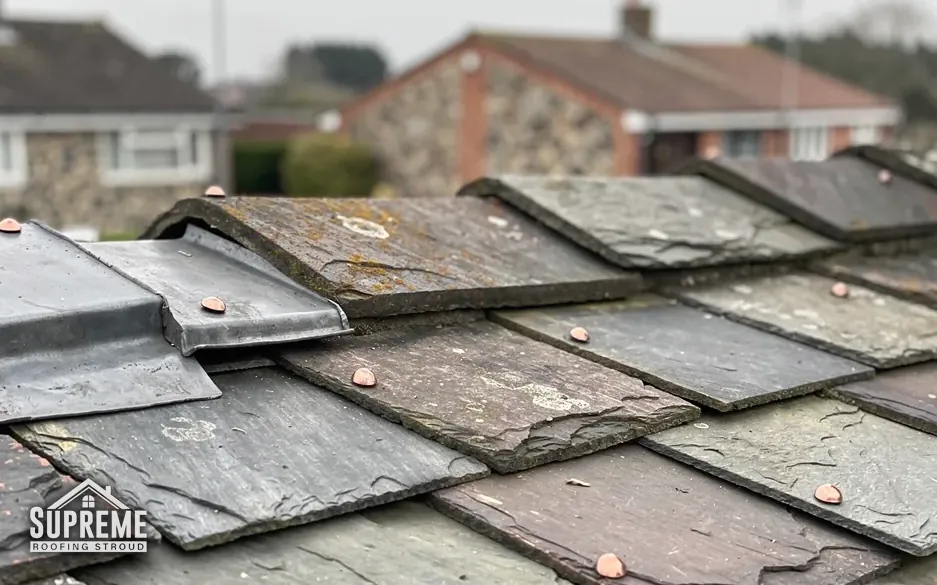
A slipped slate is refixed or replaced, and where there is no nail to hold it we hang it from a metal strip called a tingle, turned up over the slate below.
-
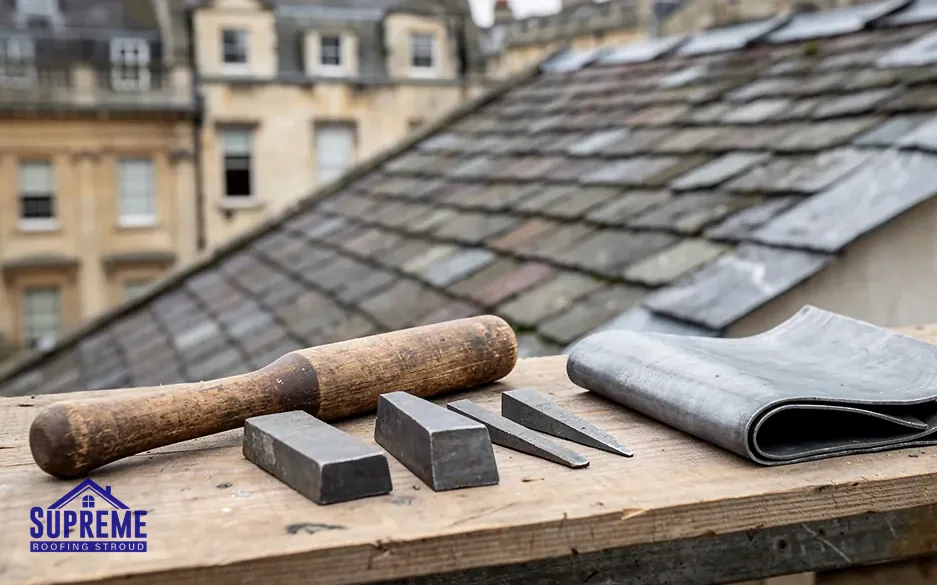
Re-slating a slope or a whole roof
We strip to the battens, renew the underlay and battens that have gone, and lay the slate again at the gauge the size and pitch call for, reusing sound slates where they will bear it.
-
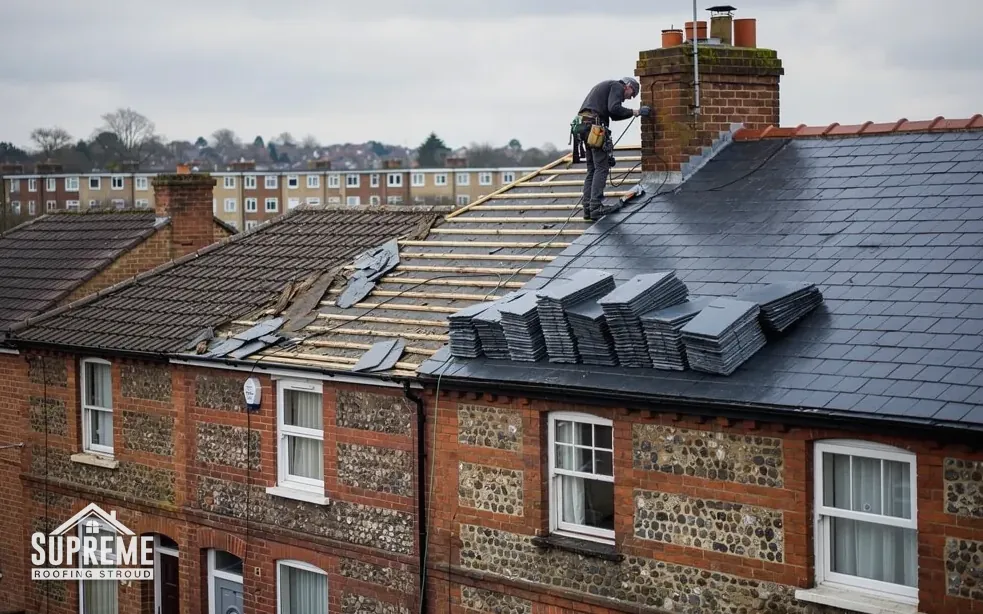
Nail fatigue and fixings
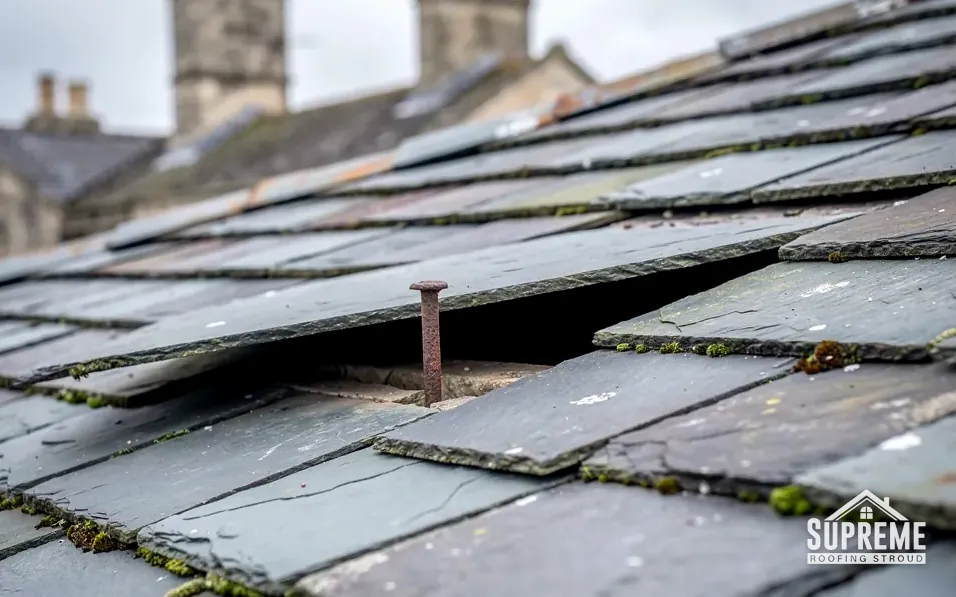
When the nails that hold the slates have corroded or snapped, patching one slate at a time stops working. We show you where the fixings have failed and what a proper repair involves.
Signs your slate roof needs attention
- Slates sitting lower than their neighbours, or lying in the gutter
- Rows of slates with a visible gap at the top edge
- Slates that flake, split into layers or sound dull when tapped
- Shiny metal strips or fresh nail heads where someone has repaired before
- Daylight or staining on the underside of the battens in the loft
How a slate roof job runs
- 1Survey from the roof and the loftWe check the slate size, the headlap and the nails from outside, then look at the underside of the battens and any underlay from inside.
- 2Written quotePriced by the slate or by the square metre, with slates we expect to reuse noted.
- 3Strip, sort and re-slateSlates come off in sections, are sorted by size and condition, and the open slope is sheeted at the end of every working day.
- 4Photographs and sign-offPhotographs of the finished slope, any Building Regulations paperwork, and the 10-year workmanship guarantee in writing.
The slate roof guide
Slate roofs, explained
Where slate comes from, how sizes and gauges work, why slates slip, when to repair and when to re-slate, and the rules that apply.
- 01Welsh, Spanish or fibre cement: what you are buying
- 02Sizes, headlaps and gauges: the arithmetic of a slate roof
- 03Why slates slip: nail fatigue, tingles and the repairs that follow
- 04Repair or re-slate: where patching stops making sense
- 05Underlay, weight and the Building Regulations on a re-slate
- 06Victorian terraces, listed roofs and looking after slate
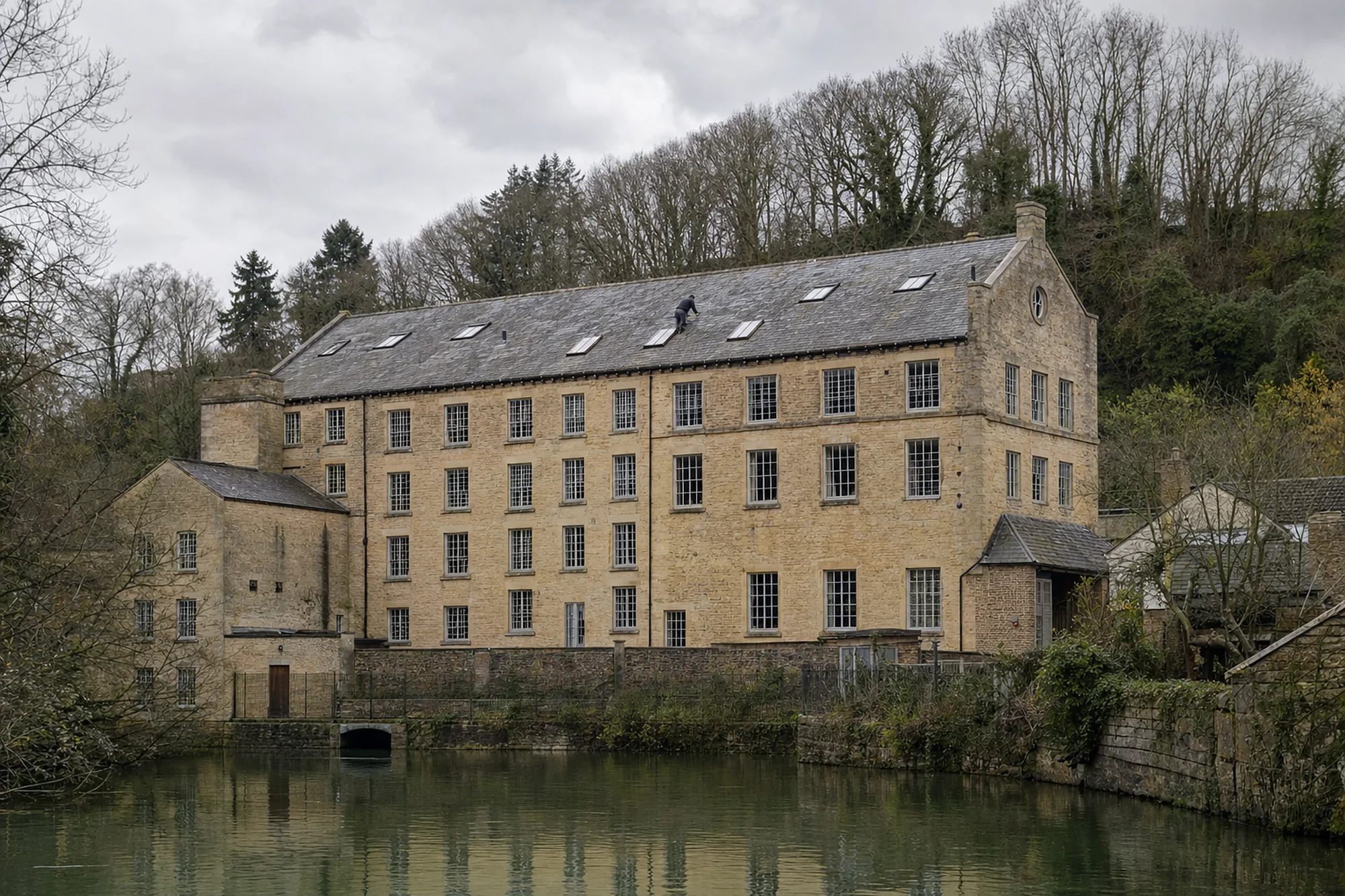
Chapter 01
Welsh, Spanish or fibre cement: what you are buying
Three kinds of slate look alike from the pavement and behave differently on the roof.
A natural slate is rock that has been split along its grain into thin sheets, trimmed to size and holed for nails. Because it is split rather than made, each slate varies a little in thickness and edge, and the quality of the roof depends on the quarry and the grade chosen. Welsh and Spanish slate are the two natural slates most often specified in this country, and the difference between them shows up first in the price and then, decades on, in how the roof has aged.
In this chapter
MyBuilder's slate roof cost guide, updated in August 2026, puts a Welsh slate roof at around £140 to £180 per m² installed and a Spanish slate roof at £100 to £130 per m². It describes Welsh slate as regularly lasting more than a century and Spanish slate as lasting 75 to 100 years. These are typical ranges, not promises. A well-fixed roof of either kind outlasts a badly fixed roof of the other, and the gap in price is large enough that it often decides the budget.
Matching what is already there
If you are repairing part of a roof, the first rule is to match what is on it. Slates of different origin differ in colour, surface and the way they weather, and a patch of the wrong slate shows from the lane for years. Our guide to Welsh, Spanish or Brazilian slate compares them in detail, and the page on the quality of Spanish slate covers what to look for in a grade.
Fibre cement slate
Fibre cement slate is a manufactured product: cement and reinforcing fibres pressed into a flat sheet in the shape of a slate. MyBuilder gives synthetic slate a typical life of 30 to 50 years. It arrives with a uniform thickness and colour, which some owners like and some find flat beside a neighbouring natural roof. It is a legitimate choice on an extension, an outbuilding or a house where natural slate is not required, and a poor one on a roof that has always been natural, because the two weather differently and sit differently at the edges.
Where two coverings are both sensible, the quote can cover each, and you choose with both totals in front of you. Our comparison of natural and fibre cement slate sets out the trade-offs.
Listed and protected buildings
The choice of covering is not always yours alone. Where the house carries a listing, or lies within a conservation area, Stroud District Council's conservation team has a say, and swapping natural slate for a manufactured one is the sort of change that tends to need consent. We raise it before quoting.
What we look at on a slate
When we are asked to identify what is on a roof, we look at the colour across several slates, the finish of the edges, the thickness and how the surface has weathered. A slate that is breaking into thin layers is behaving differently from one that has simply lost its sheen, and that difference matters when we decide whether to reuse it.
Two slate roofs can look identical from the road and age very differently.
| Type | Typical life | Installed, per m² |
|---|---|---|
| Welsh slate | Over a century | £140 to £180 |
| Spanish slate | 75 to 100 years | £100 to £130 |
| Fibre cement slate | 30 to 50 years | priced on survey |
Lifespans and installed prices are from MyBuilder's slate roof cost guide (August 2026). If you want the question of how long a roof will last answered directly, how long a slate roof lasts goes into it.
Chapter 02
Sizes, headlaps and gauges: the arithmetic of a slate roof
A slate roof keeps water out by overlap, so the numbers behind the overlap decide whether it works.
Chapter 02In this chapter
Slate sits flat and sheds water by overlapping. Each course covers the joints of the course below, and the headlap is the extra cover: the distance a slate reaches down over the one two rows beneath it. The shallower the roof, the more headlap it needs, because water on a low slope runs sideways and creeps upwards under the slate before it runs off.
In this chapter
Gauge follows from headlap
The gauge is the distance from the bottom of one course to the bottom of the next, and it is measured up the slope. For a centre-nailed slate it is the slate's length minus the headlap, divided by two. Take a 500 mm long slate with the 115 mm headlap that Cupa Pizarras gives for a 20° pitch in moderate exposure: 500 minus 115 is 385, and half of that is 192.5 mm. Take a 600 mm slate at 30°, where Cupa gives an 80 mm headlap: 600 minus 80 is 520, and half is 260 mm. Battens are fixed at exactly that spacing, which is why a re-slate starts with measuring the batten gauge before a single slate comes off.
Minimum pitch
Cupa Pizarras notes that BS 5534:2014+A2:2018 indicates a minimum pitch for natural slate of 20 degrees in moderate exposure, with a 500 mm slate and a 115 mm overlap. NHBC guidance is quoted at 20 degrees subject to headlap. For a 600 by 300 slate the same table gives no value below 25 degrees. In other words, a slate roof does not simply work at any angle; the pitch, the size of slate and the headlap are chosen together.
- 20°indicated minimum pitch for natural slate in moderate exposure
- 115 mmheadlap for a 500 by 300 slate at 20°
- 25°pitch below which hook fixings should not be used
Exposure changes the table
The headlap tables are built for moderate exposure, and Cupa notes that any area within 30 miles of a west-facing coastline is treated as severe exposure, which calls for more headlap. We check which category applies to your address from the maker's data before we price, rather than assuming.
Why this matters in a repair
If a previous repair used slates that were shorter, or fixed at a different gauge, the headlap in that patch can be less than the roof around it. That is a common reason for a leak that reappears after a repair that looked fine. Our page on slate sizes, headlaps and pitch works through the standard sizes, and the minimum pitch for a slate roof answers the pitch question on its own.
When we survey, we measure the slate, the visible lap and the batten spacing, and record them in the report, so the quote and the roof match.
A longer answer on a related point, how slates are held on, is in nails or hooks: how slates are fixed.
Chapter 03
Why slates slip: nail fatigue, tingles and the repairs that follow
The slate itself rarely gives out first. What holds it usually does.
A slate hangs on one or two nails driven through holes in its upper part and into a batten. The nail has to hold the slate against wind lift and against its own weight, year after year, while the batten moves slightly with damp and temperature. When the nails corrode, or the shank gives way, the slate slips down until the slate below stops it. That is nail fatigue, and when slates are going missing it is among the first faults we look for.
In this chapter
The pattern gives it away
A single slipped slate after a gale is an accident. A scatter of slipped slates across a slope, with the odd one lying in the gutter, points to fixings that are failing across the board. On a tired roof you can often see the lower edges of slipped slates sitting a finger's width below their neighbours, with a clean stripe at the top where the slate used to sit. Our guides to why slates slip and nail fatigue cover how to tell the two apart.
What a tingle does
A tingle is a narrow strip of metal, usually lead, copper or stainless steel, nailed to the batten and bent up over the bottom edge of the slate above so that it holds the slipped slate in place. It lets a slate be fixed without lifting the courses above it, and it is a proper repair when the slates around it are sound. It is a poor repair when applied to a slope where every slate has failed: you end up with a roof held on by dozens of strips. The page on tingles in slate roof repairs shows where they belong and where they do not.
Why a tingle shows
A tingle is visible as a metal tab below the slate. On a roof seen from the road, a few of them are acceptable. A hundred are a sign that the slope has reached the point where re-slating is the sensible answer. That is not a sales argument; it is the arithmetic of labour, because at that point the cost of fixing every slate individually approaches the cost of re-laying.
What else can slip a slate
Not every slipped slate is a fixing problem. A cracked or broken slate drops out of line, a rotten batten stops holding nails, and a roof that has been walked on badly can have slates cracked in the middle. Part of the survey is working out which of those it is, because a new nail in a rotten batten holds for the length of the next storm.
What we do on the roof
Where the cause is a single failed nail, the slate is lifted, the old nail cut with a slate ripper, and a new fixing made with a copper or stainless nail or a tingle. We note which slates were repaired in the survey photographs, so there is a record of what was done and where.
Slates fall because the fixings fail, and the fixings fail long before the slate does.
Myth: A slipped slate means the whole roof is finished.
Fact: A few slipped slates on a sound roof are a repair; slipping across a whole slope points to failing fixings, and that is a different decision.
The longer view of how slates are held, and what to do once the fixings have gone across a slope, runs into the next chapter.
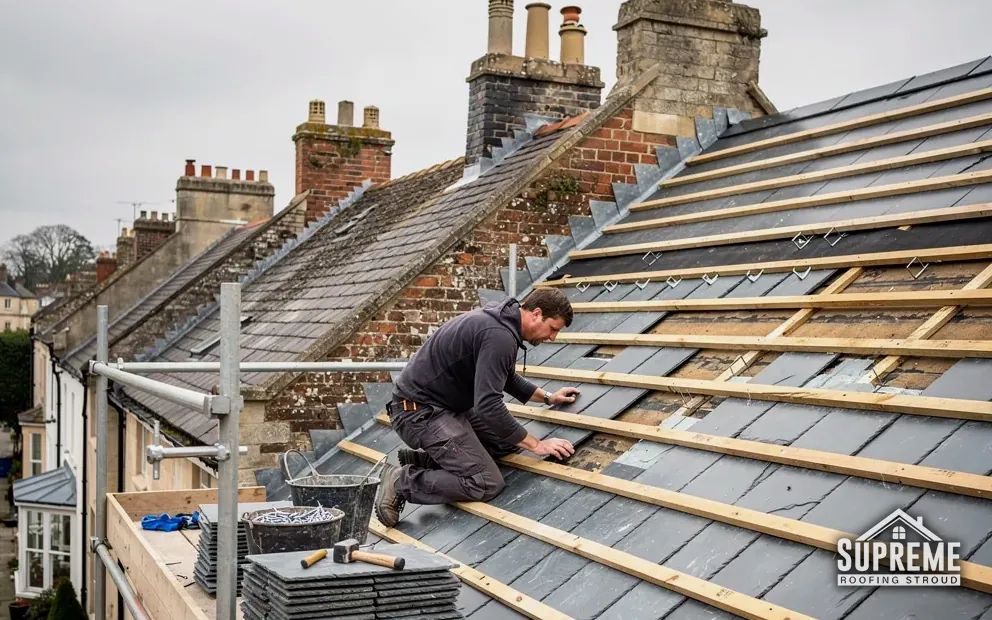
Chapter 04
Repair or re‑slate: where patching stops making sense
The choice turns on what is holding the slates and how many of them are still good.
A slate repair is cheap when it is a single slate and expensive per slate when it is a lot of them, because most of the cost is getting safe access to the roof and opening up the courses. MyBuilder's slate roof cost guide, updated in August 2026, gives £60 to £120 to replace one slate and £150 to £350 for five to ten. Checkatrade's roof repair guide, last updated in June 2026, puts natural slate repair at £150 to £220 per m², excluding VAT and access. Those figures help to show why a long list of small repairs rarely makes sense.
In this chapter
When a repair is the right answer
Repair when the damage is local and the slates around it are sound. That means a handful of slipped or cracked slates, a patch where a branch or aerial has hit the roof, or a run of slates beside a valley. If the nails in the next courses are clean and the slates are still ringing when tapped, putting a few new slates in is a proper job, and the rest of the slope does not need to be touched.
When re-slating is the better answer
Re-slate when the fixings are failing across the slope, when the battens are rotten, or when a large share of the slates is delaminating into thin flakes. In those cases every repair you pay for sits on top of a fault that is still running. The guide on repair or re-slate puts the decision into a few questions you can answer yourself from the ground.
Sorting the slates
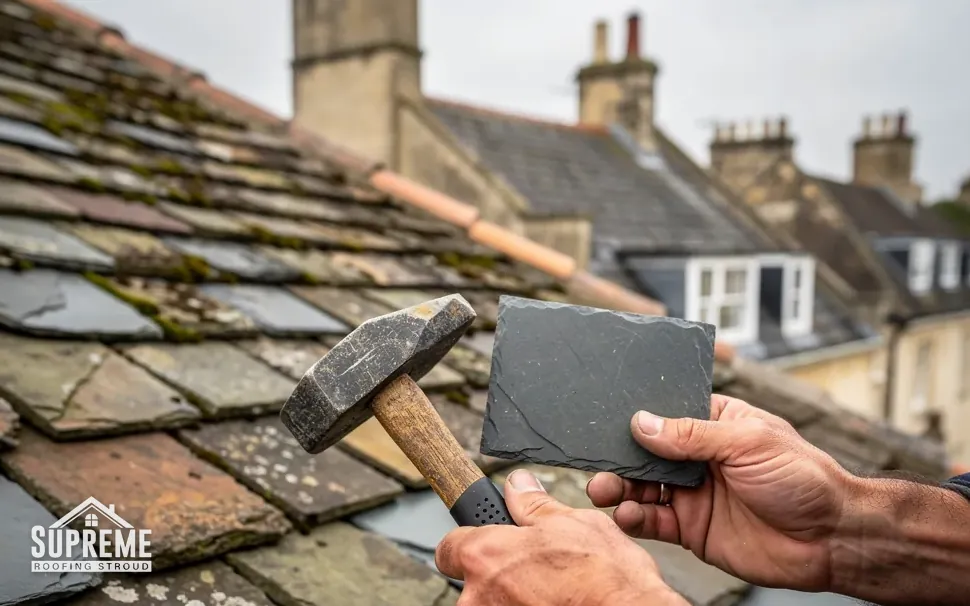
When a slope is stripped, each slate is sorted. Sound slates go back on the roof; broken and flaking ones are discarded. How many can be reused depends on the roof, and the honest answer before the strip is a range, not a figure. In the quote, reused and new slates are both allowed for, and the sort on the day confirms the split. Our page on reusing old slates explains the checks.
Battens, underlay and edges
A re-slate is the moment to renew what is underneath. New treated battens go on at the gauge calculated for the slate and pitch, a new underlay goes beneath them where the roof has none or it has perished, and the eaves, verges and valleys are rebuilt to suit. Each of those is covered in the quote.
Keeping the weather out
A slope that is stripped is covered at the end of every working day, with the sheeting weighted down and checked after wind. We plan a re-slate in sections so that no more roof is open than can be closed again in a day, and we talk through that sequence with you before the scaffold goes up.
Per job
- One slate replaced£60 to £120
- Five to ten slates£150 to £350
Per m²
- Slate repair by area£150 to £220 per m²
For the cost of a whole roof rather than a repair, how much a slate roof costs sets the national figures out in full.
Chapter 05
Underlay, weight and the Building Regulations on a re‑slate
Taking a slate roof back to the rafters triggers rules that a single repair does not.
Chapter 05In this chapter
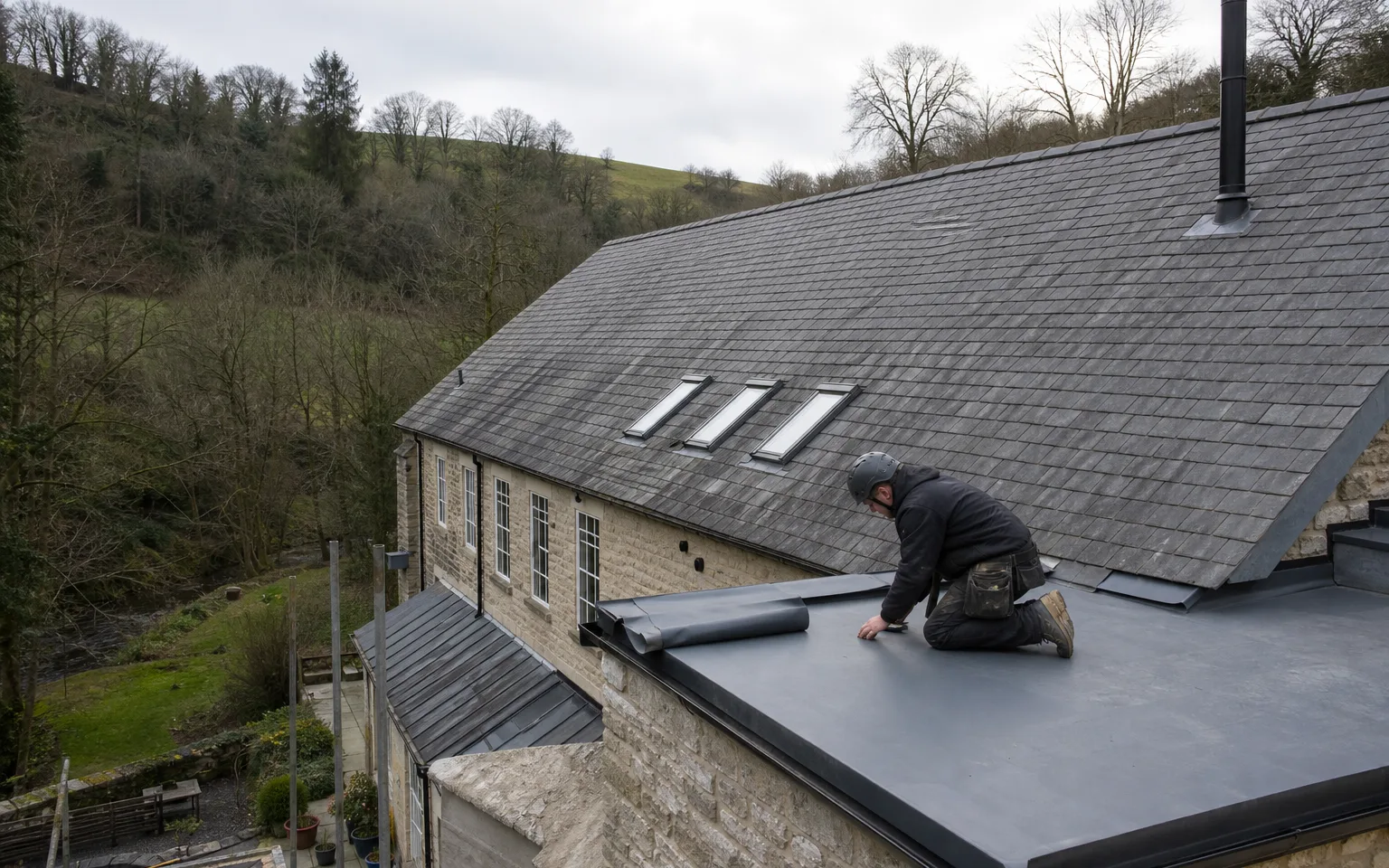
A re-slate that strips a whole roof is a bigger job than it looks on paper, because it can bring the Building Regulations into play. The Planning Portal sets two limits: work touching under 25 per cent of the building envelope and under 50 per cent of the roof does not normally call for a building control application. Re-slating the whole roof passes both. Approval then applies, and the roof may have to meet a tighter insulation standard.
Part L
Approved Document L (2021 edition, with 2023 amendments) sets a trigger of more than 50% of an individual thermal element's surface being renovated; the whole element is then taken to at least the Table 4.3 U-value, which for a roof is 0.16 W/(m²·K). A new or replacement roof element is held to the Table 4.2 limit of 0.15. How that is met on a slate roof depends on whether the insulation sits at ceiling level or between the rafters, and whether there is room for it. We work it out at the survey, and where it matters we discuss it with building control before the quote is final.
Changing the weight
The Planning Portal adds that a replacement covering that adds 15 per cent or more to the roof's weight needs approval, while Approved Document A speaks of a loading increase of more than 15%. Natural slate is lighter than the clay and concrete tiles some roofs are laid with, but going from a lightweight covering to natural slate may add load, and going from a fibre cement slate to a heavier one needs a structural check first. Our page on whether slate is too heavy for your roof explains what is checked.
Underlay and ventilation
Plenty of older slate roofs have no underlay, or an old one that has perished. A fresh one gives the slates a back-up layer when rain is driven under the laps. Marley's guidance, citing BS 5250, distinguishes between non-breathable underlay, which needs eaves ventilation of 25 mm along the length of the eaves at pitches of 15° or less (10 mm above that), and breather underlay, which, where the ceiling is sealed and the covering lets air through, can rely on 3 mm of incidental eaves ventilation or 5 mm at the ridge. Which underlay goes on is a design decision made with the roof void in mind. See what underlay goes under a slate roof and how a slate roof is ventilated.
Who handles the paperwork
In Stroud District building control is delivered by the Gloucestershire Building Control Partnership; a registered building control approver is the private route. Where a re-slate is notifiable we explain the consent and handle the notification, and you receive the completion paperwork at the end.
The rules for a roof that is part of a heritage property are different again, and that is the subject of the last chapter.
Chapter 06
Victorian terraces, listed roofs and looking after slate
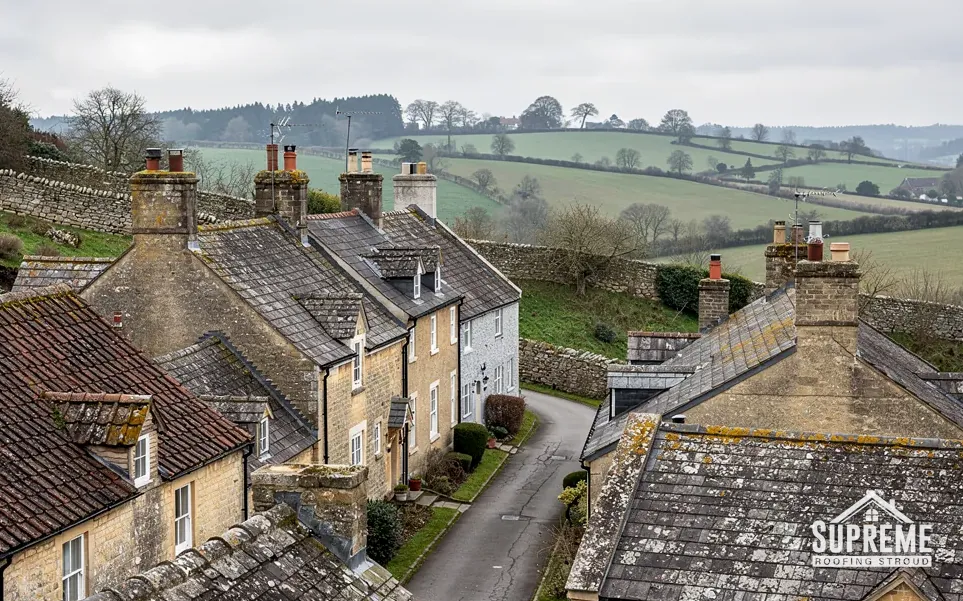
Much of the slate roofing around Stroud is on old buildings, and old buildings come with conditions.
Chapter 06In this chapter
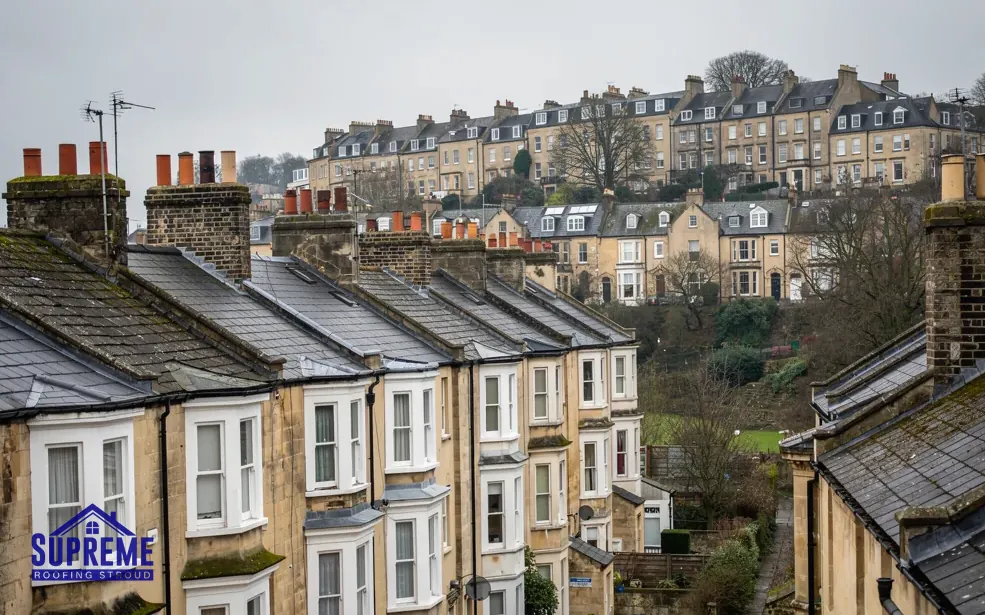
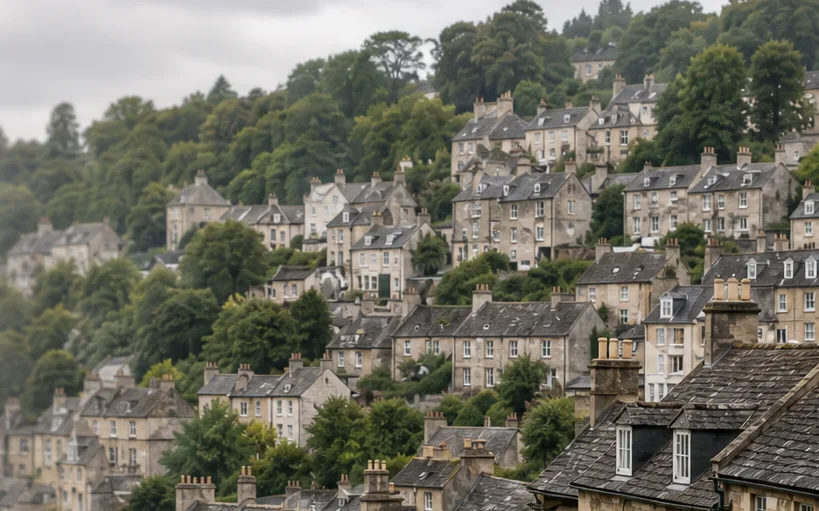
Stroud District Council lists 41 conservation areas, among them Stroud Industrial Heritage and Stroud Top of the Town, and slate is part of what defines many of them. Re-covering a roof in the same slate, laid the same way, does not usually count as development, because it does not materially affect the building's appearance. Do check whether the house is listed, or falls under an Article 4 direction.
Victorian terraces
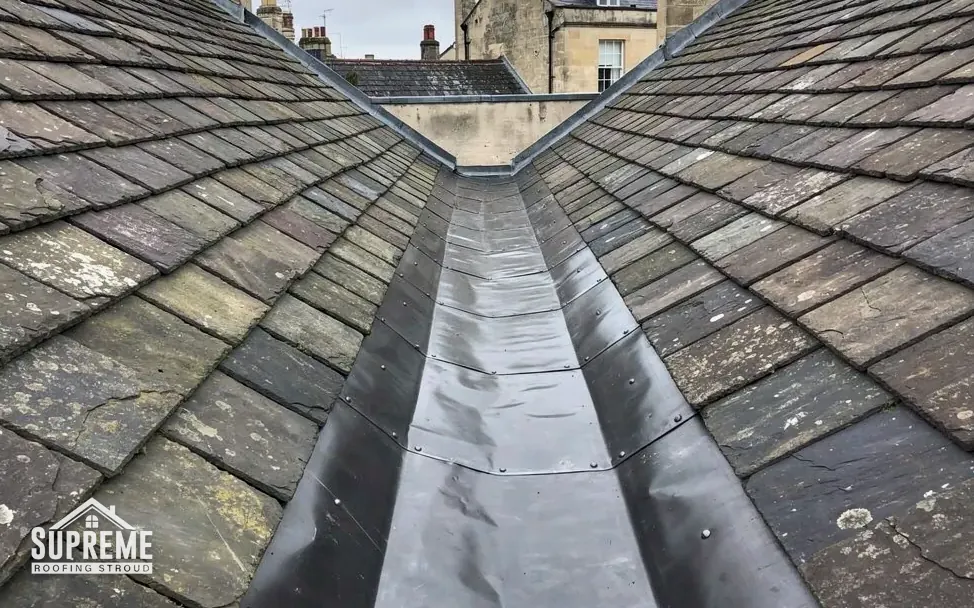
Terraced houses share roofs and party walls, so a slate repair often needs thought about the neighbour's side. Valleys, parapet gutters and abutments carry water from more than one house, and a fault in one can show up in the next. Our guide to slate roofs on Victorian terraces covers the details that recur, and how valleys are formed on slate roofs shows the common junctions.
Listed buildings
Stroud District Council says a listing protects the whole building at every grade. Alterations affecting the building's character need listed building consent, and for a slate roof that normally means natural slate of matching size, colour and fixing. Our page on slate roofs on listed and conservation buildings sets out how to approach it.
Moss and cleaning
Moss holds water against slate and can lift the edges of slates as it grows. MyBuilder's roof cleaning guide gives £500 to £1,000 for cleaning a slate roof and warns that a pressure washer may harm delicate coverings. We prefer hand scraping and a gentle wash, and a check of the nails and laps as the moss comes off. The question of whether to remove it at all is answered in should moss be removed from a slate roof.
Walking on slate
A slate is brittle across its width. One footfall in the wrong place cracks it, and the crack may not leak until the next shower. Every visit from a chimney sweep, an aerial fitter or a gutter cleaner is a chance for broken slates to be created, so we suggest a look afterwards. The page on walking on a slate roof explains how it is done safely.
After storms
After a gale, scan each slope from the lawn or lane. Slate fragments by the downpipe, or a row that has dipped, deserve an early look, and our guide to slate roofs in storms and winter weather goes through what to check. A routine of small checks is set out in how to maintain a slate roof.
A slate roof rewards small, regular attention more than almost any other covering.
Ridges and verges on a slate roof are fixed differently from the slates themselves, and our ridge and verge repairs page covers them. Lead work at valleys and abutments is on the lead roofing page.
Slate roof guides and answers
Costs, sizes, repairs, fixings and heritage rules for slate roofs, written for owners of slate houses in and around Stroud.
Guides
- How much does a slate roof cost in Stroud?Published national ranges for re-slating, slate repairs, ridge work and labour, with the factors that push a Stroud…Read the guide
- Welsh, Spanish or Brazilian slate for a Stroud roofNatural slate is not one product. Where it was quarried changes how it looks, its expected working life,…Read the guide
- Slate roofs: advantages, drawbacks and when it suitsNatural slate earns its reputation, and it also has real limits. Weighing the case for and against it…Read the guide
- How to maintain a slate roof in StroudA slate roof asks for little, but not nothing. This guide covers the routine checks, the small repairs…Read the guide
- Re-slating a roof in Stroud: process and timingA re-slate takes a slope down to its rafters and builds it back up. The order of work…Read the guide
- Slate roof repairs in Stroud: slips, tingles, nail fatigueMost slate faults come down to a short list: a slate that has cracked, one that has slid,…Read the guide
- Natural slate vs fibre cement slateBoth put a slate-coloured covering on the roof. They differ in how long they last, how they look…Read the guide
- Slate sizes, headlaps and pitch explainedSlate does not seal against rain; it throws it off by overlap. The longer the slate and the…Read the guide
- Slate roofs on Victorian Stroud terracesA 19th-century slate roof was built with materials and habits that are now long gone. Knowing what lies…Read the guide
- Slate roofs on Stroud's listed and conservation buildingsOn a protected building the slate is part of what is protected. Consent comes first, matching comes second,…Read the guide
- Slate roofs in Stroud storms and winter weatherSlate stands up to weather well, but wind finds loose fixings and frost finds weak slates. Storms do…Read the guide
- Nails or hooks: how slates are fixedEvery slate on a roof is held in place by one small piece of metal. The choice between…Read the guide
Quick answers
- How long does a slate roof last?
- Can you waterproof a slate roof?
- Why do slates slip on Stroud roofs, and how are they fixed?
- What are tingles in slate roof repairs?
- What is nail fatigue on a slate roof?
- How much does it cost to replace one slate?
- Can old slates be reused on a re-slate?
- Is a slipped slate covered by home insurance?
- What is the minimum pitch for a slate roof?
- Should moss be removed from a slate roof?
- Is slate more expensive than tiles?
- Is slate too heavy for my roof?
- Can you walk on a slate roof?
- What underlay goes under a slate roof?
- Why are my slates flaking or delaminating?
- Repair or re-slate: when patching stops making sense
- How valleys are formed on slate roofs
- Is Spanish slate good quality?
- Matching slates on a Stroud extension or repair
- How is a slate roof ventilated?
Slate roofs: common questions
Can a few slipped slates be refixed without re-slating the roof?
Yes, if the slates around them are sound and the nails in the next courses are holding. We lift the courses carefully, refix with a new nail or a tingle, and close them again. If the fixings are failing across the whole slope, the survey will say so and we show you the photographs.
What is the headlap on my slates and why does it matter?
The headlap is how far each slate overlaps the slate two courses below. A shallow pitch needs more of it. Cupa Pizarras lists a 115 mm headlap for a 500 by 300 slate at 20°, falling to 80 mm for a 600 by 300 slate at 30°. We measure yours at the survey.
Will a tingle show from the road?
A tingle is a narrow strip of metal that turns up over the slate below, so it can be seen as a small tab from below. A few are barely noticeable. Dozens of them on one slope suggest the roof is ready for re-slating.
Can I put fibre cement slate on a house that has Welsh slate?
You can, but the two weather differently and look different side by side. If the building is listed or in a conservation area, the council decides whether a substitute is acceptable. We recommend like for like.
Do I need Building Regulations approval to re-slate my roof?
Not normally when under 25 per cent of the building envelope and under 50 per cent of the roof is affected, according to the Planning Portal. Re-slating the entire roof exceeds both, so approval applies; we explain what is involved and handle the notification.
How do I know if my slates are delaminating?
Delaminating slates flake into thin layers at the edges and sound dull rather than ringing when tapped. We check this at the survey, from the roof and from below, because delaminating slates are discarded in a re-slate rather than reused.
Get your slate roof priced
Send a picture of the roofline from the road, one of any slipped slates, and the length of a spare slate if you have one. At the survey we measure the headlap and batten gauge before writing the written quote.