
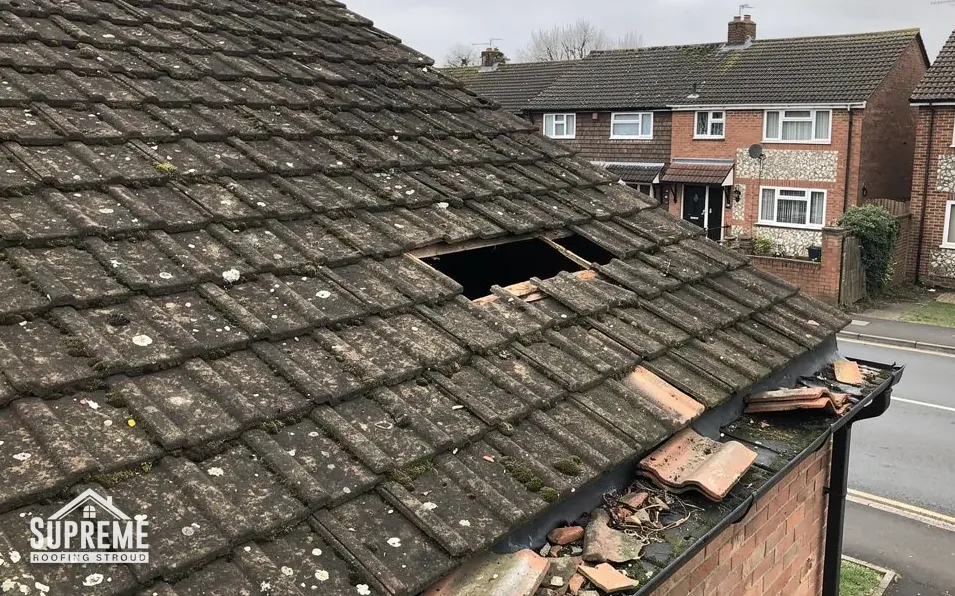
Roof repairs in Stroud, including emergencies
Leaks traced to their source, storm damage made safe first, then repaired properly. Typical UK prices come before any visit, and the quote that follows is in writing.
What roof repairs typically cost
Repair prices swing widely because a repair can be one slate or a whole valley. These typical UK ranges show where most jobs sit before we have seen your roof.
| Work | Typical price |
|---|---|
| Minor repair, such as a few slipped tiles | £100 to £300 |
| Moderate repair, such as a failed section of flashing | £500 to £1,000 |
| Storm-damage repairs | £500 to £1,500 |
| Replacing a single slate | £60 to £120 |
| Re-bedding or replacing ridge tiles | £300 to £600 |
| Emergency make-safe or temporary cover | priced on survey |
After the survey you receive a quote that covers the repair, so the price rests on what the roof needs and nothing is hidden.
Sources: MyBuilder pages on roof repair costs and slate roof costs, both dated 21 August 2026.
What we repair
A repair deals with a fault, not a whole roof. We find where the water gets in, fix that, and check what surrounds it so the fix lasts.
-
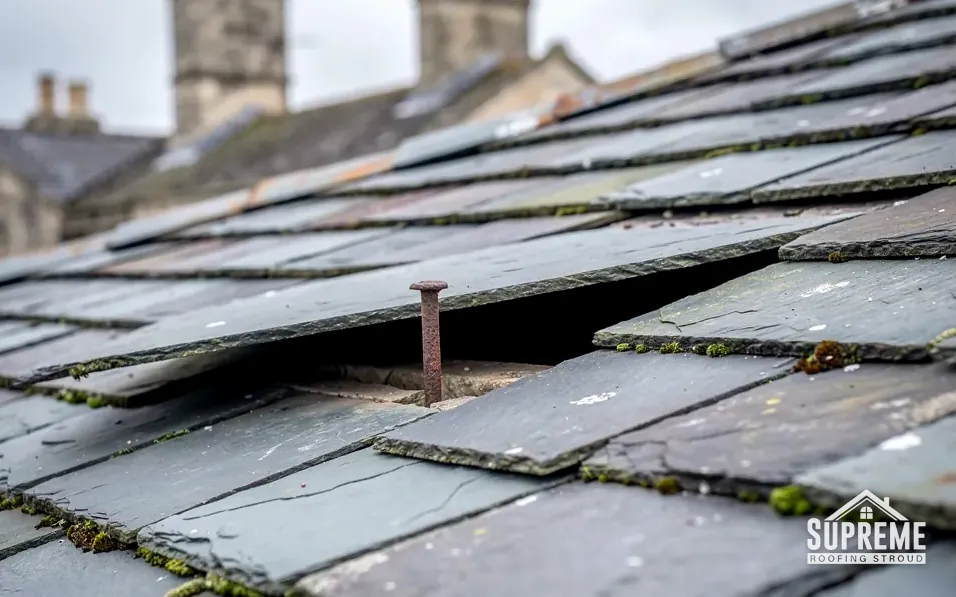
Leaks and slipped covering
Slipped, cracked or missing tiles and slates are replaced or refixed, and the battens and underlay beneath them are checked.
-
Flashings, valleys and ridges
Failed lead and mortar at chimneys, abutments, valleys and ridges are renewed, with ridges and verges fixed mechanically.
-

Storm damage and make-safe
A damaged roof is covered and secured first, then the permanent repair is planned and photographed for any insurance claim.
Signs a roof needs repair now
- A brown stain spreading on a ceiling, or paint blistering near an external wall
- Tiles or slates sitting out of line, or lying in the garden after wind
- Drips in the loft, or wet patches spreading across the roof timbers
- Lead at a chimney lifting, or cracked mortar along the ridge
- Gutters overflowing at one corner and streaking the wall below
How a repair job runs
- 1Make safe firstIf water is coming in, the opening is covered and secured before anything else, so the house stops getting wetter.
- 2Trace the sourceWe work from the stain back up through the loft and across the roof, since the visible mark is rarely under the actual fault.
- 3Written quoteThe repair is quoted with photographs of the fault, and any wider problem we spot is shown as a separate choice for you.
- 4Repair, test and tidyThe fix is made in dry conditions, checked for tightness, and the site is cleared with the waste taken away.
The repair guide
Roof repairs and emergencies, explained
What to do when water is coming in, how a leak is traced, what a temporary cover can and cannot do, and how storm damage is handled.
Chapter 01
Water is coming in: the first hour inside the house
A few sensible moves from indoors limit the damage while someone makes the roof safe.
Chapter 01In this chapter
When a roof starts to leak, the sensible aim is to protect the house, not to fix the roof yourself. A wet roof, a ladder and a cold evening are a poor mix, and nothing you can do from a ladder beats what can be done calmly from the inside.
In this chapter
Contain the water
Put a bucket or washing-up bowl under the drip and lay a towel round it to stop splashing. If a ceiling is bulging with water, make a small hole at its lowest point with a screwdriver and let the water run into a container. It looks drastic, but a ceiling holding a pool of water can collapse, and a clean hole is much easier to patch than a fallen section. Move furniture, rugs and electronics out of the way.
Electrics
Water and electricity are the real danger. If water is dripping near a ceiling light, a socket or the consumer unit, keep clear of it and switch the circuit off at the consumer unit only if you can reach that safely and dry. Where the water is running down a wall towards sockets, call an electrician as well. Our page on water near lights after a roof leak sets out what to do and what to avoid.
Photograph everything
Take photographs of the stain, the dripping water and any damaged contents. They help the roofer see what is happening, and they matter if you make an insurance claim later. Note when the leak began and what the weather was doing. A date and a description are useful to us and to your insurer.
If you can reach the loft
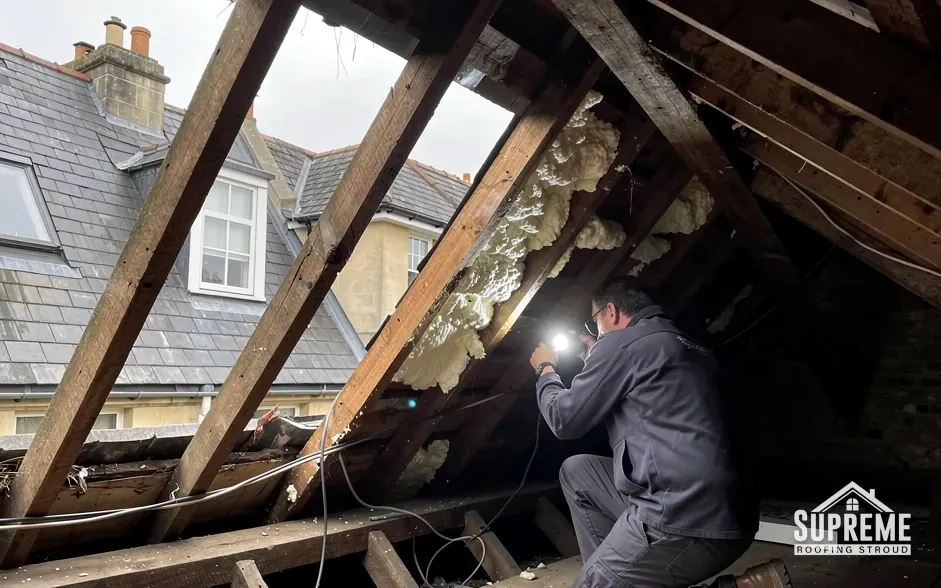
Only if the hatch is dry and the floor is boarded, take a torch and look for the wettest spot. Put a container under any drip, and keep clear of the ceiling joists, which will not carry your weight between them. Do not move wet insulation around; leave it where it is until someone has seen it.
Ring for help
Phone us on 01453 933613, send a message on WhatsApp or use the enquiry form. Leaks and storm damage go to the front of our list, and a leaking roof is made safe before anything else is done. Our guide to what to do first when your roof is leaking has the full checklist, and the page on what to tell a roofer when you call lists the details that save time on the phone.
What not to do
Do not climb on a wet or frosty roof. Do not poke at a tile that looks loose from the ground with a long pole. And do not let a small stain sit for weeks because it seems to have stopped: a leak that dries up between showers is usually still running when the rain returns.
The first job on arrival is always to stop the water, then to tell you what we found, with photographs.
Once the water is contained, the next thing is to see where it came from. That is a job for the loft and the roof, covered in the next chapter and in our page on water through the ceiling.
Chapter 02
Finding where the water gets in
The stain on the ceiling is rarely under the hole in the roof.
Water does not fall straight through a roof. It runs down the underside of the covering, along the battens, across the felt and down a rafter before it reaches a ceiling, and by then it may be a metre or two from where it came in. Tracing the true source is most of the skill in a repair, and a patch placed over the stain usually fixes nothing.
In this chapter
Start in the loft
With a torch we look for dark, damp or stained timber, and we follow the marks uphill. Wet insulation, tide marks on rafters and a damp patch around a pipe or flue all tell us where to look. If the loft is boarded or the roof is lined, we may have to lift a section to see. Our page on how roofers trace a roof leak goes through the loft inspection step by step.
Then the outside
From the roof we check the usual suspects in order. Slipped or cracked tiles are the obvious ones. Beyond those, the weak points are the joints in the roof rather than the middle of a slope: the flashing where a roof meets a chimney or a wall, the valley where two slopes meet, the ridge and hip bedding, the verge, a rooflight or dormer, and the point where a soil pipe or vent comes through. Blocked or sagging gutters can push water back under the first course of tiles.

Testing with water
When the fault is not obvious, we test with a hose, working upwards from the lowest point of the roof and covering one area at a time while someone watches inside. It takes patience, but it avoids the common mistake of fixing three things and missing the fourth. A leak that appears only in heavy rain or with a particular wind direction points to a specific angle of attack, which is why we ask about the weather when it happens. Our answer on why a roof leaks only in heavy rain explains that pattern.
Windows, dormers and pipes
Rooflights, dormer cheeks and the collars round soil pipes and flues all have seals that age. A crack in a dormer cheek, a perished rubber collar or a lifted rooflight flashing can admit water for a long time before a stain shows. If your roof has any of these, we look at them early in the trace, since they are cheaper to rule out than to miss.
Photographs of the fault
Before we repair anything, we photograph the fault and the area around it, so you can see what we found and what changed. For insurers the images are a record, and for you they are the reason a repair is quoted rather than guessed.
If two or three faults turn up, we tell you about each, so you choose what to do.
| Where the stain appears | First place we look |
|---|---|
| Ceiling beside a chimney breast | Lead flashings and the mortar fillet round the stack |
| Line across a ceiling below a ridge | Ridge bedding, and the fixings along the ridge |
| Corner of a room at the eaves | Gutter outlet, fascia and the first course of tiles |
| Wall below a roof junction | Valley gutter, abutment flashing or verge |
Water can also run in from a rooflight or a pipe passing through the covering; the point is to check every joint before deciding the cause.
Chapter 03
Make-safe and temporary covers
A tarpaulin, a patch or a temporary cover holds a roof together until the permanent repair can be done.
After a storm, or when a leak is running fast, the first job is rarely a full repair. The weather may still be wet, the fault may need materials we do not have on the van, or the roof may be unsafe to work on at all. In those cases we make the house safe: stop the water, secure what could fall, and agree the permanent repair for a drier moment.
In this chapter
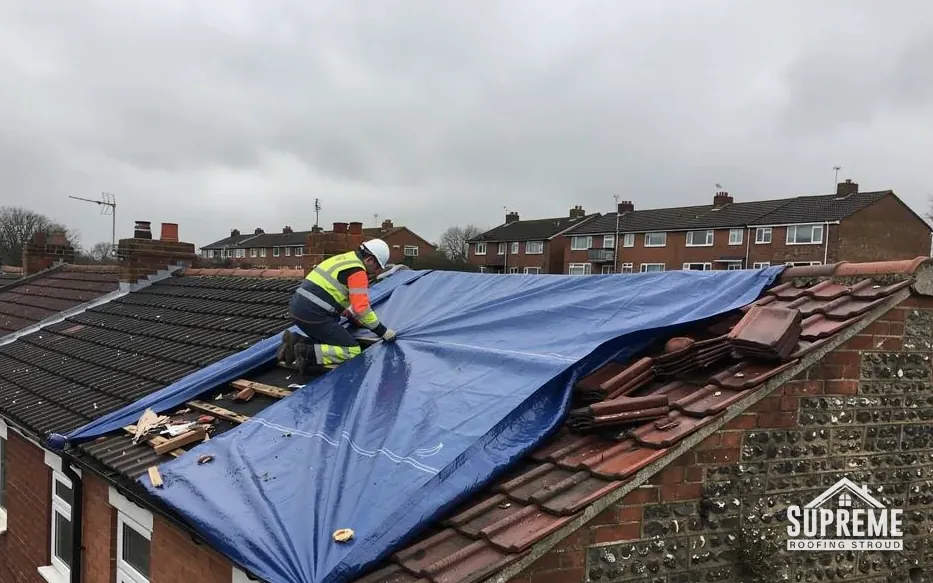
What a temporary cover is
A temporary cover is a sheet of heavy-duty tarpaulin or membrane, or a patch over a gap, fixed to hold for weeks rather than years. It is lapped over the ridge where possible so water cannot run under it, and fixed to battens, not nailed through the sheet into the tiles. The edges are secured so wind cannot get under and lift the sheet. Our page on temporary roof repairs and make-safe shows the sequence, and the answer on whether a tarpaulin can stop a roof leak covers the DIY version.
Why a tarpaulin is not a repair
Tarpaulins flap in a gale, rub holes in themselves on tile edges, and trap moisture under the sheet. Left on for months, they can do more harm than the original gap. They are a holding measure, and the quote for the permanent repair is agreed while the temporary cover keeps the weather out.
Myth: Once a tarpaulin is over the hole, the roof is repaired.
Fact: A tarpaulin is a temporary measure that keeps the weather out while the permanent repair is planned, priced and done in dry conditions.
How a temporary cover is held down
The sheet is battened at its top and edges, and weighted where fixing is impossible. We avoid driving fixings through sound tiles, because each hole becomes a new leak path. Where the roof is steep, the sheet is fixed from roof ladders, and the cover is checked after the next gale to make sure it has not shifted.
Sealants and spray-on fixes
Spray-on coatings and sealant tubes are sold as a quick answer. They can bridge a hairline crack on a flat surface, but they do not cure a failed lead flashing, a slipped tile or a rotten batten. Our answer on whether roof sealants work goes through where they help and where they hide a worse fault.
When scaffold is needed
Many repairs can be done from a ladder or roof ladders, but a repair high on a steep slope, or one that needs more than a few tiles replacing, may need scaffold. Where it does, it is allowed for in the quote, and the question of whether a repair needs scaffolding is covered in a separate answer.
Trees and falling debris
A tree or large branch on the roof needs the load taken off safely before a repair. We look at the damage from the ground, secure the area and cover the opening. The permanent work follows once the structure underneath has been checked.
We keep a record of what we covered and how, so the permanent repair can start from a known point.
Chapter 04
Storm damage and insurance claims
A claim goes more smoothly when the damage is photographed, made safe and described plainly.
After a gale, damage tends to show up in a few predictable places: tiles lifted at the ridge or verge, slates blown off, chimney flashings peeled back, gutters pulled away from the fascia, and a branch or fence panel landing on the roof. A walk around the house, looking up from the ground, will show most of it. Our guide to checking your roof after a storm is written for exactly that walk.
In this chapter
Before you phone the insurer
Take photographs of the damage from the ground and from inside, and write down what happened and when. Keep any broken tiles or debris until the insurer says you can dispose of them. If you need an emergency cover, keep the receipt. Policies differ, so read the wording on storm damage and on emergency repairs, and ask your insurer what they will pay for before work starts.
What we provide
We make the roof safe, photograph the damage and the make-safe, and write up the repair as a written quote. That quote and those photographs are what most insurers want to see. We do not deal with your claim for you, and we do not guess what a policy covers. For the claims route and what tends to be asked, see making a claim for storm damage.
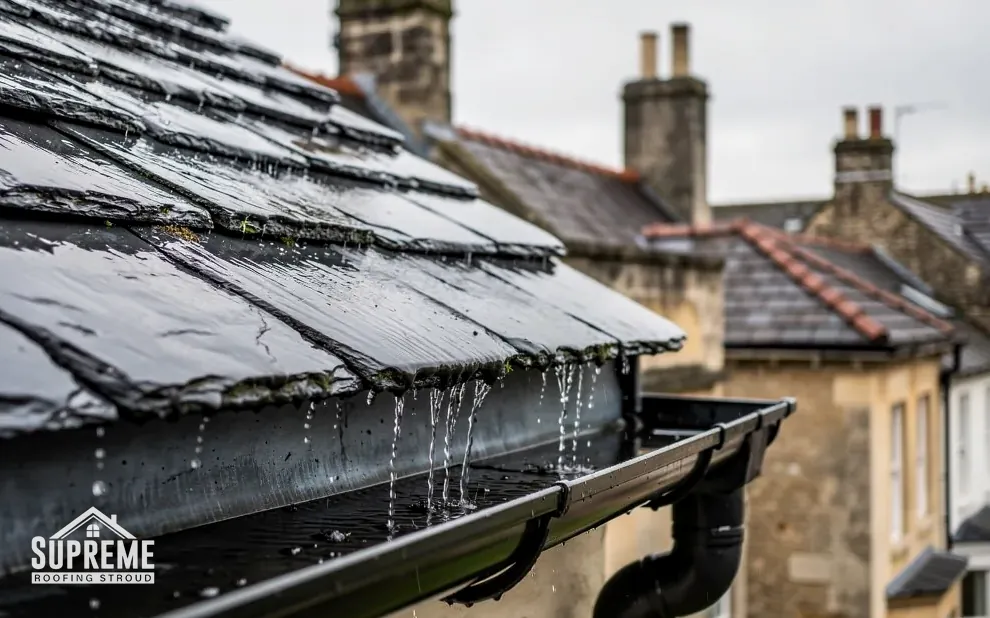
Describing the damage
When you speak to the insurer, say what you can see, not what you suspect. Name the slope or the part of the house, say whether water has entered, and mention anything the storm moved, such as a fence or a tree. Plain wording and good photographs let the claims handler decide what to send out, and avoid delays over vague descriptions.
Costs to expect
MyBuilder puts storm-damage fixes at £500 to £1,500. Individual items sit lower: replacing a single slate typically costs £60 to £120, and re-bedding ridge tiles £300 to £600. Your own repair will sit somewhere around those figures, depending on the access and the number of faults. The page on roof repair costs in Stroud breaks the figures down by job.
Snow, ice and fallen trees
Not every storm is wind. Snow loading and freeze-thaw can lift edges and crack tiles, and a fallen tree can do structural damage that takes more than a patch. Where the structure itself may be affected, the quote notes it and we recommend a structural check before the covering is touched.
- Single slate£60 to £120
- Ridge re-bed£300 to £600
- Storm-damage repairs£500 to £1,500
Keep the photographs, the quote and the receipts together in one folder; claims are decided on the paperwork.
Chapter 05
The repairs we make most often
Most faults sit at the joints: ridges, flashings, valleys and the first tiles to move.
A well-laid roof tends to fail at its details rather than its flat expanses. The commonest repairs are therefore small, local and specific, and a clear explanation of each one is a good test of any roofer you talk to.
In this chapter
Slipped, cracked and missing tiles
A tile slips when its nail fixing fails or the batten under it has rotted. We lift the surrounding tiles, replace what is broken, refix with new clips or nails and close the course. For slate, individual slates are replaced with matching ones, which is usually a short job. On older roofs we match the tile as closely as we can, because a bright new tile in a weathered slope shows.
Ridge and hip tiles
Ridges are bedded in mortar that cracks and lets go over time. When it does, we re-bed them, and since BS 5534 was revised in 2014 the tiles are mechanically fixed too, as mortar by itself is no longer trusted to hold them. A dry ridge system, which fixes with clips and a ventilated roll, is another option; MyBuilder puts it at £40 to £60 per metre. Our ridge and verge dry-fix page explains both.
Flashings and lead
Lead flashings round chimneys and walls can lift, split or be pulled loose by wind. A new flashing in lead is usually Code 4 for general work, with heavier codes where the exposure or the span demands it. Checkatrade puts lead flashing repairs at £50 to £70 per metre. If the flashing belongs to a chimney that needs more, see chimney repairs; for lead work in its own right, our lead roofing page covers it.
Flat roof patches
A small flat roof, such as a bay or porch, fails differently from a pitched one: the membrane cracks, blisters or lifts at the upstand. Checkatrade gives repair rates per m² of £100 to £140 for bitumen, £120 to £170 for EPDM and £130 to £180 for GRP, excluding VAT and access. Whether a patch lasts depends on how sound the deck below it is, and we check that before any membrane goes on.
Valleys and gutters
Valley linings can crack or silt up, and gutters block with moss and leaves. A blocked gutter overflows onto the wall or backs water under the eaves, so it is cheaper to clear it than to repair a damp wall. Our page on the most common roof repairs goes through the list in more detail.
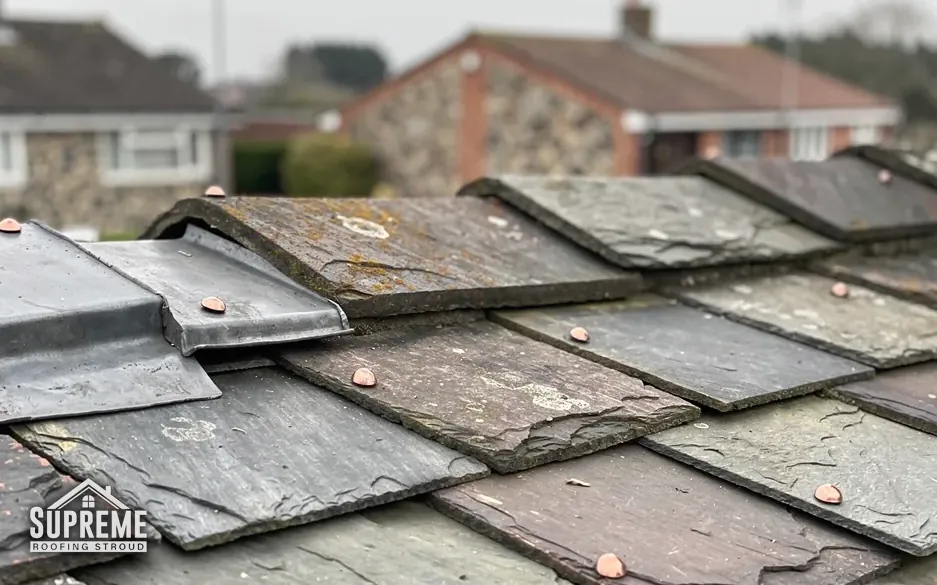
Where the covering around a fault is itself tired, you see photographs of it and two prices, one for the repair and one for the wider work.
If repairs are coming back every winter, it is worth comparing them with the cost of a new covering; the page on roof replacement sets that out.

Chapter 06
Wet weather, listed roofs and fixing faults early
Repairs are done when the roof is safe to work on, and old buildings get like-for-like care.
Chapter 06In this chapter
Roofs fail in bad weather and are repaired in better. In wet, windy or icy conditions we limit ourselves to making things safe, because a roofer slipping on a wet slate is a worse outcome than a delayed repair. Our page on roof repairs in winter and wet weather covers what can and cannot be done, and the answer to repairing a roof in the rain gives the short answer.
In this chapter
Listed and conservation-area roofs
Repairing a roof on an old building is a different task from patching a modern one. The principle is like for like: the same stone, slate or clay, laid the same way. The council's position is that every listed building has full legal protection, front and back, whatever its grade, and consent is needed for works that change what makes the building special. A repair that matches the existing covering and does not change the appearance is often not development at all, but check with the council's conservation team before you start. Churches in use follow a diocesan faculty route rather than listed building consent. Our page on repairing roofs on listed and conservation homes sets out the process.
Fixing small faults early
A slipped tile or a split flashing is a cheap repair when it is found early and an expensive one when water has soaked a rafter and the insulation beneath it. Looking at the roof twice a year, and after every serious gale, catches most faults. Gutters should be cleared at the same time. Planned work, done in good weather, is also cheaper than emergency work, because we can book the access and the materials. See planned roof repairs for how that works.
After the repair
Once the roof is mended, the ceiling and insulation need attention too. Damp insulation should be dried or replaced, and a stained ceiling should be left to dry fully before it is painted, or the stain returns. Our page on wet loft insulation after a leak explains how to tell which it is.
Moss and the slow faults
Moss holds water against tiles and in the laps between slates, and when frost arrives that trapped water expands and can lift or crack the covering. Hand scraping is typically £5 to £10 per m², according to MyBuilder, and pressure washing may damage delicate tiles. Do not let the moss grow thick on the shaded side.
- £40 to £60per metre for a dry ridge system
- £5 to £10per m² for hand scraping moss
- £150 to £500for a roof survey with photographs
An annual look from the ground, with binoculars, costs nothing and tells you where to look first.
Roof repair guides and answers
Leaks, storms, temporary covers, costs and claims: every question has its own short page, written with Stroud homes in mind.
Guides
- Roof repair costs in Stroud: typical UK prices by jobPublished national ranges for planned roof repairs, split by size of job and by covering, plus the local…Read the guide
- The most common roof repairs on Stroud homesSix repair jobs account for much of a roofer's working week. Each one has a usual cause, a…Read the guide
- How Stroud roofers trace a roof leakWhere a ceiling shows damp, the hole in the roof is usually somewhere else. Tracing a leak is…Read the guide
- Roof leaking now in Stroud? What to do firstWater is coming through the ceiling and the weather has not eased. This is the order to work…Read the guide
- Storm damage to your Stroud roof: making a claimA storm claim is won or lost on paperwork you gather in the first day or two. This…Read the guide
- Temporary roof repairs and make-safe: what's involvedA make-safe is the first visit, not the last. It stops water and falling material today and buys…Read the guide
- Roof repairs in winter and wet weather in StroudFrom November to March a roofer works with the forecast open on the phone. This guide explains how…Read the guide
- Repairing roofs on listed and conservation homes in StroudA repair on a protected roof is judged on one idea: does it leave the building as it…Read the guide
- Warning signs your Stroud roof needs repairA roof rarely fails without warning. Most faults announce themselves weeks or months early, outside on the slope,…Read the guide
- Checking your roof after a Stroud storm: a ground-level guideThe wind has dropped and the garden is littered with twigs. Before you decide the house came through…Read the guide
- Water through the ceiling: roof leaks and internal damageA brown ring on the ceiling is the end of a long journey for the water. This guide…Read the guide
- Planned roof repairs: fixing small faults before they spreadEmergency repairs are bought in a hurry and at the wrong moment. Planned repairs are the opposite: small…Read the guide
Quick answers
- Are roof repairs worth it, or money wasted?
- What damages roofs the most in the UK?
- Should you repair your own roof?
- Why does my roof only leak in heavy rain?
- Can a tarpaulin stop a roof leak?
- How much does an emergency roofer cost in Stroud?
- Does home insurance cover a leaking roof?
- Tiles blown off in a Stroud storm: what happens next
- How long does a typical roof repair take?
- Roof still leaking after a repair: what now?
- Can a roof be repaired while it's raining?
- Does a roof repair need scaffolding?
- A tree has hit my roof: what now?
- Water near lights after a roof leak: what to do
- Can a small roof leak wait?
- Do roof repairs come with a guarantee?
- What to tell a roofer when you call about a leak
- Snow and ice damage on roofs: what to check
- Do roof sealants and spray-on fixes work?
- Wet loft insulation after a roof leak: dry or replace?
Roof repairs: common questions
Why does my ceiling stain appear nowhere near a missing tile?
Water runs along the underside of the covering, down battens and rafters, before it drops. The stain marks where the water finally reaches the ceiling, so we trace it back uphill through the loft.
Can a roof leak be repaired while it is still raining?
Usually only as a make-safe. A temporary cover can go on in the wet, but a lasting repair needs a dry surface, so the permanent work is booked for better weather.
Should I keep the broken tiles after a storm?
Yes, until your insurer says otherwise. Broken tiles and debris are part of the evidence, so photograph them and keep them safe until the claim is settled.
Do I need to be at home when the roof is repaired?
Not for work on the outside. We need access to the loft to check the underside, so someone should be there for the survey, and we can arrange access if you are away.
Will a repair come with a guarantee?
Our workmanship is guaranteed for 10 years in writing, covering the repair we carry out. It does not cover separate faults elsewhere on the roof.
Can a small leak wait until the weather improves?
Sometimes, but not for long. A small leak can soak insulation and timber over weeks, so the safest step is to have it looked at and covered if needed.
Get your repair looked at
Send photographs of the stain on the ceiling and of the roof from the ground, and tell us when the leak began and what the weather was doing. We will cover anything open first, then trace the fault and send a written quote.