
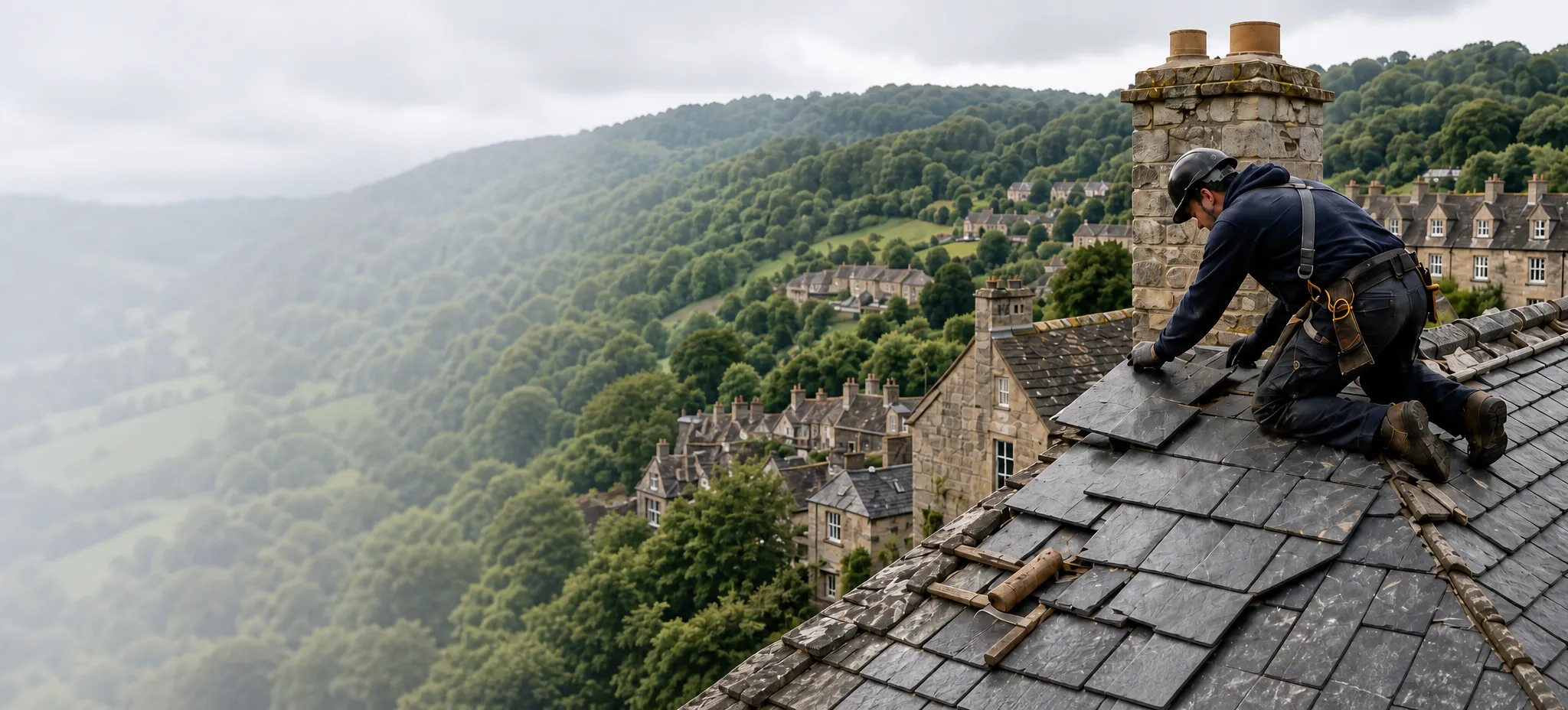
Roofers in Stroud, with the prices up front
Typical costs on every service before we visit, then a written quote and a 10-year workmanship guarantee. Covering 30 miles around Stroud.
- Typical prices published
- Written quote
- Photos of your own roof
- 10-year workmanship guarantee
Valley roofs take a beating
Caught early, most of these are a repair, not a new roof.
-
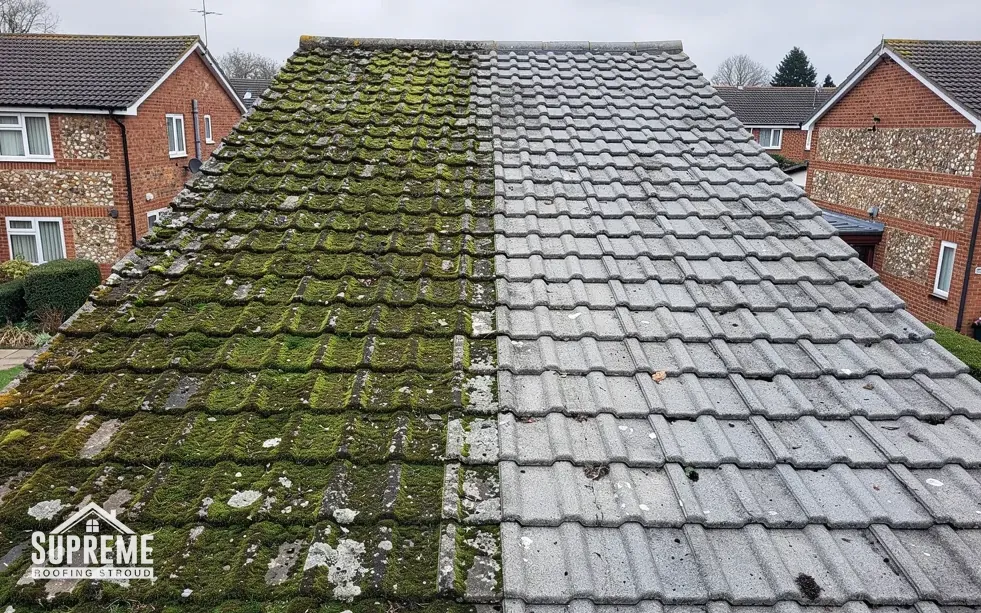
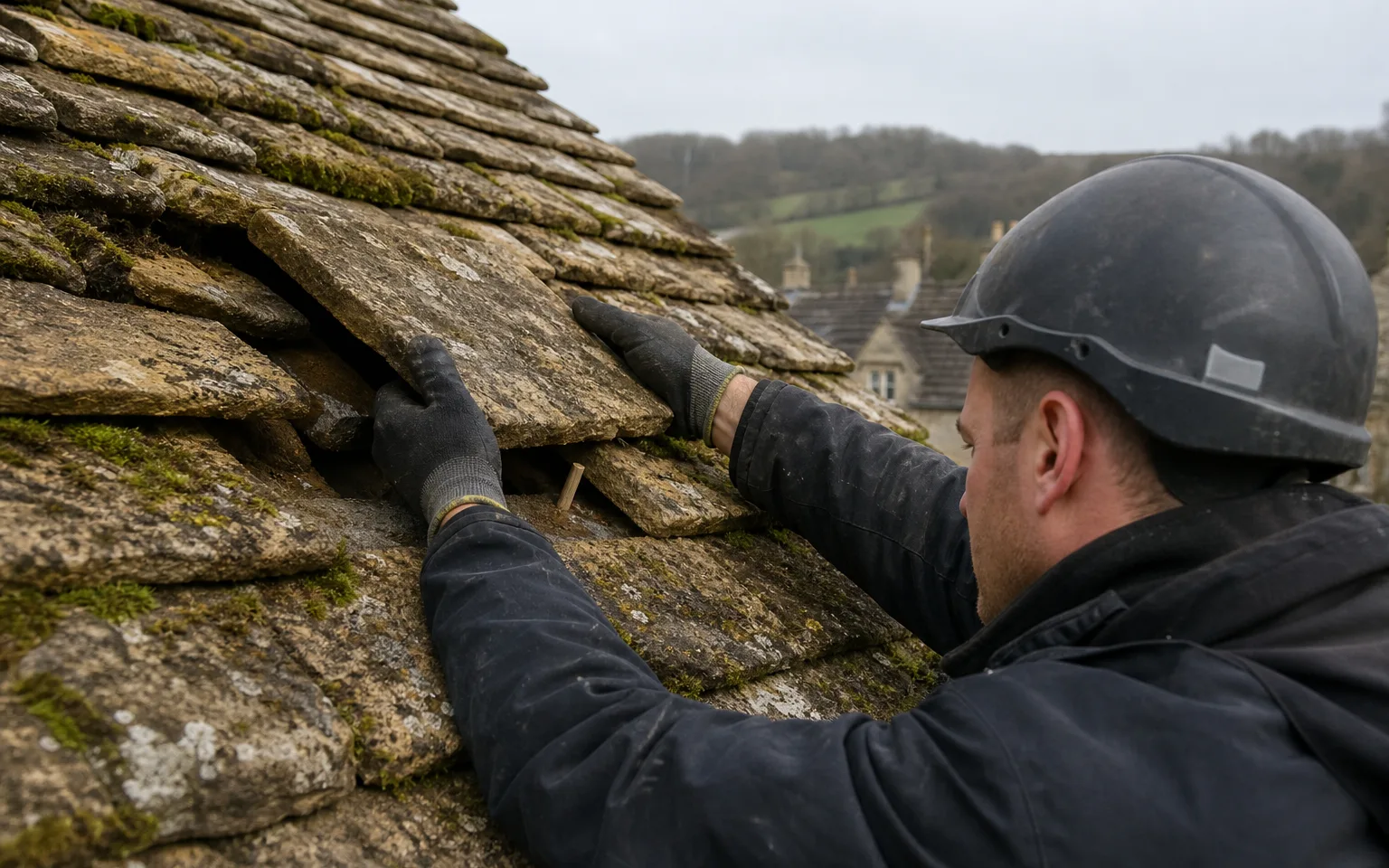
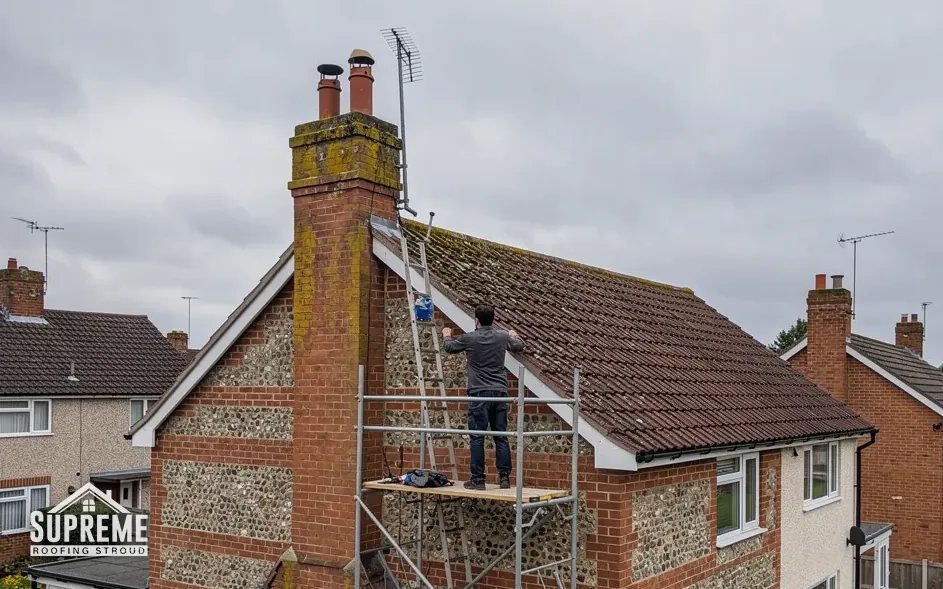
Moss holding water on the tiles
Under the beech woods on the valley sides, moss packs the laps between tiles and keeps them wet long after the rain stops.
-
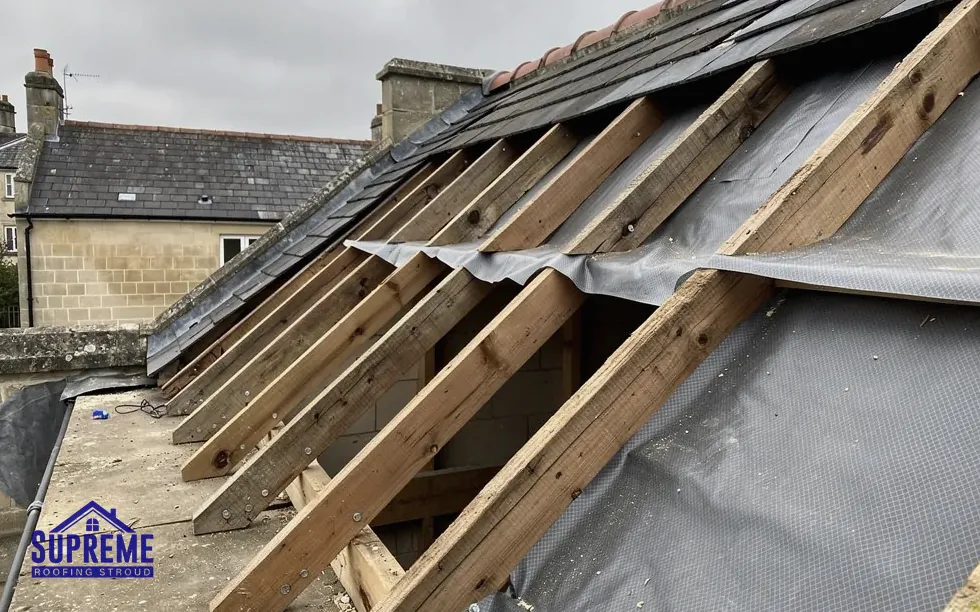
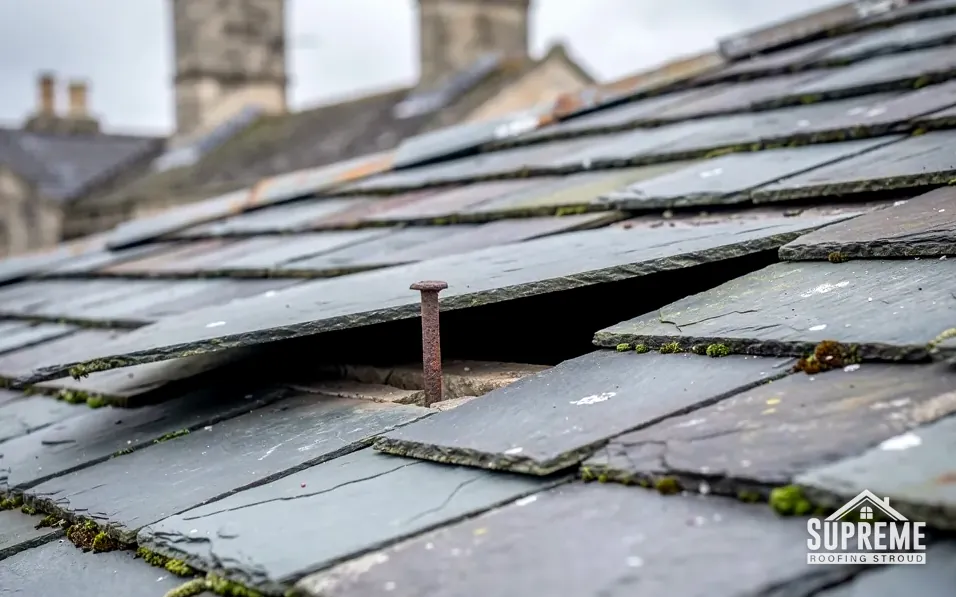
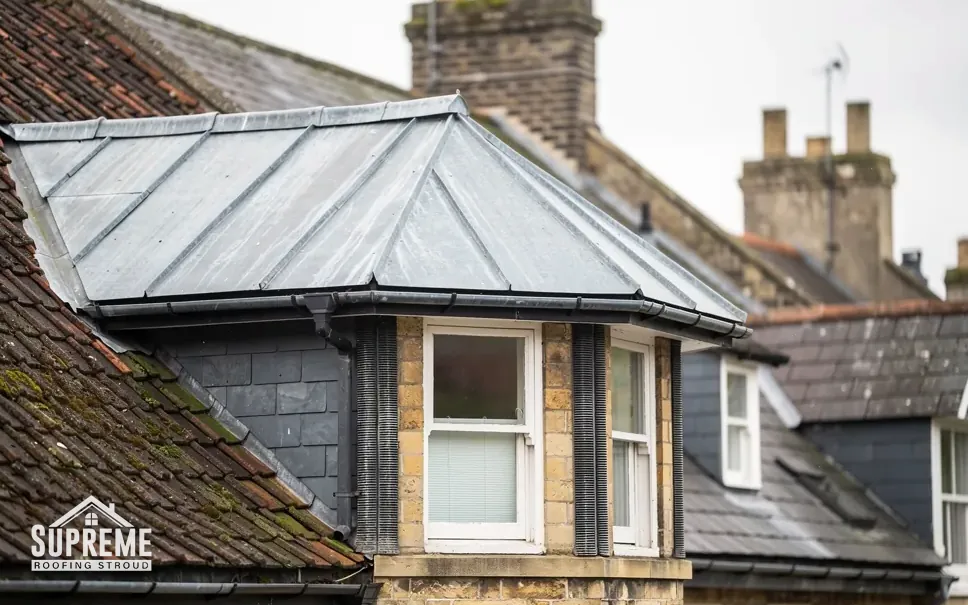
Rotten battens under a tired covering
Strip a leaking slope and the timber often tells the story: split underlay, soft battens and nails that have rusted through.
-
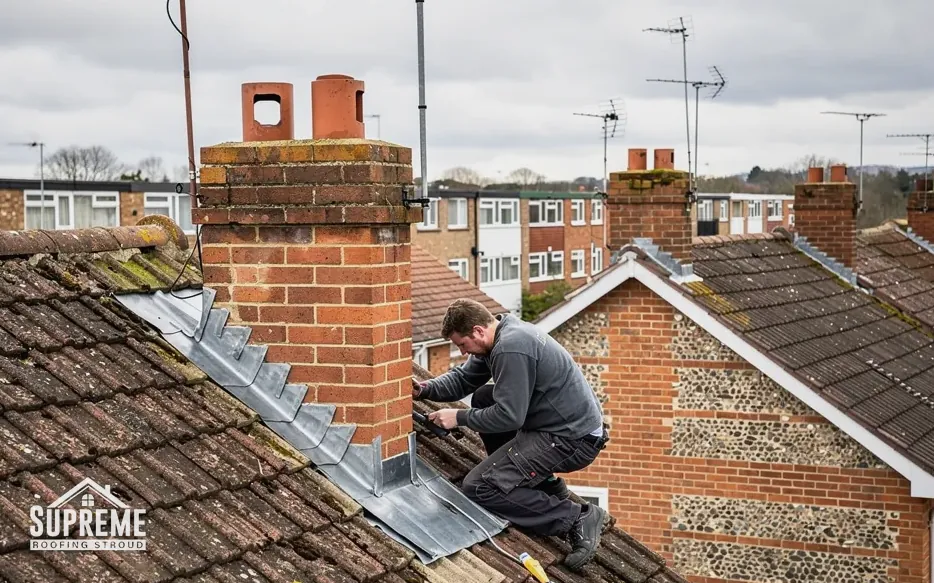
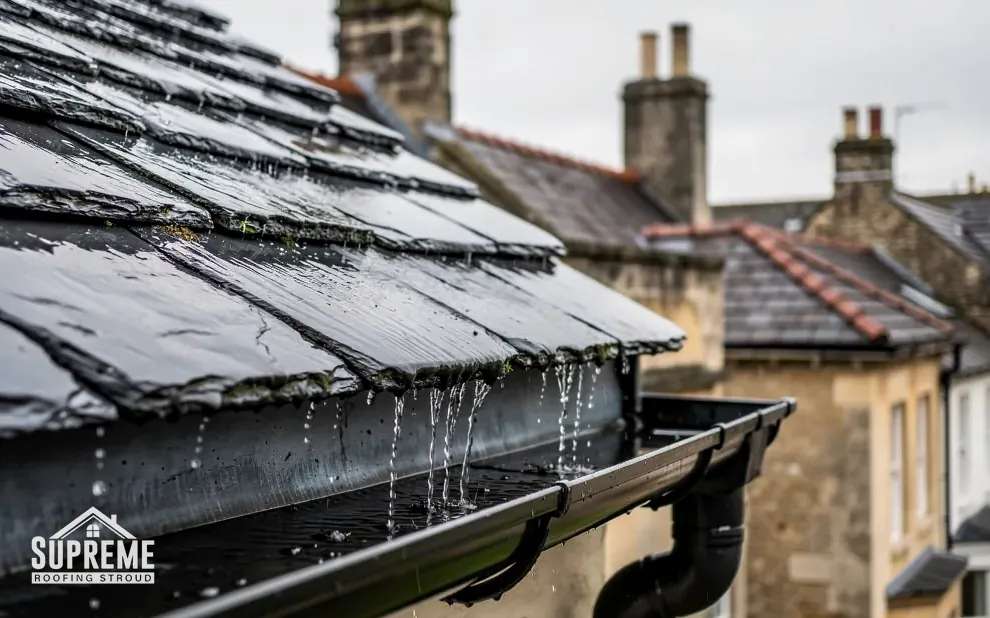
Flashing pulling away from the stack
Where lead meets a chimney, a small gap lets water run down inside the wall long before a stain shows on the ceiling.
What roof work in Stroud typically costs
| Work | Typical price |
|---|---|
| Minor roof repairs | from £150 |
| Roof inspection and report | from £200 |
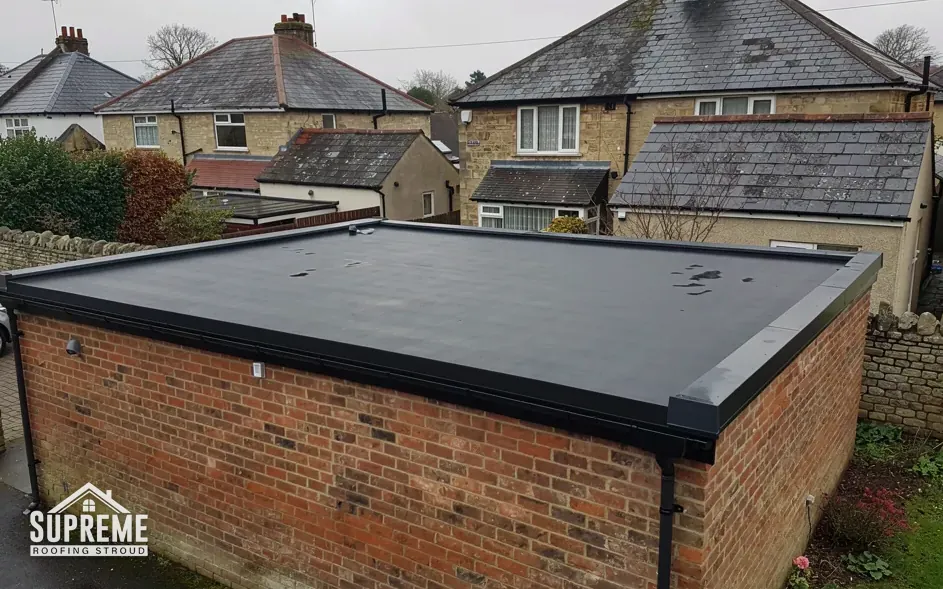
| New flat roof covering | from £100 per m² |
| Chimney stack rebuild | from £3,000 |
Guide prices. After the survey your written quote covers scaffold, materials, labour, waste and making good.
See all costsEvery roofing job, one Stroud team
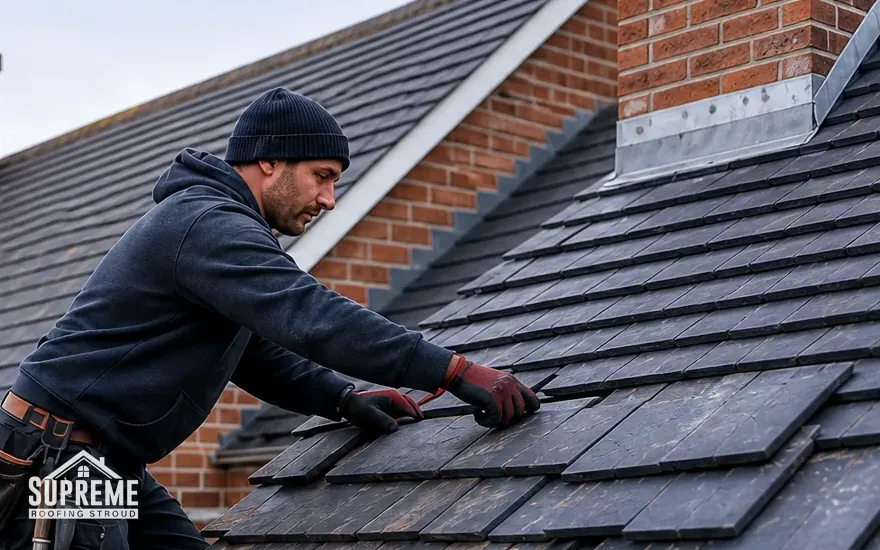
From a single slipped slate in Chalford to a full re-roof in Gloucester, the same people survey, price and do the work.
Our promise, in writing
- Guide prices before we visit
- What a quote should explain
- Stone stays stone, slate stays slate
- Site cleared and waste taken away
- 10-year workmanship guarantee
From survey to sign-off
- 1Survey and photosWe go up, or use a pole camera where access is tight, and photograph what we find.
- 2Written quoteScaffold, materials, labour and disposal all covered in a quote you can compare.
- 3The work, done safelyScaffold planned for the slope of your street, the roof kept watertight overnight.
- 4Sign-off and guaranteePhotos of the finished work, any building control paperwork, and the guarantee in writing.
Roofers across the Five Valleys and beyond
Every town within 30 road miles of Stroud, from the Severn Vale to the Cotswold edge.
Map of the area Supreme Roofing Stroud covers: a circle around Stroud reaching about 30 road miles, taking in Gloucester, Cheltenham, Cirencester, Tetbury, Dursley and the Forest of Dean.
The Stroud roofing guide
Roofing in Stroud: prices, roofs and rules, in plain English
Everything we tell homeowners before we quote, in six short chapters.
Chapter 01
What roof work in Stroud costs
Prices you can see before anyone climbs a ladder, and how a fair quote is put together.
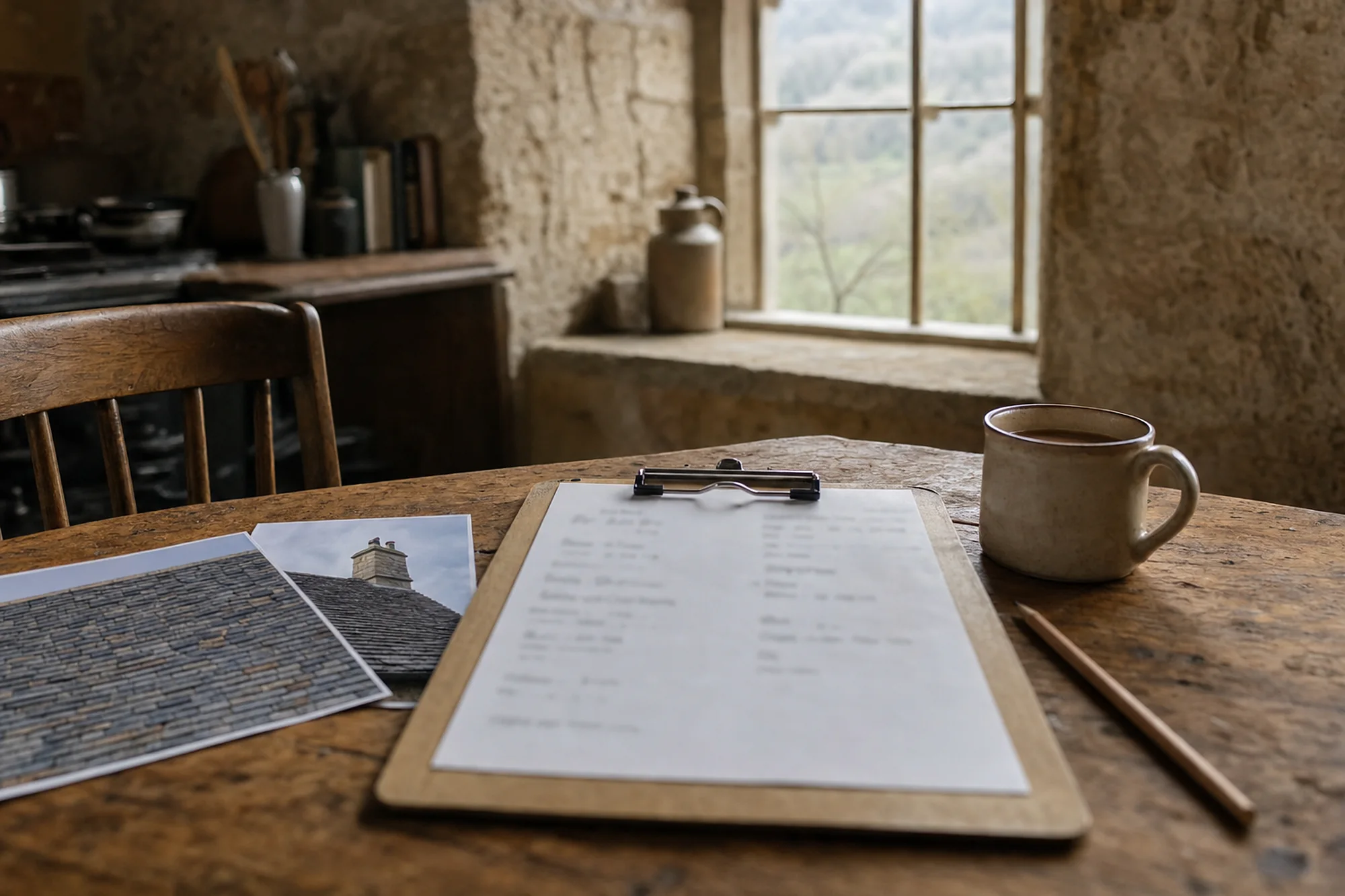
Most people ringing a roofer have one question before any other: roughly what will this cost? Very few roofing firms around Stroud will say. We publish guide prices because a homeowner who knows the likely range can spot a quote that is padded, and can also spot one that is too low to be real.
Per job
- Minor repairfrom £150
- Inspection and reportfrom £200
- Chimney stack rebuildfrom £3,000
Per m²
- Flat roof coveringfrom £100 per m²
Chapter 01In this chapter
Our own starting points are in the table above: a minor repair, a roof inspection with a written report, a new flat roof covering per square metre, and a chimney stack rebuild. Those are floors, not fixed prices. A repair that needs a scaffold, a stack that needs new lead at the base, or a flat roof with a rotten deck under the felt will all come out higher, and the quote will tell you exactly why.
In this chapter
National figures, for comparison
It helps to see what the wider market charges. MyBuilder's cost guide, updated in August 2026, puts a typical full re-roof at £5,000 to £12,000, with gable roofs at the lower end and hipped roofs at the upper. The same guide puts most roof repairs between £150 and £1,500, and storm damage fixes at £500 to £1,500. For a new flat roof it gives an average of about £75 per m², with EPDM rubber at £90 to £130 per m² and GRP fibreglass at £95 to £150 per m².
Checkatrade's roof replacement guide gives a UK average of about £8,000 for a full replacement, with most jobs between £4,000 and £19,000 before VAT. The spread is wide because roofs are. A small terraced house on a flat street is a very different job from a stone farmhouse on a slope above the Slad valley.
What moves a price
Four things drive most of the difference. Access comes first: scaffold alone averages about £1,125 on MyBuilder's figures, and on Stroud's steeper streets it often needs more lifts or a gantry over a pavement. Material is next, because natural slate and Cotswold stone cost more to buy and take longer to lay than concrete tile. Then condition: battens, underlay and timbers you cannot see until the old covering comes off. Last, waste: old tiles, felt and any asbestos cement all have to go somewhere, and disposal is a real cost.
None of this should be a surprise on the day. A good quote names each of those things. If a line is uncertain, such as timber repairs under a covering, it should say so and give a rate rather than leave it out.
Every service page on this site carries its own table of typical UK ranges, with the source and the date beside them, and our roofing costs page pulls them together. To see what a good quote contains, the quote checklist walks through what to look for.
Your quote has a price you can hold us to.
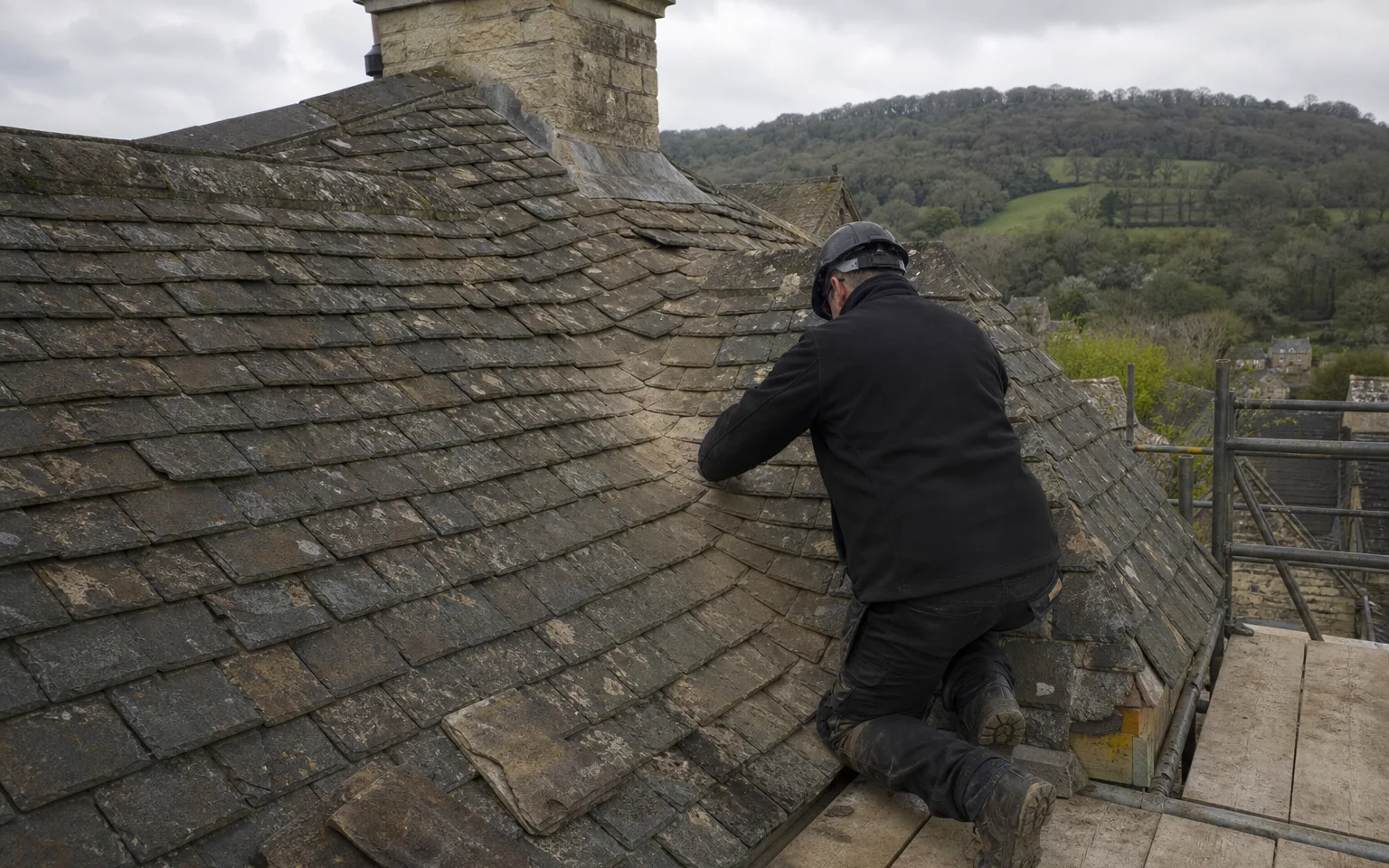
Chapter 02
Stone, slate and tile: what's on Stroud's roofs
The covering on your house decides how it is repaired, and what it must be matched with.
Chapter 02In this chapter
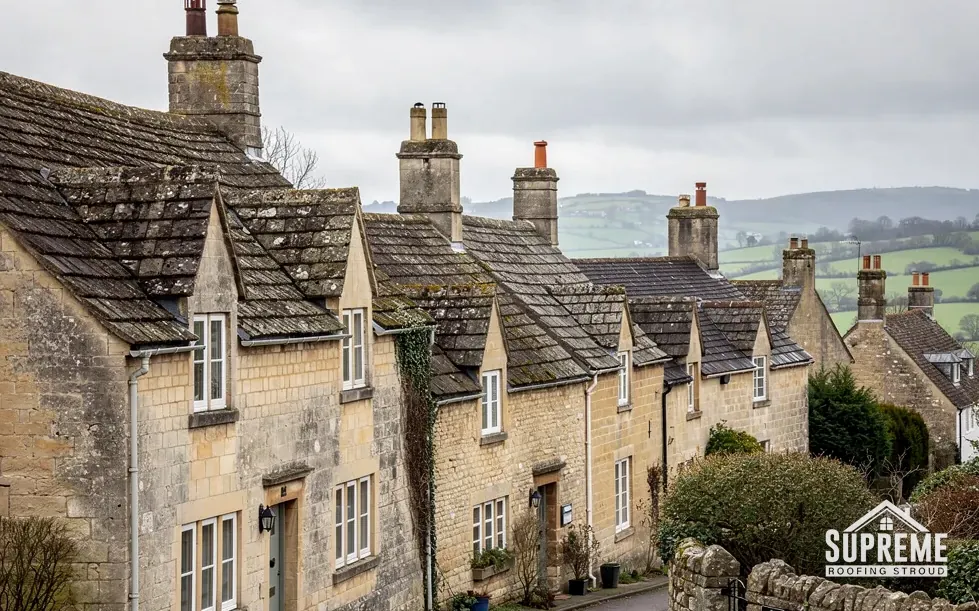
Stroud sits where the Cotswold limestone meets the clay vale, and its roofs show it. Look down from Rodborough Common and you see grey Welsh slate on the Victorian mill terraces, warm stone slate on the older cottages climbing the valley sides, red and brown tile on twentieth-century semis, and flat roofs on almost every rear extension. Each one is repaired differently.
In this chapter
Cotswold stone slate
Cotswold District Council's technical guidance describes the two oolitic limestones the slates come from, Forest Marble and Stonesfield Slate. The stone splits into far more small pieces than large ones, so roofs are laid in diminishing courses: the biggest slates, about 600 mm long, go at the eaves, and the smallest, around 150 mm, go at the ridge. Each slate traditionally hangs on its batten from a cleft oak peg. The same guidance gives a traditional pitch of 47° to 55°, and notes that a stone roof is very heavy, at about 1,000 kg for every 10 m².
That weight matters. Swap stone for something lighter, or the other way round, and the load on the timbers changes, which can bring Building Regulations into play. The guidance also says that with regular maintenance a Cotswold roof can easily last 100 years and could last 200 or 300. Our Cotswold stone roofing page goes into re-laying, sourcing and swept valleys.
Natural slate
Natural slate came to Stroud with the railway and the mills. MyBuilder's slate guide puts its life at 80 to 100 years or more, and notes that Welsh slate regularly lasts over a century. When slate fails, it is usually the nails that go first rather than the slates themselves, which is why a whole slope can start slipping at once. A few slipped slates can be refixed with tingles; widespread nail failure means stripping and re-slating, and our slate roofing page explains how to tell which you have.
Myth: Any grey tile will match a stone or slate roof well enough.
Fact: Stone slates are matched by size, colour and thickness and laid in diminishing courses; a uniform tile changes the look and often the load.
Clay and concrete tile
Clay plain tiles and concrete interlocking tiles cover most of the post-war estates around Stonehouse, Cam and Cainscross. They are lighter, quicker to lay and cheaper than stone or slate. Sources disagree on their lifespan, from 30 to 60 years for concrete and longer for good clay, so the age of the tile is only a rough guide. The battens and underlay underneath often fail first.
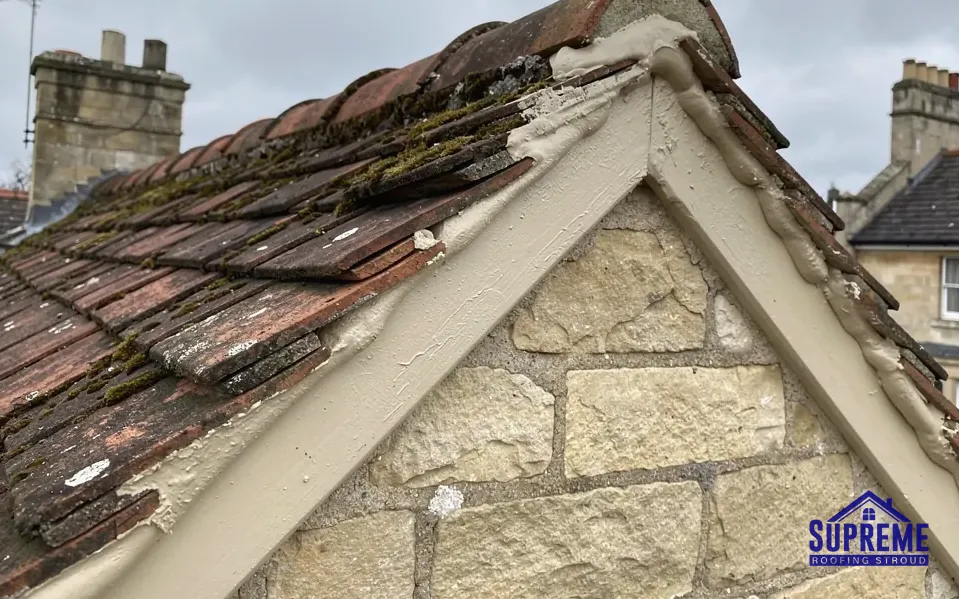
Pitch matters too. Every tile has a minimum pitch set by its maker: Marley's data puts its concrete plain tile at 35° but some of its interlocking profiles as low as 15° or 17.5°. A low-pitched extension roof that was covered with the wrong tile years ago is a common source of slow leaks, and the fix is a covering rated for that slope rather than another patch.
If you are not sure what is on your roof, a photograph from the street is usually enough for us to tell you. The guide to Stroud's houses and their roofs shows the common types by era.
Chapter 03
Repair or replace: making the call
A new roof is a big spend. Most of the time a repair is the right answer, and the photos show why.
Chapter 03In this chapter
A leak does not mean a new roof. The commonest causes we find in Stroud are local: a slipped slate, a cracked ridge tile, a split in the lead around a chimney, a gutter that has filled with leaves and backed water under the eaves. Each of those is a repair measured in hours, not days, and our roof repairs page covers the emergency side, including making a roof safe after a storm.
In this chapter
When repair stops making sense
The picture changes when the problem is the whole slope rather than one spot. On slate roofs, rusted nails let slates slide one after another. On older tiled roofs, the underlay can perish and the battens rot, so tiles sit on timber that no longer holds a nail. On flat roofs, a covering that has blistered and split all over usually means water has already reached the deck. In those cases, patching buys a season at best.
We show you photographs of what we find and say plainly which side of the line a roof is on. If a repair will hold for years, that is what we quote. If it will not, we explain why, and the quote for replacement covers the strip, the new underlay and battens, the covering and any timber work.
The regulations threshold
There is also a practical line drawn by the rules. The Planning Portal says a building control application is not normally required where the work affects less than 25 per cent of the building envelope and less than 50 per cent of the roof. Go beyond that and approval is needed, and under Approved Document L the roof may then need upgrading to modern insulation standards. That can add cost, but it also means a warmer house and a properly signed-off job. Our roof replacement page explains how a full re-roof is planned.
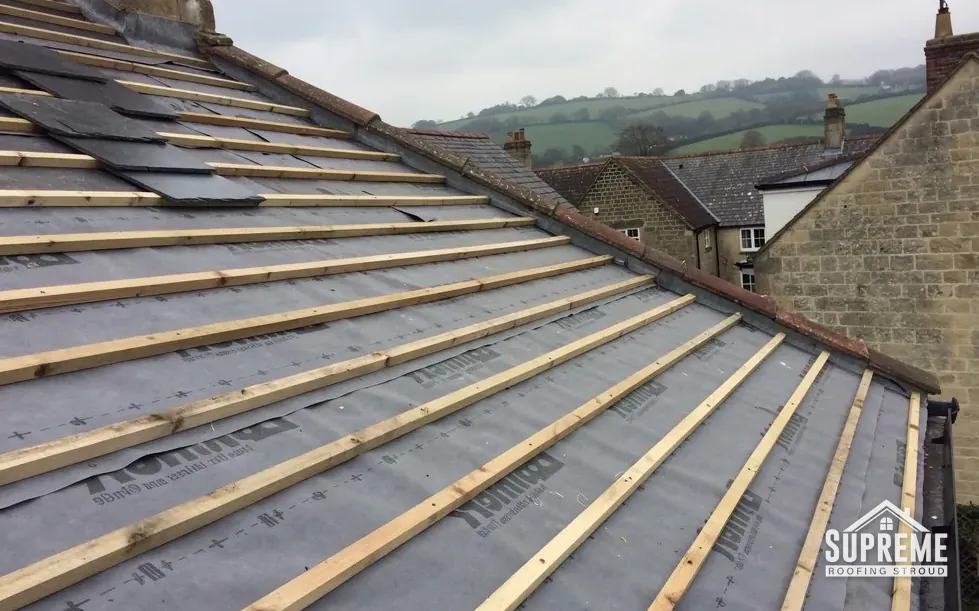
Signs it might be time
Water coming in at more than one place, daylight visible in the loft, a sagging ridge line, or a slope where slates or tiles keep slipping after each repair are all signs to look at the whole roof rather than the latest leak. So is a covering near the end of its typical life, though age alone is never the deciding factor.
Part replacement
There is often a middle way. One slope of a roof can fail while the other is sound, especially where one side faces the weather and the other sits in the lee of the hill. Re-covering a single slope, matched to the rest, can cost a fraction of a full re-roof. The same goes for flat roofs on extensions, where the house roof may be fine and only the flat section needs a new covering. We price those options side by side when they make sense, so you can see the difference in writing.
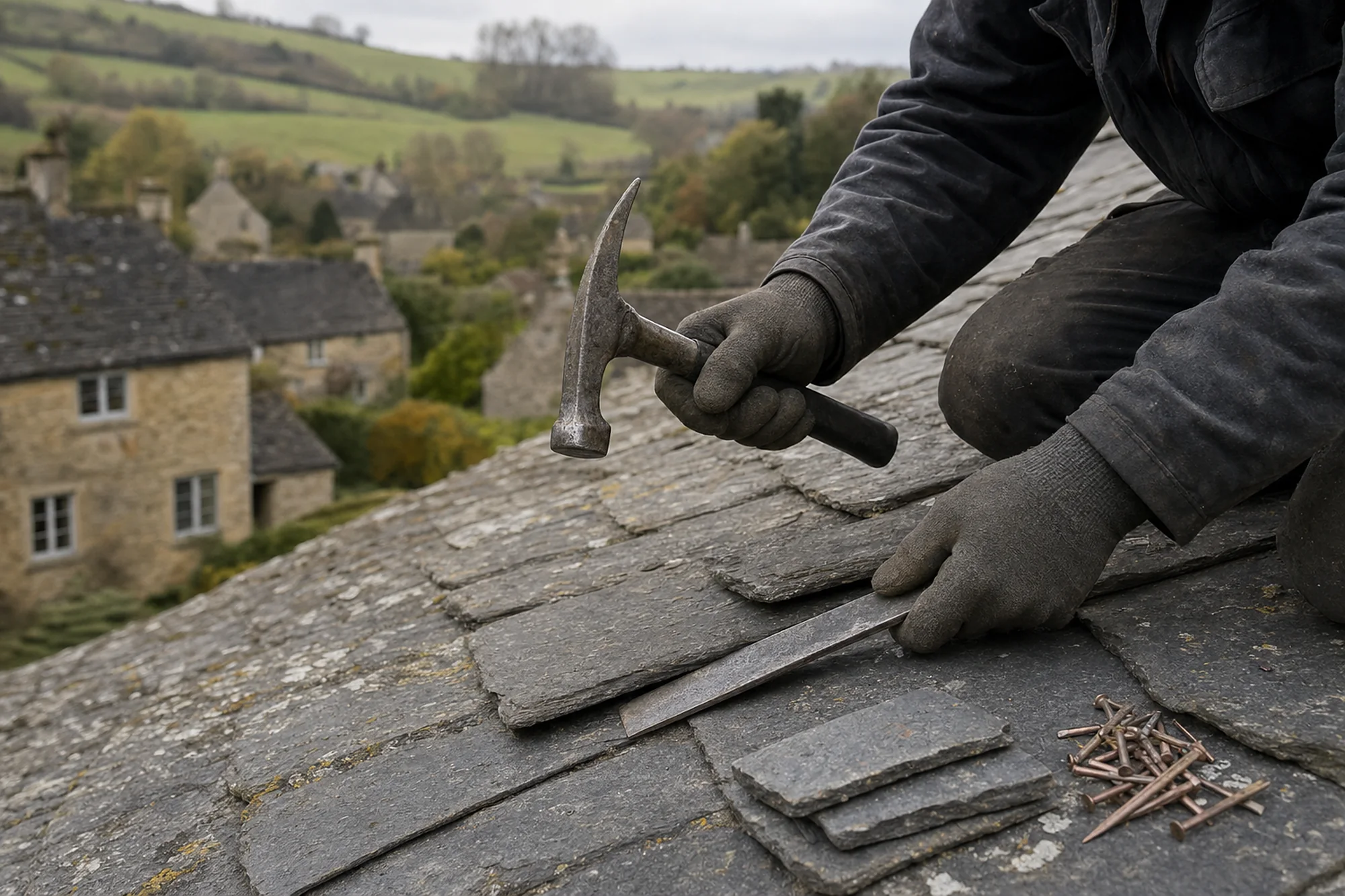
The UK roof lifespans comparison gives typical ranges by material, with sources, if you want a sense of where your roof sits.
Chapter 04
Permission and Building Regulations around Stroud
Most roof work needs no planning permission, but conservation areas, listed buildings and the National Landscape change the details.
Putting the same covering back on a roof does not usually need planning permission, because it does not materially change how the building looks. That is the starting point. What changes it around Stroud is designation, and there is a lot of it.
In this chapter
Conservation areas and Article 4
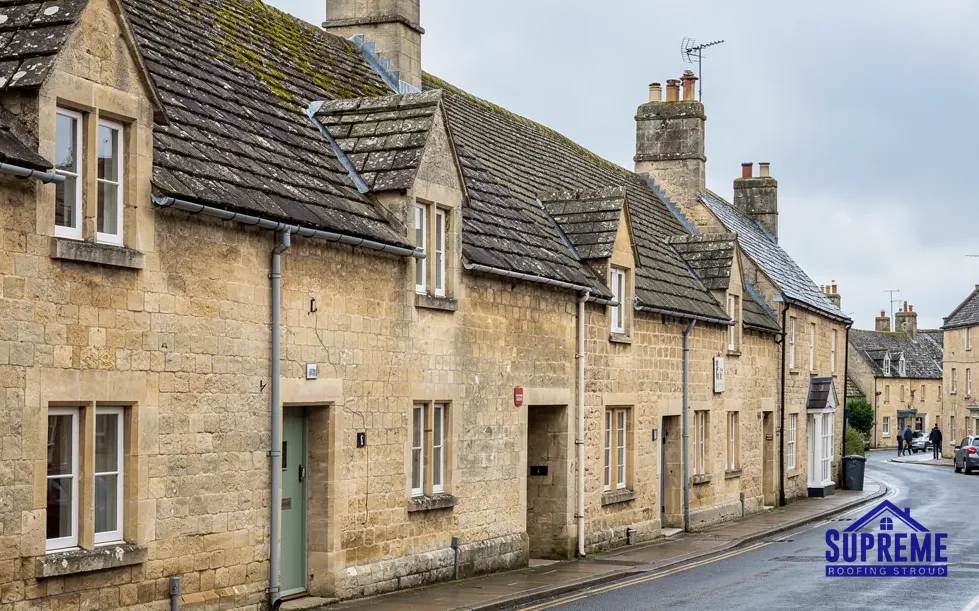
Stroud District Council lists 41 conservation areas across the district, from Stroud Town Centre and the mill complexes along the valleys to Painswick, Minchinhampton, Nailsworth and Wotton Under Edge. Five of them, Bisley, Wotton Under Edge, Stroud Top of Town, Stroud Town Centre and Frampton on Severn, also have Article 4 Directions that remove some permitted development rights. The council's page is silent on whether those directions cover roofs, so it is safest to ring the planning team before you change a covering or add anything to a roof there.
The Cotswolds National Landscape
According to the council's district profile, the Cotswold AONB, now called the Cotswolds National Landscape, covers just over half of the district's land. Inside it, and in conservation areas, dormer windows are not permitted development, so a dormer loft conversion needs planning permission. Roof windows that sit within the permitted development limits can still be fitted without it, except on a listed house or where an Article 4 direction removes that right. Our planning permission guide sets out the limits.
Listed buildings
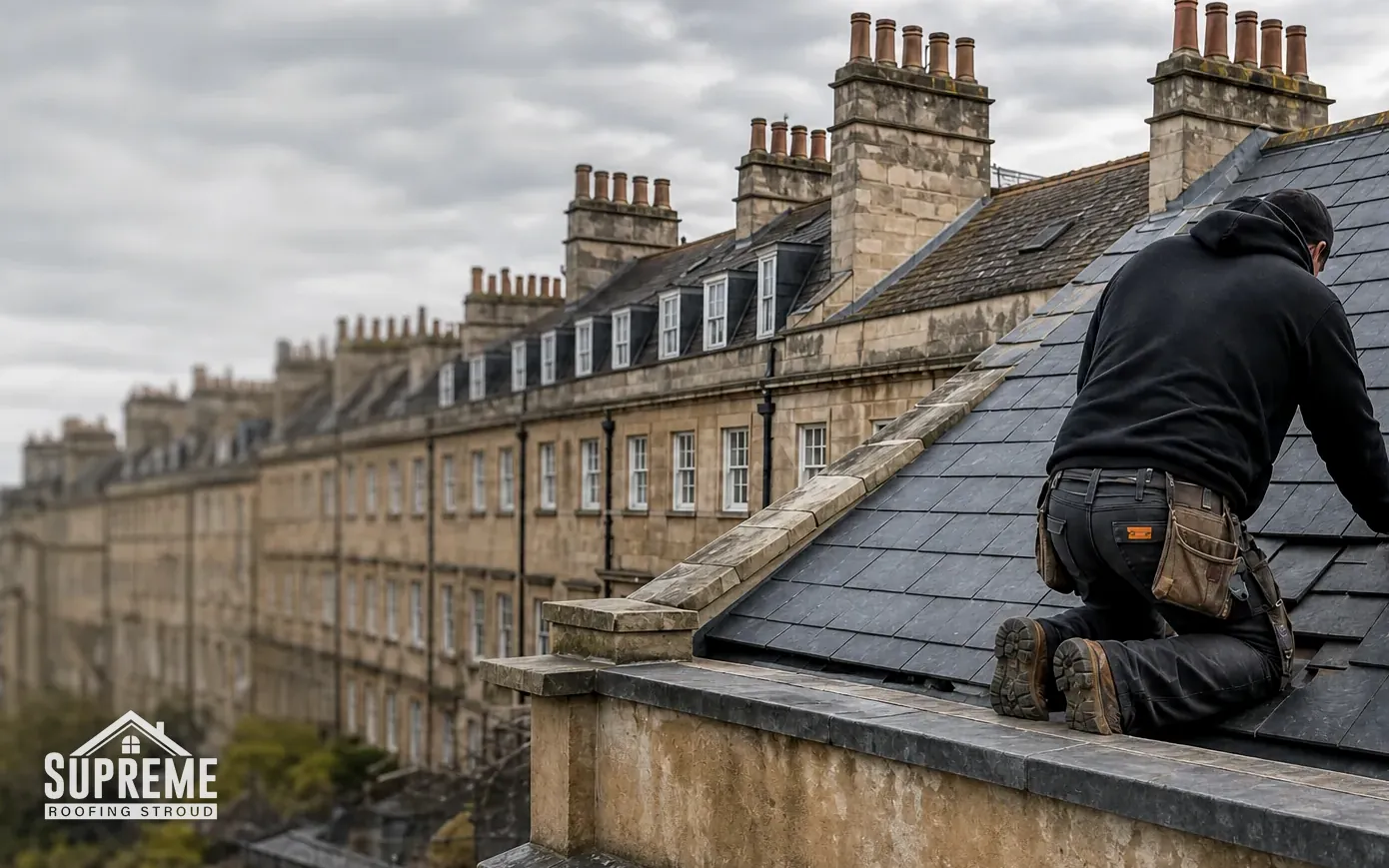
Stroud District Council says every listed building, whatever its grade, is protected inside and out. Any work affecting its character requires listed building consent, and carrying it out without consent is an offence. On a listed roof that usually means matching materials and methods exactly.
Building Regulations
Building Regulations are separate from planning. Small repairs do not need an application. Larger re-roofing does, as described in the previous chapter, and so does a covering that is around 15 per cent or more heavier than the covering it replaces. In Stroud District the council's service is the Gloucestershire Building Control Partnership, shared with Gloucester City. The alternative is a registered building control approver, the name used since April 2024.
Churches and chapels
Stroud's villages have plenty of churches and chapels, and the rules for them are different. A church still used for worship by the Church of England and some other denominations falls under the ecclesiastical exemption: roof work is authorised through a faculty from the diocese rather than listed building consent from the council. A chapel that has been converted into a house is not exempt, so it is treated like any other listed or unlisted home. Our church roof permissions answer explains the difference.
| Job | Planning | Building Regulations |
|---|---|---|
| Like-for-like repair | Not usually needed | Not usually needed |
| Re-roof over 50% of the roof | Not usually, if like for like | Application needed |
| Heavier covering, 15% or more | Depends on appearance | Application and structural check |
| Dormer in a conservation area or the National Landscape | Permission needed | Application needed |
| Any change to a listed roof | Listed building consent | Depends on the work |
Where an application is needed, we handle the building control notification and tell you which body is signing the work off. For the local detail, see building control in Stroud.
Chapter 05
Choosing a roofer and reading a quote
What to ask, what to expect on paper, and the warning signs that are worth walking away from.
Chapter 05In this chapter
Hiring a roofer is mostly about paperwork you can check. A name, a landline and an email address you can write to. A survey before any price. A quote in writing that lists the work, the materials, the scaffold and the waste. A guarantee that says what it covers and for how long. If any of those is missing, ask for it before you agree to anything.
In this chapter
Reading the quote
A useful quote reads like a plan of the job. It names the covering, such as Spanish slate or a particular concrete tile, rather than just saying roof tiles. It says whether the underlay and battens are being replaced. It includes the scaffold, so access is accounted for. It says how waste is removed and whether disposal is included. It shows VAT. And where something cannot be known until the roof is open, like the state of the timbers, it gives a rate rather than a vague promise to deal with it.
When you compare two quotes, compare what they cover, not just the totals. A cheaper total that leaves out new battens, or quotes for reusing old lead, is not the same job. Our guide to choosing a roofer lists the questions we would ask in your position.
Warning signs
Be wary of anyone who knocks on the door to say they noticed a problem with your roof, asks for most of the money up front, wants cash only, or pressures you to decide on the spot. A genuine roofer will happily leave a written quote and let you think about it. The doorstep roofers guide covers the common tricks.
Guarantees
Ask what a guarantee actually covers. Ours is a 10-year workmanship guarantee, in writing, covering the work we carried out. It is separate from any manufacturer's guarantee on materials, and it is not an insurance policy. Knowing the difference tells you who to call if something goes wrong in year six.
Deposits and timing
For larger jobs it is normal for materials to be ordered in advance, and some roofers ask for a deposit to cover them. Ask what the deposit is for and when the balance is due, and get it written into the quote. Ask, too, how long the job should take and what happens if the weather turns, because a roof that is open must be covered every night until it is finished.
- about £1,125typical scaffold cost on a re‑roof
- £250 to £300typical roofer day rate
- £100 to £1,000typical waste disposal on a re‑roof
Those three things are often where quotes differ most, so they are worth checking first. The quote checklist covers the rest.
Chapter 06
Looking after a roof in the Five Valleys
Small jobs twice a year keep most roofs out of trouble, especially under the trees.
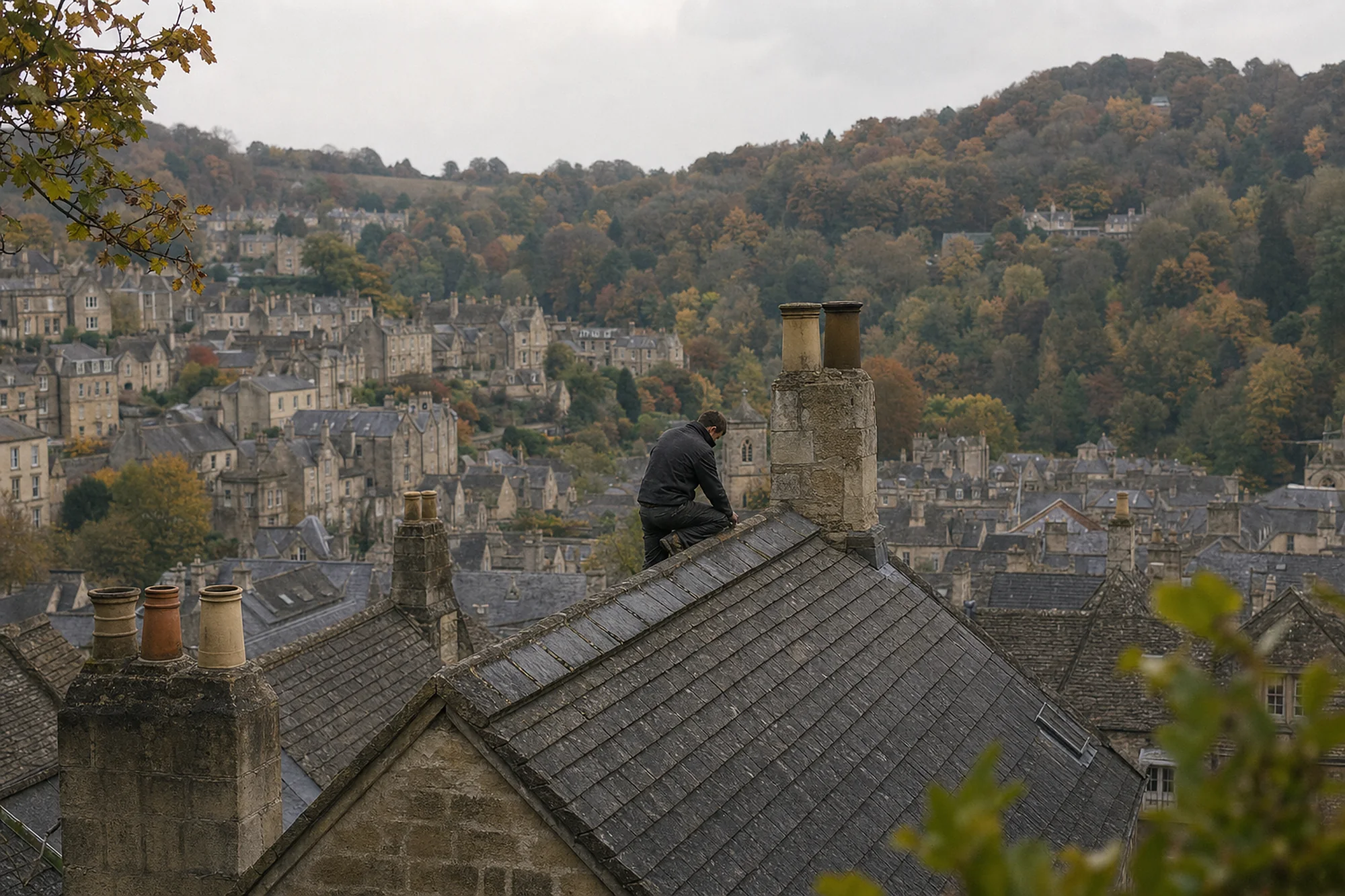
Stroud's valleys are home to around 49,000 people, according to Stroud District Council's district profile, just over 40 per cent of the district. A lot of them live in houses tucked into wooded hillsides, and that setting shapes how roofs age. Leaves fill gutters each autumn. Shade keeps the north-facing slopes damp, and moss settles in the laps of tiles and stone slates. None of that is dramatic, but left alone for years it is what turns a sound roof into a leaking one.
In this chapter
Moss and stone roofs
On Cotswold stone roofs, moss is more than a cosmetic problem. Cotswold District Council's technical guidance makes the point bluntly: if a stone roof was scraped once a year, it could last twice as long. Scraping by hand, rather than pressure washing, removes the moss without damaging the slates or blasting water up under them. Our roof cleaning and moss removal page explains the methods.
Gutters and downpipes
A blocked gutter overflows down the wall, soaks the brick or stone and can push water back under the lowest course. Manufacturers typically recommend a gentle fall to the outlet, somewhere between about 1:600 and 1:350 depending on the system, and brackets close enough together that the run cannot sag. After autumn, check that water runs freely and that nothing is dripping at the joints.
Ventilation and condensation
Not every damp loft is a leak. If the underlay is the older non-breathable kind, Marley's guidance based on BS 5250 calls for 10 mm of ventilation along the eaves on roofs pitched above 15°, and 25 mm on shallower roofs. Blocked eaves, often from loft insulation pushed too far, can cause condensation that looks like a leak. We check both before quoting for either.

After a storm
After high winds, look along the ridge and verges from the street. A missing ridge tile, slates lying in the garden or a gap along the gable edge are worth a call before the next rain. Since BS 5534 was revised in 2014, ridges and verges are mechanically fixed rather than relying on mortar alone, so an older bedded ridge is often the first thing to move.
Getting to the roof
Access is the other side of looking after a valley roof. Plenty of houses in Chalford, Thrupp and the Slad valley sit above or below a lane rather than on it, with steps to the front door and a garden falling away behind. Scaffold has to be planned around that, sometimes with a tower on one side and a full lift on the other, and materials may need carrying further than on a flat street. We look at access on the survey and allow for it in the quote, so it never turns into an extra halfway through a job. Our guide to roof access in the Five Valleys covers what to expect.
A simple routine is in our seasonal maintenance checklist. If you would rather we did it, an inspection with a photo report covers the lot.
Roofing guides for Stroud homeowners
Plain-English answers on costs, permissions, quotes and looking after your roof, written for homes in and around the Five Valleys.
Guides
- How to choose a roofer in Stroud: questions and paperworkHiring a roofer is a sequence of small decisions, and most of them are made on paper. The…Read the guide
- Stroud's houses and their roofs: from mill cottages to estatesWalk from a Bisley cottage down to a Nailsworth terrace and out to a 1950s estate, and the…Read the guide
- UK roofing materials compared: tile, slate, stone and flatThere is no single best roofing material in the UK, only the best fit for a given house,…Read the guide
- What roof work costs in Stroud, and how a quote is builtRoof prices are published long before anyone visits your house, and they are only a guide. Typical national…Read the guide
- Building Regulations for roof work in England explainedSmall repairs sit outside the rules. A full strip, a heavier covering or a structural change does not.…Read the guide
- Planning permission for roof work in Stroud DistrictPutting the same roof back is usually not development. Adding a window, a dormer or a different material…Read the guide
- Roof insurance claims: what home insurance usually coversHome insurance is built to pay for sudden damage, not for a roof reaching the end of its…Read the guide
- Buying a house near Stroud? What to check on the roofA roof is one of the costliest things you inherit with a house, and one of the easiest…Read the guide
- A seasonal roof maintenance checklist for Stroud homesMost roof failures start small and slow: a blocked gutter, a lifted tile, a crack in a flashing.…Read the guide
- Steep streets and scaffold: roof access in the Five ValleysOn a hillside terrace the roof is often the easy part. Reaching it safely, with materials, on a…Read the guide
- Roof work on listed and conservation-area homes in StroudSwapping the covering on an ordinary house is routine. The rules shift when the house carries a listing,…Read the guide
- Roofer guarantees explained: workmanship, materials, insuranceThree different promises sit behind the word guarantee, made by three different parties. Knowing which one you are…Read the guide
Quick answers
- How to check a Stroud roofer is genuine before you hire
- Doorstep roofers in Stroud: spotting scams and saying no
- Is VAT charged on roof repairs and new roofs?
- Gable, hip or flat: the main roof shapes on UK homes
- What is the most durable roofing material in the UK?
- What a roofing quote should include
- Should a roofer ask for a deposit up front?
- Roofer or builder: who should do your roof job?
- Will the roofer you hire do the work themselves?
- How long common roof jobs take, from repair to re-roof
- Does a roof guarantee transfer when you sell?
- Should you fix the roof before selling your Stroud house?
- Building control for roof work in Stroud: GBCP explained
- Does the Cotswolds National Landscape affect roof work?
- Article 4 directions in Stroud: do they cover roofs?
- Roofing terms explained: a plain-English glossary
- How to complain about a roofer's work
- Church roof repairs in Stroud: faculty and consent
- What roof pitch means and why it matters
- How long different roofs last: a UK comparison
Roofing in Stroud: your questions
Do you work on Cotswold stone roofs in conservation areas?
Yes. Stone roofs in conservation areas are re-laid or repaired with matching stone slates, laid in diminishing courses. Where the house is listed, we check what consent is needed with the council before any work is priced.
Why do you publish prices when most roofers don't?
Because a homeowner who knows the typical range can judge a quote properly. Our guide prices are starting points; the written quote after the survey covers the whole job so you know what your money is for.
Will a new roof on my terraced house in Stroud need scaffold over the pavement?
Often, yes, on streets where the house fronts the pavement. That usually needs a licence from the highway authority, which we arrange, and the cost is allowed for in the quote.
Can a few slipped slates be fixed without replacing the whole roof?
Usually. Individual slates can be refixed with tingles. If slates are slipping across a whole slope because the nails have rusted, a repair only buys time and re-slating is the lasting answer.
Do I need Building Regulations approval to re-roof my house?
Not normally if the work affects less than 25 per cent of the building envelope and less than 50 per cent of the roof. Beyond that, or with a covering 15 per cent or more heavier, an application is needed, and we handle it.
Is the 10-year guarantee an insurance policy?
No. It is our written workmanship guarantee covering the work we carry out. Materials carry their own manufacturer guarantees, which we pass on to you with the paperwork.
Can you look at a leak the same week I call?
Leaks and storm damage jump the queue, and where water is coming in we make the roof safe first. Call 01453 933613 or send photos on WhatsApp so we can see what we are dealing with.
Do you cover towns outside the Five Valleys?
Yes. We cover every town within 30 road miles of Stroud, including Gloucester, Cheltenham, Cirencester, Tetbury, Dursley and the Forest of Dean. The areas page lists every one.