

Roofers in Cirencester
A market town on the River Churn that was once Roman Corinium and later a wool merchants' town, where stone-built streets and a Grade I church set the standard for every roof.
Cirencester at a glance
- Distance
- 13 road miles east of Stroud
- Council
- Cotswold District Council
- Conservation area
- First designated January 1968
- Listed
- Church of St John the Baptist, Grade I
Cirencester's roofs: Corinium, wool money and Cotswold stone
Cirencester lies on the lower dip slopes of the Cotswold Hills, an outcrop of oolitic limestone, with the River Churn flowing through the eastern side of the town. That geology is the reason the place looks as it does. As Roman Corinium, its late-second-century defensive wall enclosed 240 acres, which made it the second-largest city by area in Roman Britain. Little of that is visible from a roof, but it shows how long people have been building here, and how much of it has been rebuilt.
The medieval layer is easier to see. Wool merchants' wealth funded the rebuilding of the nave of the Grade I listed Church of St John the Baptist between 1515 and 1530, and the church is sometimes called the Cathedral of the Cotswolds. The merchants also built for themselves: fine houses of Cotswold stone stand in and around Coxwell Street and Dollar Street.
Cotswold District Council is the planning authority. Its character appraisal records that the town's first conservation area was designated in January 1968, less than a year after the Civic Amenities Act introduced the mechanism. A review in 2008 proposed four areas: Cirencester Park, Gloucester Street and River Walk, Cirencester Town Centre and Cirencester South. We work on the basis that a house in the centre is likely to need planning care, and we check the address with the council.

Hillside terraces of stone houses with slate roofs and chimneys 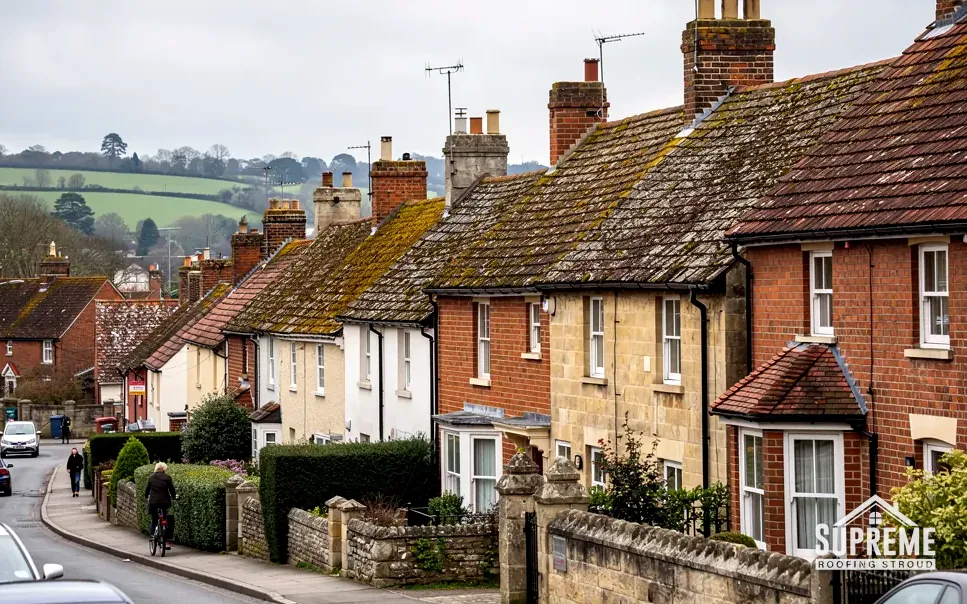
Sloping street of brick and stone terraced houses with mossy tiled roofs
Chapter 01
Oolitic limestone and the stone slates cut from it
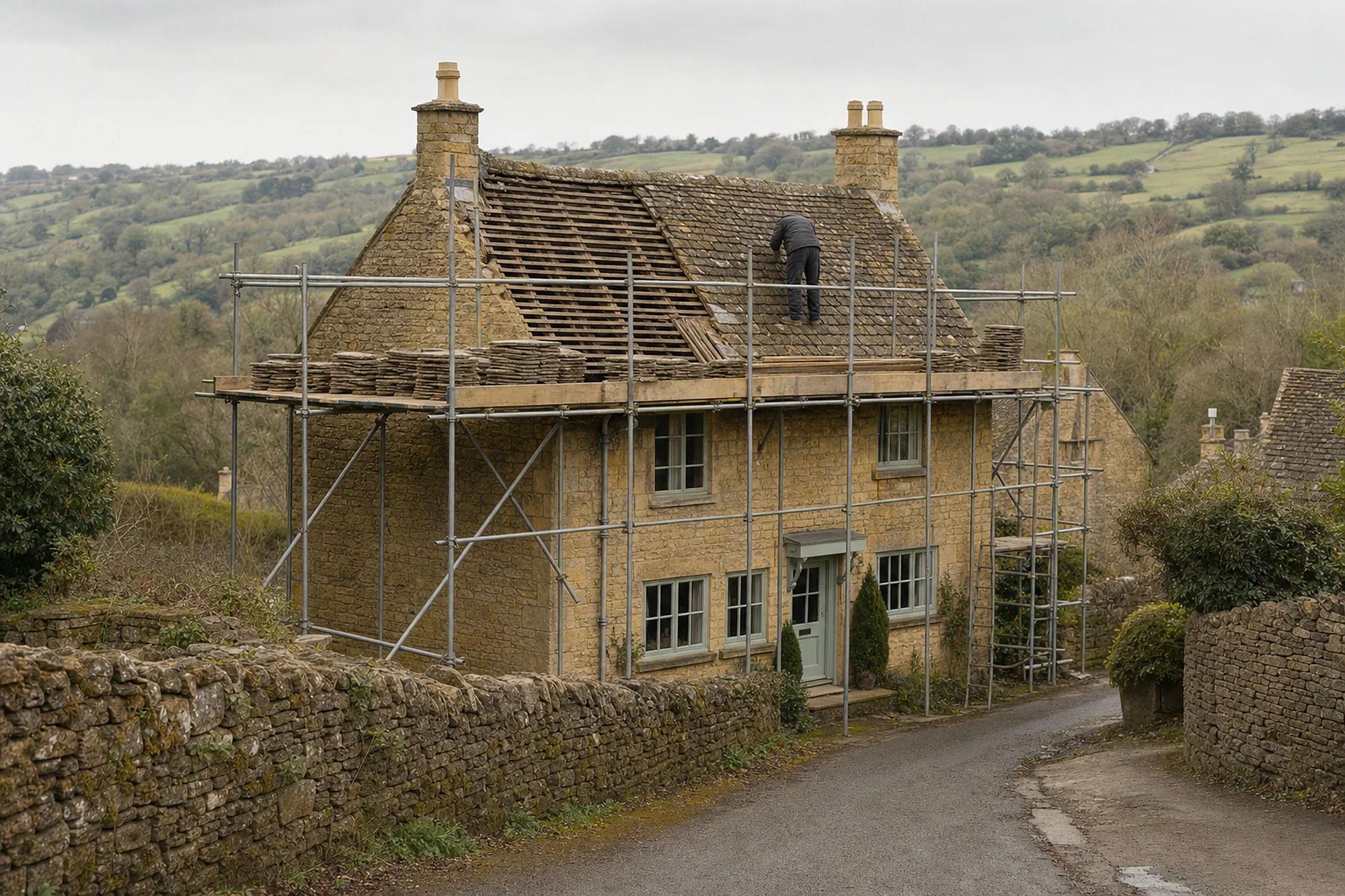
Where the ground is limestone, the traditional roof is limestone too.
Chapter 01In this chapter
The district council published an owners' guide to stone slate roofing back in 2000, and it remains the most detailed local guide to the craft. Its geology is brief: two limestones supply the slates, Forest Marble, which is split by hand into pieces called presents, and Stonesfield Slate, which splits when frost gets into the bed. The guide also notes a local habit of speech, with stone tile used more in the southern part of the district and stone slate in the northern. They name the same covering, so you may hear either in Cirencester, and the roofs themselves turn up in a long band from Chipping Campden to near Bath.
In this chapter
If your house was built when the merchants' streets were new, or in their style, the roof may be stone slate. We find out on the survey by looking at the slopes, the ridge and the chimney heads, not by assuming. Where stone slate is present, our price is for stone slate. On substitutes the guide quotes English Heritage policy: fibre-resin slates, concrete tiles and reconstituted stone are inappropriate stand-ins for the real thing on historic buildings, and sandstone and limestone should not be mixed on one roof.
Weight and pitch
The guide puts the weight of a stone slate roof at about 1000 kg per 10 square metres, which is heavy by any standard. Its description of the plain traditional roof is a straight pitch at 47 to 55 degrees. Treat that as what builders used to do, rather than as a limit that any repair must meet. The weight matters because a heavy covering needs a sound structure, and because under Approved Document A a replacement covering roughly 15 per cent heavier than the old one brings in building control and a check of the structure. In practice, that means that replacing stone with something lighter, or a lighter covering with stone, is a decision with consequences for the timbers.
Our approach
On a stone roof we look at the timbers as well as the stone: purlins and rafters for rot, wall plates for movement, and the ceiling below for stains. Our Cotswold stone roofing page sets out the full method, and the spoke on diminishing courses explains why the slates get smaller towards the ridge.
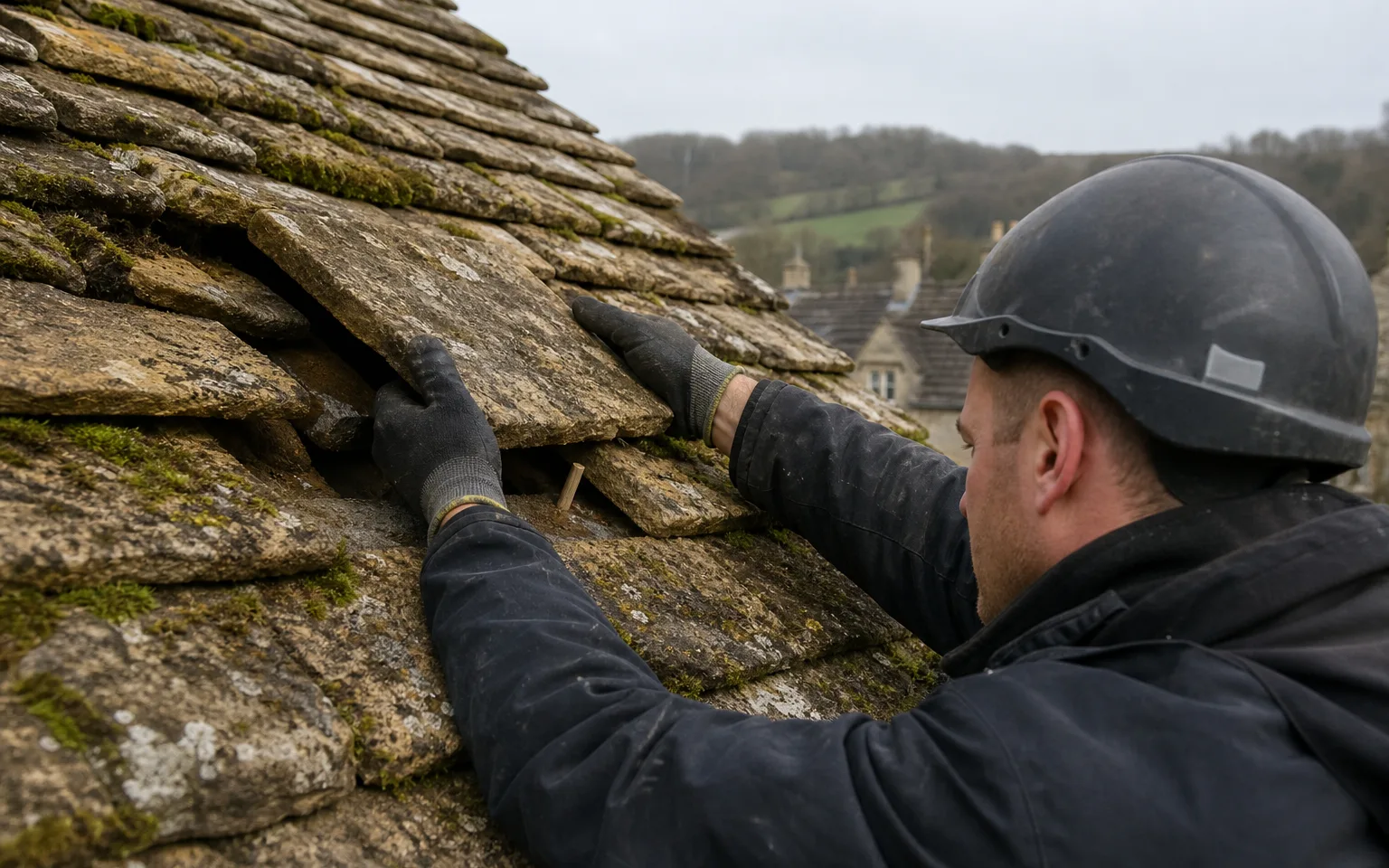
On limestone ground, check for a stone roof before anything is priced.
| Term | Meaning |
|---|---|
| Cussoms | Largest slates, normally about 600 mm long and sometimes up to 750 mm, in a double eaves course |
| Followers | The course that comes next above the cussoms |
| Short cocks | Smallest slates, only about 15 cm long, used at the highest part of the slope |
| Presents | Slates split by hand from Forest Marble |
Chapter 02
Coxwell Street, Dollar Street and the merchants' houses
Houses built on wool money were built to last, and they are still being maintained.
Chapter 02In this chapter
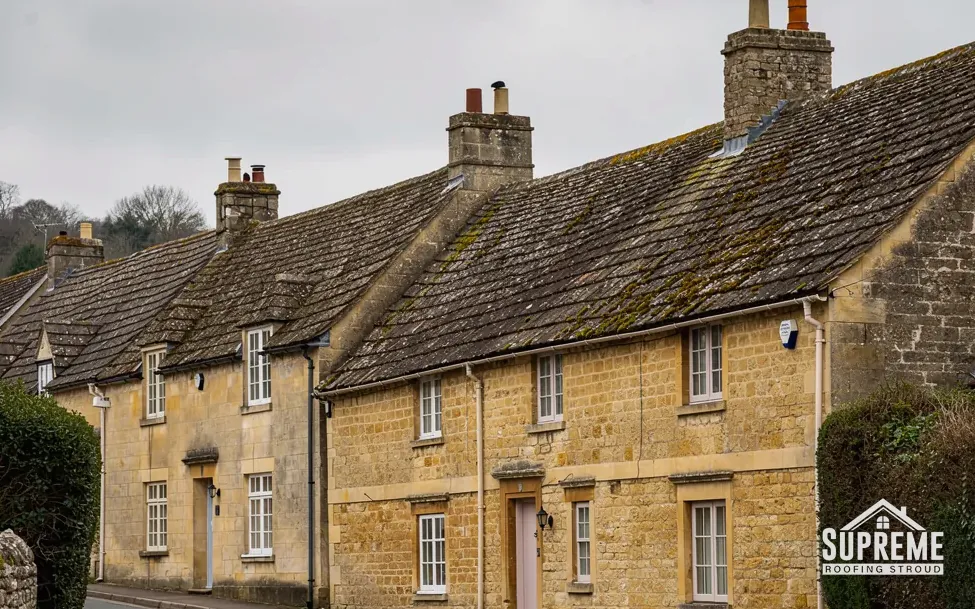
The merchants' houses of Coxwell Street and Dollar Street are the best-known domestic buildings in the town, and they show what Cirencester roofs were meant to be. They are fine houses of Cotswold stone, but the walls say nothing certain about how each one is roofed today. A house of that age has had several roofs, and the covering you see today may be the third or fourth. Some are stone slate that has been re-laid and patched; others may carry a later covering.
For an owner of a house like that, the useful questions are practical. Is the roof the original covering or a replacement? Are the valleys formed in the traditional way? In a swept valley the slates are specially cut and curve round the junction, which looks better than a plain lead channel but takes more skill, and the council's guide describes plain close-mitred or open lead alternatives as quicker and cheaper, though they look plainer. If your roof has swept valleys, repair means keeping them. Our swept valleys page explains what is involved.
Reading the roof from the street
Standing on the pavement outside a merchant's house you can make a rough guess at the roof's history. Slates that shrink in size as they climb suggest a traditional stone covering laid in courses. A uniform covering from eaves to ridge suggests a later replacement. Dressed stone along the ridge is part of the traditional picture too. These clues are not proof, and we confirm them from the loft, where the pegs, battens and underside of the slates tell the real story.
Listed houses and consent
Many town-centre houses are listed, and a listing protects the entire building. Anything altering its character needs listed building consent, granted by Cotswold District Council. That takes in changing the roof covering or altering the ridge. Like-for-like repair with matching stone is normally the least contentious route, and a detailed schedule of what will be replaced helps. We can produce that schedule from our survey.
Costs, with a caution
Typical UK guides put stone slate re-roofing at about £160 to £210 per square metre, with the origin of the stone, its age and your location all moving the price (Checkatrade, 2026). That figure is national and not specific to the Cotswolds, and an old stone roof can bring extras such as timber repairs and scaffold. The written quote after a survey covers them.
- 240acres enclosed by Roman Corinium's late-2nd-century wall
- 1515year the rebuilding of the nave of St John the Baptist began, funded by wool merchants
- 1968year the town's first conservation area was designated
Chapter 03
The Churn, the town centre and getting to a roof
A compact stone town makes for tight access, and the plan has to be written down.
Chapter 03In this chapter
Cirencester's centre is compact, with narrow streets, lanes and passages between buildings, and the River Churn on the eastern side. A roof job in a place like this begins with a question about access. Can a lorry stop outside? Is there a yard behind? Does the scaffold fit between buildings, or must it stand on the pavement? Where scaffold sits on the public highway, it needs a licence, and the application takes time, which is why we ask about start dates early.
In this chapter
When the street is too narrow for deliveries, materials may be brought in smaller loads or lifted from a different side. Heavy stone slates are a particular issue, because they come on pallets and weigh a great deal. A hoist or a telehandler helps where the site allows it, and the quote shows the cost of whichever method suits the building. On a terrace of connected houses, work on one roof can affect the next, so we check party walls and chimneys together.
Four conservation areas on the council's map
The 2008 review proposed four conservation areas for Cirencester: Cirencester Park, Gloucester Street and River Walk, Cirencester Town Centre and Cirencester South. Earlier designations included Watermoor and St Peter's Road. Boundaries have changed over the years, so the safest approach for any address is to ask the council which designations apply today. We help you frame the question, and we put the answer on the survey sheet.
Rainwater and the river
The Churn runs through the eastern side of the town, and low ground near it means that water leaving the roof matters. Downpipes should discharge to a proper gully or drain, not onto a wall base. At the survey we follow each downpipe down to where it ends, and if a gully is blocked we tell you, because a roof repaired above a flooded foundation solves only half the problem. Typical UK guttering costs are £30 to £70 per metre (MyBuilder, 2026), and our guttering, soffits and fascias page explains what drives a price.
Stone roofs and moss
Stone slates hold moss and lichen, and a traditional remedy is scraping by hand. According to the council's guide, scraping once a year could double the life of a stone roof, and that a well kept Cotswold roof can pass 100 years and possibly reach 200 or 300. Typical UK guides price moss cleaning from about £300, with manual scraping at £5 to £10 per square metre (MyBuilder, 2026). Pressure washing is not suitable for delicate roof surfaces. Our roof cleaning and moss removal page explains the safer methods.

If you are unsure whether your roof is stone slate, send us a photograph of the slope and the ridge, and we will say what the picture suggests and what a survey would need to confirm.
Map showing Cirencester and the Stroud service radius, with nearby towns we also cover.
Near Cirencester
Roof work we do here
Corinium, Coxwell Street and the wool church
How do I know whether my Cirencester house has a stone slate roof?
Look at the slopes from the street: stone slates are thick and uneven, laid in diminishing sizes from big at the eaves to small near the ridge. A survey confirms the type, and the quote then prices that material.
Do the merchants' houses near Coxwell Street need special consent for roof repairs?
If a house is listed, changes to its character need consent from Cotswold District Council before they start. Matching repairs are the simplest to agree, and we supply a detailed schedule.
Is the St John the Baptist church roof handled like a house roof?
No. For a church in use, the exemption for church buildings applies, and roof work is cleared by a faculty from the diocese instead.
Can I replace a stone slate roof with concrete tiles in Cirencester?
On a historic building, English Heritage policy as reproduced by Cotswold District Council says concrete tiles are inappropriate alternatives to real stone slates. The extra weight is also a structural question, so check with the council and building control first.