

Roofers in Kemble
Roof work in Kemble, from the spire of All Saints to the houses around the station, in a village that sits closer to the source of the Thames than any other.
Kemble at a glance
- Distance
- 15.1 road miles east-south-east of Stroud
- Council
- Cotswold District Council
- Conservation area
- Kemble and Kemble Station
- Setting
- Upper Thames headwaters, near Thames Head
Kemble's roofs, between Thames Head and the station line
Kemble is the settlement closest to Thames Head, the source of the River Thames, and it lies 15.1 road miles east-south-east of Stroud. The ground is the headwaters country south-west of Cirencester, and that is the first thing a roofer thinks about here: the village stands at the very top of a river system, so the job on any roof is to get rain away from the walls and let it go.
The village has an unusual boundary history. It was part of Wiltshire until 1 April 1897, when it moved to Gloucestershire, so records for older houses may sit in two county archives. That matters if you are trying to find out when a roof was last altered, or whether a building has a protected status. Cotswold District Council is the planning authority for the village today.
The oldest landmark is All Saints Church, with its Norman door, a tower dating from 1250 and a spire added in 1450. A full restoration in 1872 brought a chapel of ease across from Ewen to form a new south transept, so the church carries several roof lines from different centuries.
Around it the conservation area is named for both the village and its station, which tells you the council treats the railway-age part of Kemble as heritage too. What covers your own house is something we establish on the survey, with photographs, rather than guess from the street.

Stone terraced houses with slate roofs and chimneys stepping up a hill 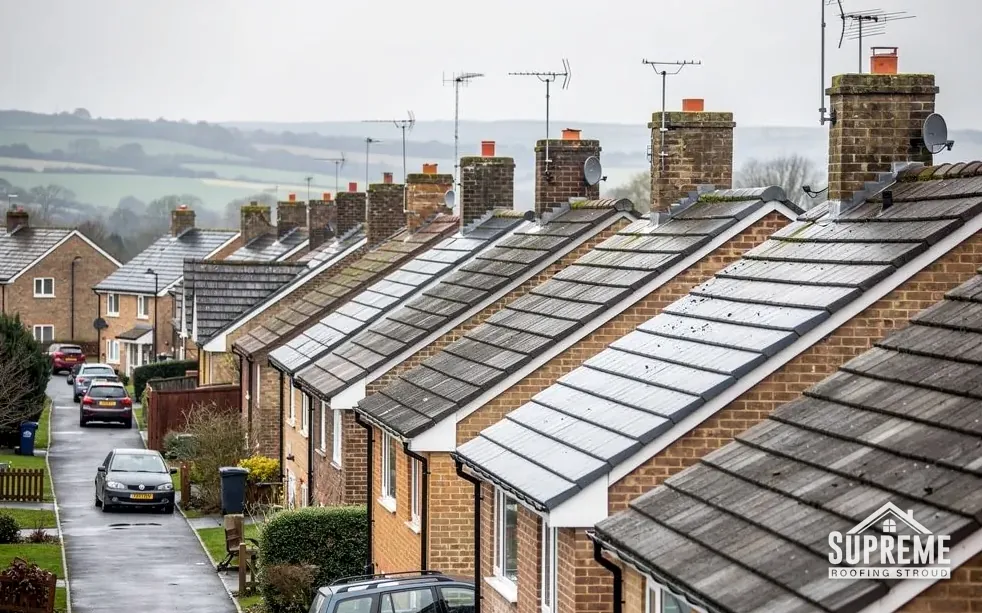
Terraced houses on a hillside street with tiled roofs and brick chimneys
Chapter 01
A spire from 1450 and the lightning of 1834
Tall roofs, church roofs and how they are reached and repaired.
Chapter 01In this chapter
All Saints has a spire, and Kemble's history of that spire includes a bad day. Lightning struck the church steeple in July 1834, and the chancel was rebuilt in 1840. Whatever else that tells you, it shows how exposed a tall structure is on open ground, and why the metalwork on towers and spires, the flashings, the cappings and the fixings that tie them to the stone, deserves a proper look every so often rather than only after a storm.
Most Kemble roofs are nowhere near that tall, but the principle carries down to a two-storey house. The highest point of a roof is where wind lifts a loose ridge or a slipped tile first, and it is also the hardest place to reach from the ground. We check ridges, chimney stacks and the junctions around them on every survey, and we photograph what we find so that you can see the same detail we are looking at.
Church roofs and who authorises the work
Anyone on a parish church council should know that the approval route depends on how the building is used. A church that is open for worship has its own system of permissions, run through the diocese, and the permission that matters is a faculty rather than listed building consent. Once worship stops, or a chapel is turned into a home, the building normally needs listed building consent from Cotswold District Council instead. Legal advice is not our job, but we will tell you which route your building is likely to follow before you commission any work.
Reaching a high roof
A spire or a tall tower cannot be repaired from a ladder. It needs a scaffold designed for the structure, which makes access the biggest cost on the job, and it is why we allow for the scaffold carefully in the quote. On a smaller building such as a village hall or a chapel, a tower or a short scaffold lift may be all that is needed, and we will say which is the sensible option when we have seen the roof.

Where old roofs meet
The 1872 restoration added a south transept, and any building with additions like that has places where one roof meets another or runs into a wall. Those junctions, whether a valley, an abutment or a gutter hidden behind a parapet, are where an old building most often leaks, because the flashing there has to move with two structures at once. On a village house with an extension from a later century the same is true. We open up and look at the junction instead of judging it from the ground, and the photographs go into your survey report.
Our roof inspections and surveys page explains what a survey covers, and why a report with photographs is the sensible first step on any old or tall building.
The highest part of a roof takes the weather first and is reached last.
- 1250date of the tower at All Saints, Kemble
- 1450year the spire was added to the tower
- 1834year lightning struck the church steeple, in July
Chapter 02
The junction village: station buildings and a conservation area
Kemble once joined three lines, and its conservation area still carries the station's name.
Kemble was once a railway junction. Branch lines ran in from Cirencester and from Tetbury, both dismantled in the 1960s, and the station survives on the Golden Valley Line. The council recognises that history in the name of its designation, the Kemble and Kemble Station Conservation Area, so a house near the station and a house by the church fall under the same planning rules.
In this chapter
For a roof, a conservation area changes less than people expect and more than they hope. Re-roofing with like materials is normally not development, so a straight repair or a like-for-like replacement does not usually need planning permission. The conversation starts when the plan involves a different covering, a new rooflight position or any kind of addition. Dormer windows, for example, are not permitted development in a conservation area, which is a common surprise for anyone planning a loft room. If you are thinking of roof windows, our guide to roof windows in a conservation area sets out where the line falls.
Planning and building control are separate
Planning permission and Building Regulations are different systems and one does not cover the other. Building control approval is not normally needed while a re-roof stays under 25% of the building envelope and under 50% of the roof. Past either figure an application is required, and Part L may then call for extra insulation. Where a notification is required we handle it, either through Cotswold District Council's building regulations service or a registered building control approver, whichever you prefer.
Roofs of the railway age
Where houses date from the railway age, the pattern can include terraces or pairs with shared chimney stacks, party walls between neighbours and old flashings that have had a long life. When one owner repairs a stack, the neighbour's side is affected too, so we raise it early and, where it helps, price the work so that the neighbours can share a scaffold.
None of that is unique to Kemble, but in a village where the station is part of the designation it is worth knowing before you plan work close to it.
Sharing a scaffold with a neighbour
Scaffold is one of the larger costs in any re-roofing quote, and on a pair of houses that both need work, one scaffold can serve both. We set out the shared option when we survey, so you and the neighbour can each see what you would pay on your own and what you would pay together. It is only an option: nothing is shared unless both sides agree.

Chapter 03
Keeping water moving at the head of the Thames
Gutters, falls and outlets for a village where the river begins.
Chapter 03In this chapter
A roof does two jobs: it keeps rain out, and it carries rain away. In a village at the top of the Thames, we give the second job equal weight. A tile that has slipped lets water in once. A gutter that has blocked lets water in again every time it rains, soaks the wall below, and can push damp through to the inside long before anyone sees a stain on a ceiling.
Gutter makers typically ask for a gentle slope to the outlet, somewhere between about 1:600 and 1:350 depending on the system, and brackets spaced closely enough that a full gutter does not sag. When a run holds standing water, the fall has been lost, usually through bracket movement or a sagging fascia behind it. Resetting the brackets is a short job. Replacing a rotten fascia board is longer, which is why we look at the timber behind the gutter and not only the gutter itself.
What guttering costs
For a sense of scale, MyBuilder's 2026 price guide puts new guttering at £30 to £70 per metre, with scaffold extra where the eaves are high. That is a national guide, not our own figure. After the survey, our quote covers the gutter, the fascia, the scaffold and the clearing away. Our gutters, soffits and fascias page sets out the options.
The airfield and larger roofs
The airfield was home to the Red Arrows from 1966 to 1983 and is now Cotswold Airport. Buildings on an airfield tend to have big roofs: hangars, workshops and sheds with long spans and long valley gutters. The roofing work on those is a different trade from a cottage re-tile, and it falls under our commercial roofing work. Access plans, working at height and keeping a business running below an open roof all belong in the quote.
Clearing leaves and debris
Trees and open land mean leaves, seeds and moss end up in gutters and valleys. We would rather you cleared a gutter in the autumn than called us in the new year, and for a high or awkward run we can do it as part of a survey visit, so the clearing and the inspection happen on the same scaffold or ladder.
If you manage a large building near Kemble, send us the address and a photograph of the roof and we will tell you what a survey would cover.
Map showing Kemble and the Stroud service radius, with nearby towns we also cover.
Near Kemble
Roof work we do here
Thames Head, All Saints' spire and the station line
My Kemble house is inside the station conservation area. What can I change on the roof without asking?
A like-for-like repair or replacement is not usually development, so it does not normally need planning permission. Switching to a different covering, adding a new opening or building a dormer is another matter, and we suggest you check with Cotswold District Council's planning team before ordering materials.
Does the old Wiltshire boundary affect roof work on an older Kemble house?
Not the work itself, but it can affect where the paperwork sits. Kemble moved from Wiltshire to Gloucestershire on 1 April 1897, so earlier records for a house may be in either county's archives. We photograph the roof as it stands, which gives you a record whatever the archives hold.
Who authorises roof repairs on a parish church that still holds services?
The permission needed is a faculty, granted through the diocese, rather than listed building consent from the council. We can survey the roof and price the repair, and the parish then takes that quote through its own approvals.
Can you quote for a large airfield-style shed roof as well as a house?
Yes. Large commercial roofs get the same survey, photographs and written quote. Because they need an access plan and often a working business below, that plan is written into the quote before work starts.