
Roofers in Ashton Keynes
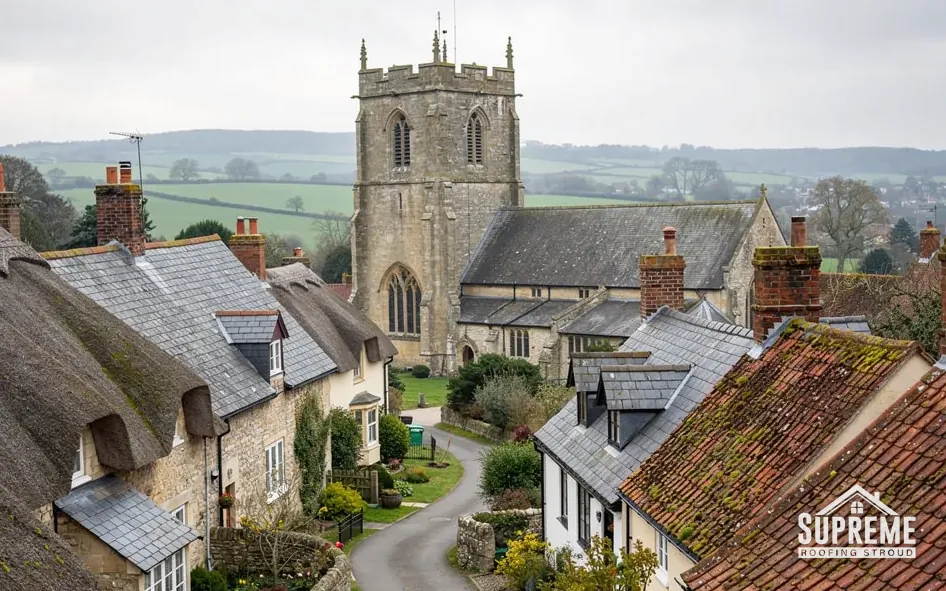
Roof work in Ashton Keynes, where the young Thames splits into channels beside the village and gravel lakes now fill about half the parish.
Ashton Keynes at a glance
- Distance
- 18.1 road miles east-south-east of Stroud
- Council
- Wiltshire Council
- Conservation area
- Ashton Keynes village
- Setting
- Upper Thames gravel plain in the Cotswold Water Park
Ashton Keynes, a village among Thames channels and lakes
Ashton Keynes is 18.1 road miles from Stroud, out toward the east-south-east, and sits inside the Cotswold Water Park. The River Thames runs through the village on both sides, split into several channels, about 6.5 miles from its source at Thames Head. A great deal of the surrounding land is water of one kind or another, and that colours every roofing conversation we have here.
Gravel extraction began around 1944, and by 2010 the lakes it left behind covered about half the parish. The place was settled long before that. Domesday records it in 1086 as Essitone, it passed to Tewkesbury Abbey in 1102, and a 12th-century moated ringwork stood just north of the village. So the old village sits in a landscape that was rebuilt around it, with historic buildings, gravel pits turned lakes, and the young river all within a few minutes' walk.
One fact matters for any owner. Ashton Keynes has a designated conservation area, named after the village and administered by Wiltshire Council. The Grade I church of the Holy Cross is built of coursed limestone, and the village's four medieval crosses are scheduled monuments. On an ordinary house the survey establishes the covering, and the photographs we take show you its condition and the details that matter.
What the setting does tell us is that water is never far away. We pay attention to where gutters discharge, to shaded slopes that hold moisture, and to low roofs that collect debris from nearby trees.
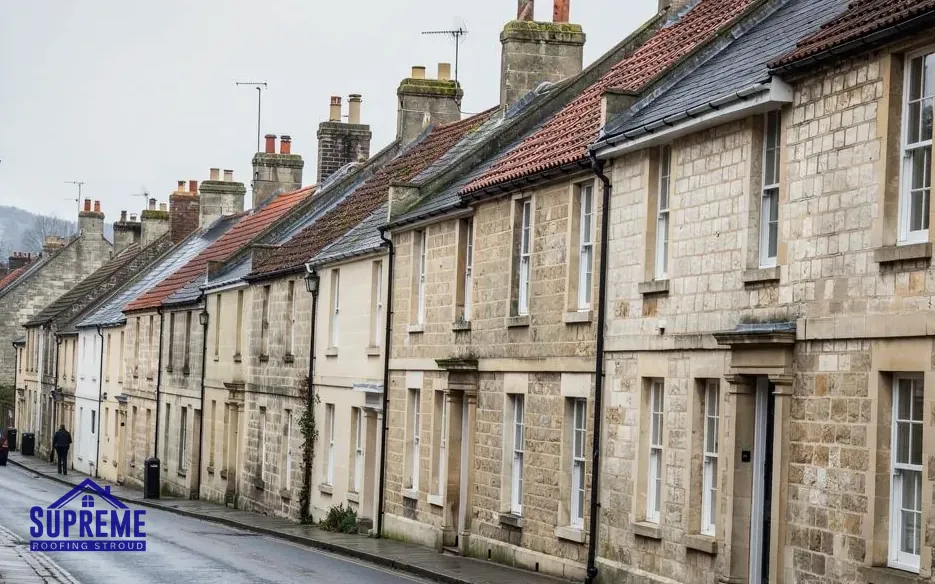
Street of stone terraced houses with slate and clay tile roofs 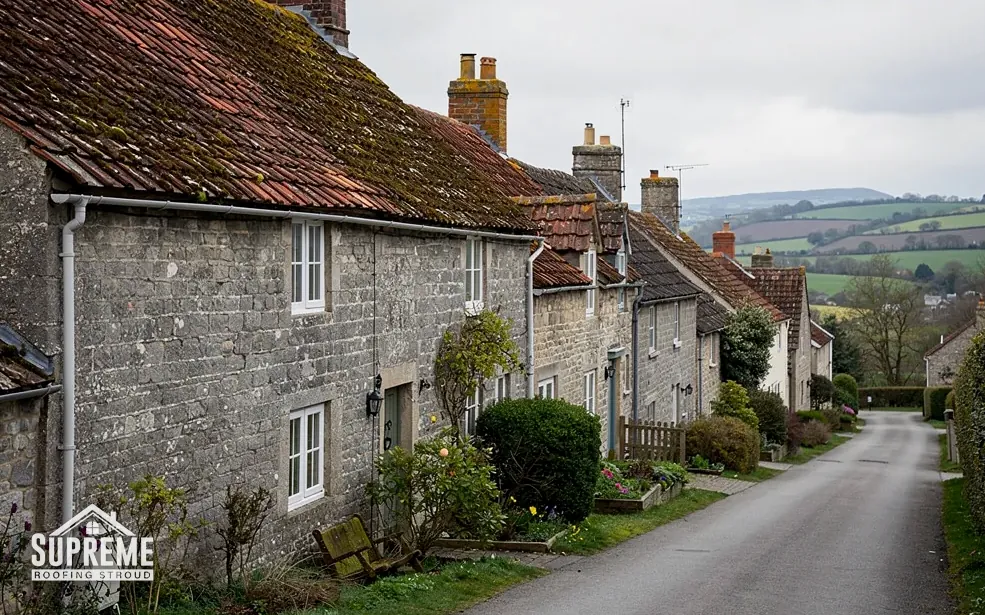
Row of stone cottages with mossy clay tile roofs along a quiet lane
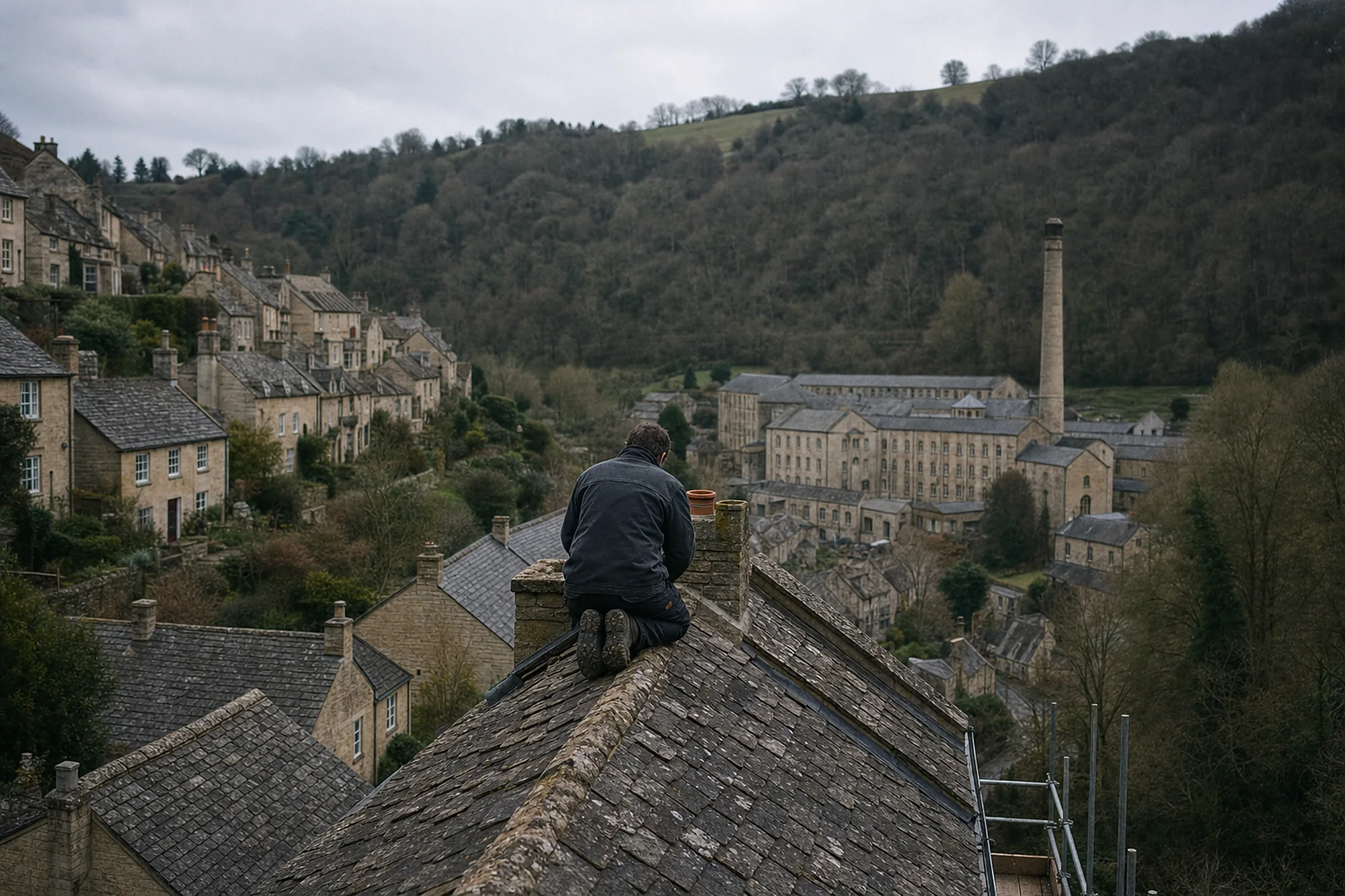
Chapter 01
A village that stands beside the Thames in many channels
With water on every side, moss, damp and blocked drains are the jobs that come first.
Chapter 01In this chapter
The Thames at Ashton Keynes is not one river but several, braided around the village. Houses back onto streams, lanes cross small bridges and many gardens end at the water. For a roof, that means two things. Air near water tends to stay damp, and trees and hedges along the banks drop leaves into gutters and onto slopes.
Those are maintenance conditions rather than defects, and the answer is regular attention. Moss builds on a covering that stays damp, and it lifts the edges of tiles or slates when it grows thick, which lets water run underneath. Debris in a valley or a gutter slows the flow, then dams it, and overflow soaks the wall below. A tile roof can be cleaned and re-pointed. A blocked valley can be cleared. Both cost far less when caught early than when the water has already reached the plaster.
MyBuilder (2026) gives a manual scraping rate of £5 to £10 per square metre for moss, and a soft wash at £15 to £20. Pressure washing is listed at £10 to £15 but is flagged as something that may damage delicate tiles, so on an older roof we would choose the gentler method. Our roof cleaning and moss removal page explains each approach and when we recommend a wash or a scrape.
Leaves, banks and valleys
Houses that back onto a bank often have trees at the end of the garden. A valley gutter, where two slopes meet, is where leaves collect first, and it is also the part of a roof where a small blockage does the most harm. We look at valleys with a ladder rather than from the ground, because they can look clear from below and be packed with silt above. We also check the roof edge where a hedge or branch touches the covering, since rubbing wears tiles and slates and the branch holds moisture against them.
What the survey looks for beside water
We begin at the ridge and work down: loose or missing ridge tiles, tilting slates or tiles, cracked pointing at verges and lead around the chimney that has curled away from the brick. Then we check the gutters for sagging, rust or joints that weep, and the downpipes for blockages at the base. A damp patch on an inside wall can be a roof fault, a gutter fault or a plumbing fault, and the photographs help sort out which. When we send them with the quote, we mark what we found against what we recommend.
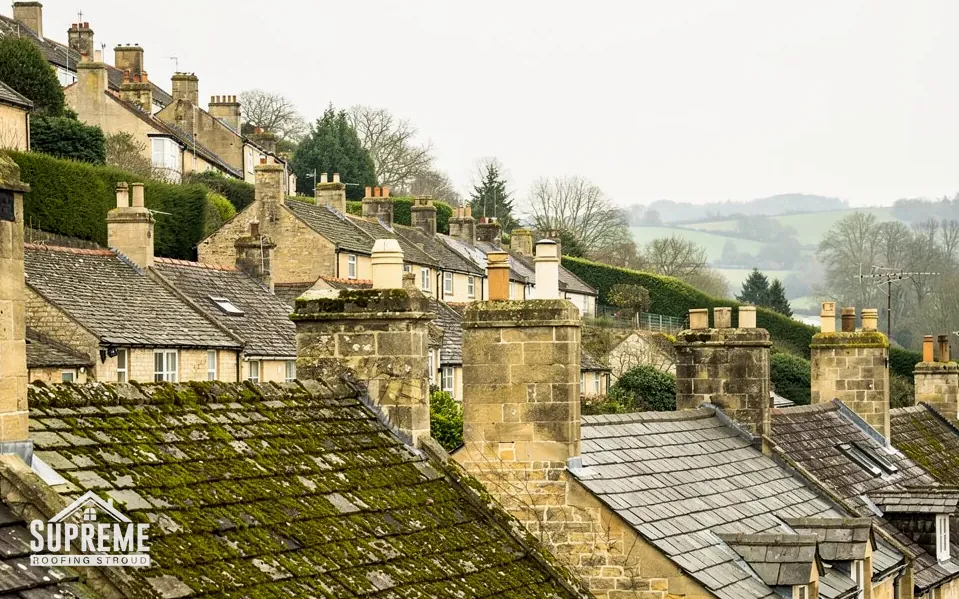
If you are unsure whether you have a problem at all, a survey is a better start than a repair. MyBuilder (2026) gives a national range of £150 to £500 for roof inspections, and our roof inspections and surveys page describes what a visit covers.
Where air stays damp, a roof needs looking at before it needs fixing.
Chapter 02
Gravel lakes, new houses and the flat roofs behind them
A parish reshaped by extraction has seen extensions and outbuildings where fields used to be.
Chapter 02In this chapter
The lakes of the Cotswold Water Park did not exist before the gravel was dug. Extraction in this parish began around 1944, and by 2010 the water covered about half the land. The result is a parish whose edges are lined with lakes, with homes and outbuildings in a setting that was once farmland.
In this chapter
Here, as anywhere, extensions, garages, garden rooms and porches tend to be covered with flat or shallow roofs, and those fail differently from a pitched covering. Water lies on a flat roof for longer. A small fault in the membrane, an upstand that has lifted or an outlet that has blocked shows up quickly as a stain on a ceiling. The usual materials are built-up felt, EPDM, which is a synthetic rubber sheet, GRP, which is glass-reinforced plastic, and single-ply PVC.
Lifespans are typical ranges, not promises. Flat roofs generally last between 15 and 30 years according to MyBuilder (2026). EPDM is commonly quoted at 20 to 30 years or more, GRP at 25 to 40 years, and a good felt job at up to 20 years. Condition and workmanship decide where a given roof lands in those ranges.
On a flat roof the first measurement is the fall. The recommended minimum finished fall is 1:80, and BS 6229 expects roofs to be designed for 1:40 to allow for tolerances and deflection. A roof that ponds after rain may need tapered insulation, a new outlet or a new deck, and the survey says which. Our flat roofing page sets out each material and the typical national prices.
Where extensions meet the old house
The junction between an extension and the original wall is the most likely place for a flat roof to leak. We check the upstand, the flashing that covers it and the first run of covering beside the wall. A flat roof that is otherwise sound can still admit water here, and the repair is often a matter of reforming a detail rather than replacing the whole roof. If the survey shows that a patch will hold, we will tell you that, and if it shows that a new covering is the better value, the photographs make the case.
Garages and outbuildings
Garage roofs on older properties may be asbestos cement, which is non-licensed work when removed carefully and unbroken, according to HSE guidance. Before quoting we inspect the sheets and note how the cement sheets would be lifted off, where they would be taken and what goes up in their place.
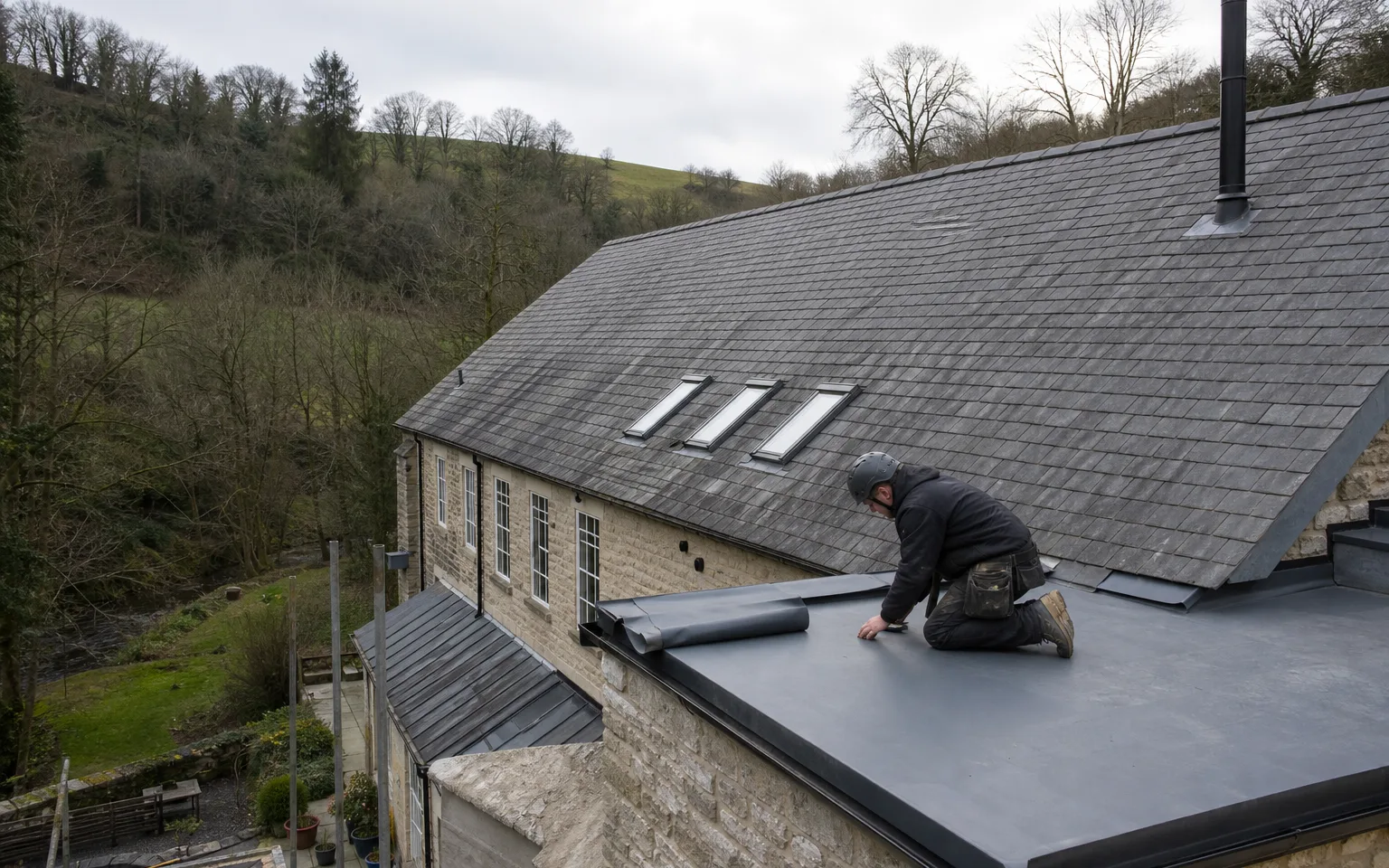
- Bitumen felt£70 to £100 per m²
- EPDM£90 to £130 per m²
- PVC single-ply£95 to £140 per m²
- GRP£95 to £150 per m²
Chapter 03
Holy Cross church, four medieval crosses and the conservation area
A Grade I church and a protected village centre set the rules for how old roofs are treated.
Chapter 03In this chapter
The Church of the Holy Cross has stood in Ashton Keynes since the late 12th century. It is built of coursed limestone, was restored by William Butterfield in 1876 to 1877, and was listed Grade I in 1955. The village also has four medieval crosses, each a scheduled monument, including a churchyard preaching cross that now serves as the war memorial.
In this chapter
For roof work, the church sets a clear rule. The ecclesiastical exemption covers a church in use, so the diocese issues a faculty for its roof and no listed building consent is involved. A house is different. If your house is listed, consent for works that affect its character comes from Wiltshire Council. If it is not listed but stands within the conservation area, ordinary repairs that restore what is there are normally simple, whereas an altered roofline or new covering type deserves an early call to the planners.
Re-roofing in the same material and appearance does not usually count as development in planning terms. A different material, a new roof feature or an added dormer is another matter. Dormers do not benefit from permitted development rights in a conservation area, which means a loft conversion with a dormer calls for a planning application. Our roof windows in a conservation area guide explains what applies to rooflights.
The older centre
The village record runs back to Domesday and a 12th-century ringwork, but what matters on site is simpler: older buildings carry older details, such as thick walls, deep eaves and chimneys that have been rebuilt more than once. We read those details before we plan the work, and we ask you what you know of the building's history. Previous repairs, extensions and changes to the loft all affect how the roof should be handled.
Why like for like matters here
A conservation area exists to protect the look of a place as a whole. In a village where houses, church and crosses sit close together, one roof in the wrong colour or the wrong profile shows from the lane. So we keep old coverings in their own material, match colour and size when units must be replaced, and photograph ridge, verge ends and eaves so the new work follows the old lines.
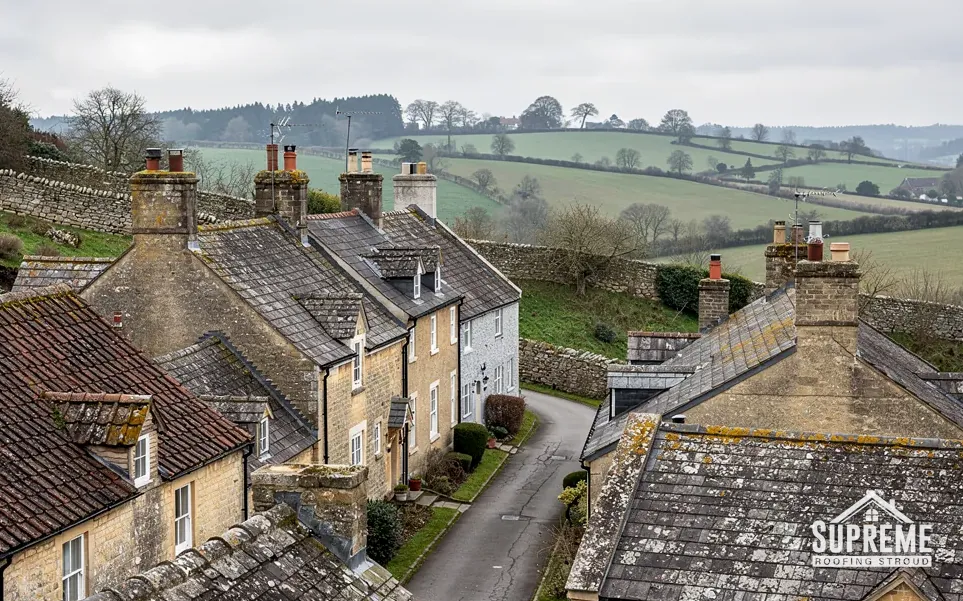
The survey photographs go with a written quote covering scaffold, strip-out, new materials, labour, waste and making good. Our workmanship carries a 10-year guarantee in writing. Ring 01453 933613, message on WhatsApp, or send the enquiry form on this page.
Map showing Ashton Keynes and the Stroud service radius, with nearby towns we also cover.
Near Ashton Keynes
Roof work we do here
Thames channels and gravel lakes in Ashton Keynes
Does living beside the Thames channels in Ashton Keynes mean more moss on my roof?
Damp air and overhanging trees help moss take hold, especially on shaded slopes. We look at the north-facing and tree-side slopes first and recommend a scrape or a gentle wash rather than a pressure wash that could damage older tiles.
My Ashton Keynes house is in the conservation area. Can I replace the roof covering?
A like-for-like replacement is normally straightforward. A switch of covering, or something new on the roof, is worth running past Wiltshire Council's planning team first, and a listed house needs listed building consent.
Who authorises roof repairs to the Church of the Holy Cross?
While services are held there, a diocesan faculty covers the church roof, and the council's consent route does not apply. The four medieval crosses are scheduled monuments, so work on them needs scheduled monument consent, which Historic England administers.
My flat-roofed extension keeps ponding after rain. What should I check?
Ponding usually points to too little fall, a blocked outlet or a sagging deck. The recommended minimum finished fall is 1:80, so we measure the slope and the outlet before suggesting patch repair, tapered insulation or a new covering.