
Roofers in Minety
Roofing in Minety, 19.4 road miles south-east of Stroud, a clay-vale village that once made its own ridge tiles and later spread out along the railway.
Minety at a glance
- Distance
- 19.4 road miles south-east of Stroud
- Council
- Wiltshire Council
- Church
- St Leonard, Grade I (1959)
- Setting
- Clay vale near the infant Thames
Minety's roofs: pottery clay, the Swill Brook and the railway
Minety lies in north Wiltshire between Malmesbury and Swindon. The Swill Brook forms part of its northern boundary and joins the infant Thames near Ashton Keynes, and the land is a clay vale beside the old Forest of Braydon. For a roofer, the clay is the interesting part. The local clay was suitable for firing, fuelled by timber from the Forest of Braydon, and Minety ware pottery and ridge-tiles were made here in the 14th and 15th centuries. Few villages can say that the very part of the roof that fails most often was once made on their own doorstep.
The village is in two parts. Upper Minety grew around the parish church, while Lower Minety grew after the railway arrived, with the station serving the village from 1841. The Church of St Leonard was built in the 15th century, restored in 1896, and has carried a Grade I listing from 1959.
Whether a given cottage keeps an old-style ridge or a modern one, we treat every ridge the same way: look at how it is fixed, whether it is bedded or dry-fixed, and what has become of the mortar. Minety is not one of Wiltshire's conservation areas, but listing status is worth confirming with Wiltshire Council before work starts on an older house.
Each survey ends with a dated set of photographs and a ranked list of faults, most pressing first.

Detached red brick Edwardian house with mock-Tudor gables and a tiled roof 
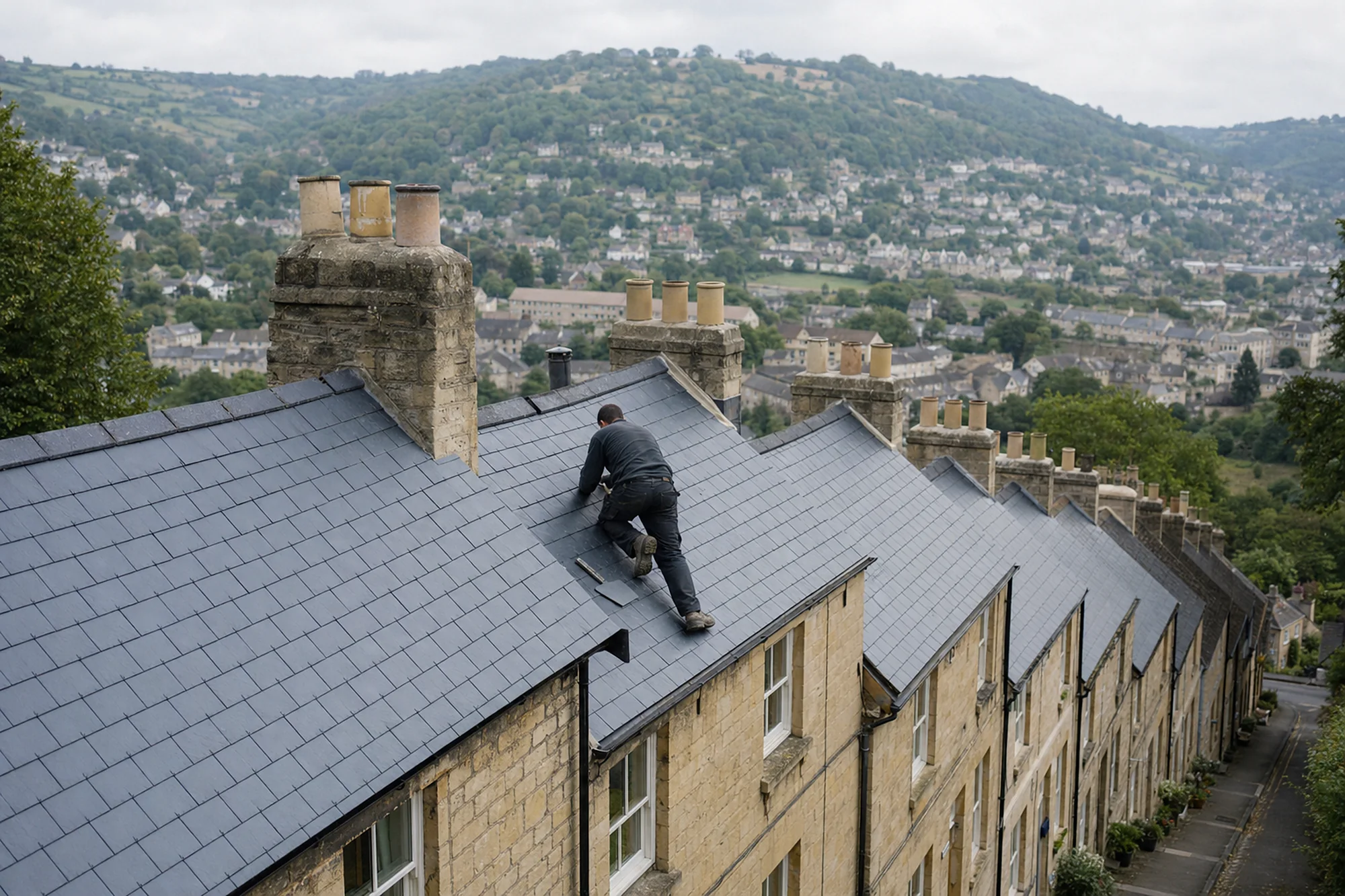
Stone terraced houses with slate roofs and chimneys stepping up a hill
Chapter 01
Minety ware and the long history of the ridge tile
A village that fired its own ridge-tiles in the 14th and 15th centuries, and what holds a ridge on today.
Chapter 01In this chapter
A ridge-tile does a simple job. It sits along the apex, closing the gap between the two slopes and throwing water off to either side. Minety's potters were making them, along with other pottery, in the 14th and 15th centuries, firing the local clay with timber from the Forest of Braydon. The fashion for fixing them with mortar is much older than any modern standard, and it explains why the ridge is still the most mended part of many roofs.
In this chapter
The modern position is clear. BS 5534 was revised in 2014, and since then a ridge cannot rely on mortar's own strength to stay put, so a bedded ridge or hip now gets screws, clips or straps as well. A mortar-bedded ridge can still be repaired, and we do not call mortar banned. But a ridge that has cracked, dropped a tile or lost its pointing is a good moment to talk about a mechanical fixing, and BS 8612 is the test specification that dry systems must meet.
What we look at on a ridge
From a ladder or a tower we check each tile for cracks, then the mortar for hairline gaps, then the line of the ridge for dips, which can signal a sagging timber below. We also look inside the loft with a torch for daylight at the ridge and for stained timber, since either points to water getting in. A ridge that has been repointed more than once may be carrying a lot of old mortar, and the weight of it is one more reason to consider a lighter fixing.
Reading the history on a roof
An older roof can carry several repairs from different decades. A ridge tile of a different colour, a patch of newer mortar, a run of tiles laid with a different overlap: each is a clue to what has been done, and we record it. Our guide to heritage ridges explains how an older ridge is handled, and our ridge, verge and dry-fix service covers the fixings in detail. Our written 10-year guarantee applies to the workmanship on any ridge we fix.

A ridge that has been mended with mortar for centuries now needs a mechanical fixing too.
Myth: Mortar has always held ridge tiles on, so it must be good enough.
Fact: Since the 2014 revision of BS 5534, mortar's tensile strength alone is not relied on, and ridge and hip tiles are fixed mechanically too.
Chapter 02
Upper Minety, Lower Minety and the 1841 railway
Two halves of one village, grown around different anchors, and the questions each half raises overhead.
Chapter 02In this chapter
Minety is not one cluster of houses but two. Upper Minety grew around the parish church, and Lower Minety grew after the railway arrived, with the station serving the village from 1841. That gives us a rough order to work from. The upper village is the older settlement, and the lower village grew later because of the line, so the parish church and the station are two reference points for the village's age.
What the pattern gives is a way to organise a survey. In the area round the church, the right first question is how old the roof structure is, because an old frame can hide earlier coverings, extra nail holes and hand-cut timber that has seen several re-roofs. In the lower village, the right first question is when the roof was last covered, because a roof of the railway-era or later tends to have had one or two coverings and may be due for its next. We ask about both when we visit, and the written report records what we find rather than what we expect.
Lead, flashings and the age of a stack
Chimney stacks and the lead around them are the parts of many roofs that outlast a covering. A stack that has stood a century or more may still be sound while its flashings are not. We check the junctions around any stack for lifted lead, gaps in the pointing and cracked flaunching, which is the sloping mortar cap that holds the pots. The repair for a failed flashing is usually small, and our ridge and verge work and our guttering, soffits and fascias service often go together on the same visit.
When a church roof is involved
St Leonard's church was built in the 15th century, restored in 1896, and has carried a Grade I listing from 1959. Because the church is still in use for worship, its roof work does not go to the council. It goes to the diocese, which can grant a faculty, whereas a house or former chapel would need listed building consent. Houses and former chapels do not share that exemption. If you own an older building near the church, ask Wiltshire Council about its status before you plan any roof work, and keep the answer with your papers, because a future buyer's solicitor may ask for it.
| Part of the village | How it grew | First roof question |
|---|---|---|
| Upper Minety | Around the parish church | How old is the roof structure? |
| Lower Minety | After the railway arrived; station from 1841 | When was it last covered? |
| St Leonard's Church | Built in the 15th century, restored in 1896 | Who authorises the work? |
| Northern edge | Swill Brook marks part of the boundary | Where does the roof water go? |
Chapter 03
A clay vale near the Thames: gutters, drainage and moss
Low, flat ground by a brook asks different things of a roof than a hillside does.
Chapter 03In this chapter
Minety stands in a clay vale near the infant Thames, where the Swill Brook marks part of the northern boundary and carries the parish's water on to the infant Thames near Ashton Keynes. On a survey near the brook we check where each downpipe discharges, whether into a gully, a soakaway or straight onto the ground, and we note any staining at the foot of the wall that shows where water has stood. Low, flat ground beside a brook changes the practical side of roof work, and the first visit is where we find out exactly how it affects your job. Mention how soft the ground is round the house when you call, so the right boards and bases are on the lorry. There is no slope to take a ladder's weight, so ladder feet and scaffold bases are set on boards on soft ground. There is no hillside to deliver materials from above. And water leaving the roof has nowhere downhill to go, so the gutters, downpipes and soakaways around a house matter more than the covering above them.
In this chapter
That makes drainage the first thing we look at on a Minety survey, ahead of the covering, the ridge or the stacks. A roof that sheds water badly will undo any repair above it, and a gutter that has been left to fail can stain and soften a wall as surely as a broken tile. Gutters sag, joints open, and downpipes block with leaves and moss. If water is spilling over the edge of a gutter it lands on the wall or the ground beside it, and on clay that soaks slowly it can pool close to the foundations. A repair is usually a case of realigning, refixing or replacing a short run, and our guttering service covers each length.
Moss and shade
Roofs that sit under trees or beside hedges stay damp for longer and collect moss. Moss keeps the covering wet and can lift tile edges, which makes clearing it sensible upkeep. MyBuilder's roof cleaning guide gives manual scraping at £5 to £10 per m², soft wash at £15 to £20 and pressure wash at £10 to £15, and warns of damage to delicate tiles from pressure washing. Our roof cleaning and moss removal service explains which method suits which covering.
Putting it in the quote
Following the survey, the written quote deals with scaffold or tower, cleaning or repairs, materials, labour and clearing the site. Photographs of your own roof sit beside the quote, so you can match it to what we saw up there.

- Manual scraping, per m²£5 to £10
- Pressure wash, per m²£10 to £15
- Soft wash, per m²£15 to £20
Map showing Minety and the Stroud service radius, with nearby towns we also cover.
Near Minety
Roof work we do here
Pottery clay ridge tiles and Lower Minety
Minety once made ridge-tiles. Does that change how a ridge here is repaired?
The history is a good story, but the repair follows whatever is on the roof. We look at how the ridge is fixed, then replace tiles to match and add a mechanical fixing where mortar has failed, in line with BS 5534.
Does a house near St Leonard's Church need special consent for roof work?
Only if the building itself is listed or covered by a local control. St Leonard's holds a Grade I listing of its own, which does not pass to the houses nearby, so each building is checked individually. Wiltshire Council can confirm the status of any older house before work is planned.
I live in Lower Minety. Is my roof likely to need attention because of its age?
Age alone tells us little. Lower Minety grew after the railway arrived, but that does not date any one house. We look at the roof itself, the covering, the fixings and the ridge, and write up what we see.
Why do you check the gutters first on a flat, low-lying plot?
Because with no slope to carry water away, overflow from a failed gutter collects beside the house. Fixing the drainage is usually less costly than repairing what the overflow has damaged, and it is often one of the smaller costs.