

Roofers in Brinkworth
Roofing in Brinkworth, 21.4 road miles from Stroud to the south-east, where brick, stone and a long line of houses between two brooks leave no single roof type to assume.
Brinkworth at a glance
- Distance
- 21.4 road miles south-east of Stroud
- Council
- Wiltshire Council
- Church
- St Michael and All Angels, Grade I
- Setting
- Clay ridge between Brinkworth brook and Woodbridge brook
Brinkworth's roofs on the ridge between two brooks
Brinkworth stands on a ridge between Brinkworth brook and Woodbridge brook, along the Swindon to Malmesbury road. The parish sits on Oxford Clay for the most part, which is where the Victoria County History begins its description. A village built on a ridge between two streams and along a through road has an obvious shape, and that shape governs how a roof job is run here.
The same history makes a point that matters to any roofer: the older houses are built of a variety of materials. Red brick is recorded at Clitchbury Manor and Box Bush House, and stone at Brinkworth House. We therefore refuse to generalise. A Brinkworth survey starts from what is in front of us, and the quote follows the findings, with no assumption about brick, stone, tile or slate until the photographs are taken.
The village has also grown in stages. Council houses were built in 1934 and 1938, and Brooklands, an estate of 35 council houses, followed about 1953. Private houses have appeared since about 1970, and by 1989 the village formed a continuous line of building from Causeway End to the Suffolk Arms. St Michael and All Angels, the parish church, has a 15th-century tower and a Grade I listing.
Any older house in the village is worth checking with Wiltshire Council for conservation area or listing status before changes are planned.

Hillside of stone terraced houses with mossy stone tile roofs and chimneys 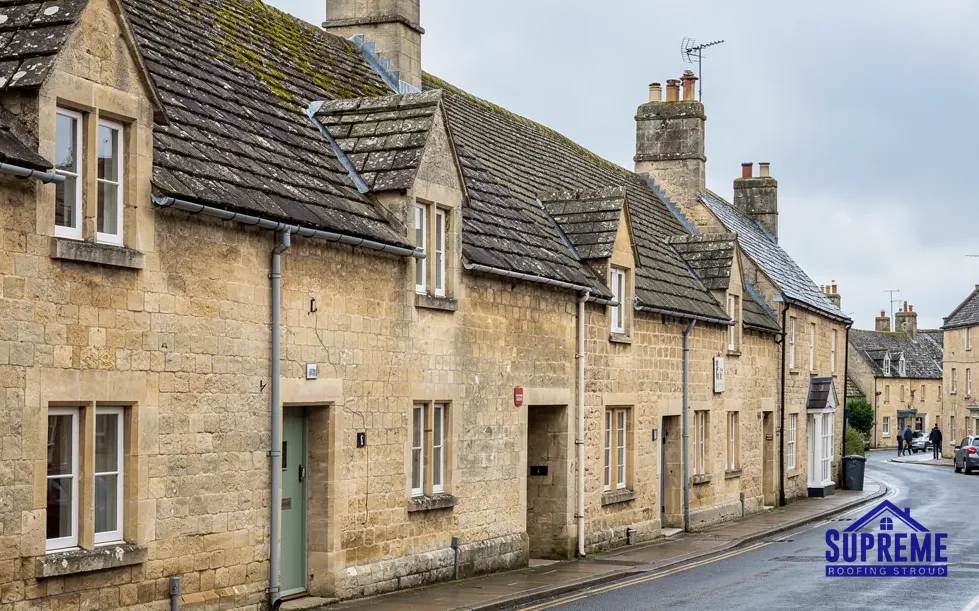
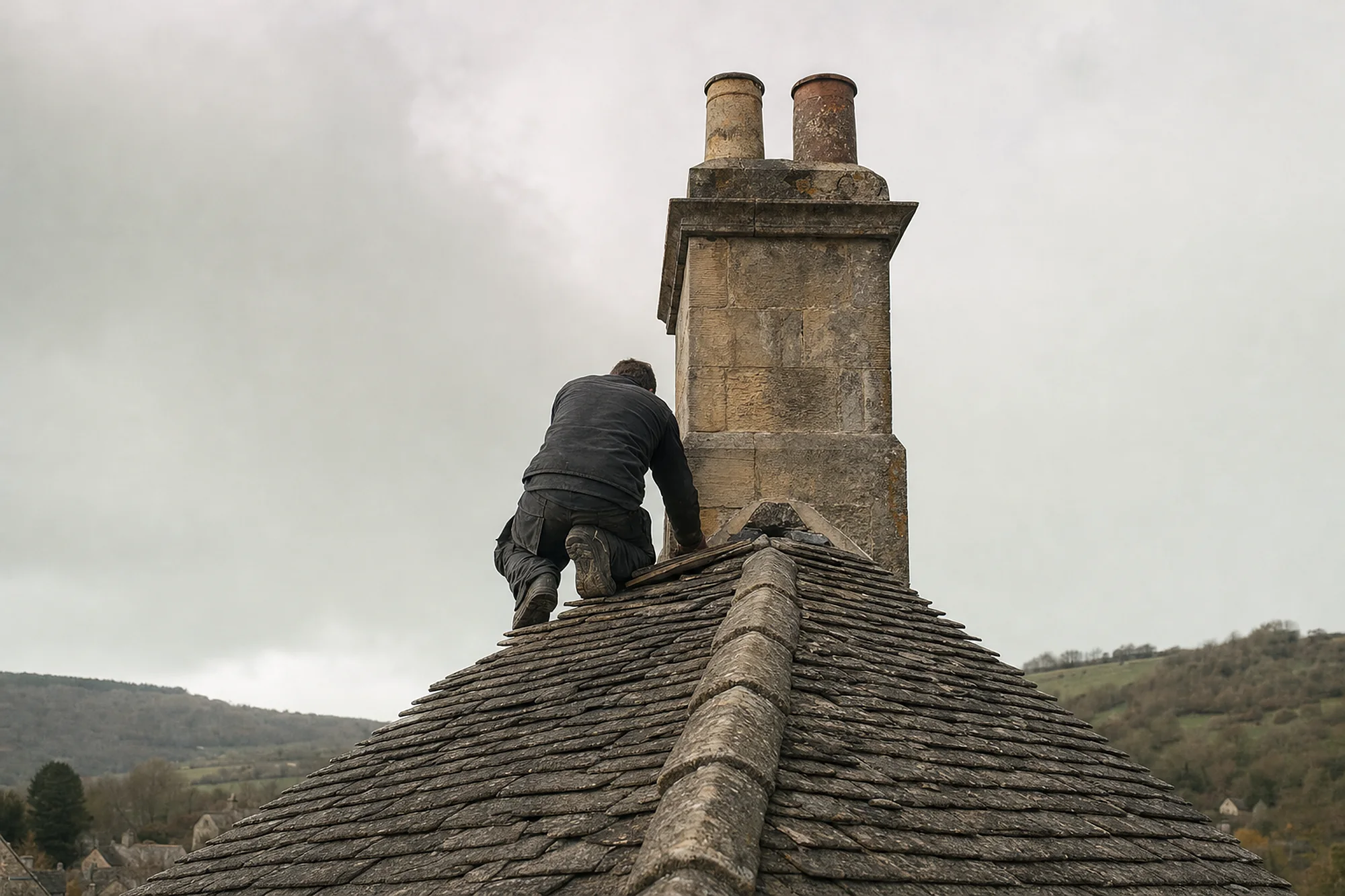
Terrace of stone cottages with dormer windows and stone tile roofs
Chapter 01
Red brick at Clitchbury and Box Bush, stone at Brinkworth House
When the older houses use a variety of materials, matching like for like starts with finding out what each one is.
Chapter 01In this chapter
Three houses named in the County History show the range: red brick at Clitchbury Manor and Box Bush House, and stone at Brinkworth House. Box Bush House was built of red brick in the early eighteenth century and Brinkworth House in stone between about 1840 and 1884, so their roofs come from very different building habits. What the three tell a roofer is that two building traditions share the parish, and that a repair designed for one will not necessarily suit the other.
Brick and stone behave differently where they meet a roof. Brick stacks are made of small, regular units bedded in mortar, with joints that weather and need repointing as the years go by. Stone stacks and gables use bigger, irregular blocks, and their weak points are more often the bedding of copings and the verge. In both cases the junction between masonry and roof is lined with lead, and in both cases it is the flashing, not the covering, that is the commonest first sign of trouble. A soaker, the small piece of lead tucked under the covering at the edge of a wall, can lift or split where the masonry has moved.
What like for like means across two materials
On an older house we price the same covering you already have, in the same style and at the same pitch, unless you ask for a change and the planners agree. If a roof has lost a few slates or tiles, we try to match colour, size and thickness, and we explain when a perfect match is not available. If the house is listed, an alteration touching its character requires listed building consent, and the roof is no exception.
Stacks, pots and flaunching
A chimney stands higher than any other masonry on the house, and it tends to show age first. We look at the pointing, at the flaunching that fixes the pots, and at the lead. Our chimney repairs service handles repointing, flaunching and flashing repair. For a house with a roof covering that has simply run out of life, our roof replacement service strips and relays, stage by stage.
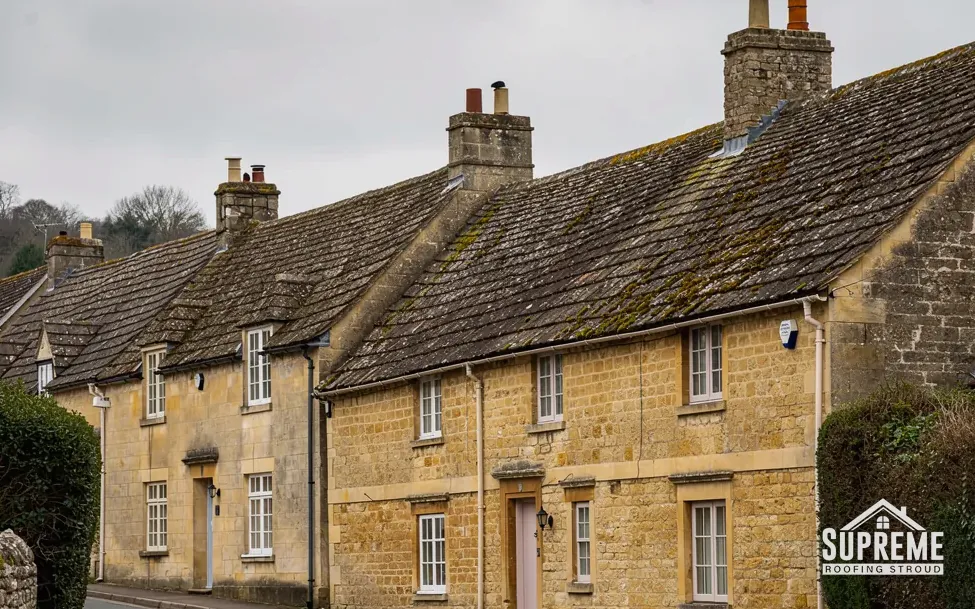
Where materials are mixed, start by finding out which one you have.
| House | Material recorded | What we check first |
|---|---|---|
| Clitchbury Manor | Red brick | Stack pointing and flashings |
| Box Bush House | Red brick | Gable and verge junctions |
| Brinkworth House | Stone | Copings and abutments |
Chapter 02
From Causeway End to the Suffolk Arms
A village that formed one continuous line of building changes how a scaffold, a skip and a delivery are planned.
Chapter 02In this chapter
By 1989 Brinkworth formed a continuous line of building from Causeway End to the Suffolk Arms, along the Swindon to Malmesbury road. Ribbon development like that has a very simple geometry: the road is at the front, the back garden is at the rear, and the house in between is often only one room deep. What that means for a roofer is that the front of the house is on a through road, and the back is a long garden, so the choice of where to put the scaffold, the skip and the stack of new material is a real decision.
If the road side is busy, the scaffold may stand on a footway that needs a licence, and a skip on the carriageway needs a permit. If the garden side is quieter, the scaffold can go there, but then every load of tiles has to be carried through the house or round the side, and the old covering has to leave by the same route. We look at both options at the survey, quote for the more economical workable one and give the reason beside it.
We also take account of what sits at the back of each plot. Outbuildings, lean-tos and old coal stores are common on long gardens, and their roofs are sometimes forgotten until they leak. A survey that covers only the house misses them, so we ask about every roof on the plot and include each one if you want it.

The ridge between the brooks
Brinkworth brook and Woodbridge brook run either side of the ridge, and the parish is on Oxford Clay for the most part. Clay takes rain in slowly, so the ground beside a house can stay wet long after a storm has passed. What we do watch is where roof water goes: downpipes that discharge into poorly draining ground, gullies that silt up, and soakaways that no longer take the flow. A sound roof can still cause trouble if its water has nowhere to go, and on clay, drainage can be slow.

Why a long frontage helps the survey
Reading a line of roofs from the road is the quickest way to spot differences between neighbours: a ridge that has dipped, slates that have slipped, a stack that leans. We do that walk before we climb anything, and it tells us where to look closely once we are up there.
A line of houses means neighbours on both sides and often a shared roof run. A leak at one house may begin at the next, where a party wall flashing or a shared valley has failed. We trace the water back along the line and photograph the junctions, which saves the cost of repairing the wrong place. Our roof repairs service is built around finding the real cause before quoting for the visible damage.
Chapter 03
Council houses of 1934 and 1938, Brooklands and the post-1970 houses
Three phases of building from the 1930s onwards, and the age-related checks that go with each.
Chapter 03In this chapter
The County History records Brinkworth's housing growth in clear phases. Council houses were built in 1934 and 1938. Brooklands, an estate of 35 council houses, came about 1953. New private houses have been built mostly since about 1970. Those three phases give us three sets of questions.
For the 1930s houses the question is continuity. A roof from that decade may well have had two or three coverings already, with timbers that have outlived the nails holding the battens to them. We press on the battens, check the nailing, look at the lead round each stack, and study the ceilings below for old tide marks. At Brooklands, 35 houses built to the same pattern raise a more practical point: the roofs share a design, so a neighbour's repair is useful evidence about yours, and anyone planning a re-roof can compare quotes on near-identical jobs.
Extensions are the other thing a century of building leaves behind. A flat-roofed porch, a lean-to kitchen or a single garage added to a council house years after it was built tends to have the shortest-lived covering on the property. We treat those as a separate section of the survey, so that a failing felt roof over a back kitchen does not drag the cost of a sound main roof into the same figure.
Houses from about 1970 onwards
The newest phase is the least settled. Houses of that era may carry mortar-bedded ridges, felt-type underlays and timber fascias, all of which age at their own pace, and the oldest of them are now many decades into their lives. Our guttering, soffits and fascias service covers the boards and gutters that tend to need attention before the covering does.
- 1934year council houses were first built, with more in 1938
- 35council houses on the Brooklands estate, built about 1953
- 1970approximate year new private building began in earnest
A church that changed its saint
The History notes that the parish church was dedicated to St Michael by 1763, having been St Peter in 1248 and 1512. Its stone rubble walls, ashlar dressings and tall 15th-century tower mean any work on its roof starts with the authorising body, because worship keeps a church out of the council's hands and routes its roof work through the diocese, by faculty. A house next door is different. For that, we explain which consents apply, take care of the Building Regulations notification where it is needed, and take our waste away when we leave. The workmanship carries a written 10-year guarantee.
Map showing Brinkworth and the Stroud service radius, with nearby towns we also cover.
Near Brinkworth
Roof work we do here
Clitchbury Manor brick and Brinkworth House stone
My Brinkworth house is red brick. Does that alter the way the roof gets repaired?
Brick stacks and gables weather through their pointing and flashings, so the repair usually focuses on those junctions before the covering. We match the existing covering and note any change of style in the quote.
Do the Brooklands houses need their roofs done together?
Not necessarily, but a group of 35 houses built about 1953 tends to age at a similar rate, so a fault on one roof is often worth checking for on its neighbours. We can compare notes with the owner next door if both agree.
Will a house on the main road through Brinkworth need a scaffold licence?
If the scaffold must stand on the public footway, a licence is needed, and the same applies to a skip on the road. We check the frontage at the survey and apply once a start date is fixed.
Brinkworth sits between two brooks. Does that affect the guttering?
Ground on clay can be slow to drain, so we check that downpipes discharge cleanly and that gullies are not silted, because water that stands against a wall finds its way into the building. A short run of new guttering is often among the smaller improvements worth making.