
Roofers in Lyneham
Lyneham's roofs belong to a village first recorded in 1224, a parish church from the 14th century and a flying station that shaped the place from 1940 until 2011.
Lyneham at a glance
- Distance
- 25.5 road miles south-south-east of Stroud
- Council
- Wiltshire Council
- Setting
- North Wiltshire village beside the former RAF Lyneham airfield
- Parish church
- St Michael and All Angels, 14th century
Lyneham's roofs: a priory parish that became an airfield village
Lyneham has a documented past that runs a long way back. The Domesday Book of 1086 recorded 42 households at Stoche, in the north-west of what is now the parish, and Lyneham itself first appears in 1224. Bradenstoke Priory was founded close by in 1142, and a church at Lyneham that belonged to the priory is mentioned in 1182. The building standing today, St Michael and All Angels, was put up in the 14th century, and its chancel was rebuilt in 1862 to 1865 by William Butterfield.
The modern village has a second origin story. In 1940 a large area of farmland became an RAF station that reached close to the western edge of the village. The C-130 Hercules fleet was based there until June 2011, and the site is now MoD Lyneham, home to the Defence Technical Training College, operational since September 2015. The church was listed at Grade II in 1955, in an entry that names it together with the RAF Chapel.
For a roofer, that history means two things. The parish has some very old buildings, and it has a long record of change at its edge, which tends to leave a mix of building types close together. We do not guess what covers a given house from the village's story. We climb up, look, photograph it and write down what we find. Wiltshire Council is the planning authority for Lyneham. The road distance from Stroud is 25.5 miles, so we book the survey for a fixed date with you.

Detached red brick Edwardian house with mock-Tudor gables and a tiled roof 
Stone terraced houses with slate roofs and chimneys stepping up a hill
Chapter 01
From 1940 to 2011: an RAF station, then a training college
A site that changed hands twice leaves roofs of every size and owner nearby.
Chapter 01In this chapter
For seven decades the airfield was the biggest single fact in Lyneham's landscape. The station opened in 1940, and the Hercules transport fleet stayed until June 2011. In September 2015 the site became operational again as the Defence Technical Training College. That sequence matters to the village because a place that loses one large employer and gains another ends up with homes, workshops, storage units and agricultural sheds that were built, sold and re-let on different timelines.
In this chapter
Work on land that the Ministry of Defence manages follows its own arrangements, so this page is about the homes, farms and small commercial units in and around the village. If you look after a unit or a block with a large, low-pitched roof, the questions are different from those on a house. We ask how the water leaves the roof, whether the falls are enough and whether the covering is a single sheet or a built-up layer system.
BS 6229 asks for a design fall of 1:40, which leaves a finished fall of 1:80 once tolerances and deflection are taken up. Ponding water on an existing roof therefore points to a deck that has moved or an original build that was set too flat. National cost guides from MyBuilder put a replacement felt roof at £70 to £100 per m², EPDM at £90 to £130 per m² and GRP at £95 to £150 per m². Those are typical UK ranges, not quotes. A survey fixes the actual area, the roof access and the number of outlets.
Units that have changed hands often carry a layered history on the roof: a membrane laid over an older membrane, a patch near an outlet, a rooflight added later. When we find that, we say which layer is doing the work and which is only holding water in. Stripping to the deck costs more on the day but removes the doubt, and the quote sets that choice beside the overlay option so you can weigh both.
Sheds, barns and sheet roofs
Corrugated sheets are a familiar covering on sheds and barns in the countryside, and some older ones are asbestos cement. Sheets that are intact can be lifted off with care and bagged under HSE's non-licensed rules; once they are cracked or broken up, the job becomes notifiable and is planned differently. We assess the sheets before any date is set. Our commercial roofing page covers the larger roofs, and the flat roofing page explains falls, outlets and coverings.
A puddle that outlasts the rain is the roof reporting on its own falls.
- 1940farmland became an RAF station beside the village
- June 2011the month the C-130 Hercules fleet's time there ended
- September 2015the Defence Technical Training College became operational
Chapter 02
Bradenstoke Priory, St Michael's and the older parish
Medieval foundations sit behind the village's oldest buildings and the permissions they carry.
Chapter 02In this chapter
Long before the airfield, Lyneham lay in the orbit of a religious house. Bradenstoke Priory was founded nearby in 1142, and the church at Lyneham that belonged to the priory is first mentioned in 1182. The present church is later, from the 14th century. The Domesday entry for Stoche, with its 42 households, shows how old the settlement pattern is.
None of that settles what is on the roofs of today's cottages and farmhouses. What it does tell you is that older buildings are likely to be among them, and that is worth checking before you plan any work. A steep pitch, small irregular courses and thick timbers in the loft often point to older construction. A shallow pitch, large uniform tiles and sawn, machine-cut timber point to later work. We note which you have, and the quote follows from it: a roof that needs matching in its original material is priced like for like, not switched to something quicker.
In a church that still holds services, the ecclesiastical exemption replaces council consent with a faculty from the diocese. Elsewhere, a listed building needs listed building consent from Wiltshire Council before you alter anything that matters to its character. St Michael's itself is Grade II; for any other building you are unsure of, the National Heritage List for England and the council's planning team give a definite answer.
What an older roof asks for
On a roof that has been repaired many times, we look at the fixings before the covering. Rusted nails, softened battens and slipped tiles are early items on our checklist. Lead around a chimney or against a gable wall should lie flat and be free of splits. If it is cracked, the repair is a lead patch or a replacement flashing; MyJobQuote gives a chimney flashing patch at £150 to £250 as a national guide. Our roof repairs page weighs a patch against a re-roof and says which figure is fairer.
Barns and lofts with other occupants
Old farm buildings and church-side lofts are the places where bats and nesting birds are most likely to be found, and both are protected. If we see signs we stop, tell you and explain the next step before any covering is lifted. If you are unsure what is on your own roof, send a photograph shot from the road, and we can usually tell the age and type of covering well enough to say what a survey needs to look at.
Myth: Only the grand buildings in a parish are ever listed.
Fact: Listing can reach cottages, farm buildings and outbuildings as well as churches, so the listing question is settled before the figures are.
Chapter 03
What a survey covers on a house near the old airfield
One checklist covers every roof we survey here, and the quote follows from it.
Chapter 03In this chapter
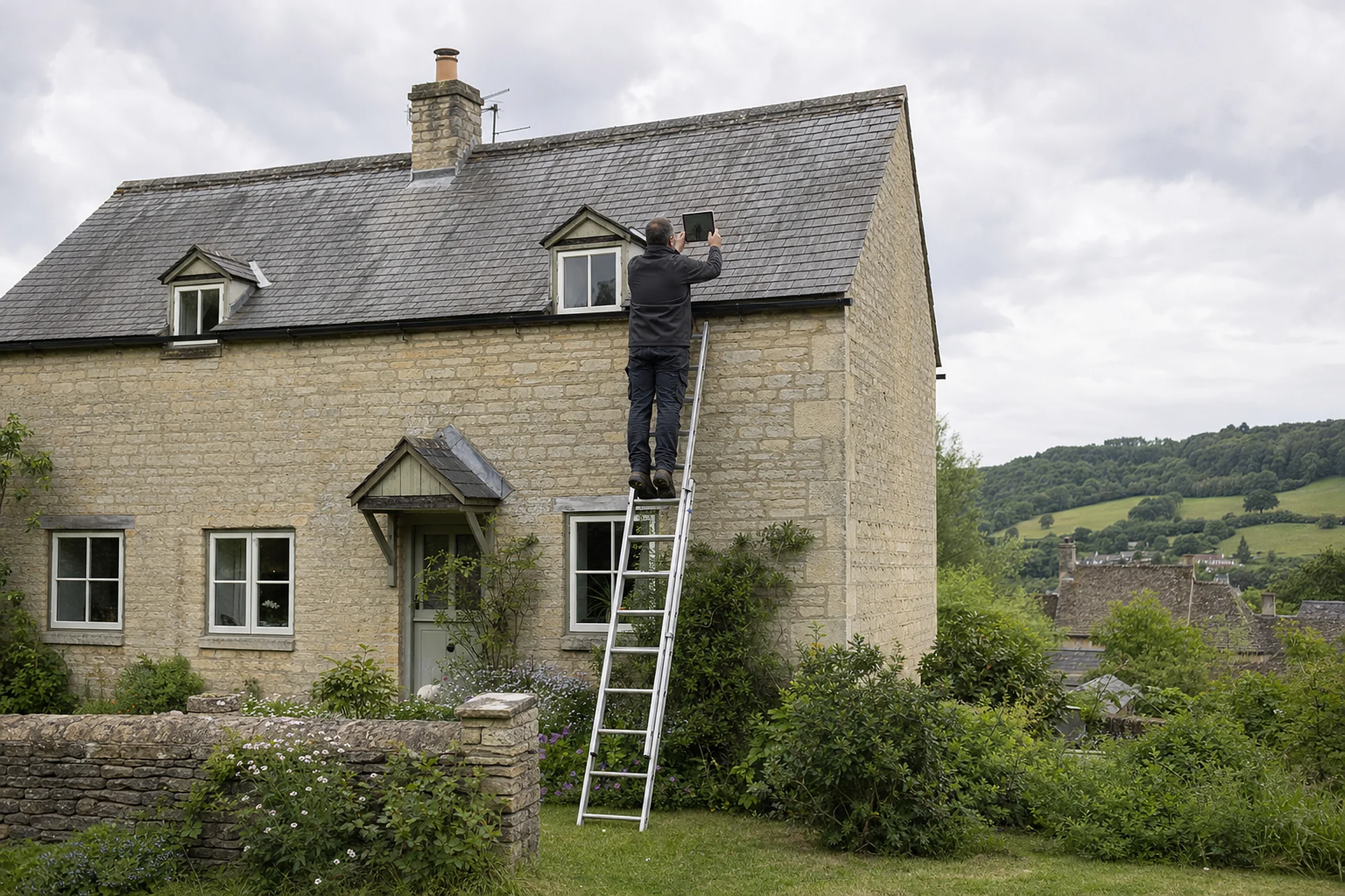
On a pitched house roof the survey is the same sequence, whatever the age of the house. We start outside, from a ladder or the scaffold, and look at the ridge, the verges, the abutments and the eaves. We then go into the loft and check for daylight, damp timber, insulation and the state of the underlay. Everything is photographed on your roof so you can read the report without us.
In this chapter
Ridges and hips matter because BS 5534:2014 expects mechanical fixing for them, not mortar alone. Verges are where wind lifts first on an open edge, and a cracked mortar verge is an easy repair if caught early. A dry-fix ridge system costs about £40 to £60 per metre according to MyBuilder (2026), with a typical job at £500 to £1,000.
Replacing the whole covering is a bigger decision. MyBuilder (2026) gives £5,000 to £12,000 as the typical range for a UK house, with labour at £50 to £130 per m² and scaffold around £1,125. What changes the figure is the roof's size, its complexity, the number of dormers or hips and how easy the access is. If the work touches less than 25% of the building envelope and less than 50% of the roof, Building Regulations approval is not normally needed; above that, it is, and a thermal upgrade under Part L may follow. We explain the position before you commit, and where approval applies we make the notification to a registered building control approver or the council's own service.
Gutters and the roof edge
The roof edge is where a lot of leaks start and where a lot of money is wasted by doing it in two visits. Fascias, soffits and gutters sit just below the covering, and if the eaves are open for the roof, they are open for the gutter as well. Guttering is priced nationally at £30 to £70 per metre (MyBuilder, 2026). Gutter makers quote falls of roughly 1:600 to 1:350, depending on the system, so a run that holds standing water has usually sagged or was set level.
The quote that follows
The written quote arrives after the survey, covering the making good, the skip, the materials, the labour and the scaffold. Compare it like for like with others, and ask any roofer to explain a line that is not clear. The workmanship guarantee runs for ten years and is written down, and when we leave, the site is clear.
Map showing Lyneham and the Stroud service radius, with nearby towns we also cover.
Near Lyneham
Roof work we do here
Priory parish, RAF station and St Michael's church
Why does water stand on the flat roof of my Lyneham unit?
Ponding usually means the falls are too shallow or the deck has dipped. A roof is designed for a fall of 1:40 to finish at 1:80 or better. We measure the falls at the survey and quote for any tapered insulation or outlet work.
The farm shed near the old RAF station has corrugated sheets. Are they asbestos?
Older sheets can be. We look at the condition first. Intact asbestos cement can be taken down carefully under HSE's non-licensed guidance, while broken sheets bring in notification, so we say which applies before any work is booked.
Is my house near St Michael's church likely to be listed, and does that stop a repair?
Listing is checked, not assumed. A listed house needs consent from Wiltshire Council for work affecting its character, and the church itself goes by faculty. A like-for-like repair is often straightforward once the status is clear.
How does a Lyneham quote differ from a quick phone price?
A phone price guesses at the roof. After the survey and its photographs, the written quote covers every cost, from scaffold to waste, so you can see what the job asks and compare it with another firm.