
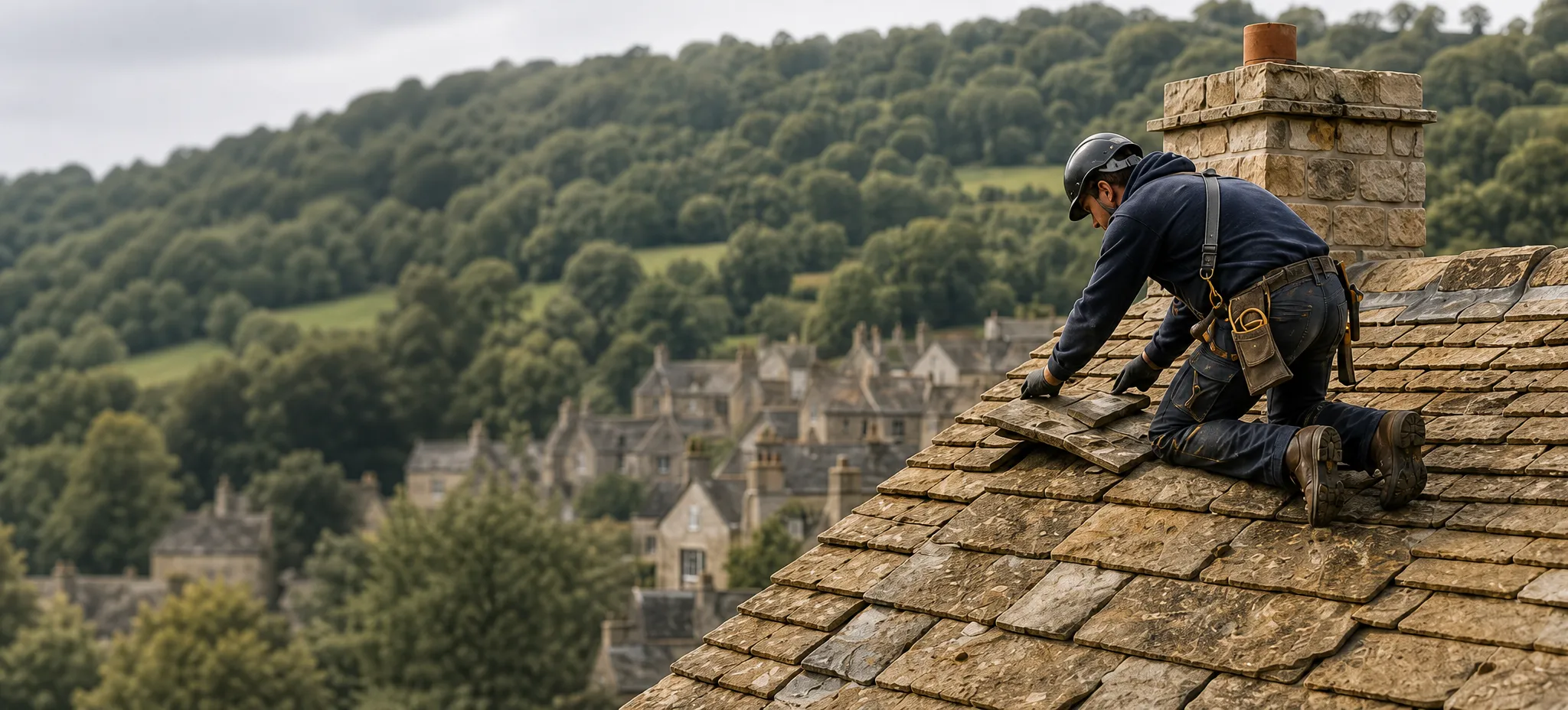
Cotswold stone roofing in Stroud
Re-laying, repairs and new stone roofs, matched course by course. Typical prices below, then a written quote after the survey.
Typical Cotswold stone roof costs
National figures for comparison. Stone roofs vary more than most, so your own price comes from the survey.
| Work | Typical price |
|---|---|
| Stone slate roof, supply and lay | £160 to £210 per m² |
| Roof survey with photographs | £150 to £500 |
| Scaffold for a re-roof | about £1,125 |
| Slipped or broken stone slates | priced on survey |
| Swept valley rebuild | priced on survey |
After the survey the written quote covers the job: scaffold, stripping, sorting and reusing sound slates, new stone, labour and waste.
Sources: Checkatrade slate roof cost per m², September 2026 (national stone slate range, not Cotswold-specific); MyBuilder roof inspection and new roof cost guides, August 2026.
Stone stays stone
A stone roof is repaired with stone, laid the way it was laid in the first place. That is what keeps it watertight, and what keeps it looking right in a Cotswold village.
-
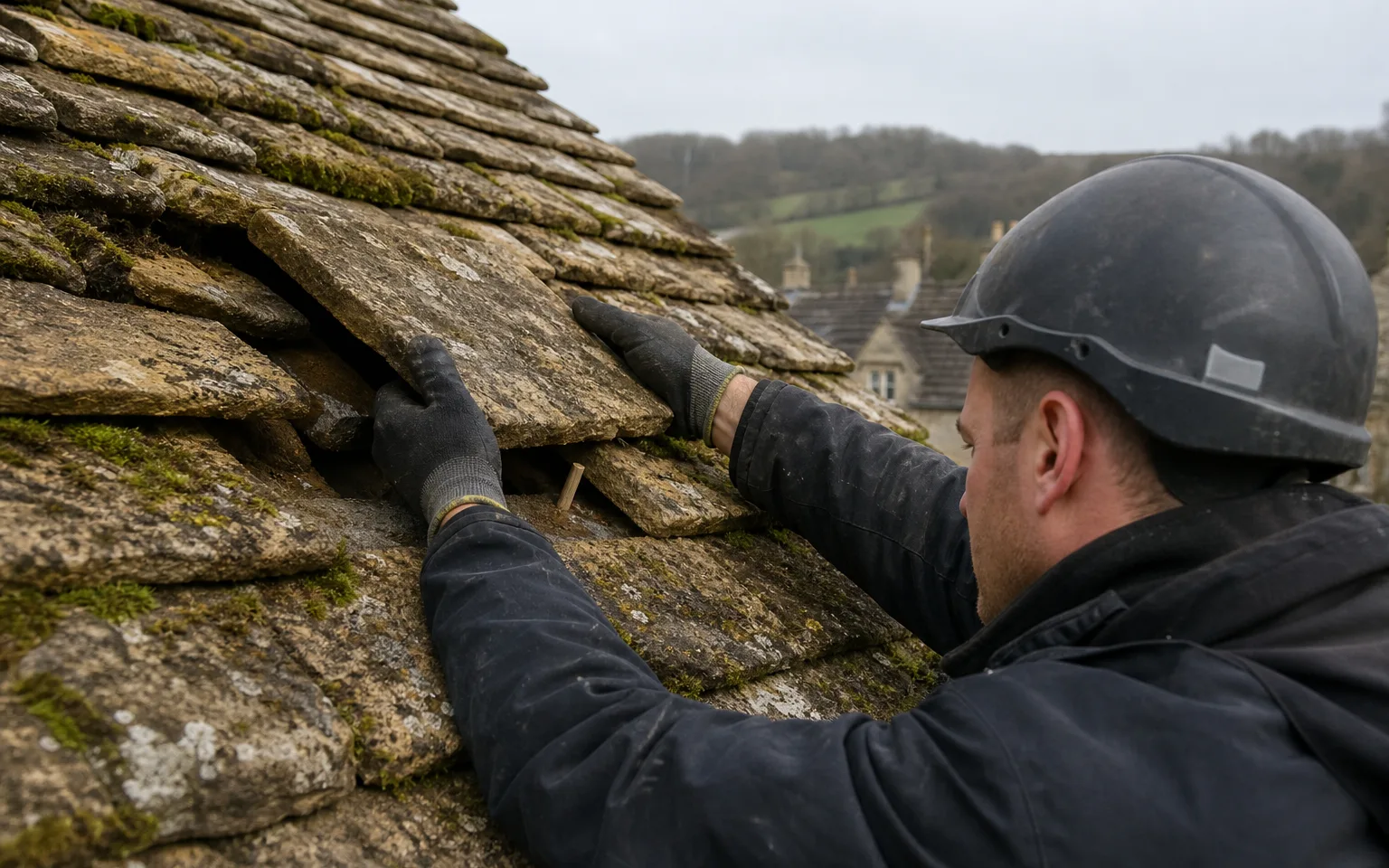
Slipped and broken stone slates
Rotted oak pegs and frost-split slates are refixed or replaced with stone matched for size, colour and thickness.
-
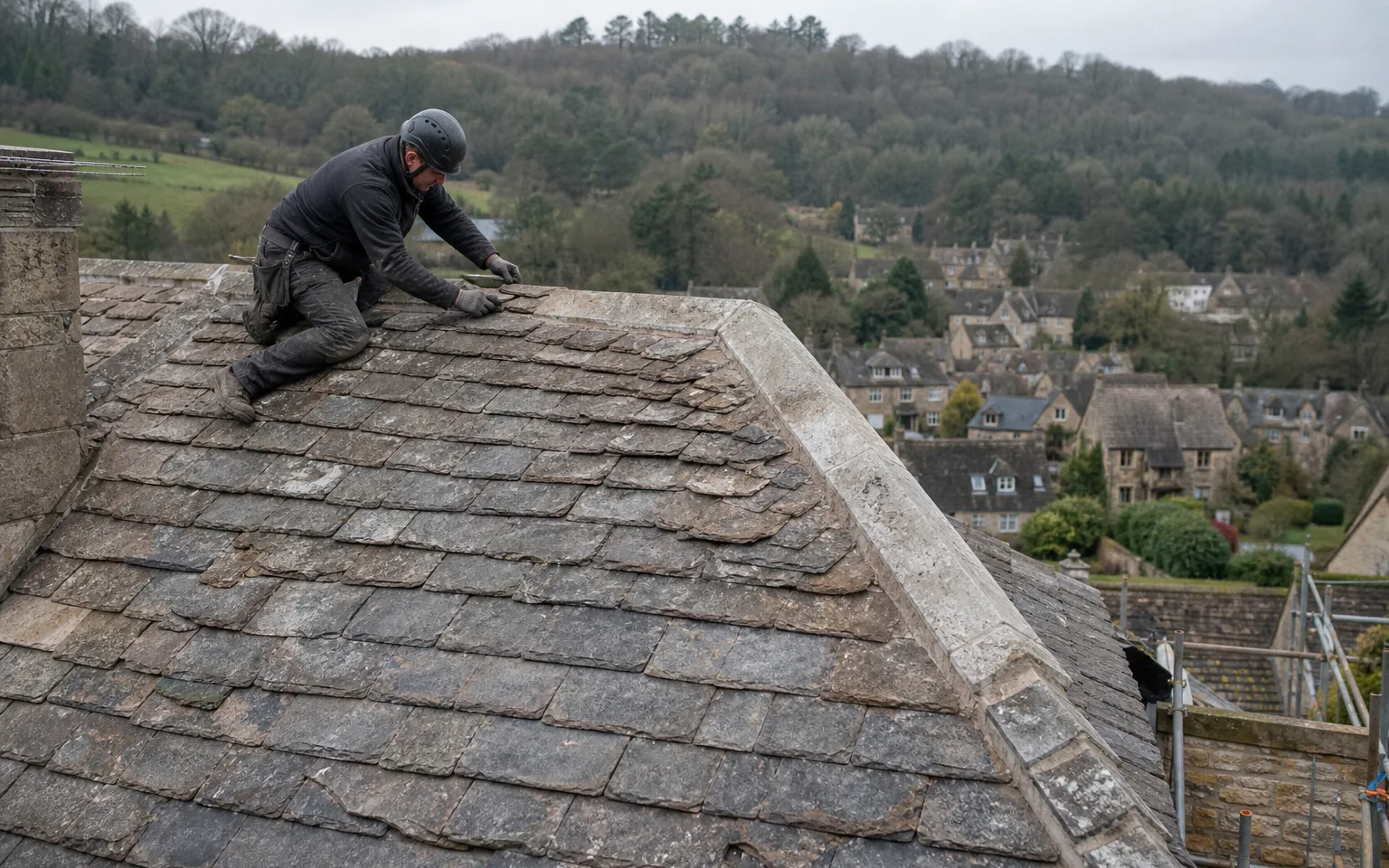
Re-laying in diminishing courses
Where a slope has failed, we strip it, sort and save every sound slate, and re-lay it from the large eaves slates up to the small ones at the ridge.
-
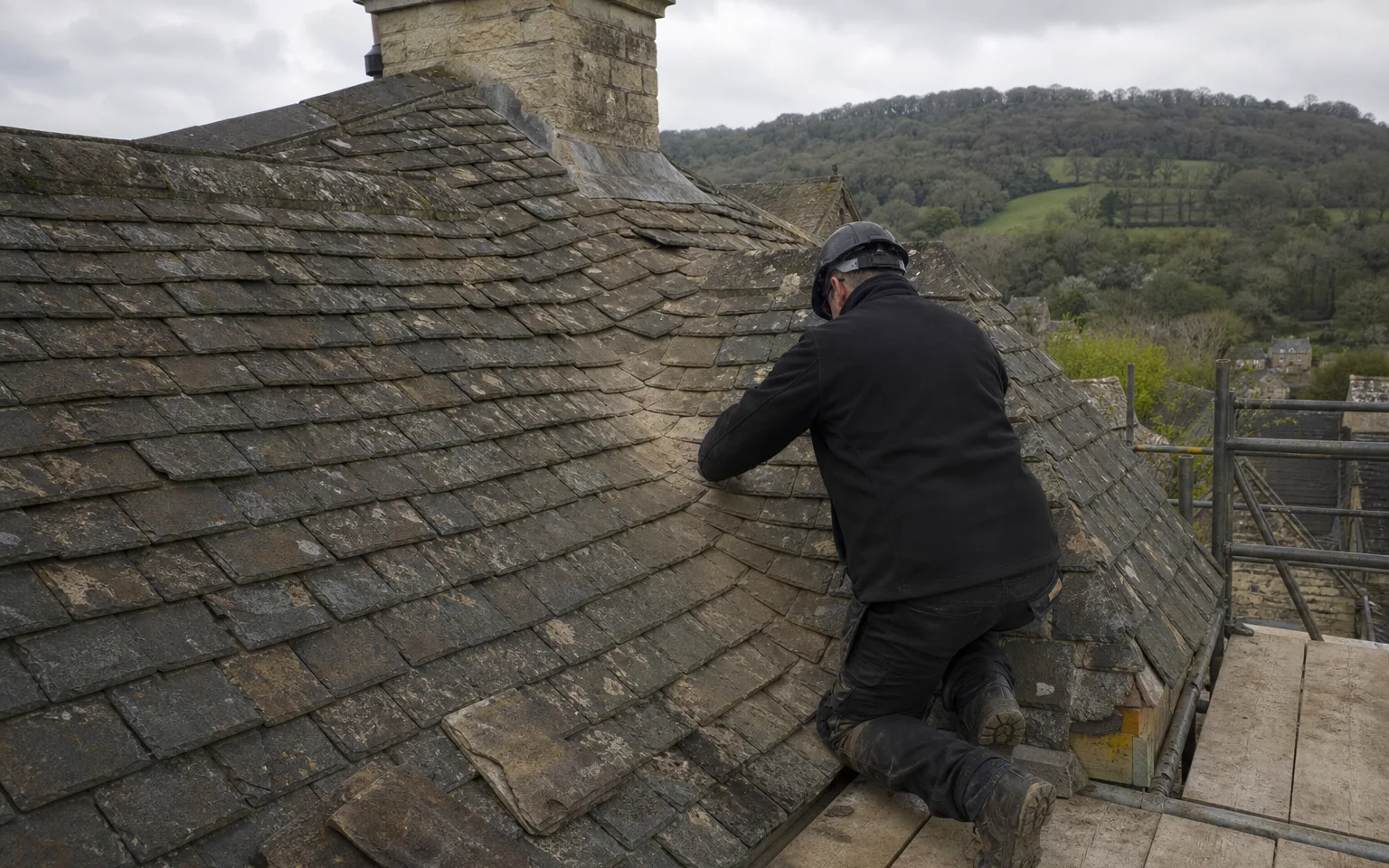
Ridges, valleys and verges
Dressed stone ridges re-bedded and mechanically fixed, swept valleys rebuilt with cut slates, and gable edges made good.
Signs your stone roof needs attention
- Slates lying in the gutter or on the ground after wind
- A slope where the courses look wavy or have dropped at the eaves
- Daylight or damp patches on the underside of the stone in the loft
- Thick moss packed between the slates on the shaded side
- Mortar falling out at the ridge, verges or against the chimney
How a stone roof job runs
- 1Survey and photosWe look at the courses, the pegs and the timbers from inside the loft as well as from the roof.
- 2Written quoteIncluding how many new slates we expect to need once the sound ones have been sorted.
- 3Strip, sort and re-laySlates numbered by size as they come off, so each course goes back where it belongs.
- 4Sign-off and guaranteePhotographs of the finished courses, any consent paperwork, and our 10-year workmanship guarantee.
The stone roof guide
Cotswold stone roofs, explained
How they are laid, what goes wrong, where new stone comes from, and the rules that apply around Stroud.
Chapter 01
How a Cotswold stone roof is laid
Large slates at the eaves, small ones at the ridge: the logic of diminishing courses.
Chapter 01In this chapter
A Cotswold stone roof looks simple from the lane and is anything but. Cotswold District Council's technical guidance on stone slate roofing explains why. The slates come from two oolitic limestones, Forest Marble and Stonesfield Slate. Forest Marble was split by hand into slates known as presents; Stonesfield Slate was left out over winter for the frost to split it. Either way, a quarry yields plenty of small slates and comparatively few big ones, and roofers made a virtue of that by laying them in diminishing courses.
In this chapter
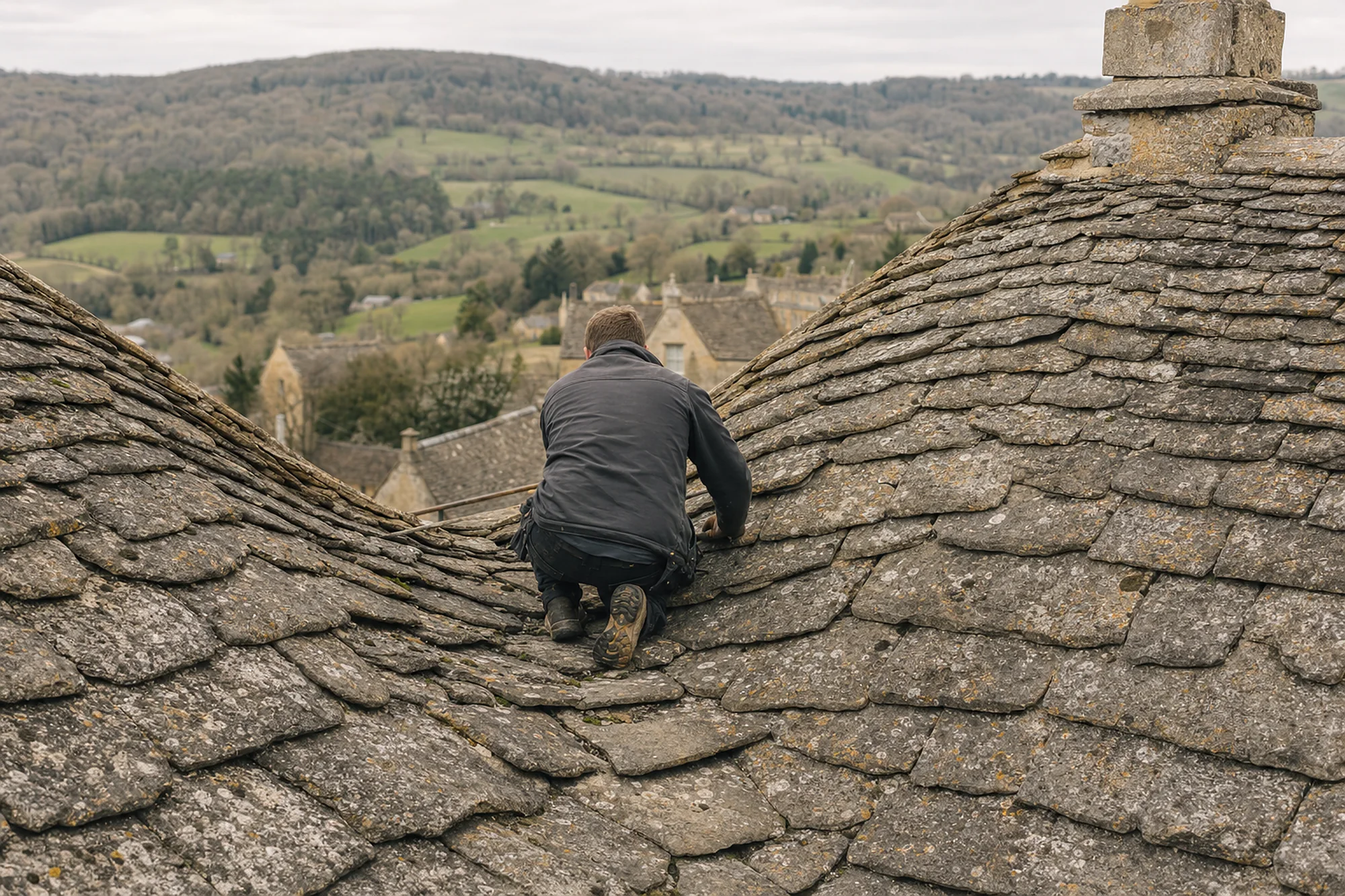
The largest slates go at the eaves. The guidance gives them as normally about 600 mm long, with some up to 750 mm, laid in a double eaves course. These are the cussoms, and the course above them are the followers. From there each course gets a little shorter as it climbs, until the smallest slates, the short cocks, finish at the top of the slope at only around 150 mm. The result is that graded, rippling texture you see across a village roofscape, and it is also why a stone roof cannot simply be re-covered with a uniform product.
Pegs and battens
Each slate traditionally hangs from its batten on one, or sometimes two, wooden pegs, usually cleft oak, driven through a hole near the top of the slate. Nothing holds the slate down except its own weight and the slates lapping over it. That is why old pegs are often the first thing to fail: when a peg rots or splits, the slate slides out of its course, and the slates above it lose their support.
Pitch
The same guidance describes the simplest Cotswold roof as a straight pitched roof, usually at 47° to 55°. That steepness is part of how the roof works. A rough, heavy slate with irregular laps sheds water best on a steep slope, and the high pitch is also why stone roofs dominate the skyline of older Cotswold villages. It is a traditional range rather than a regulation, but it tells you how much a stone roof depends on its geometry.
Ridges and verges
Ridges on stone roofs were always made from a simple angled section of dressed stone, according to the guidance, rather than half-round clay. At the gable edges the stone is finished against the wall or with a slight overhang depending on the building. When we re-bed a ridge today it is also mechanically fixed, because since BS 5534 was revised in 2014 mortar alone is not relied on to hold ridge and hip fittings. Our ridge and verge page explains the fixing standards.
Getting the courses right is the difference between a repair that disappears into the roof and one that stands out from the lane for the next fifty years. That is why we measure and photograph the existing gauge before we strip anything.
A stone roof is graded by hand, course by course, from eaves to ridge.
| Name | Where it goes | Typical length |
|---|---|---|
| Cussoms | Double course at the eaves | About 600 mm, some up to 750 mm |
| Followers | The course above the eaves | Slightly shorter than the cussoms |
| Short cocks | The highest part of the slope | About 150 mm |
The full set of names, from cussoms to short cocks, is in our answer on Cotswold slate names, and the laying method is covered in depth in the diminishing courses guide.
Chapter 02
New or reclaimed stone: the conservation view
Second-hand stone is not automatically the right answer, and the guidance explains why.
Chapter 02In this chapter
When a stone roof needs more slates than its own sound ones can supply, the obvious question is where the extra stone comes from. Many people assume reclaimed slates are the conservation-friendly choice. The guidance reproduced by Cotswold District Council in its 2000 technical note takes a firmer line.
In this chapter
English Heritage policy
The council's guidance reproduces English Heritage's policy on sourcing stone slates. It says that wherever possible new stone slates rather than second-hand should be used, and that reclaimed slates should be used only on the building or group of buildings they came from. The reasoning is practical. The guidance notes that the demand for second-hand slates has led to many other old buildings being stripped, occasionally through theft. Buying reclaimed stone of unknown origin can mean taking a roof off one historic building to put it on another.
Matching new stone
The same policy asks that new slates match the old in geological type, colour, texture, size and thickness. It is specific on one point: sandstone and limestone slates should never be substituted for each other. It also warns that sawn rather than split slates can be technically and aesthetically unacceptable, because a sawn face does not weather or lap the way a split one does.
Myth: Reclaimed stone slates are always the most authentic choice for an old roof.
Fact: The English Heritage policy reproduced by the council prefers new stone, and reclaimed slates only on the building they came from.
Where new stone comes from
The guidance mentions that French limestone slate from the Côte d'Or had been very successfully used on some Cotswold projects, and lists the number of Cotswold quarries producing stone slate at the time. That figure is from 2000, so it is a guide to history rather than to today's supply. In practice we source stone for each job and tell you in the quote exactly what is proposed: the stone, where it is from, and whether any of your own slates are being reused.
Substitutes
Artificial slates made of fibre resin, concrete tiles and reconstituted stone are described in the English Heritage policy as inappropriate alternatives to real stone and not suitable for historic buildings. On an unlisted house outside a conservation area the decision is yours, and a reconstituted product can be the right budget choice for an extension. On a listed building or in a sensitive setting, expect real stone to be required. Our page on reconstituted and artificial stone slates sets out when they are usually refused.
Theft and security
The same guidance that warns about buildings being stripped for second-hand slates is a reminder that stone on a roof has value. Outbuildings and barns with stone roofs, out of sight of the house, are the most exposed. When we work on a property with stone outbuildings, we note their condition in the survey photographs, which also gives you a record of what is on the roof if you ever need it for an insurance claim. Our answer on stone slate theft has more practical steps.
The quote can cover more than one option where more than one is realistic, so the choice is made with the numbers in front of you.
For the detail on sourcing, read reclaimed or new stone slates.
Chapter 03
Repair or re‑lay a stone roof
Most stone roofs fail slowly and in patches. The pegs, not the stone, usually decide what happens next.
Cotswold stone is a durable material. Kept up properly, the council's guidance reckons a roof of it will pass its hundredth year comfortably, and it mentions roofs that could reach 200 or even 300. What wears out first is everything around the stone: the oak pegs, the battens they hang on, the mortar at the ridge and verges, and the timbers carrying the weight.
In this chapter
When a repair is enough
A handful of slipped slates on one slope, a broken slate after a frost, or a gap at the verge are repairs. The slate is lifted, the course is opened carefully, a new peg or a matched slate goes in, and the course is closed again. Done well, it is invisible from the ground. If the slates around the repair are sound and sitting tight, there is no reason to touch the rest of the slope. Our stone slate repairs page explains how this is done without disturbing the sound slates around it.
When the slope needs re-laying
The picture changes when slates are slipping all over a slope. That usually means the pegs or battens have failed across the board, and refixing individual slates will just move the problem along. The answer is to strip the slope, sort the slates, renew the battens and underlay, and re-lay it. The guidance notes that when a roof is stripped it is common for about half of the slates to have perished. Planning for that up front is what keeps a stone roof job on budget.
Sorting and grading
When a slope comes off, every slate is checked. Sound slates are graded by length and stacked so the courses can be rebuilt in order. Perished ones go aside. The quote estimates how many new slates will be needed; the sort on the day confirms it, and if the number is different we show you before the new stone is ordered.
Timbers
Stone is heavy, and old roof timbers under it sometimes sag or show rot at the feet of the rafters. Stripping a slope is the one chance to see them properly. If repairs are needed, we agree them with you once the timbers are exposed, with photographs, so you can see what is being proposed and why.
Keeping the roof weathertight
A stone roof cannot be stripped and re-laid in a day. Even a single slope can take a week or more, because every slate is handled, graded and laid by hand. Between sessions the open section is covered and weighted, and the covering is checked at the end of each day and after any wind. That is part of why stone work is planned around the weather where possible, and why we talk through the likely length of the job before it starts.
Stone roofs fail at the pegs long before the stone gives up.
If you are weighing the two, our guide to re-laying a stone roof walks through a full job from scaffold to sign-off.
Chapter 04
Weight, pitch and the timbers underneath
A stone roof is one of the heaviest coverings there is, and that affects both the structure and the rules.
Chapter 04In this chapter
Cotswold District Council's guidance puts it simply: stone slate roofs are very heavy, at about 1,000 kg for every 10 m² of roof. That is far more than a modern concrete or clay tile, and much more than slate. The timbers of a stone-roofed house were sized for that load, and they have often been carrying it for a very long time.
Changing the covering
The weight becomes a regulations question when the covering changes. Approved Document A treats an increase in roof loading of more than 15 per cent as significant, and the Planning Portal says a new covering that increases the weight of the roof covering by 15 per cent or more needs Building Regulations approval. Putting stone onto a roof that was built for something lighter, such as on an extension where you want the new roof to match the house, needs a structural check before anyone orders a slate.
The reverse matters too. Taking stone off and replacing it with a lighter covering can change how the roof behaves, and on a listed building or in a conservation area it is very unlikely to be acceptable anyway. Our guide to roof timbers under stone looks at what we check.
Re-roofing thresholds
A full re-lay of a stone roof is a large job in Building Regulations terms. The Planning Portal's thresholds are 25 per cent of the building envelope and 50 per cent of the roof: stay under both and you would not normally need to apply. Re-laying a whole roof goes beyond that, so an application applies, and Approved Document L can require the roof to be brought up to a better insulation standard where that is technically, functionally and economically feasible. On a stone roof, how the insulation is added has to respect the building, so we discuss it with building control before the work starts.
- about 1,000 kgweight of every 10 m² of stone slate roof
- 47° to 55°traditional pitch of a straight Cotswold roof
- 15 per centheavier covering that needs Building Regulations approval
Underlay
Many old stone roofs had no underlay at all, just the slates lapping over each other. When a slope is re-laid we fit a breathable underlay, which adds a second line of defence against wind-driven rain and helps with condensation. Whether that suits a particular listed roof is part of the conversation with the conservation officer.
Pitch and the shape of the roof
The steep traditional pitch also limits what can be added to a stone roof. A shallow extension roof will not carry stone well, which is why many extensions on stone houses use a different covering at the back.
Building control in Stroud District is the Gloucestershire Building Control Partnership. On a stone re-lay we make the application ourselves and pass you the completion paperwork at the end.
Chapter 05
Listed buildings and conservation areas around Stroud
A lot of stone roofs sit in conservation areas or on listed buildings, and the paperwork comes before the scaffold.
Chapter 05In this chapter
Stroud District Council lists 41 conservation areas across the district, and stone roofs are a big part of what makes many of them special: Painswick, Minchinhampton, Bisley, Amberley, Sheepscombe and Uley among them. Over half of the district also lies within the Cotswolds National Landscape. None of that stops repairs, but it does shape them.
Like-for-like work
Putting the same stone back, laid in the same courses, leaves the appearance of the house unchanged, so in planning terms it is not usually development at all. Most stone roof work falls into that category. Changing the material, the colour or the profile is a different matter, and in a conservation area it is likely to need permission.
Article 4 Directions
Article 4 Directions apply in five of the district's conservation areas: Bisley and Frampton on Severn, Wotton Under Edge, and the two Stroud areas, Top of Town and Town Centre. The council says they remove certain permitted development rights from some houses, but its page does not say whether roofs are covered. If your house is in one of those areas, we check with the planning team before any change is proposed.
Listed buildings
Stroud District Council's guidance is clear that all listed buildings, whatever their grade, are legally protected, inside and out, back and front. Work that affects the character of a listed building needs listed building consent, and going ahead without it is a criminal matter under the 1990 Act. On a stone roof, that usually means real stone, matched to the original, laid in the original way, with any change to details such as the ridge or valleys agreed first. Our page on listed and conservation-area stone roofs covers the process.
Churches
Many village churches around Stroud are stone-roofed. Where the building is in active use by an exempt denomination, including the Church of England, its roof is dealt with through the church's own faculty system rather than the council's consent process. Once a chapel has become a house, that exemption no longer applies and it is treated like any other home.
Dormers
Because conservation areas and the National Landscape are designated land, a new dormer is not permitted development there. On a stone roof a dormer needs planning permission and careful detailing. Roof windows within the permitted development limits are treated differently, unless the house is listed or an Article 4 direction applies.
For a quick answer on when consent applies, see do I need consent to re-roof in stone.
Chapter 06
Looking after a stone roof
Small, regular jobs are what let a stone roof reach its hundredth year and beyond.
Chapter 06In this chapter
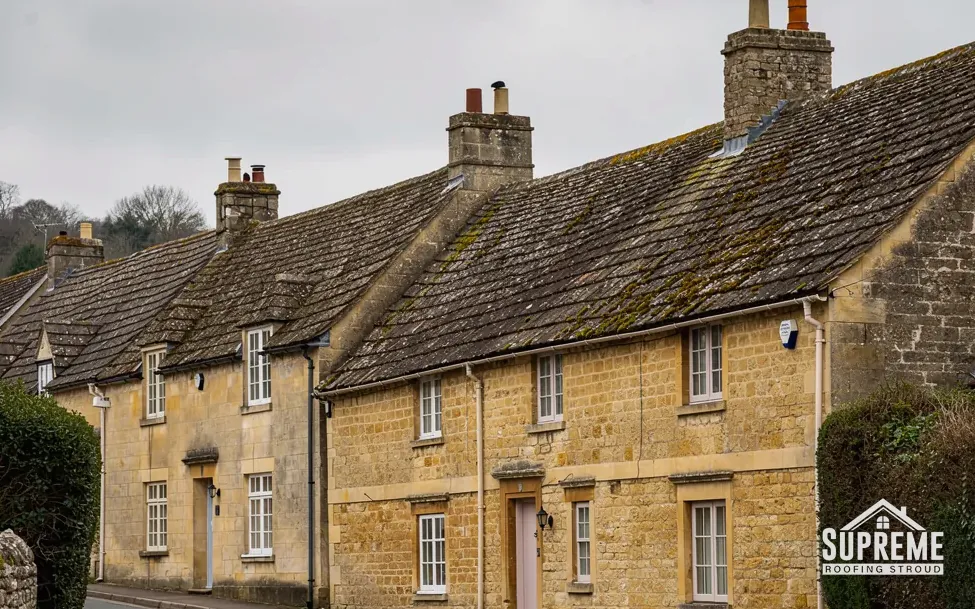
Of all the advice in Cotswold District Council's guidance, one line stands out for owners: an annual scrape, it suggests, could double the life of a stone roof. Moss holds water against the stone and in the laps between slates. In a hard winter, that water can freeze and split slates that would otherwise last for generations.
Scraping, not pressure washing
Moss is removed by hand, working down the roof with the laps rather than against them. MyBuilder's roof cleaning guide notes that pressure washing may damage delicate tiles, and on a stone roof the risk is worse, because water driven up under the laps soaks the battens and pegs. A gentle scrape and a clear-out of the gutters below does more good. Our roof cleaning and moss removal page covers the methods for every type of roof.
Valleys and abutments
Stone roofs often meet a chimney or a higher wall with a mortar fillet rather than lead. Those fillets crack over time and are a common leak point. Swept valleys, built with specially cut slates, need the same attention: the guidance describes them as the traditional detail and notes that cheaper alternatives such as close-mitred or open lead valleys are best avoided on these roofs. Keeping the original valleys sound is far cheaper than rebuilding them.

After storms and frost
After a gale or a hard frost, look along each slope from the ground. A slate out of line, a gap in a course or fragments in the gutter should be looked at while the weather is still dry. A single slipped slate caught early is a short repair. Left alone, it lets water onto the batten below and loosens the slates around it.
Inspections
For a stone roof we suggest a look every few years and after any major storm, ideally from the roof and from inside the loft. A survey with photographs lets you see the state of the pegs, the courses and the valleys without climbing up yourself, and it gives you a record to compare against next time.
The cost of keeping a stone roof in good order is small next to the cost of re-laying it, and the comparison below shows the national figures side by side.
Moss is the slow enemy of a stone roof; a yearly scrape keeps it in check.
Per job
- Roof survey£150 to £500
- Slate roof clean£500 to £1,000
Per m²
- Hand scraping moss£5 to £10 per m²
A simple routine is in our guide to looking after a Cotswold stone roof, and our answer on scraping moss from stone explains why it matters.
Stone roof guides and answers
How stone roofs are laid, repaired, sourced and protected, written for owners of stone houses around Stroud.
Guides
- Cotswold stone roof costs around Stroud: new, reclaimed, repairStone is the dearest roof covering most people near Stroud will ever price. The published national figure is…Read the guide
- Diminishing courses: laying a Cotswold stone roof from eaves to ridgeLong slates at the eaves, short ones at the ridge, and battens that creep closer together as the…Read the guide
- Reclaimed or new stone slates in Stroud: the conservation viewConservation policy is plain about stone slates: new ones are preferred, old ones stay on their own building,…Read the guide
- Re-laying a Cotswold stone roof near StroudRe-laying means the stone comes off, is sorted and mended, and goes back on the same house. This…Read the guide
- Cotswold stone slate repairs in Stroud: slipped and brokenMost stone roof leaks start with one slate that has slipped or split. We find the cause, replace…Read the guide
- Swept valleys on Cotswold stone roofs around StroudWhere two stone slopes meet at an internal corner, the old answer was to curve the slates round…Read the guide
- Listed and conservation-area stone roofs in StroudStone roofs on protected buildings are judged on their stone, pitch and detail as well as on keeping…Read the guide
- Reconstituted and artificial stone slates: when they're refusedA cast or pressed copy of a stone slate looks tempting beside a quote for the real thing.…Read the guide
- Looking after a Cotswold stone roof in StroudA stone roof can outlast the people who own it, but only if small faults are caught while…Read the guide
- Lime mortar, torching and pointing on stone roofsLime is the soft, breathing mortar that older stone roofs were built with. It turns up in the…Read the guide
- Roof timbers under heavy stone slates in Stroud homesA stone slate roof is among the heaviest coverings a house can carry. This guide follows that weight…Read the guide
- Stone roofs in a Stroud winter: frost and wet-weather workFrost is how Stonesfield stone was split in the first place, and it can undo a slate in…Read the guide
Quick answers
- How long does a Cotswold stone roof last?
- Stone slate or stone tile: what's the difference?
- Why are Cotswold stone slates hung on oak pegs?
- Why are Cotswold stone roofs so steep?
- Cussoms, followers and short cocks: the slate names
- Where do new Cotswold stone slates come from?
- Insuring and claiming for a stone roof
- Do I need consent to re-roof in Cotswold stone in Stroud?
- Should moss be scraped off a stone roof?
- Stone slate theft: protecting your roof
- Can sandstone slates replace limestone ones?
- How are ridges made on stone roofs?
- Should a stone roof have underlay?
- Cotswold stone or Welsh slate: how they differ
- How many old stone slates can be reused?
- Dormers on Cotswold stone roofs
- Buying a stone-roofed house near Stroud: what to check
- Matching stone slates on a Stroud extension
- Stone roof verges and gable edges
- Mortar fillets at stone roof abutments
Cotswold stone roofs: common questions
Can you match the stone slates on my cottage?
Usually, yes. We measure the courses and look at the colour and thickness of your slates, then source stone to match. Where some of your own slates are sound, they go back on the roof in their original courses.
Will I need listed building consent to repair my stone roof?
If the house is listed, work that affects its character needs consent, and on a stone roof that usually means matching the original exactly. Small like-for-like repairs are often fine, but we check with the council before quoting.
How many of my old stone slates can be reused?
It varies by roof. The council's technical guidance notes that it is common for about half the slates to have perished when a roof is stripped. We estimate in the quote and confirm when the slates are sorted.
Can a stone roof be repaired in winter?
Small repairs can, in dry spells. Larger re-laying is better planned for drier months, and any open roof is kept covered every night until the courses are closed again.
Is reconstituted stone allowed on a house in a conservation area?
It depends on the building and the council. On listed buildings and in sensitive settings, real stone is usually expected. On a modern extension outside a conservation area, a reconstituted product can be acceptable.
Why does my stone roof have no felt underneath?
Many old stone roofs were laid without underlay, relying on the laps and the steep pitch. When a slope is re-laid we add a breathable underlay, subject to any conservation requirements.
Get your stone roof priced
Send us a photo of the roof from the lane and one of any slipped slates, and tell us whether the house is listed. We will book a survey, look at the courses and the loft, and send a written quote.