

Roofers in Painswick
A hill town of locally quarried Cotswold stone overlooking one of the Five Valleys, 3.4 miles north-north-east of Stroud.
Painswick at a glance
- Distance
- 3.4 road miles north-north-east of Stroud
- Council
- Stroud District Council
- Conservation area
- Painswick Conservation Area (no. 13)
- Grade I listed
- St Mary's Church, Court House, Beacon House, Painswick House
Painswick's hilltop roofs, from Friday Street to St Mary's
Painswick stands on a hill above one of Stroud's Five Valleys, and it grew from the wool trade. Wikipedia names locally quarried Cotswold stone as its main building material, while the Victoria County History finds the town rich in houses of the seventeenth and eighteenth centuries, with many older ones rebuilt in stone around 1600. Houses of medieval origin survive mainly in Bisley Street and Friday Street. Walk those two streets and you read the town's age in the walls before you ever look up.
The roofs matter just as much. St Mary's parish church is built of limestone ashlar with stone slate roofs, and its nave, chancel and sanctuary were reroofed in the restoration of 1879 to 1880. The church is Grade I listed, as are the Court House, Beacon House and Painswick House. Painswick House dates from the 1730s, and its Rococo Garden was laid out in the 1740s. A town with that many high-grade buildings sets the standard for the ones around them.
It also falls in Painswick Conservation Area, number 13 on Stroud District Council's list of 41. We survey first and match what is on your roof, because on a stone building a change of material is a bigger decision than the roofing price suggests. Our Cotswold stone roofing page describes the traditional method in detail, and your quote follows once we have been up to look.
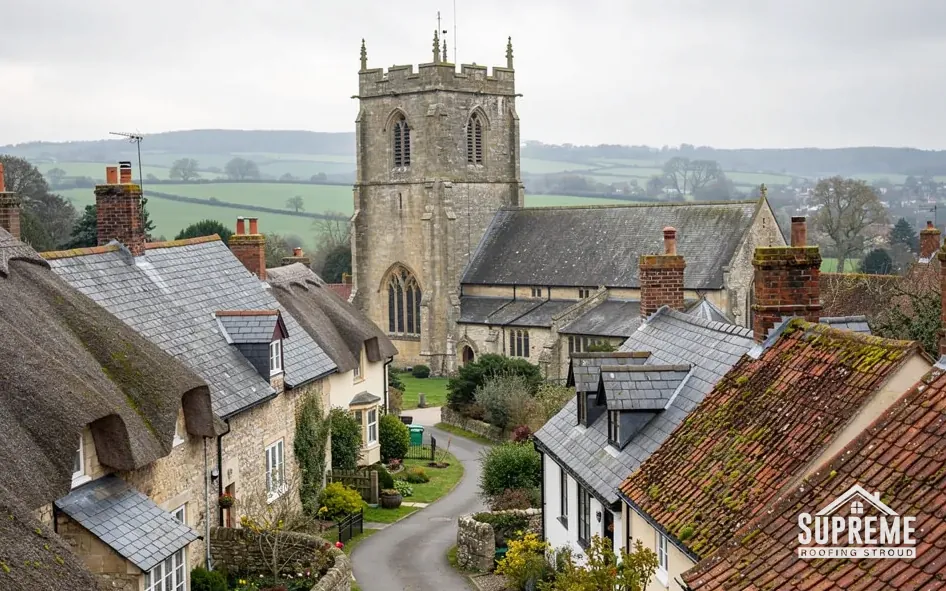
Village of thatched and tiled cottages around a stone church tower 
Modern brick housing estate with grey tiled roofs along a curving road
Chapter 01
Wool money, stone rebuilds and the weight overhead
Where a house was roofed for stone slate, its frame still expects that weight.
Chapter 01In this chapter
Painswick's wool-trade wealth shows in its houses. Money from cloth paid for stone, and the VCH dates many of the rebuildings to around 1600. A roofer's interest is in what those houses were built to carry. A stone slate roof is very heavy: Cotswold District Council's technical guidance of 2000 puts it at about 1000 kg for every 10 square metres. The timbers underneath were sized and jointed to carry that load, which is why the covering and the frame belong together.
That has direct consequences for any repair or replacement. Putting a lighter covering on a roof built for stone leaves spare capacity but changes how the building looks and sheds water. Going the other way, from a light covering to stone, can overload rafters that were never meant to take it. If the new covering would be heavier by 15 per cent or more, approval under the Building Regulations is needed, and the Planning Portal also recommends a word with a structural engineer or surveyor before anything is ordered. So we ask the weight question during the survey, and the answer is reflected in the written quote.
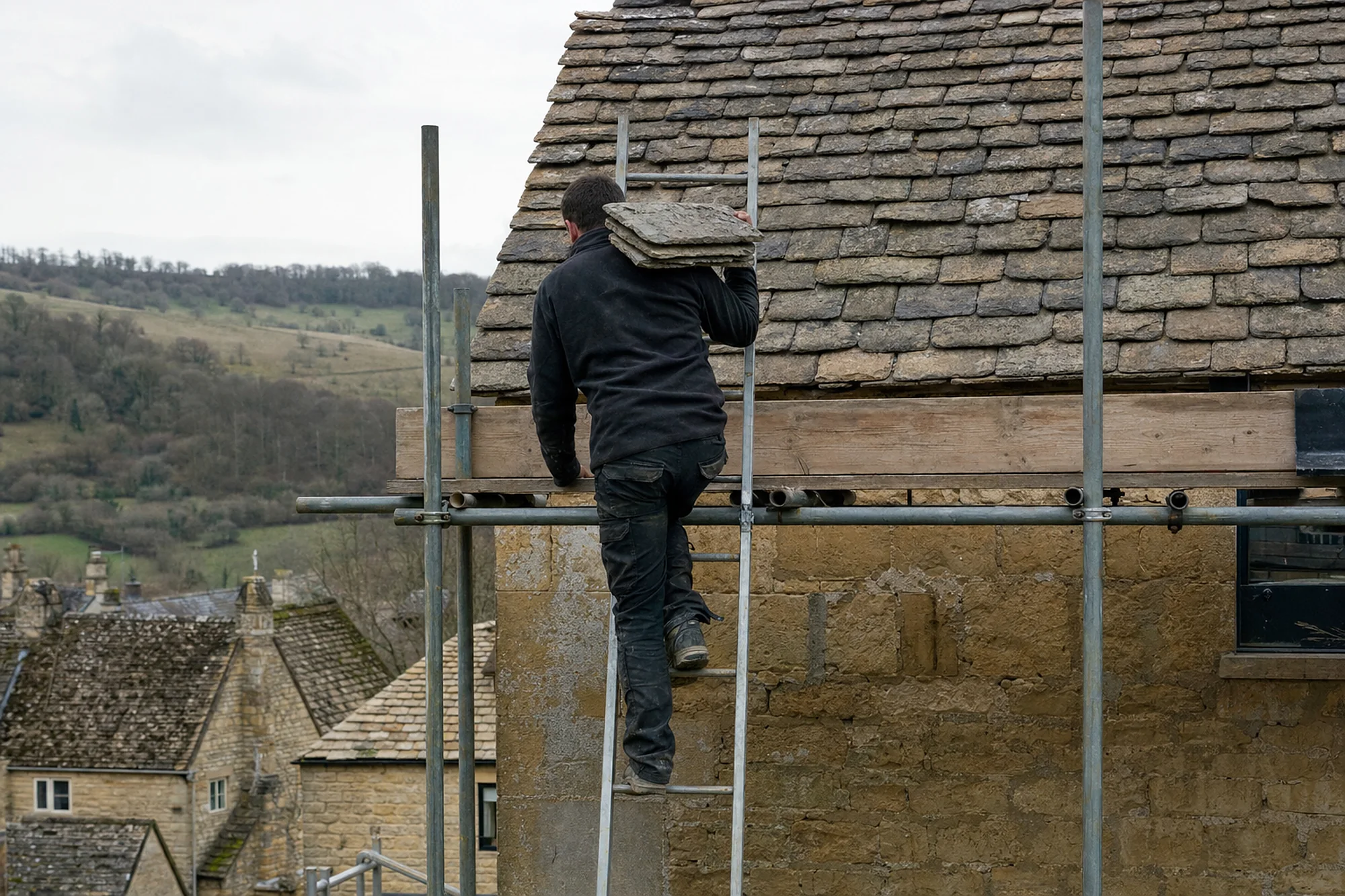
Traditional Cotswold roofs run at a steep pitch, usually between 47 and 55 degrees, according to the same guidance. That steepness helps stone shed water, and it is also why access matters: a steep stone roof needs proper scaffold, and in the narrow streets of an old wool town that takes planning. On Bisley Street, Friday Street and the lanes off them we measure the space before we price the scaffold, and allow for it in the quote.
Older roof timbers can carry damp or old beetle damage after years of slow leaks, and a stained ceiling inside a house of this age is a sign to look at the rafters and wall plates, not just the covering. We photograph what we find and explain what is cosmetic and what is structural. If a section of timber needs replacing, we tell you and agree it so it does not hide inside the job.
On an old wool-town house, the frame and the covering belong together.
- 1879 to 1880restoration in which St Mary's nave, chancel and sanctuary were reroofed
- 1730sdate of Painswick House, a Grade I listed building
- 1740sdecade in which the Rococo Garden was laid out

Chapter 02
Diminishing courses, oak pegs and swept valleys
How a stone slate roof is put together decides how it should be repaired.
Chapter 02In this chapter
A traditional Cotswold roof is built up in diminishing courses, meaning the courses get shorter as they climb. Quarried stone yields small pieces in abundance and large ones sparingly, so the generous slates (cussoms, around 600 mm and occasionally 750 mm) are doubled along the eaves, followers come next, and the little short cocks finish the top. A slate is hung over a batten on a cleft oak peg or two, pushed through a hole drilled near its head.
That fixing is simple and effective, and it is also what fails first on many old roofs. A rotted or broken peg lets its slate drop out of line, and rain finds the gap. Putting one right means lifting the courses around it, so even a handful of slates is seldom a quick job. The council's guidance links lifespan to upkeep: scrape off moss every year and a roof could last twice as long, and given regular maintenance a stone roof can last a century without difficulty. That points to a sensible order for any stone roof: repair, then maintain, and strip only what has really perished.
Moss and lichen are part of the picture. A light growth does little harm, but a thick mat holds water against the stone and keeps the roof wet for longer. Removing it by gentle scraping suits stone better than pressure washing, which MyBuilder notes may damage delicate coverings. Scraping by hand costs roughly £5 to £10 per square metre according to MyBuilder in 2026. We walk the roof carefully because old stone and old pegs do not tolerate heavy feet, and we lay boards where needed.
The other feature to know is the swept valley. Where two slopes meet in an inside corner, the stone courses curve round the angle on specially cut slates, with no metal showing. The guidance calls lead valleys, mitred or open, quicker and cheaper to make but poorer in appearance. If a swept valley has failed, we price the stone rebuild and the lead alternative together, so you can weigh them. Our lead roofing page explains the codes and where lead belongs on a stone roof, such as chimney flashings and gutters between roofs.
The same guidance records that a stripped roof often turns out to have around 50% of its slates perished. Once yours is off, we sort and count what comes down, set aside the sound stone for re-use and tell you about any shortfall.
Repair first, maintain next, and strip only what has perished.
- Stone slate, low per m²£160
- Stone slate, high per m²£210
- Welsh slate re-roof per m²£140 to £180
- Spanish slate re-roof per m²£100 to £130
Chapter 03
Grade I neighbours and the number 13 conservation area
St Mary's, the Court House and Painswick House set the bar for stone, colour and detail.
Chapter 03In this chapter
Painswick has an unusual concentration of Grade I buildings: St Mary's Church, the Court House, Beacon House and Painswick House. A listed building carries protection indoors and out, and Stroud District Council says that holds whatever the grade. Alterations that touch its character need consent from the council, apart from a church in use, where the diocese issues a faculty. Outbuildings and garden walls can be covered through their link to a listed house, and the council's conservation department can confirm where yours stands.
Painswick Conservation Area, number 13 on the council's list, covers a good deal more than the Grade I buildings. Beyond the statutory side, it sets the visual tone for every roof that can be seen from the street. St Mary's, with its stone slate roofs, shows the standard the town sets for a covering. Repair in the same stone by the same method is the sensible starting point. Swapping the covering, adding a roof feature or altering the colour of stone is another matter, and you would want the planning team's view before it goes into any quote. Article 4 Directions apply in five Stroud conservation areas, and Painswick is not among them, though the council advises checking with the planning team in any case.
On materials, the English Heritage policy printed in the 2000 council guidance prefers new stone to second-hand, reserves salvaged slates for their original building and forbids exchanging sandstone with limestone. We work to that, and a quote says which stone is priced. If you ask us to re-roof a stone house, we describe the stone you have, give you a written price for matching it, and say what each alternative would change.
Chimneys, gables and the junctions between old and later extensions are where lead earns its place in a town of stone. A properly dressed flashing lasts decades, and a patched one tends to fail where stone and metal meet. We photograph each junction, so you can see what needs doing before any decision.
Gutters deserve a mention on a hillside of stone. Water running off a steep roof arrives fast, and an undersized or sagging gutter throws it against the wall, where it stains and slowly erodes the stone. On older houses, the eaves gutter may sit on stone corbels or iron brackets set into the wall, which complicates replacement. We check how each gutter is carried, whether the falls still run to the outlet, and whether a new run can be hung without disturbing masonry that deserves leaving alone.
Map showing Painswick and the Stroud service radius, with nearby towns we also cover.
Near Painswick
Roof work we do here
Friday Street and St Mary's stone slates in Painswick
A few stone slates have slipped on my Painswick house. Can they be re-hung?
Often. A slipped slate usually points to a rotted peg or a loose batten. We lift the courses either side, renew the peg or batten and re-hang the stone in its original order. Slates that have perished are replaced with matching stone, and the quote covers that.
I live in the Painswick conservation area. Can I change my roof covering?
The usual first step is to match your present covering. Changing material is different, so ask Stroud District Council's planning team first; our survey notes describe your present covering in a form you can send them.
My house is near St Mary's. Who decides about roof work on the church itself?
While it is in use, St Mary's is authorised by a faculty from the diocese, not by the council's listed building consent. That is for the parish to arrange. For a house nearby, the first question is whether your own building is listed.
How heavy is a stone roof, and does it matter if I want a different covering?
The 2000 guidance from Cotswold District Council puts stone slate at about 1000 kg per 10 square metres, and a new covering 15 per cent or more heavier triggers approval and an engineer's check. The survey covers the sums and the quote shows the result.