
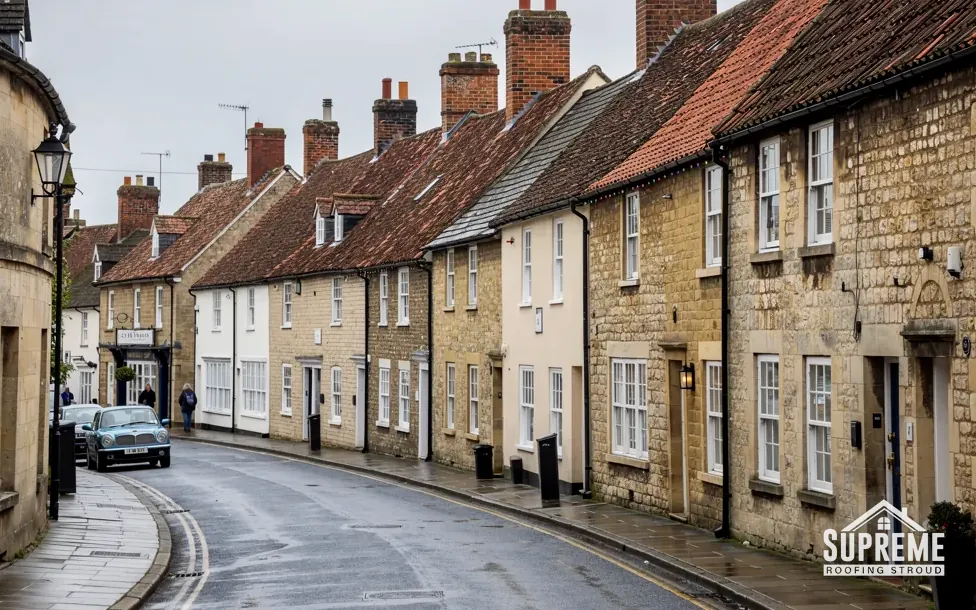
Roofers in Cranham
A scattered village on the Cotswold escarpment, with beech woods crowding the steep northern slopes, 7.3 miles north-north-east of Stroud.
Cranham at a glance
- Distance
- 7.3 road miles north-north-east of Stroud
- Council
- Stroud District Council
- Setting
- Cotswold escarpment beech woods above the Painswick stream
- Grade II* listed
- St James's Church, on its ridge
Cranham's roofs under the beeches, from the ridge church to Cranham Corner
Cranham's northern boundary follows the Cotswold escarpment, and the British History Online account of the parish names beech woods as the major feature of the landscape, especially on the steep northern slopes. Trees therefore shape what a roof needs here. Many houses sit within reach of branches, and everything from gutter to ridge is touched by leaf fall, shade and overhang.
Settlement is scattered. The church stands isolated on a ridge, the main village grew up beside the Painswick stream, and there are small settlements at the Knoll, Overtown and Cranham Corner. St James's Church, of ashlar whose tower dates to around 1500 give or take a few decades, is listed Grade II*. Clay dug from the Painswick stream once fed potteries that made chimney pots and rough earthenware, until the village pottery closed in 1906. In the 1950s many houses went up around the church and school, including an estate of 12 council houses. Cranham does not appear on Stroud District Council's list of conservation areas.
Gustav Holst wrote the tune for the carol In the Bleak Midwinter at Midwinter Cottage here, which gives the village a quiet claim to fame. The practical point for a roofer is simpler, and it matters more to your roof than any of the history: a roof in Cranham may be a cottage by the stream, a farmhouse on a lane to one of the hamlets or a 1950s house near the school. We survey each one on its merits. Start with roof cleaning and moss removal if the trees are your main worry.

Victorian terraced houses with slate roofs and chimneys on a hillside 
Flint and brick cottage with a clay tile roof beside a road

Chapter 01
Beech woods, leaf fall and the roofs underneath
Trees close to the house change what a roof needs each autumn and each spring.
Chapter 01In this chapter
With beech woods as the village's major feature, a roof in Cranham is likely to have trees nearby. Trees are good neighbours, but they put a steady load on a roof. Leaves pile up in gutters and in valleys, the inside corners where two slopes meet, and a blocked valley can overflow beneath the covering. Shade keeps a roof damp for longer after rain, so moss takes hold on the north-facing slopes first. Overhanging branches rub at the covering in wind and drop twigs where they are hard to see. Beech leaves and beech mast, the husks of the nuts, can also pack into small gaps, such as the space behind a bargeboard or the throat of a gutter outlet, and the build-up is only found when water starts coming through.
Our survey starts with the places debris gathers. We check valley linings, gutter outlets, the roof edge where the covering overhangs the gutter and the joints in long gutter runs. A gutter that holds water after rain is sagging, and a full gutter overflowing at a joint will stain a wall below. The simple fix is a clear-out and a few refitted brackets. The expensive one is a fascia board rotted by a gutter that has leaked onto it for years. Our guttering, soffits and fascias page covers what replacement involves.
On moss, the gentlest approach is usually the best one. MyBuilder prices manual scraping at £5 to £10 per square metre, soft washing at £15 to £20 and pressure washing at £10 to £15, and cautions that a pressure washer may damage fragile coverings. For older and softer coverings we favour scraping, then a look at the surface underneath. Removing moss exposes any cracked or porous pieces, so we mark those for replacement rather than leaving them to fail.
Fascias and soffits suffer under trees as well. A soffit is the board closing the underside of the eaves, and a fascia is the board the gutter hangs from. Damp leaf litter packed behind a gutter keeps the fascia wet, and rot can start unseen. On survey we press a blade into the timber and record any soft patches in the report.
Where branches are close, ask an arborist to cut them back before or after the roof work. We do not cut trees ourselves, but we will tell you on site which branches are within reach of the covering and which are not. Clearing overhang cuts the leaf load on gutters and lets the roof dry out faster after rain, so the work lasts longer.
Under trees, a roof is judged by its gutters as much as its covering.
- Tile roof clean£400 to £750
- Pitched roof clean£450 to £850
- Slate roof clean£500 to £1,000
- Manual scraping per m²£5 to £10

Chapter 02
Painswick stream clay, chimney pots and the closed pottery
The village once made chimney pots, which is a fair reason to look hard at the ones on its roofs.
Chapter 02In this chapter
The BHO account of Cranham records that clay from the Painswick stream supported nineteenth-century potteries making chimney pots and rough earthenware, and that the village pottery closed in 1906. Nobody can say which pot on which house came from that source. What the history offers is a reason to treat chimneys here as a feature worth keeping, since clay pots are part of how a Cranham roofline reads.
A chimney stack has four parts that wear at different rates. The pot sits in a bed of mortar called flaunching, which slopes to shed water. The stack itself is brick or stone, pointed with mortar that weathers away. The flashing is the lead dressed round the foot of the stack, where it leaves the slope. Below that, the stack passes through the roof space and may be damp in the loft long before anything shows on a ceiling. A crumbling flaunching is among the first things to look for, and a cracked pot tends to follow.
MyBuilder lists a flashing repair at £250 to £1,200 and a stack rebuild at £2,000 to £10,000 or more, updated 21 August 2026. Repointing averages about £750. Those are national ranges, and the wide spread reflects access and height. A stack at the end of a long drive on a ridge, as many Cranham houses have, needs scaffold allowed for in the quote. Our chimney repairs page explains how we decide between repointing and rebuilding.
An unused chimney still needs care. A flue left open with no cap lets rain in, and one capped without ventilation can encourage damp. We look at what the chimney is used for, whether the flue is lined and how the pot is capped, and then propose the smallest repair that does the job. A lined, working flue is a matter for a registered installer or your insurer, not for a roofer, so we stay with the stack and the flashing.
It also pays to check the stack from inside the loft. A white, powdery stain on brickwork, or a damp patch on the chimney breast, often shows that rain is entering well above where the ceiling mark appears. The photographs from that visit go into your report alongside the outside views.
Chapter 03
Hamlets, lanes and the 1950s houses around the school
Spread-out settlement means long drives, and later houses call for a different set of checks.
Chapter 03In this chapter
A scattered village means a roofing job here is seldom next door to another, which also affects how we plan the day, how many trips the lorry makes and how we keep the site tidy. The church stands on its ridge, the main village sits by the Painswick stream, and the Knoll, Overtown and Cranham Corner are separate small settlements. We plan the trip around the lane and the property: where the van can stand, how far slates, tiles or bags of mortar have to be carried and whether a track will take a scaffold delivery. That goes into the quote as access, and you see it before you agree.
The houses built around the church and school in the 1950s are a different sort of roof from the cottages by the stream. They include an estate of 12 council houses. We make no assumption about what covers any individual one, since roofs of that age have often been renewed since. What we can describe is how the survey goes: the condition of the underlay and the timber battens it sits on, the state of the verge and ridge, and how the loft is ventilated.
Ventilation matters because a cold roof relies on air moving through the void. BS 5250, as Marley summarises it, sets eaves ventilation at 25 mm for pitches of 15 degrees or below and 10 mm for steeper ones. Leaf debris, paint or a badly fitted insulation roll can block those eaves gaps, and damp air then settles in the timbers. With a house of this age, we examine the eaves twice, from outside and from within the loft.
Renovating more than 50% of a roof's surface brings Approved Document L into play, which asks for the whole roof to reach a U-value of 0.16 W/(m²·K), in practice with added insulation. The survey tells you whether your plan is near that line, and when the work is notifiable we look after the Building Regulations paperwork.
Finally, Cranham's church of St James is Grade II* listed. Its roof, while the building is in use, is the diocese's business through a faculty. Any survey or quote for it would wait until the parish has settled how to proceed.
Spread-out settlement means the lane is part of the job.
Map showing Cranham and the Stroud service radius, with nearby towns we also cover.
Near Cranham
Roof work we do here
Beech shade, chimney pots and Cranham Corner
My Cranham roof is shaded by beech trees and keeps growing moss. What should I do?
Start by scraping the moss gently by hand and clearing gutters and valleys, then check what is under it. We mark cracked or porous pieces for replacement. Where branches overhang, an arborist can cut them back, and the roof will then dry faster after rain.
Cranham once made chimney pots. Is a clay pot on an old stack worth saving?
Often. A sound pot can stay if its flaunching and the stack below are repaired. We inspect the pot for cracks, re-bed it where needed, and quote for repointing and flashing so the whole job is covered.
Do you work on roofs at the Knoll, Overtown and Cranham Corner?
Yes. These settlements are within our area, and the survey records the lane, the space for a scaffold, where materials can be set down and whether neighbours share the drive, since a shared track often needs a word with the other households before a delivery arrives. The written quote allows for access.
Does a 1950s council-house roof in Cranham need loft ventilation checked?
It is high on our list. BS 5250 sets eaves ventilation for cold roofs, and leaves, paint or insulation can block it. We examine the eaves from outside and from the loft, and photographs from the survey show what we found.