
Roofers in Brockworth
Roof work in Brockworth, 9.1 road miles north-north-east of Stroud: from the Grade I church and Tudor court at the old village centre to the housing built around the former airfield.
Brockworth at a glance
- Distance
- 9.1 road miles north-north-east of Stroud
- Council
- Tewkesbury Borough Council
- Listed
- St George's Church, Grade I
- Setting
- Old Roman road, with Cooper's Hill in the parish
Brockworth's roofs, from Cooper's Hill to the old airfield
Brockworth sits on the old Roman road south-east of Gloucester, and its parish takes in Cooper's Hill, a local landmark with a slope of around 50 per cent (26.6 degrees), according to Wikipedia. No house roof is that steep, but the hill is a fair reminder that this is a parish with real gradient, and that gradient is something we price rather than discover on the day.
The buildings fall into clear layers. At the old village centre, St George's Church is the oldest surviving building and is listed Grade I. Beside it stands Brockworth Court, a Tudor house built between 1534 and 1539 for Richard Hart, the last prior of Llanthony, which is listed Grade II*, with a tithe barn on the same site also at Grade II*. Then comes the twentieth century. The Gloster Aircraft Company built Hawker Hurricanes here from 1939, the works closed in 1962, and the site became Gloucester Business Park, with the Coopers Edge housing developed around the former airfield.
Three separate jobs share this parish. There are protected historic roofs, houses from the renewed growth after the mid-1950s, and commercial premises on the business park, and every one is surveyed differently. Tell us the age of the building and send a photograph, and we will say what we expect to find before anyone climbs a ladder. That conversation costs nothing and often settles whether a visit is needed at all.
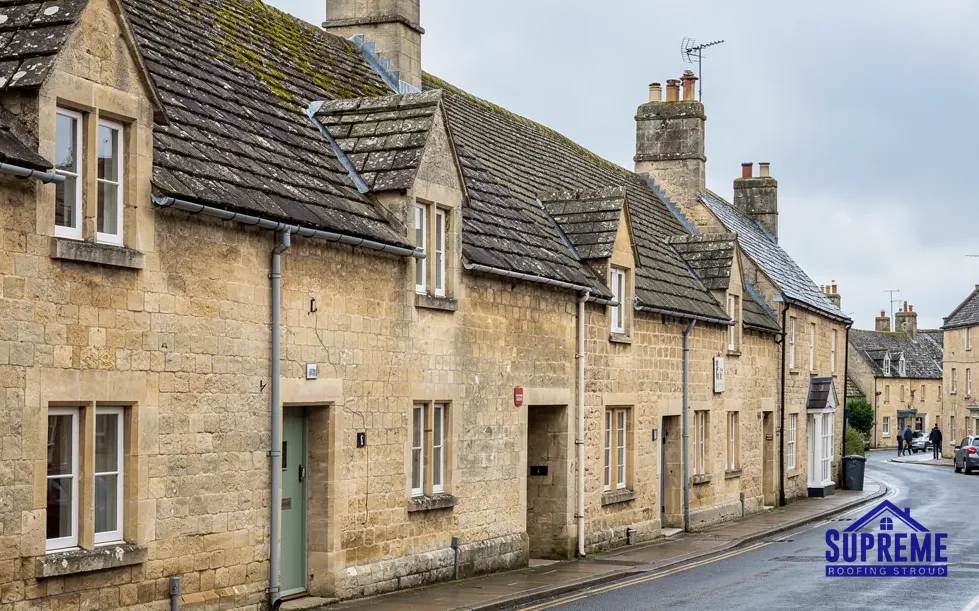
Terrace of stone cottages with dormer windows and stone tile roofs 
Hillside terraces of stone houses with slate roofs and chimneys

Chapter 01
Cooper's Hill and roofing on falling ground
A hill with a 26.6 degree slope is a useful prompt to talk about plots that fall away from the road.
Chapter 01In this chapter
Cooper's Hill is the best-known slope in the parish, and Wikipedia gives its gradient as around 50 per cent, which is 26.6 degrees. A hill like that is not a street, but it makes a handy comparison for any Brockworth plot where the ground drops away from the road. The scaffold stands on that ground, not on a level drive, and the quote should say how the difference is handled.
On sloping ground, scaffold goes up in stepped lifts so the working platform along the eaves stays level while the standards land at different heights. Base plates need firm footing, and on soft ground boards go under them. That takes longer to erect than a straight run on flat tarmac, so the scaffold adds to the cost. As a national guide, Checkatrade's 2026 roof replacement figures put scaffold at £700 to £1,300, and a stepped erection tends to sit towards the upper end of any range like that.
Materials are the next question. Tiles, battens and bundles of slate are heavy to carry up steps or along a garden path, so at the survey we look at where a hoist can stand and where a delivery lorry can stop. If it is a short carry from the road, handling is a modest part of the labour. If the back of a house sits well above or below the front, handling can become the largest line, and it is far better to know that before the order is placed.
Pitch is not the same as ground slope
The pitch of a roof is set by its structure and its covering, not by the hill under the house. Marley gives a minimum of 15 degrees for its Lincoln clay pantile and 35 degrees for its concrete plain tile, and every product has its own data sheet. Before any replacement covering is ordered we compare the existing pitch with the new tile's minimum, because a low pitch rules some tiles out however good they look in a brochure. Our pitched roofing page explains how pitch, headlap and exposure fit together.
Ladders on a falling slope
A ladder needs the same care as scaffold. We do not reach a roof from a ladder footed on unsound ground, and for a short repair we say plainly when a tower, or a roof ladder from a safer point, makes more sense than a full scaffold. If a job would cost more in scaffold than in work, we talk it through with you instead of quietly pricing it in. Gutter clearing and a few slipped tiles are the usual examples, and a tower on level ground at the front can often reach what a full lift would have been built for.
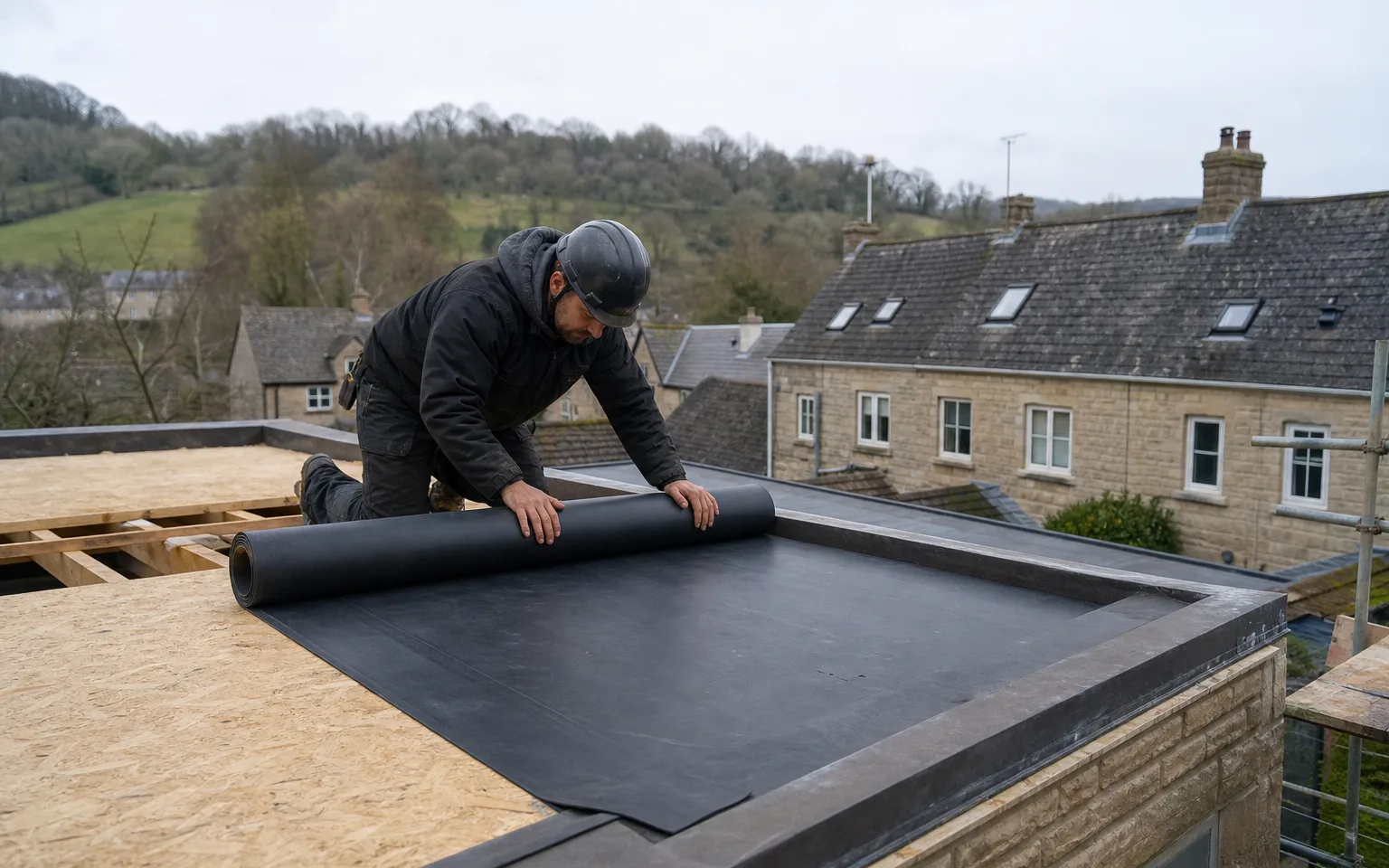
The ground under the scaffold is part of the quote.
Chapter 02
Hurricanes, the business park and Coopers Edge
A parish that grew in bursts has roofs of several ages side by side.
Chapter 02In this chapter
Brockworth's last century was an industrial one. The Gloster Aircraft Company's factory built Hawker Hurricanes from 1939, and the Gloster E28/39 made its first test flight from the Brockworth airfield on 8 April 1941. The works closed in 1962 and the site became Gloucester Business Park, while the Coopers Edge housing was developed around the former airfield. Wikipedia adds that after the mid-1950s, renewed housing growth, motorways and redistricting changed the area's appearance.
A parish that grows in bursts ends up with buildings from many different decades, and the age tells us where to look first. Between the medieval church and the newest houses there are more than eight centuries of building on the same few miles of ground, and each decade left its own habits in the timber, the fixings and the flashings. A house from the mid-century expansion has had decades of weather on its first covering, so trouble tends to sit at the edges: the top line, the gable ends, the lead round a chimney, and the gutters. A house in the newer housing around the airfield is younger, so the covering itself is likely to be sound and the useful checks are in the details, such as how the ridge is fixed and whether the underlay has been damaged by a slipped tile.
Ridges are worth a word. The ridge is the top line where two slopes meet, and a hip is the sloping edge on a hipped roof. Since the 2014 revision of BS 5534, mortar cannot be relied on to hold those tiles; each also takes a mechanical fixing. On an older house we often find mortar that has cracked and a tile that has simply been sitting in it, and re-bedding with proper fixings is the repair.
Extensions and flat roofs
Post-war houses often gained a flat-roofed kitchen, garage or porch later. BS 6229 designs a flat roof for a 1:40 fall, leaving 1:80 once it is finished, and a roof that holds puddles is usually one laid without that slope. We check the line of the deck with a level before suggesting patch repair or a new membrane.
Commercial roofs on the business park
Premises on Gloucester Business Park are a different scale again: larger spans, rooflights, long gutter runs and access that depends on the tenant. We cover that work on our commercial roofing page, and we agree access, safe working areas and any out-of-hours needs with whoever manages the unit before a date is fixed.
- 1939year the Brockworth factory began building Hawker Hurricanes
- 8 April 1941first test flight of the Gloster E28/39 from the Brockworth airfield
- 1962year the aircraft works closed and the site became Gloucester Business Park
Chapter 03
St George's, Brockworth Court and the protected roofs
Three listed buildings at the old centre, and three different routes to permission.
Chapter 03In this chapter
The oldest part of Brockworth has some of the most protected roofs in this part of Gloucestershire. St George's Church is listed Grade I. Brockworth Court, the Tudor house built for Richard Hart between 1534 and 1539, and the tithe barn at the Court are both listed Grade II*. These are the highest grades in the parish, and the rules that apply to a roof differ by building.
In this chapter
St George's, as a church in regular use, falls under the ecclesiastical exemption, so roof work there goes through the diocese by faculty, not through the council. Brockworth Court is a house, and that changes the route: alterations that touch a listed building's character need authorisation, which here means Tewkesbury Borough Council. Whatever the grade, ask the council's conservation team before a plan is drawn up.
What that means in practice is like for like. On a historic roof we keep the existing material and the existing details wherever they can be saved. English Heritage policy, as reproduced in Cotswold District Council's 2000 stone slate guidance, prefers new stone slates to second-hand ones, and says reclaimed slates belong on the building they were taken from. We borrow the logic for any covering: match type, colour, size and thickness, and keep a record of what was lifted.
Barn roofs
A tithe barn carries a very large roof over a wide span, with long timbers that are sensitive to water. A small defect high on the roof can wet a timber for a long time before anything shows below, and by then the repair is a carpentry job as well as a roofing one. On a barn, we look at the junctions between the main roof and any lean-to, the condition of the battens and the openings where the roof meets a gable, and we photograph each one for the written report.
Planning for a protected roof
Surveys on protected buildings take longer, because we are recording as well as inspecting. Our written quote arrives after the survey and covers every stage. Where the answer is a full new covering, the roof replacement page lays out how those stages run. Notifiable work goes to your building control body, which in this borough means Cheltenham and Tewkesbury Building Control, and we handle that paperwork. If you are still deciding between patching and replacing, the same page sets out how we tell the two apart, and the survey photographs make the comparison concrete.
Map showing Brockworth and the Stroud service radius, with nearby towns we also cover.
Near Brockworth
Roof work we do here
Brockworth Court, St George's and the old airfield
Does a roof beside Brockworth Court or St George's need different handling from one in Coopers Edge?
Yes. The old centre has Grade I and Grade II* buildings where the existing material and details should be kept, and consent routes apply. The newer housing around the former airfield is a normal re-roof or repair, though we still check the ridge fixings and the flashings.
Can you repair a roof on a plot that drops away from the road?
Yes. We survey the back of the house as well as the front, plan stepped scaffold where the ground falls, and allow for the scaffold and the carrying of materials in the quote.
Who deals with building control for roof work in Brockworth?
Cheltenham and Tewkesbury Building Control is the council's service here, and a registered building control approver is the private option. We explain the choice, and file the paperwork ourselves when a job calls for it.
My unit is on Gloucester Business Park. Can you survey a larger roof?
We can. A commercial survey records the spans, rooflights, gutter runs and access routes, and we agree safe working areas with whoever manages the building before a date is set.