

Roofers in Churchdown
Roofing in Churchdown, in the Severn Vale between Gloucester and Cheltenham: a large community under Chosen Hill, with a hilltop church and a Grade II* manor house. From Stroud it is 11.4 road miles to the north-north-east.
Churchdown at a glance
- Distance
- 11.4 road miles north-north-east of Stroud
- Council
- Tewkesbury Borough Council
- Hilltop church
- St Bartholomew's, Grade I
- Setting
- Severn Vale, below Chosen Hill
Roofs below Chosen Hill, from Domesday to the railway
Churchdown lies between Gloucester and Cheltenham, below Churchdown Hill, which most people call Chosen Hill and which rises to 155 metres (510 ft). Wikipedia traces the name to the 1086 Domesday Book, where it appears as Circesdvne. On top of the hill stands St Bartholomew's Church, on the site of a pre-Christian Iron Age settlement, listed Grade I. Down in the village, Caledonia Manor House is listed Grade II*.
The modern parish is big. Wikipedia gives a population of 10,990 at the 2011 census, and Wikidata records 10,870 for 2021. A railway station served Churchdown from 1874 until 1964, so for ninety years the village had a rail link of its own. That is a long stretch of time for building to happen in, and a community of this size will have roofs from many different periods. Historic England's entry for Caledonia Manor House describes a sixteenth-century timber-framed building, altered and extended from the late seventeenth century, under a tiled roof; for the thousands of later homes, the covering on your own roof is something we confirm by going up to look.
What we can offer is a way of working that fits a place with a protected church, a protected manor and a great many ordinary homes between them. A photograph of the roof, the approximate age of the house and the street are enough for a first conversation, and the survey does the rest. The written quote comes afterwards, with the guide ranges we publish on our service pages available to you beforehand.
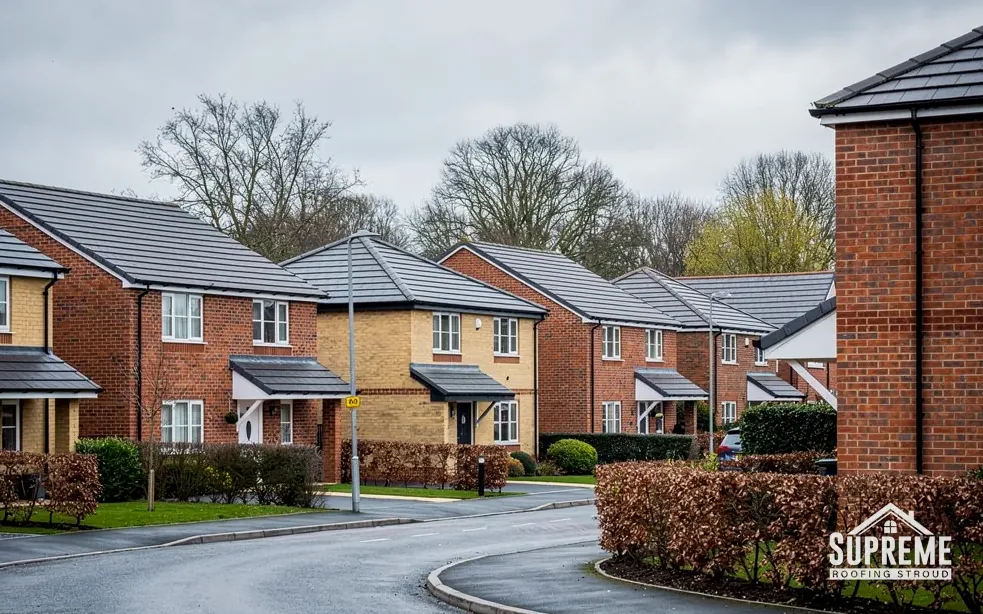
Modern brick housing estate with grey tiled roofs along a curving road 
Hillside of stone terraced houses with mossy stone tile roofs and chimneys

Chapter 01
Working on the Chosen Hill church roof
St Bartholomew's stands where the lane ends and the carrying begins.
Chapter 01In this chapter
St Bartholomew's Church crowns Churchdown Hill, 155 metres above sea level by Wikipedia's figure, and the church carries a Grade I listing. Ask anyone who has repaired a roof up there and the first difficulty they mention is the climb, not the slopes. Materials, tools and waste all have to travel the same route that visitors take, and on a hill there is no easy place for a lorry to stand next to the building.
That changes how a job is planned. Slates, lead and timber are usually brought as far up as a vehicle can go and then moved by hand, by barrow, or by a small powered carrier. Scaffold is delivered in lengths that can be carried and built up in sections. A hoist at the base of the tower or nave wall lifts loads to the working level, while the debris from old coverings comes down in bags or chutes rather than being thrown. All of that takes hours, and on a hill site those hours are a real part of the price. We explain them so you can see why the figure is what it is.
The Iron Age settlement under the church is a second reason for care. Anything that digs, drives or pins into the ground, from scaffold bases to a skip, should be agreed with the diocese before it arrives, and any waste leaving the site goes down the hill in sacks, not loose. That decision is not ours to make, so we put the question to them in writing and wait for the answer.
Permission for a church in use
A Church of England building that is used for worship is outside the council's listed building consent system. The rule is the ecclesiastical exemption, and the permission is a faculty, which the diocese grants. So the order of events on a parish roof is survey, specification, faculty, and only then scaffold. Our roof inspections and surveys page sets out what goes into the written report that supports an application.
Gutters and drainage on a steep site
Rain that leaves a church roof must be carried clear of the walls, and on sloping ground the point where it lands deserves thought. We follow each downpipe to its drain or soakaway. A pipe that stops short of its gully sends the water straight back to the foundation, and stone walls are slow to dry once they are wet. Long gutter runs on old buildings are worth setting out with a level, because a sagging length holds water and spills it over the edge.
On a hilltop job, the carrying is as much work as the roofing.
- 155 mheight of Churchdown Hill, also called Chosen Hill (510 ft)
- 1086year the name first appears in the Domesday Book, as Circesdvne
- 1874year Churchdown's railway station opened; it served the village until 1964
Chapter 02
A station, a suburb of eleven thousand and a lot of lofts
In a community this size, the commonest roof questions are about the loft below.
Chapter 02In this chapter
Churchdown's station opened in 1874 and closed in 1964, and its population was 10,990 at the 2011 census. Between those dates a village on a hill turned into a place with thousands of homes. Street by street the dates differ, but the scale alone has a consequence for roofing: a community this large has plenty of roofs that were renewed once and are coming up for another look, and plenty that have never been touched.
When a roof is replaced, what lies under it often matters as much as what sits on top. Three things come up repeatedly in the lofts we inspect. The first is ventilation. Marley's reading of BS 5250 asks for a continuous 25 mm gap at the eaves under non-breathable underlay on pitches up to 15 degrees, falling to 10 mm on steeper ones. The second is insulation. Renovating more than 50 per cent of a roof's surface brings in a thermal upgrade under Part L, set at 0.16 W/(m²·K), so building control is told before work starts. The third is the condition of the timbers, because wet rafter feet and rotted battens appear only when the old covering comes off.
Insulation deserves a plan of its own. Once the old covering is off, the rafters are open and the depth available between them is plain to see, which is the least expensive moment to decide how much insulation the roof can take without blocking the ventilation gap. We measure that at the survey and photograph the loft so the figures can be checked later.

Terraces and shared walls
Where houses share a party wall, a new roof meets the neighbour's at the junction, and the flashing there has to be right. Two neighbours who both need work can split one scaffold, which brings down the cost of each job, and we will price the pair side by side. The roof replacement page follows a full new covering from the first morning to the last.
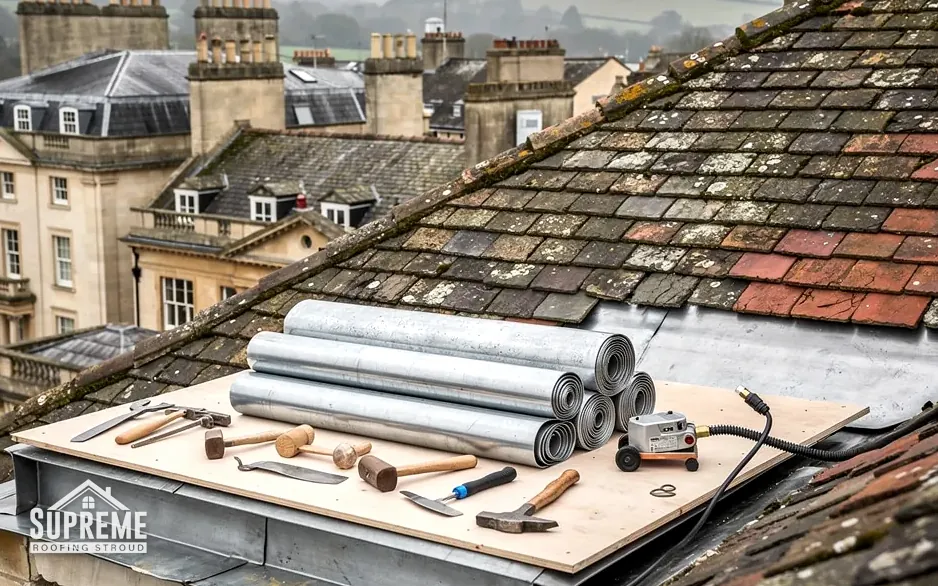
Chimneys that have outlived their roofs
A stack often stands for longer than the roof around it. When the covering is renewed, look first at the lead along the slope side of the stack, then the pointing in the courses, then the flaunching on top, the mortar fillet that seats the pots and throws water off. Our chimney repairs page covers repointing, rebuilding and flashings.
Chapter 03
Caledonia Manor House and the listed home
Grade II* means the whole building is protected, and the roof is part of it.
Chapter 03In this chapter
Caledonia Manor House in Churchdown is listed Grade II*, according to Historic England's list entry 1305066. For its owners, and for owners of any listed home in the area, the principle is the one every council applies: listing covers the entire building, outside and in, so the roof is as protected as the front door.
In this chapter
Under section 7 of the Planning (Listed Buildings and Conservation Areas) Act 1990, no one may carry out works to alter a listed building in any way that would affect its character without authorisation, and section 9 makes it an offence to do so. In Churchdown the authorising body is Tewkesbury Borough Council. The sensible course is to speak to its conservation officers before any roof work is priced, and to send them photographs, a description of the work and the materials proposed. Allow time for the answer: a consent decision is not instant, and a scaffold booked too early simply stands idle while the paperwork catches up, with the hire charge running the whole time.
What a listed-roof quote looks like is different from an ordinary one. It starts with a record of what is there: covering, battens, pegs or nails, the lead at each junction, and the condition of the timbers. It names the proposed repair against each defect. If a covering must be renewed, the new one matches the old in material, size and laying pattern, so the roof reads the same from the road. For historic coverings, Cotswold District Council's technical guidance says that new substitutes such as concrete tiles or reconstituted stone are inappropriate for historic buildings, and we follow that thinking for any old roof.
Questions to ask a roofer
Ask how the existing covering will be recorded, who will take the photographs, what will be reused, and who deals with the council. A roofer who cannot answer is not ready to start. Ask, too, who deals with Building Regulations. Cheltenham and Tewkesbury Building Control is the council's service in this borough, and for notifiable work we take care of that application for you.
Between the two cities
Churchdown sits between Gloucester, which is a city, and Cheltenham, which is a town, so crews and materials can reach it from either direction. We plan the delivery route when we price the job, so that the lorry, the skip and the scaffold arrive when the street can take them. Narrow roads and parked cars decide more about a start time than the roof does, and a driver who has to circle the block is a driver being paid to wait. Where a drive is shared or a verge is soft, we say how the vehicles will be placed and who needs to move a car.
Map showing Churchdown and the Stroud service radius, with nearby towns we also cover.
Near Churchdown
Roof work we do here
Chosen Hill church and Caledonia Manor House
How do you get materials up to a church on Chosen Hill?
In stages. Materials come as far as a vehicle can safely go, then move by hand or small carrier, and a hoist lifts them at the building. The carrying time is allowed for in the price.
Do I need a faculty or listed building consent for St Bartholomew's roof?
A church in use needs a faculty from the diocese, not listed building consent. A private listed house such as Caledonia Manor House needs consent from Tewkesbury Borough Council.
Can a Churchdown re-roof include new loft insulation, or is that a separate job?
Not in the way you might expect. The covering and the insulation are two parts of the same job, and if you want one without the other that is a choice we are happy to price both ways.
Can two neighbouring Churchdown houses share one scaffold?
Often they can. Where both roofs need work and a wall is shared, a single scaffold can serve both houses, and we price the pair together and agree each owner's share with them.