
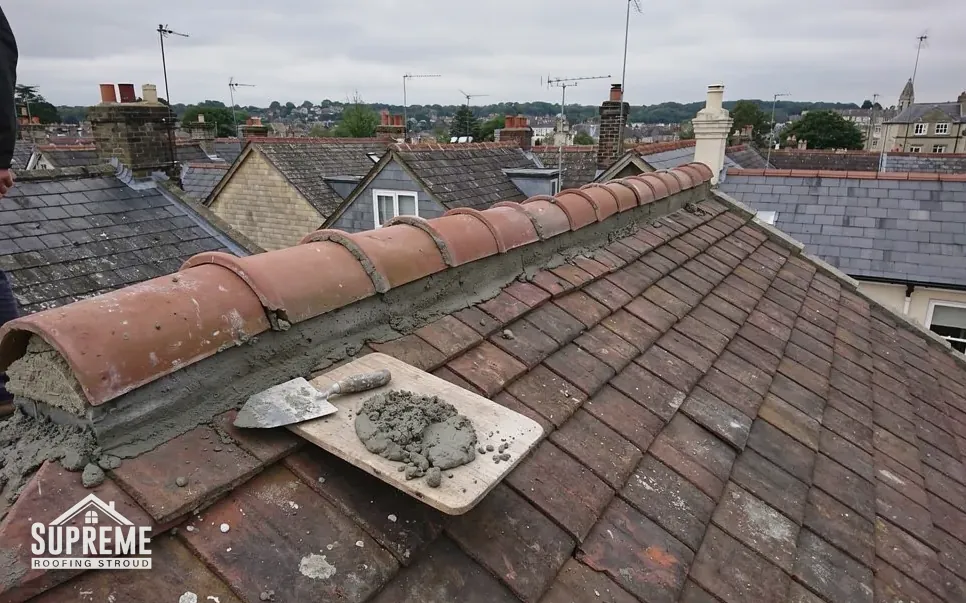
Ridge and verge repairs in Stroud
Loose ridge tiles, crumbling verge mortar and storm damage along the top and edges of your roof, repaired or replaced with dry-fix. Typical prices sit below, and the survey leads to a written quote.
Typical ridge, hip and verge costs
National cost guides give the ranges below. They are a yardstick for comparing quotes, not a price for your roof, which depends on the length of run, the tile type and the access.
| Work | Typical price |
|---|---|
| Repointing a ridge or hip | £200 to £400 |
| Re-bedding or replacing ridge tiles | £300 to £600 |
| Dry ridge system, fitted | £40 to £60 per metre |
| Dry ridge, typical whole job | £500 to £1,000 |
| Storm damage repair, typical range | £500 to £1,500 |
| Dry verge system | priced on survey |
When the survey is done, your written quote covers access, removal, new fixings and fittings, labour and waste.
Sources: MyBuilder slate roof cost guide, roof repair cost guide and dry ridge installation cost guide, all updated August 2026. National ranges, not Supreme Roofing prices.
Ridge, hip and verge work we do
These are the lines where two slopes meet or a slope meets a gable. They take the weather first, and they are where the fixing standards are strictest.
-
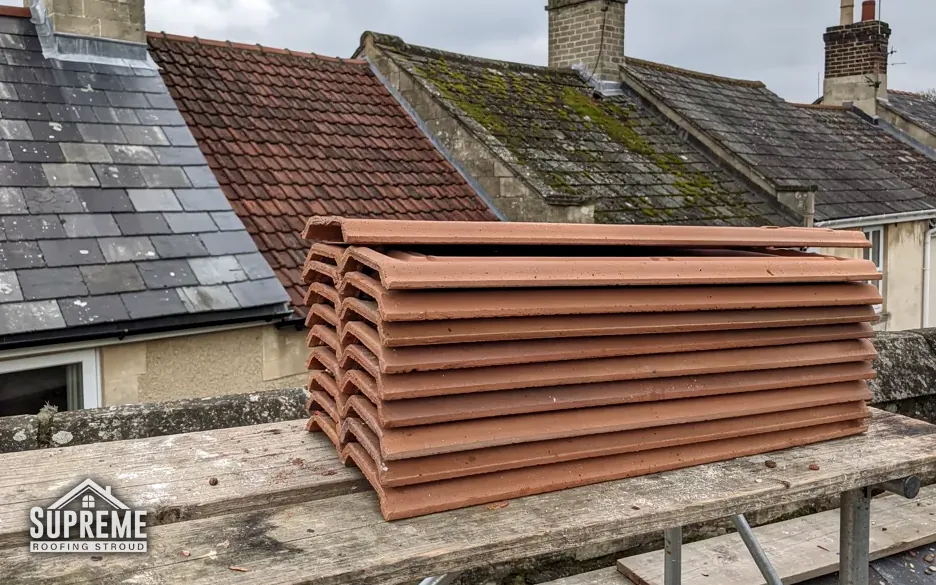
Re-bedding and repointing
Loose ridge and hip tiles are lifted, the old bed is cleared, and the tiles go back on fresh mortar with mechanical fixings, so the mortar is not the only thing holding them.
-
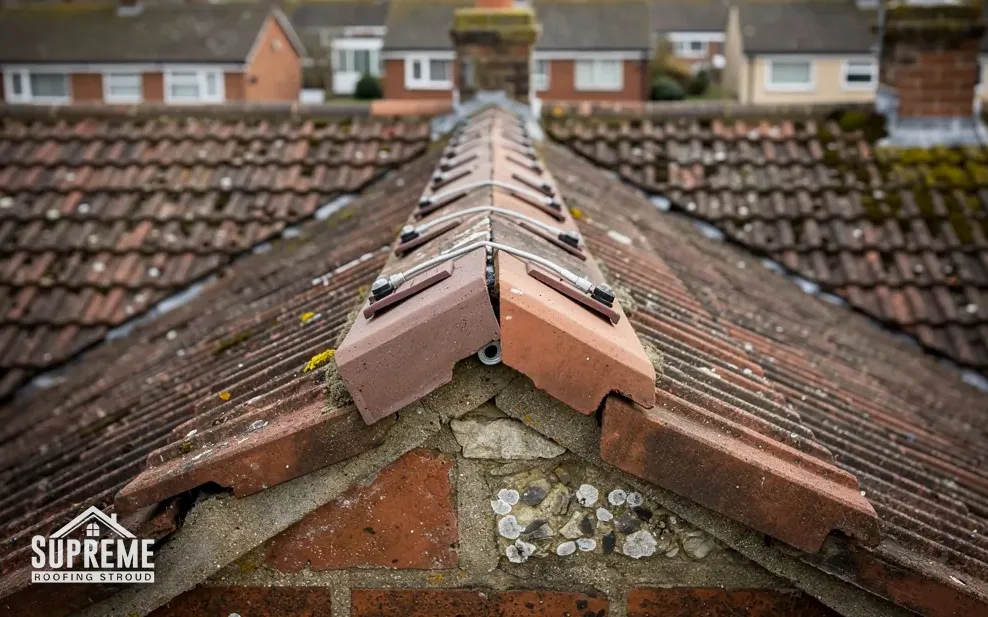
Dry ridge, dry hip and dry verge
A dry-fix system clips or screws the ridge, hip or verge fittings to the roof without a wet mortar bed, using products tested to BS 8612.
-
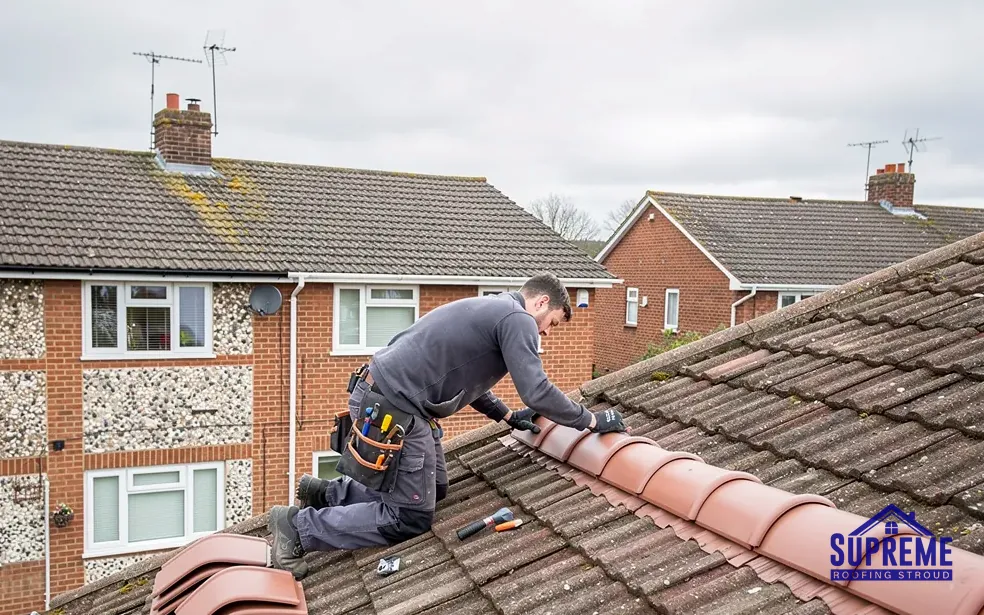
Verge repairs and storm make-safes
Cracked verge pointing, lifted undercloak and tiles shifted by wind are made safe first, then repaired properly once the weather allows.
Signs your ridge or verge needs attention
- Ridge tiles that rock or tilt when seen against the sky
- Crumbs of mortar in the gutter or scattered along the path beneath the roofline
- A crack running along the pointing where the ridge meets the tiles
- A gap or lifted tile at the gable edge, with the verge mortar missing
- Damp staining on the top of a ceiling or the wall plate in the loft
How a ridge or verge job runs
- 1Survey the line, not just the tilesWe check the ridge and verge from a tower or ladder, count the tiles that have moved, and look at the underside of the ridge from the loft.
- 2Written quoteMetres of ridge, hip and verge, with the choice between mortar and dry-fix covered where both suit.
- 3Remove, clean and refixLoose tiles come off, the old bed and any rotten ridge batten are cleared, and the new fixings go in before anything is bedded or clipped.
- 4Photographs and sign-offPictures of the finished line, plus any Building Regulations paperwork and our 10-year workmanship guarantee, in writing.
The ridge and verge guide
Ridges and verges, explained
What holds ridge, hip and verge tiles on, which standards apply, and how to choose between mortar and dry-fix.
- 01BS 5534 and BS 8612: why ridge tiles are fixed as well as bedded
- 02Re-bedding and repointing: two repairs that are easily confused
- 03Dry ridge, dry hip and dry verge: how the systems work
- 04Verge repairs: undercloak, pointing and blown caps
- 05Storm-loosened ridges and the tile that has already fallen
- 06Lime-bedded ridges, hip irons and older roofs
Chapter 01
BS 5534 and BS 8612: why ridge tiles are fixed as well as bedded
Mortar used to be the whole answer. The standards now ask for more.
Chapter 01In this chapter
The ridge is the line along the top of a pitched roof where two slopes meet. A hip is the sloping line where two slopes meet at an outside corner, and a verge is the roof's sloping edge where it stops at a gable wall. All three are finished with fittings, usually ridge tiles, hip tiles and verge tiles, and all three are exposed to wind from several directions at once.
In this chapter
For generations those fittings were held on by a bed of mortar and nothing else. Marley, writing on its website (updated February 2026), explains that the 2014 revision of BS 5534 made clear that the tensile strength of mortar alone could no longer be relied upon, and that all bedded roof tiles and fittings should include mechanical fixings. For us that means a re-bedded ridge is now a bedded and fixed ridge: mortar for the seal and the bearing, and a screw, clip or bracket for the grip.
What BS 8612 adds
BS 8612 is the test specification for dry verge, hip and ridge systems. Marley says only products that have been properly tested can be used to gain compliance. When we propose a dry-fix system we name the product in the quote, so you can check it against the maker's data sheet.
Mortar is not banned
It is a common worry that mortar bedding is no longer allowed. It is not. What changed is that mortar is no longer the only thing holding the tiles in place. A bedded ridge with mechanical fixings is acceptable, and on some period roofs it is the more suitable choice, because the mortar gives the tile a continuous seat along its length. Our page on whether mortar for ridge tiles is banned answers the question in full, and the BS 5534 and BS 8612 fixing rules go through what each standard covers.
Why the change matters on the roof
A ridge tile that is bedded only in mortar relies on the bond between mortar and clay or concrete. Wind lifting the tile, frost expanding water in a crack and the slow movement of a roof timber all test that bond. When it fails, the tile has nothing else to hold it, and it slides or falls. A mechanical fixing stops that last step. It does not stop the mortar cracking, but it stops the tile leaving the roof when it does.
What we check before choosing
Three things decide the method: what the ridge is made of, what state the ridge batten and rafters are in, and whether the roof is historic. A modern concrete tile roof in good order suits dry-fix well. A lime-bedded ridge on a period roof may be repaired with lime and a concealed fixing. We discuss the choice with you, show the pros and cons for your particular roof, and price both where both are sensible. The page comparing mortar and dry-fix sets out the trade-offs.
Mortar seals the joint; the fixing is what keeps the tile on the roof.
Myth: Mortar bedding for ridge tiles has been banned.
Fact: Since BS 5534:2014 the tiles must be mechanically fixed too, so the mortar is never the only thing between a tile and the ground.
Mortar and fixings do different jobs, and the repair that combines them is the subject of the next chapter. It also shows the difference between repointing and re-bedding, which people often mix up when they ring for a quote.
Chapter 02
Re-bedding and repointing: two repairs that are easily confused
Repointing fills a cracked joint. Re-bedding rebuilds it from the roof upwards.
Chapter 02In this chapter
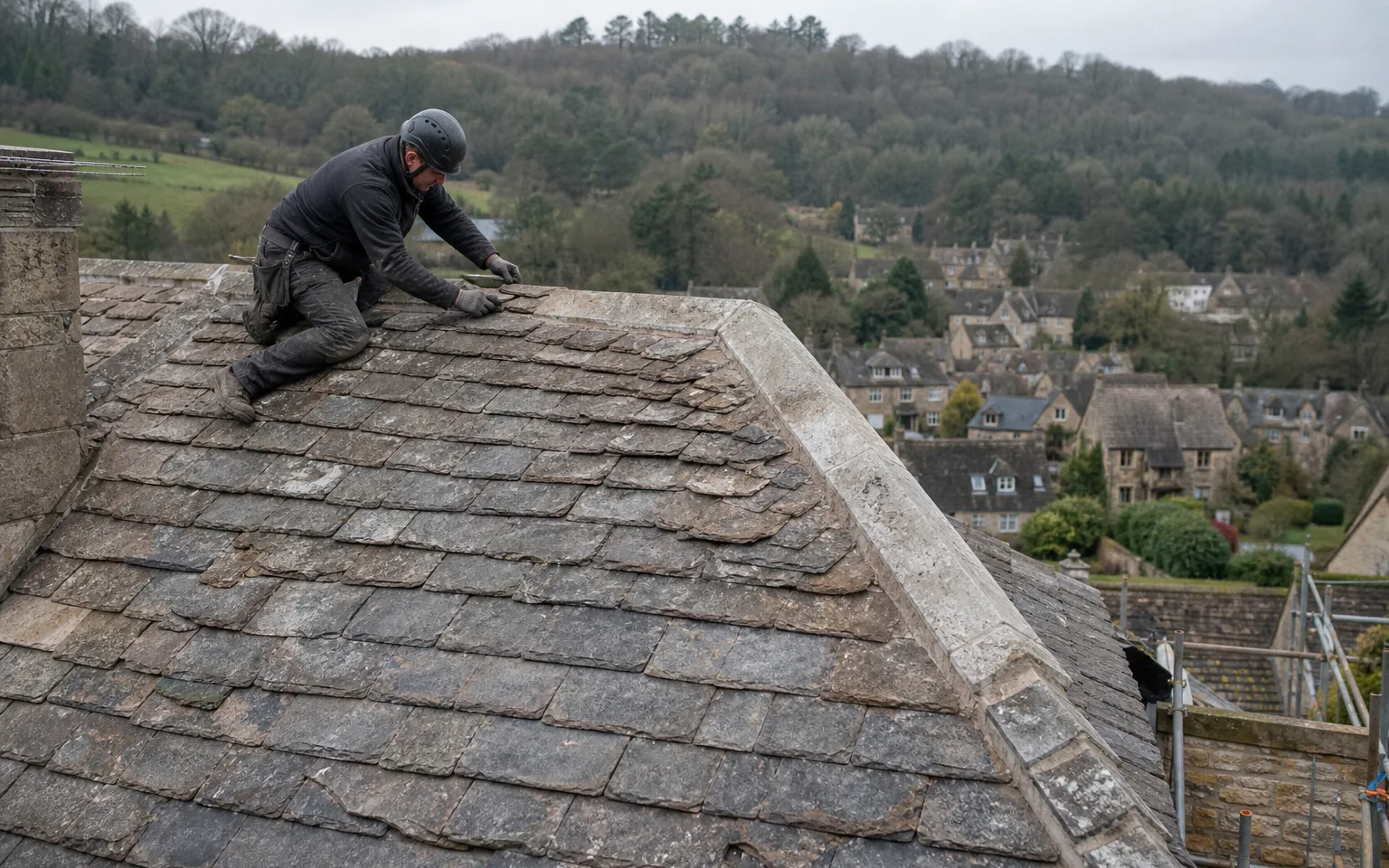
Repointing a ridge means raking out the loose, cracked mortar along the visible joint and filling it with fresh mortar. It is cheaper than re-bedding because the tiles stay where they are. It works when the bed underneath is sound and only the face of the joint has weathered. MyBuilder's slate roof cost guide, updated August 2026, puts repointing a ridge or hip at £200 to £400. It will not cure a ridge whose tiles rock, because the bed under them has already gone.
In this chapter
Re-bedding
Re-bedding means lifting every tile in the affected run, clearing the old mortar from the tiles and the roof, checking the timber ridge batten, and building a new bed. The tiles are then reset and fixed. MyBuilder gives £300 to £600 for re-bedding or replacing ridge tiles. The cost rises with the length of run, with tiles that are cracked and need replacing, and with the access needed to reach the top of the roof.
How to tell which you need
Push gently on a ridge tile from a ladder, or look from the ground for tiles that sit unevenly along the line. A ridge that has only cracked pointing, with every tile solid, may take a repoint. A ridge where tiles tilt or have slipped has lost its bed. Our page on whether repointing ridge tiles is enough goes through the signs, and re-bedding ridge tiles on Stroud roofs sets out the method and its limits.
Why mortar cracks
Mortar shrinks as it cures, and a ridge flexes in the wind, expands in sun and contracts in frost. Over years, hairline cracks let water into the bed, and water that freezes in the bed widens the crack. Sand and cement mixes differ in strength, and a mix that is too strong for the tile can split the tile edge instead of the mortar. The question of why ridge mortar cracks and falls out has its own answer.
Cracked tiles
A cracked tile is replaced rather than glued, and matched for profile and colour. We keep the old tile for comparison and photograph the new run against the old. Half-round, angled and hogback ridge tiles are not interchangeable, so the type is identified before anything is ordered.
The timber under the mortar
Under a bedded ridge there is usually a timber ridge board or batten. If water has been getting in, that timber may have softened. Re-bedding on top of rot just buries the problem, so we probe the wood while the ridge is open, and if it needs renewing we agree it with you and it goes in the quote, with photographs.
- Repoint ridge or hip£200 to £400
- Re-bed or replace ridge tiles£300 to £600
- Dry ridge, whole job£500 to £1,000
For the money side in more detail, ridge, hip and verge repair costs in Stroud lays out what changes a price.
Chapter 03
Dry ridge, dry hip and dry verge: how the systems work
Clips, screws and a ventilated strip replace the wet bed, if the roof suits them.
Chapter 03In this chapter
A dry-fix ridge is built from a continuous strip or batten fixed along the ridge line, with the ridge tiles screwed or clipped to it. There is no bedded mortar to crack. The joints between tiles are covered by flexible seals or by the geometry of the fitting, and the strip usually allows a controlled amount of air to pass, which helps ventilate the roof void. The same idea is used at hips and verges. Our pages on dry ridge systems and dry hip systems explain how each is fitted.
What dry-fix costs
MyBuilder's dry ridge guide, updated August 2026, gives £40 to £60 per metre, with a typical job at £500 to £1,000. Checkatrade's roof repair guide is higher, at £50 to £70 per metre for dry ridge and £70 to £100 per metre for dry hip, excluding VAT. Those figures differ because the sources are different guides with different assumptions, and the way to compare is to check what each one includes.
The verge
A dry verge replaces the mortar at the gable edge with a one-piece cap or a section clipped to an undercloak. It avoids the mortar that cracks and falls from verges, but it changes the look of the edge, because a dry verge presents a different profile to a mortar-pointed one. The page on dry verge systems, fitting and standards covers the types, and why a dry verge rattles or clicks covers one common complaint.
Ventilation
Where the roof is a cold roof, a ventilated ridge can help the void breathe. Marley, citing BS 5250, says that with a breather underlay a ridge or high-level ventilation of 5 mm can be used. We work out the ventilation of the whole roof before choosing a ridge product, because blocking existing air paths with a closed ridge can cause condensation. See ventilated dry ridge and roof ventilation.
Where dry-fix does not suit
Dry-fix is built to fit particular tile profiles. On very irregular hand-made tiles, on a roof with a sagging ridge line or on a heritage roof where the appearance of the ridge matters, a bedded ridge may be the better choice. Slate roofs can take a dry ridge if the system is designed for it, as the page on fitting a dry ridge to slate explains.
Older roofs
Dry-fix can be retrofitted to older roofs, provided the rafters and ridge board will take the fixings. We check from the loft, and the answer to whether dry verge can be fitted to an older roof depends on what is found there.
| System | Guide figure | Source |
|---|---|---|
| Dry ridge | £40 to £60 per metre | MyBuilder, August 2026 |
| Dry ridge, ex VAT | £50 to £70 per metre | Checkatrade, June 2026 |
| Dry hip, ex VAT | £70 to £100 per metre | Checkatrade, June 2026 |
| Dry verge | priced on survey | Quote after survey |
If a dry verge needs approval in a conservation area, the answer is in consent for dry verges in Stroud.
Chapter 04
Verge repairs: undercloak, pointing and blown caps
The gable edge is where wind gets under the tiles first.
Chapter 04In this chapter
A verge is where a pitched roof ends against a gable wall. Traditionally the last tiles overhang the wall slightly, and the gap beneath is closed with an undercloak: a strip of fibre cement board, slate or plain tile bedded on the wall, and over it the overhanging tiles are pointed in mortar. The pointing keeps rain out of the edge and helps pin the tiles down. Over time it shrinks, cracks and falls away, and the tiles at the edge lift in the wind.
Cracks and falls
Cracks along the verge pointing are an early warning. Left alone, rain runs under the tile edge and can rot the batten ends, and lifted tiles invite more wind underneath. A repoint can restore a verge whose undercloak and tiles are sound. If the undercloak has slipped or rotted, it is replaced first. Our guide to mortar verge repairs in Stroud sets out the sequence, and what a verge undercloak is explains the part.
Why verges fail in wind
Wind pushes against the gable wall, accelerates over the edge of the roof and lifts what it finds. Verge tiles that are fixed only by their mortar are the first to go. In BS 5534 terms, verge tiles are fixed mechanically too, and the fixings sit where the mortar cannot reach. Our page on dry verge caps blown off looks at the equivalent failure on dry systems, where a cap pulls free of its clips.
Making safe
If a tile at the verge has slipped and is hanging, it is a danger to anyone walking below. A make-safe removes the loose pieces, covers the exposed edge and leaves the proper repair for when conditions allow. We put leaks and storm damage first, and the opening step is to stop the roof taking in water.
Access
Verges on a gable are among the harder places to reach, particularly on a terrace on a steep valley side or a house at the end of a lane. Scaffold is part of the picture. Checkatrade's re-roof guide gives £700 to £1,300 for scaffold in 2026, and MyBuilder about £1,125. Where one repair needs scaffold anyway, it makes sense to do the verge, the ridge and any chimney work together. Our page on whether ridge tiles need scaffolding covers when it is justified.
Neighbours
On semi-detached and terraced houses the verge may be shared or sit against a party wall. Cracks at the junction sometimes belong to the neighbour's side, and we tell you what we see and what is yours to repair.
For chimney stacks that meet the roof near the ridge, our chimney repairs page covers the flashing and pointing.

Chapter 05
Storm-loosened ridges and the tile that has already fallen
After a gale, the ridge is the first place to check.
Chapter 05In this chapter
Wind does most of its damage at the highest and most exposed points of the roof, and the ridge, hips and verges are exactly that. Tiles that were already loose, with cracked bedding or tired fixings, go in a storm. Others shift a little and are left sitting off line, ready to go in the next one. MyBuilder's roof repair guide, updated August 2026, puts storm damage fixes at £500 to £1,500.
From the ground
Look along the roofline from the lane or garden. A ridge tile out of line, a gap in the ridge, a dark mark where mortar has fallen or fragments of tile on the ground suggest a problem. Do not climb up. Our guide to storm-loosened ridge tiles gives the checklist, and what to do when a ridge tile has fallen off covers the first steps.
Make-safe, then repair
If tiles are loose enough to fall on a path or neighbour's property, they are removed or secured first. A ridge opened by wind lets rain into the roof void, so a temporary cover goes over the gap. The permanent repair follows once the roof can be worked on safely. A rebed or a dry-fix is chosen at that stage, with the loft checked for damp that has already got in.
Insurance
Whether a policy covers a loose ridge depends on its wording, the cause and the condition of the roof, and we cannot say what any policy pays. Photographs of the damage, the date of the storm and a written description of the repair help a claim. The survey photographs we take are as useful for a claim as they are for the repair. The page on loose ridge tiles and insurance sets out what to ask.
Winter work
Mortar and frost do not mix, and fresh mortar needs protecting from frost and from heavy rain while it cures. A dry-fix system has no wet bed, so it can be fitted in cold weather with less concern. For winter repairs we plan the sequence around the forecast, and cover the work at the end of each visit. See ridge and verge repairs in winter weather.
Time on site
A short run of ridge can be repaired in a single visit; a long ridge, a run of hips or a verge on both gables takes longer. The page on how long a ridge repair takes explains what drives the time, and we give you an expected duration in the quote rather than a promise.
A ridge that moved once in the wind will move again.
A loose ridge on a slate roof is covered on our slate roofing page, and general leak repairs on the roof repairs page.
Chapter 06
Lime-bedded ridges, hip irons and older roofs
On a period house the ridge is part of the building's character.
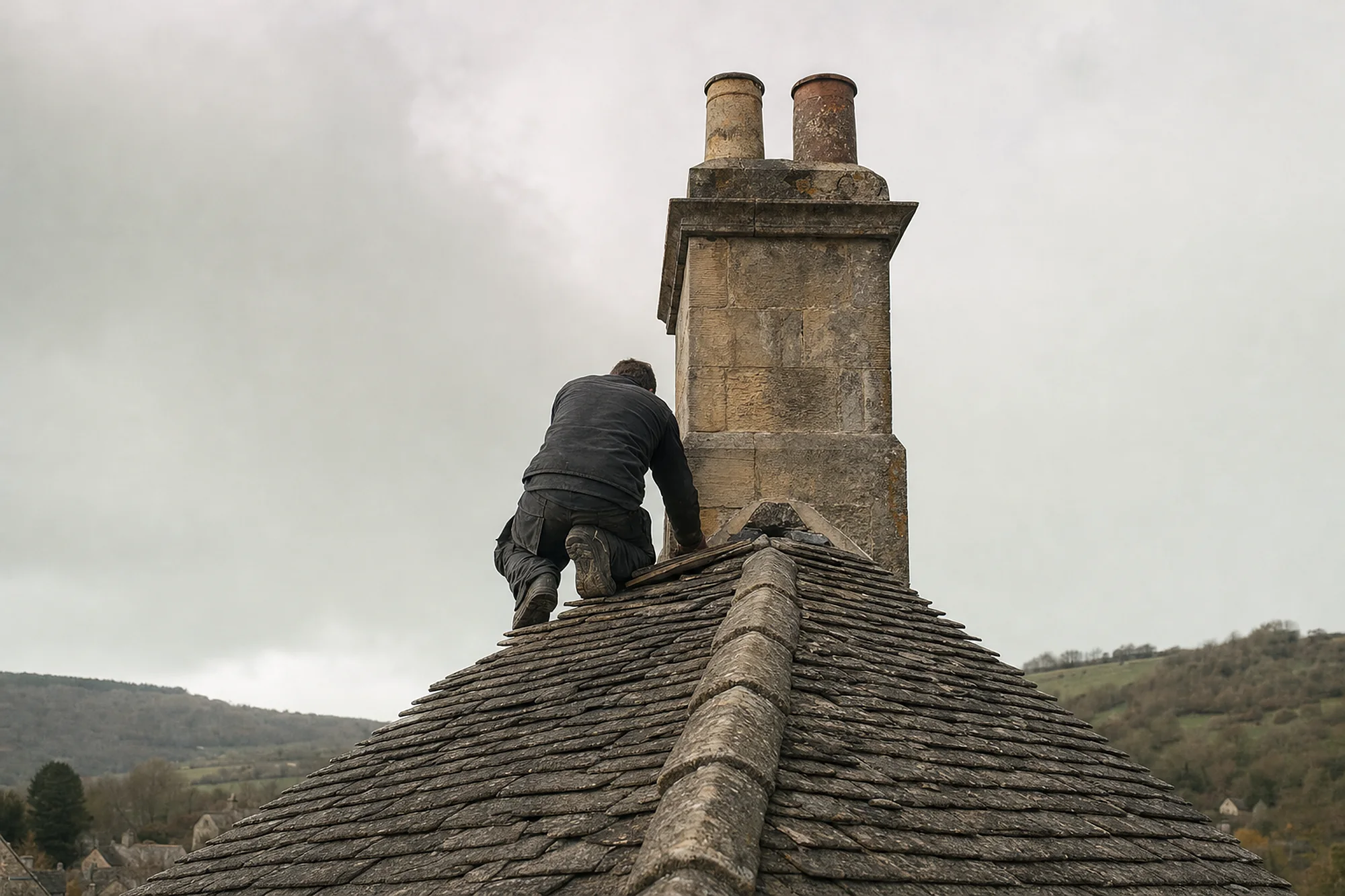
On a house older than the cement age, the ridge was probably bedded in lime mortar, which is softer and more permeable than a modern cement mix. A lime bed moves with the roof, and it lets moisture out through the joint instead of trapping it. That is why a heritage ridge is often repaired in lime, with a concealed fixing added to meet current practice. Our page on lime-bedded ridges on period and listed roofs covers the method.
In this chapter
Ridge tile shapes
Ridge tiles come in several shapes, including half-round, angled and hogback. They are not interchangeable, and the wrong one on an older roof is easy to spot from the lane. Half-round, angled and hogback ridge tiles shows the differences.
Hips and hip irons
Hip tiles run down the sloping corner of a hipped roof, and at the foot of each hip a hip iron, a small metal bracket screwed to the rafter, stops the lowest tile sliding. A hip iron that has rusted away or was never fitted is a common reason for a slipped hip tile. Our guides to what a hip iron is and whether you need one and hip tile repairs go through them.
- 2014year BS 5534 made mechanical fixing of bedded ridge and hip tiles the norm
- 41conservation areas in Stroud District
- 5of them with Article 4 Directions
Conservation areas and listed buildings
Of the 41 conservation areas Stroud District Council lists, five carry Article 4 Directions, covering Wotton Under Edge, Bisley, Frampton on Severn and two parts of Stroud. The council's published page leaves open whether roofs fall inside them, which is a question for its planners before any ridge or verge is altered. Putting back the same thing is not normally development; swapping a mortar verge for a dry one, or changing the ridge profile, could alter how the roof looks. For a listed building, any change that affects character needs listed building consent.
Doing it yourself
Re-bedding a ridge is work at the highest point of the roof, with heavy tiles and wet mortar. The roof edge is the hazard. Our page on re-bedding ridge tiles yourself explains why we advise against it, and what to do if you are determined.
What we record
On older roofs we photograph the existing ridge and verge details before touching them. That record shows the conservation officer what is being matched, and shows you what the roof looked like before and after.
Ridges that are cracked rather than fallen are the topic of can a cracked ridge tile be repaired.
Ridge, hip and verge guides and answers
Costs, standards, dry-fix systems and repairs for ridge, hip and verge work, written for owners of tiled roofs in and around Stroud.
Guides
- Ridge, hip and verge repair costs in StroudWhat re-bedding, replacing, repointing and dry-fixing a ridge or hip typically costs across the UK, where each range…Read the guide
- Dry ridge systems in Stroud: how they work and when to fitA dry ridge replaces the mortar bed with a line of screwed and clipped components. Each part has…Read the guide
- Dry verge in Stroud: systems, fitting and standardsThe verge is the roof edge at a gable, and it takes more punishment than most of the…Read the guide
- BS 5534 and BS 8612: the ridge and verge fixing rulesTwo British Standards govern how ridge, hip and verge pieces are held on. This guide sets out what…Read the guide
- Re-bedding ridge tiles on Stroud roofs: method and limitsA ridge that has cracked, slipped or let go of its mortar can usually be taken off and…Read the guide
- Hip tiles and hip irons: repairs and dry hipHips slope, so gravity works on every tile along them. What goes wrong on a hip follows from…Read the guide
- Mortar verge repairs in Stroud: undercloak, pointing, cracksThe mortar along a gable edge takes weather from two sides and moves with the roof beneath it.…Read the guide
- Lime-bedded ridges on period and listed roofs in StroudOn a protected roof the ridge is part of what is being protected. Lime bedding, stone or hand-made…Read the guide
- Storm-loosened ridge tiles in Stroud: risks and repairsA ridge that has started to move is a warning, not a nuisance. Wind loosens ridge tiles for…Read the guide
- Mortar or dry-fix for your Stroud ridge and verge?Both methods can give a sound roof edge, and both now rely on mechanical fixings. The choice comes…Read the guide
- Ventilated dry ridge and roof ventilationA ventilated ridge lets moist air escape through the top of the roof. This guide explains how that…Read the guide
- Ridge and verge repairs in winter weatherWinter is when roofs get damaged and the worst time to bed new mortar. Some work can be…Read the guide
Quick answers
- Do dry verges need consent in Stroud conservation areas?
- Is repointing ridge tiles enough?
- Why is my dry verge rattling or clicking?
- A ridge tile has fallen off your Stroud roof: what now?
- Are loose ridge tiles covered by insurance?
- Can dry verge be fitted to an older roof?
- What mortar mix is used for ridge tiles?
- Can a cracked ridge tile be repaired?
- Dry verge caps blown off: why and how they're fixed
- Can I re-bed ridge tiles myself?
- What is a hip iron and do I need one?
- Half-round, angled and hogback ridge tiles
- What is a verge undercloak?
- Can a dry ridge go on a slate roof?
- Can a leak come through the ridge?
- How long does a ridge repair take?
- Do you need scaffolding to repair ridge tiles?
- Is mortar for ridge tiles banned?
- Why does ridge mortar crack and fall out?
- Dry hip systems: are they worth it?
Ridge and verge repairs: common questions
Can my loose ridge tiles be repaired, or must they be re-bedded?
Repointing suits a ridge whose tiles are solid but whose joint has cracked. If the tiles rock or tilt, the bed beneath them has gone and re-bedding is the repair. We test the tiles at the survey and show you which applies.
Is dry ridge better than mortar for a Stroud house?
It depends on the tile and the age of the building. Dry-fix suits many modern concrete and clay roofs. A period roof may be better repaired in lime with a concealed fixing. We price both where both make sense.
Why does a ridge need fixing as well as mortar?
The 2014 revision of BS 5534 moved away from trusting mortar by itself, according to Marley. A mechanical fixing keeps the tile on the roof even after the bedding cracks.
Does a dry verge change how the gable edge looks?
Yes. A dry verge cap has a different profile from a mortar-pointed edge. In a conservation area or on a listed building, ask the council before choosing one.
What do I do if a ridge tile falls in a storm?
Keep clear of the area below it, take a photograph from the ground and ring us. Leaks and storm damage come first for us; we secure the roof, then repair the ridge when conditions allow.
Can ridge tiles be repaired in winter?
Dry-fix can go on in cold weather. Mortar needs frost protection while it cures, so we plan around the forecast and cover the work at the end of each visit.
Get your ridge and verge priced
Send a photo of the ridge from the ground, one of any tile on the path, and tell us whether the roof is tiled in concrete, clay or slate. At the survey we check the bed, the fixings and the batten before writing the written quote.