
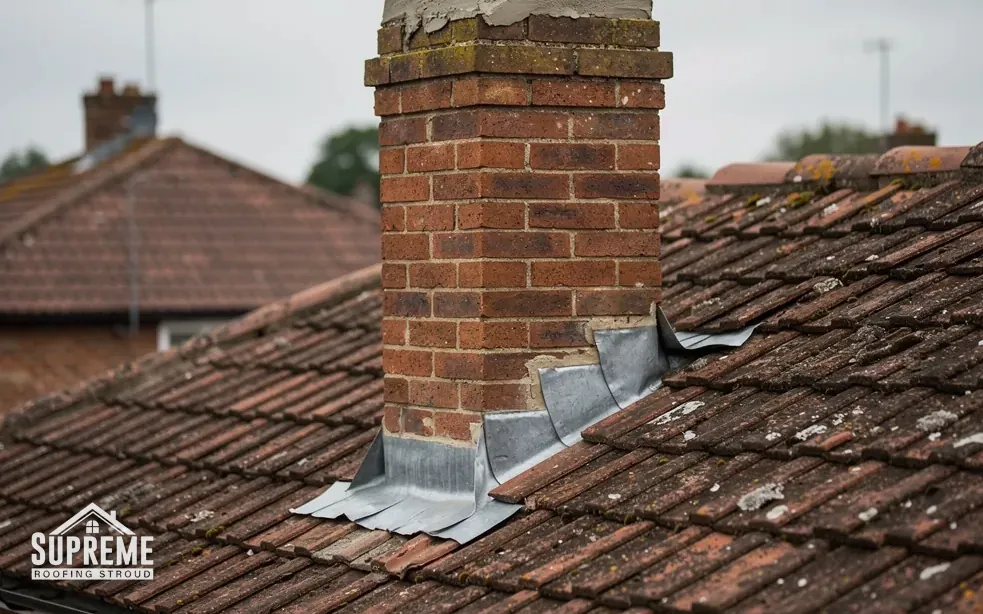
Chimney repairs in Stroud
Repointing, flaunching, flashings, pots and cowls, leaning stacks and full rebuilds, in brick or stone to match. Typical costs come first, and a written quote in writing follows the survey.
Typical chimney repair costs
Published cost guides supply the national figures below, so a rough budget exists before we arrive. What you pay turns on stack height, flue count and the way we get up to it.
| Work | Typical price |
|---|---|
| Chimney repointing, average job | £500 to £2,000 |
| Chimney flashing repair | £250 to £1,200 |
| Lead flashing patch at a chimney | £150 to £250 |
| Chimney stack rebuild | £2,000 to £10,000 and above |
| Roof survey with photographs | £150 to £500 |
| Flaunching, pots and cowls | priced on survey |
After the survey, a written quote follows covering scaffold, masonry, mortar, lead, labour and waste.
Sources: MyBuilder chimney repair cost guide, updated August 2026; MyJobQuote cost of replacing leadwork on a chimney, September 2026; MyBuilder roof inspection cost guide, August 2026.
Everything above the roofline
A chimney stack is the most exposed masonry on the house and the part nobody inspects. We repair it in the materials it was built in, so a stone stack stays stone and a brick stack stays brick.
-
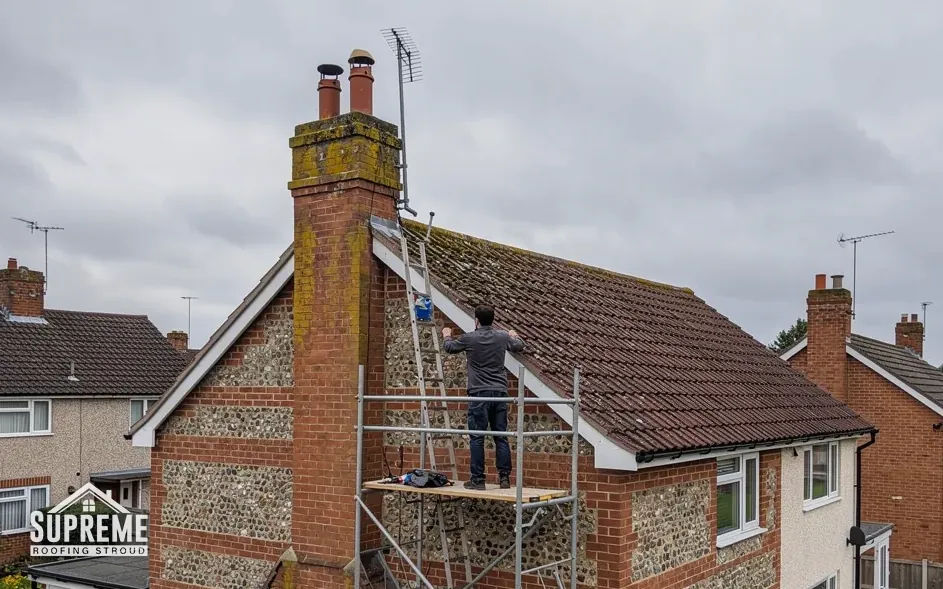
Pointing, flaunching and pots
Joints raked out and refilled, the mortar bed around the pots renewed, and cracked pots or loose cowls replaced and bedded properly.
-
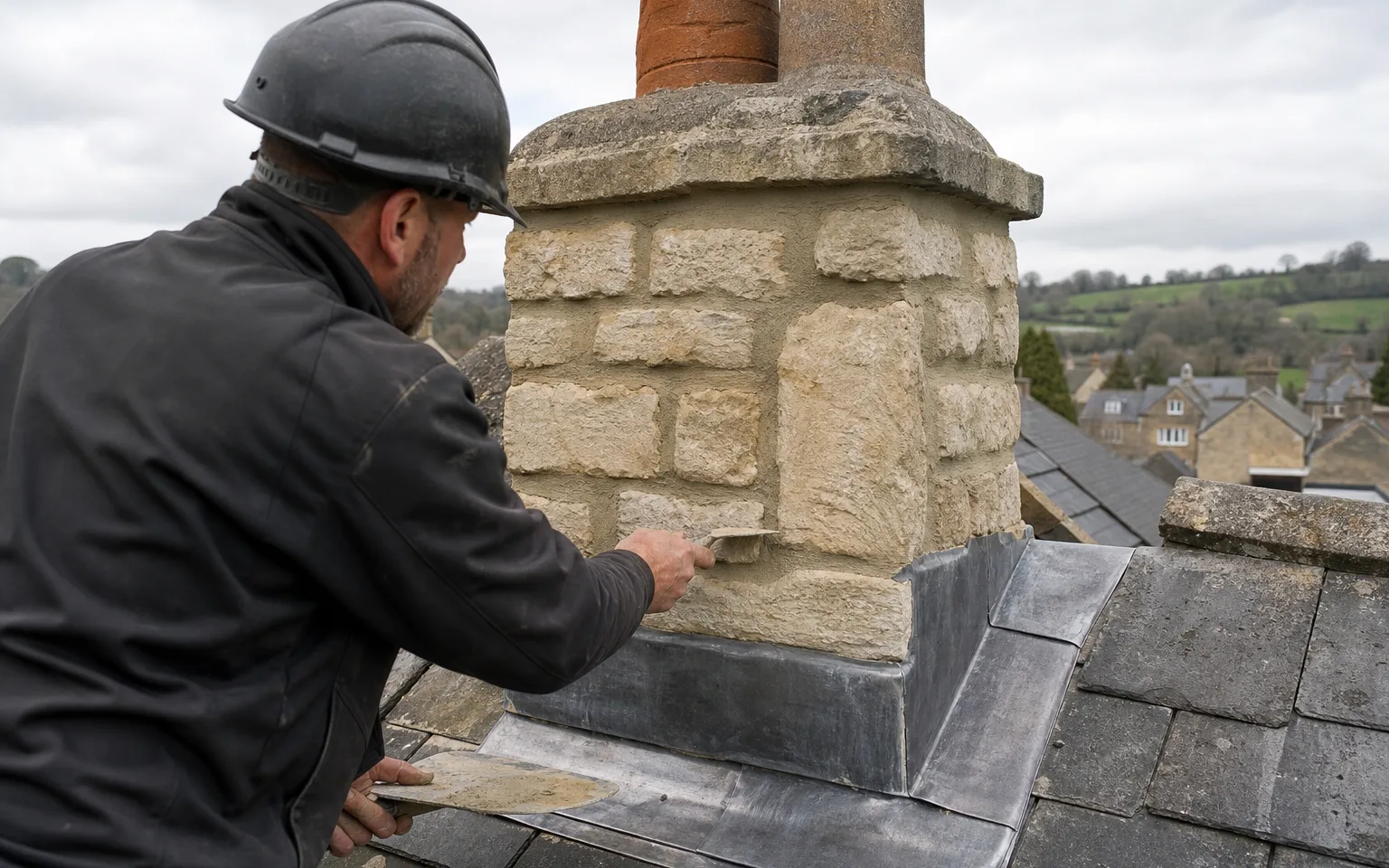
Flashings and back gutters
Lead where the stack meets the roof renewed or repaired, with soakers and the channel behind the stack made watertight.
-
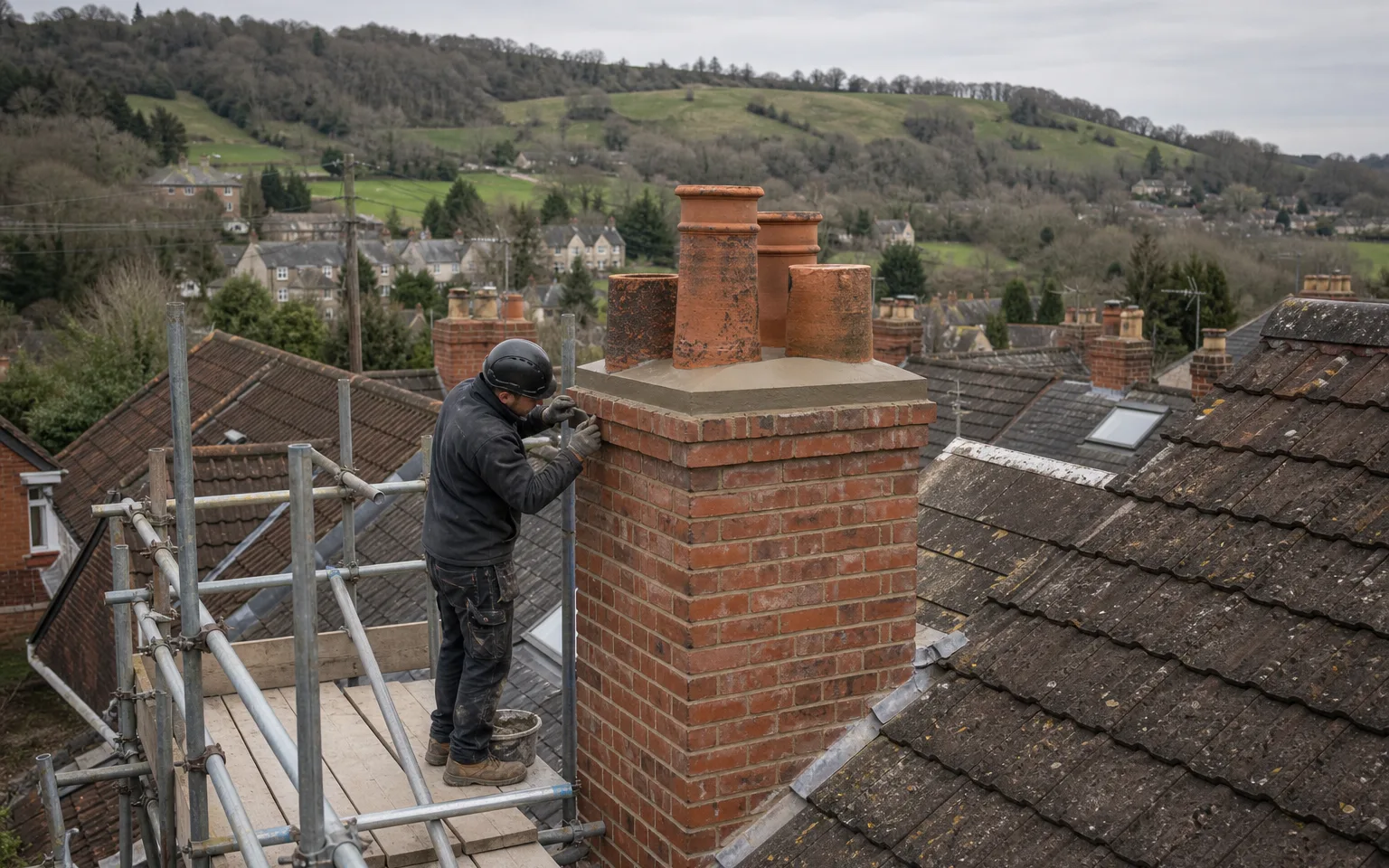
Leaning stacks and rebuilds
Loose or tilting stacks made safe, then taken down and rebuilt course by course, or reduced and capped where that is the right outcome.
Signs a chimney needs a look
- Mortar crumbling or missing between the bricks or stones
- Brick faces flaking away, or flaunching cracked around the pots
- A brown stain on the wall or ceiling beside the chimney breast after rain
- Lead at the base of the stack lifting, split or pulled out of the joints
- A stack that visibly tilts, or a gap opening between the stack and the roof
How a chimney job runs
- 1Survey from the loft and the roofWe check the stack from inside, where damp shows in the brickwork, then close up on the roof for joints, flaunching and lead.
- 2Written quoteScaffold or chimney access is allowed for in the quote, alongside the masonry, lead and labour.
- 3Work in dry spellsMortar and flaunching are laid when the stack can stay dry while it sets, with sheeting over the open top between visits.
- 4HandoverPictures of the completed stack and lead, with our 10-year workmanship guarantee given in writing.
The chimney guide
Chimney stacks, explained
What fails first, why leaks start at the lead, how a lean is judged, who has to agree to removal and how we get up there.
Chapter 01
Repointing a stack: joints, mortar and matching
A stack takes weather on four sides, and its mortar joints are the first part to wear out.
Chapter 01In this chapter
A chimney stack stands clear of the roof with weather hitting every face. Rain strikes it from every direction, the wind dries it fast, and the top courses sit in the coldest air the house has. The mortar joints take the punishment first. Once they crumble, the bricks or stones lose the grip that holds them in line, water gets into the core of the stack, and a job that needed a trowel becomes one that needs a scaffold and a rebuild. Repointing is the repair that interrupts that sequence early.
In this chapter
What the work involves
Repointing means raking out the old mortar until we reach sound material, brushing out the dust, wetting the masonry and packing fresh mortar into the joints in layers, then finishing the face to match. The weak point in many failed jobs is the raking. A thin skim of new mortar smeared over decayed old mortar looks tidy for a season, then drops off. We rake to sound material, and the survey photographs show the condition of the joints before we start.
Lime or cement
The mortar needs to be softer than the brick or stone it holds. Older masonry laid in lime moves a little and lets moisture escape through the joints, which is how it dries out. Hard cement pointing does the reverse: it seals the joints, pushes the moisture out through the faces of the bricks, and the faces flake and fall away. That is why we use a lime-based mix on older stacks and match the colour and sand to the original. On a newer stack in hard brick a stronger mortar can be right, and we say which and why in the quote.
Brick and stone are different jobs
A brick stack has regular joints of a constant width, and the pointing profile, flush or recessed, is part of how the stack looks. A stone stack on an older house has wide, uneven joints, and the stones may be rubble or dressed blocks laid in courses. Matching means copying the joint width, the depth and the finish so that the repair sits quietly alongside the stone. Where individual stones or bricks have crumbled right through, they are cut out and replaced rather than buried in mortar. Our page on chimney repointing goes through the signs and the method in more detail.
What drives the price
MyBuilder's 2026 chimney guide puts repointing at about £750 on average, within a range of £500 to £2,000. The bar below breaks that down by type of house. The height of the stack, the number of flues it carries and whether it sits at the ridge or on the side wall all move the figure, and so does how we reach it, which is covered in the access chapter further down.
A stack is repointed to sound material, never skimmed over the old mortar.
- Bungalow chimney£200 to £700
- Semi, side chimney£600 to £900
- Semi, central chimney£900 to £1,500
- Average across jobsabout £750
Pointing that is overdue is cheap compared with what follows it. Water that gets into a stack in winter freezes in the joints and the pieces move, which is how a repointing job turns into a rebuild.
Chapter 02
Flaunching, pots and cowls at the top of the stack
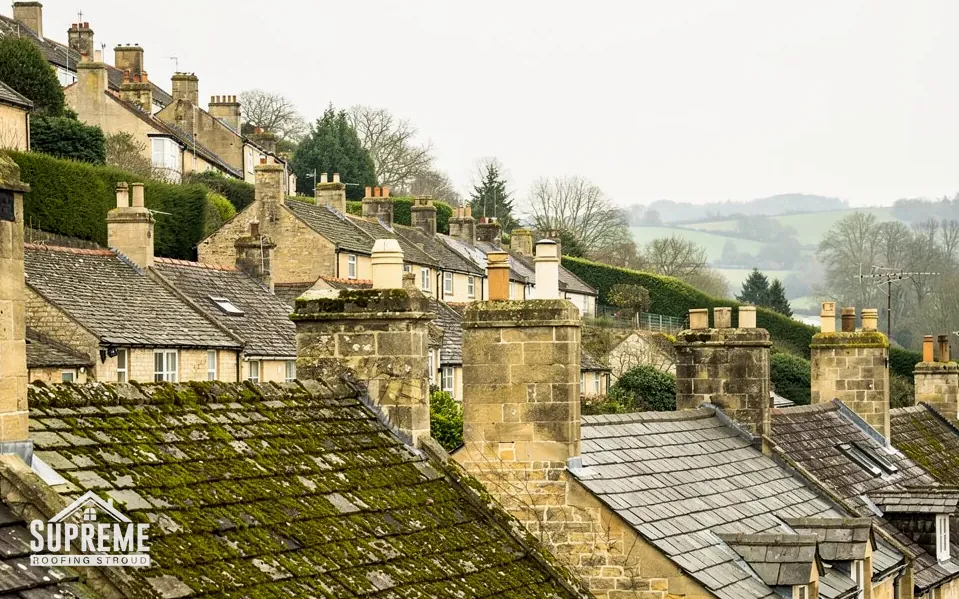
The mortar bed around the pots is what sheds water off the top. When it cracks, the rain goes down the flues instead.
Chapter 02In this chapter
Flaunching is the sloping mortar bed around the base of the pots on top of a stack. It does two jobs: it holds the pots in place, and it sheds rain outward so that water runs off the stack rather than collecting between the flues. It is built up in a dome with a drip edge, and it has to cope with weather, frost and the heat that comes up the flue from a fire or a boiler.
How flaunching fails
It cracks. Thermal movement from below, frost from above and plain ageing open fine lines across the surface, and water then runs into the gaps. Flaunching that has lifted from the pot, or shrunk back from the edge of the stack, lets water behind it. The signs from the ground are a pot that looks loose or tilted, mortar debris in the gutter below, and damp patches inside that appear after rain. Plenty of leaks blamed on the roof begin at the top of the stack, so the pots and their bed get checked early in any survey. Our page on chimney flaunching covers the repair step by step.
Pots
A pot carries the smoke clear of the stack and keeps the flue open. Old clay pots crack, especially once the flaunching has failed and rain has had time to work in. A cracked pot can be replaced on its own: the old one is lifted off, the new one is matched for height and diameter, and the flaunching is made good. If several pots on a stack are cracked, it is usually simpler to renew the flaunching across the whole top.
Myth: A coat of masonry paint or sealant on the stack makes repointing and flaunching unnecessary.
Fact: A surface coating cannot close open joints or cracked flaunching, so water still finds its way in behind it.
Cowls, caps and bird guards
A cowl sits on top of a pot to keep rain, wind and birds out, and to improve the way a flue draws. A cap does a similar job on a flue that is no longer used. An unused flue still wants air moving through it to keep the inside of the chimney dry, so the top is covered with a vented cap rather than sealed shut. Bird guards stop nesting material from blocking an active flue. We fit them with stainless fixings and bed the pot or cowl so that it cannot be knocked loose by wind. Choosing between them depends on whether the flue is used and what it serves, so ask us at the survey and we will explain the options for yours.
Priced on the day we see it
What sets the price is the number of pots, their height and the condition of the top of the stack. The survey records all three, and the quote covers them, fixed in writing.
Pots and cowls have their own page, chimney pots and cowls, with the question of which to choose for a working flue and which for an unused one.
Chapter 03
Flashings, soakers and the back gutter
Where the stack meets the roof is the commonest place for a chimney leak to start.
Chapter 03In this chapter
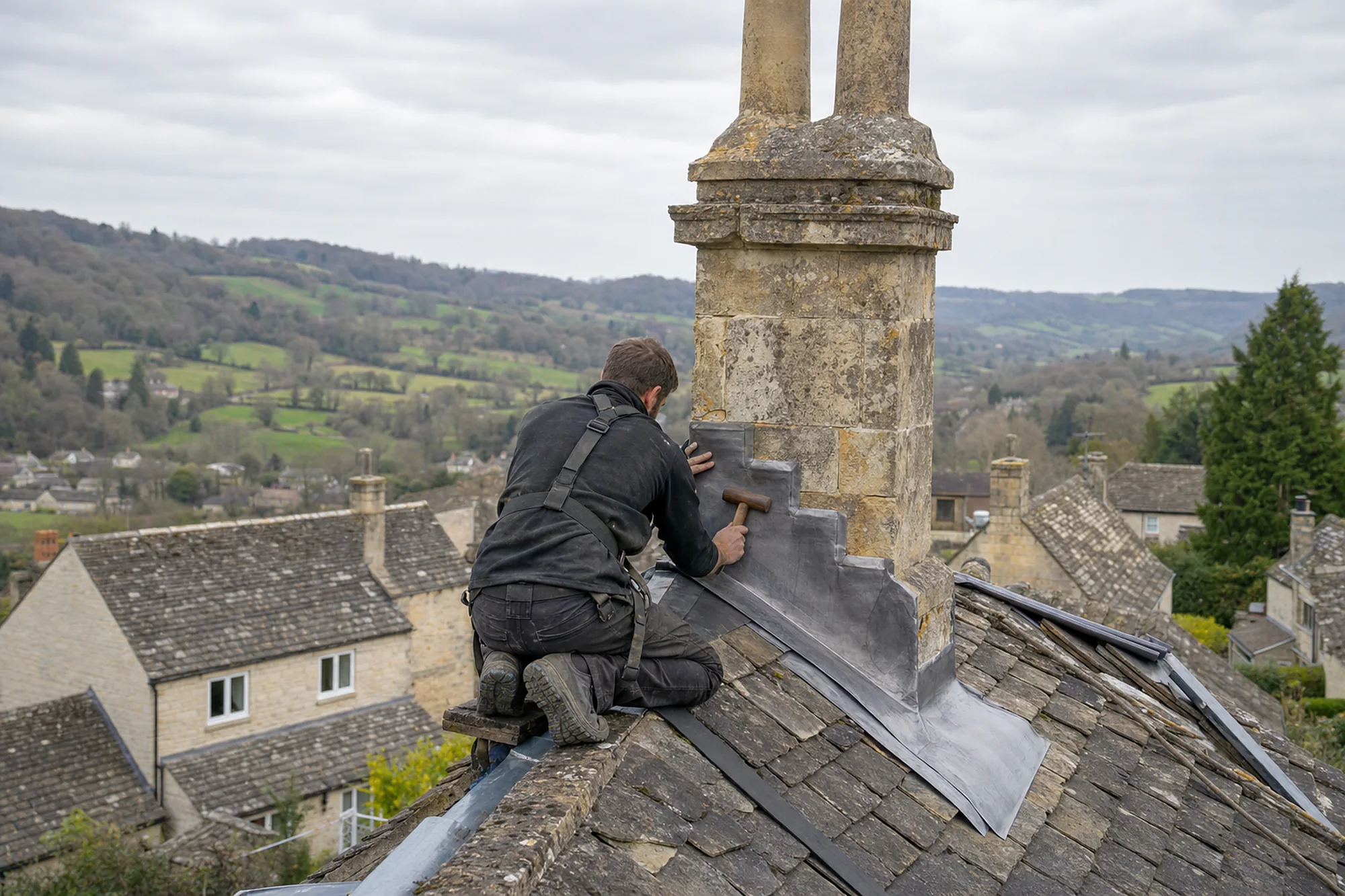
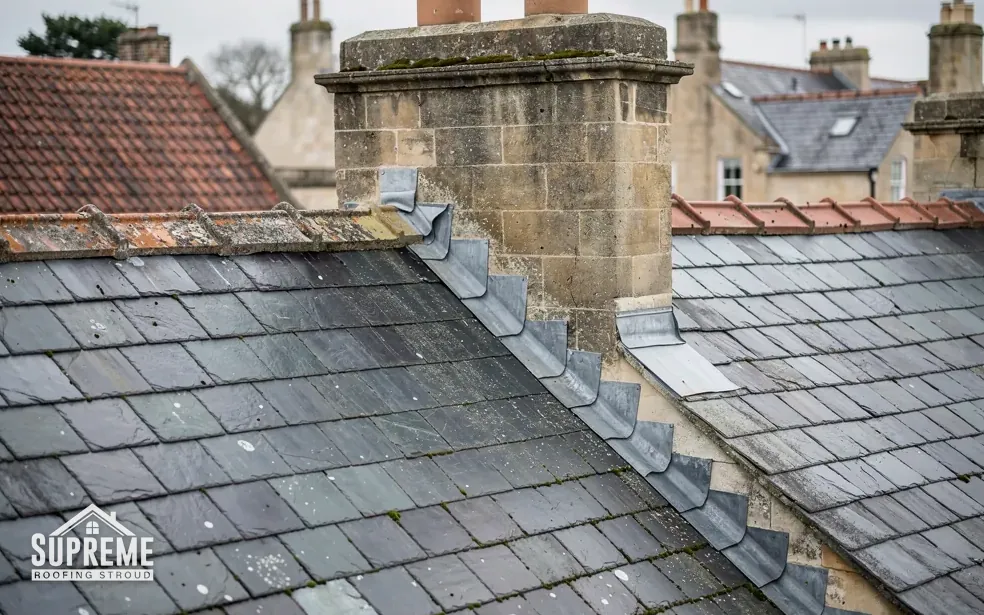
A chimney is a hole in the roof surface, and everything around it has to be sealed so that water runs past rather than in. That sealing is done in lead, in pieces with names. The flashing is the strip of lead that covers the join between the stack and the roof covering. A soaker is a small folded piece of lead that sits under each course of slate or tile at the side of the stack and turns up against the brickwork. The back gutter is the lead channel on the upper side of a stack, which carries water round to either side.
The parts, front to back
The apron flashing covers the front of the stack where it meets the slope. Stepped flashings run up the sides, following the brick or stone courses, with each step tucked into a joint. At the back, the gutter lifts the water over the stack's width and sends it down around it. Water that is not diverted this way collects against the upstream face of the stack, and that is where leaks begin.
Why they fail
Lead does not rot, but it moves with temperature, and over-long pieces crack along the folds. Flashings also work loose where the mortar they are tucked into has weathered, and where the stack has moved. Cement fillets, which are sometimes used in place of lead, crack away from the stack. Sealant smeared over a gap stops a drip for a while, but it is a stop-gap. Our chimney leaks guide sets out each leak path and how we find which one you have.
What the lead should be
For general flashing work, Leadworx describes Code 4 as the standard choice, and soakers are cut from lighter lead, Code 3 in the codes tables from Royston. A stepped flashing priced by Checkatrade assumes Code 5. MyJobQuote notes that lead flashing should be fitted in lengths of around 1.5 metres, so that expansion has somewhere to go. Correctly fitted lead flashing can last for over 80 years, according to MyJobQuote's 2026 guide, which is long enough to outlast the mortar it is tucked into. The details are in our section on lead roofing.
Cost
MyJobQuote gives £150 to £250 for patching the flashing at a chimney, and an average of about £570 for a full replacement. That average covers £350 to £460 without scaffold and £700 to £920 where scaffold is needed. MyBuilder's wider range for flashing repair, £250 to £1,200, reflects the difference between a single failed run and a stack that needs all four sides redone.
Lead is only as watertight as the joint it is tucked into.
| Part | Where it sits | What it does |
|---|---|---|
| Apron flashing | Front face of the stack | Covers the join with the roof slope below |
| Stepped flashing | Both sides, following the courses | Seals the side joins, each step tucked into a joint |
| Soakers | Under the slates or tiles at the sides | Turn water back onto the covering below |
| Back gutter | Upper side of the stack | Channels water round the stack to each side |
For the upper channel on its own, read our answer on the chimney back gutter.
Chapter 04
Leaning stacks: repair, rebuild or reduce
A visible tilt changes the job from maintenance to a safety question, then to a rebuild.
Chapter 04In this chapter
A stack that leans is no longer just a repair. It carries a lot of weight, high above the roof, and if it falls it takes the roof slope and whatever is beneath it. A leaning chimney is the one chimney problem we treat as urgent: we make the area safe first and plan the repair second.
Why stacks lean
The usual cause is weather working on the joints from one side. The joints on the windward face wear and open, the masonry on that side settles slightly, and the stack tilts toward it. Water in the core of the stack freezes and pushes the pieces apart. Aerials and satellite dishes strapped to a stack add leverage in the wind. Removing the chimney breast inside the house without supporting the stack above is another cause: the masonry above loses its base. Our page on the leaning chimney goes into how each cause is read from the ground and from the loft.
How we judge it
From the roof, a plumb line or a spirit level against the stack shows the lean. From the loft, we look for cracks, gaps between the stack and the roof timbers, and daylight where there should be none. Horizontal cracks running through the stack, bulging faces, and bricks or stones that move under a gentle push are the signs of a structure that can no longer be repaired in place.
Repair, rebuild or reduce
If the lean is slight, the masonry is sound and the cause is water in the joints, repointing and a new flaunching can be enough, after which we check the stack again after the next hard winter. If the stack has moved, bulged or loosened, the sound way to correct it is to take it down to a level that is plumb and solid, sort the bricks or stone, and rebuild it to its original height, using the same materials. MyBuilder puts a stack rebuild at £2,000 to £10,000 and above, and the range is wide because height, number of flues and access vary so much.
Sometimes the right answer is neither. A stack that serves no flue can be reduced in height and capped, which is cheaper and lowers the weight on the roof. Where the stack is a visible part of the house, in a conservation area or on a listed building, the look of the chimney is part of what is protected and the decision needs consent before work begins.
While you wait
If you can see a lean, keep people and cars away from the ground below the stack, and do not light fires in the grate. Send us a photograph from the garden or the lane, and we will tell you what we need to see.
A full rebuild is described in our guide to chimney rebuilds, including how the old materials are sorted and reused.
Chapter 05
Taking a chimney down, and who has to agree
A redundant stack can come down, but listing, conservation areas and neighbours decide how and whether.
Some stacks are better gone. A chimney serving no fire or boiler, on a roof that is otherwise sound, is a standing maintenance cost and a leak path. Taking it down below the roofline means opening the roof, removing the masonry to the level of the ridge or the slope, closing the roof with matching battens, underlay and covering, and sealing the flue openings below. It is a job with several parts, and the permissions need sorting before anything goes up.
In this chapter
Planning and appearance
Like-for-like repair of a stack does not usually change the external appearance of the house, so it is not normally development. Removing a stack does change it, and the chimneys are often among the features that define a roofline. Before taking one down, check with Stroud District Council's planning team whether permission is needed, particularly in a conservation area. We would rather you asked before work than after.
Listed buildings and conservation areas
On a listed building, the district council's guidance gives full legal protection to the entire structure regardless of grade. Removing or rebuilding a stack on a listed building affects its character, and the law makes doing so without consent an offence. The council lists 41 conservation areas, and Article 4 Directions apply in five: Stroud Town Centre, Stroud Top of Town, Bisley, Frampton on Severn and Wotton Under Edge. Nothing on the council's page tells us if those directions reach chimneys or roofs, so ask the planning team. Our guide to listed chimney repairs sets out the order in which we approach it.
Structure and building control
When a stack comes down, the roof structure around it has to be made good, and the flues below, which may serve other rooms or the house next door, have to be left safe. If the work alters the structure, speak to your building control body, which in Stroud District is the Gloucestershire Building Control Partnership. We explain what is involved and can deal with the Building Regulations notification if the job is notifiable.
Shared stacks
On terraced and semi-detached houses, one stack often serves two homes. Work to a shared stack needs the neighbour to know about it, to agree access, and often to share the cost. Who is responsible depends on your deeds, and we cannot advise on that. What we can do is photograph the stack, write down the scope and give you both the same written quote.
Where the answer is a smaller change, a stack can be reduced in height and capped. That also needs a check on whether the change is visible from the street, and the same conversation about consent applies.
- 41conservation areas in Stroud District
- 5of them with Article 4 Directions
- just over 50%of the district's land area inside the Cotswolds National Landscape
The full walk-through of the work is in chimney removal, which also covers what happens to the flues left behind.
Chapter 06
Reaching the stack safely: scaffold, ladders and steep ground
How we get to the top of the stack decides the safety of the job, and a good part of its price.
Chapter 06In this chapter
Chimney work is work at height on the most awkward part of the roof. The stack stands at the ridge or gable, the slopes either side are often steep, and the person working there needs both hands free for the trowel. For anything more than a quick look, the only sensible way up is a scaffold, and our quote allows for it, so its cost is plain.
The options
A full scaffold along the eaves, with a lift up to the stack, is the standard for repointing, flaunching or lead work. A tower or a purpose-built scaffold around the stack itself can serve when the house is small or the job is limited to the top courses. For a small inspection or a loose pot, a ladder hooked across the ridge and a crawling board can be enough, but they carry no materials and give no protection to the people below. We choose the access at the survey, based on what the job needs.
Valley-side ground
Around Stroud, access is often the difficult part of a chimney job. Houses sit on steep lanes and terraced hillsides, the nearest place to stand a scaffold tower may be a neighbour's garden, and the stack can be several storeys above the lower side of the building. We look at that during the survey and price it into the quote, so that it is not discovered on the day. If the scaffold needs a licence for the pavement or a neighbour's permission for the garden, we tell you who needs to be asked.
What scaffold costs
Published guides give scaffold figures for whole re-roofs, not for a single stack. MyBuilder's 2026 guide puts the scaffold for a re-roof at about £1,125, and Checkatrade's, updated in October 2026, gives £700 to £1,300. A chimney-only scaffold is a smaller structure, so we price it on survey rather than borrowing those numbers. If scaffold is already standing for a re-roof or a lead renewal, the chimney work can use it, which is one reason to do the jobs together.
Doing the work well
Mortar and flaunching need dry weather to cure, so we pick the days with that in mind and cover the open top of the stack when we leave. Debris from the stack is lowered, not dropped, and when we finish, you get the roof and garden back clear, with the rubbish taken away. The survey photographs give you a record of the condition before we start.
If you are thinking of doing any of this yourself, remember that a stack is not a climbing point and that falling masonry is as dangerous as falling yourself. The most useful thing an owner can do is photograph from the ground and call us.
Our answer on scaffolding for chimney work lists the access choices for each type of job.
Chimney guides and answers
Costs, mortar, leaks, leaning stacks, pots and cowls, listed buildings and the smaller questions, written for owners of chimneys around Stroud.
Guides
- Chimney repair costs in Stroud: repointing to rebuildsA chimney job can cost a few hundred pounds or several thousand, and the gap comes down to…Read the guide
- Chimney repointing in Stroud: when and how it's doneThe joints between the bricks or stones of a chimney take the worst of the weather. This guide…Read the guide
- Chimney flaunching: cracks, repairs and replacementFlaunching is the plain-looking mortar at the very top of a chimney, and it carries more responsibility than…Read the guide
- Why Stroud chimneys leak and how roofers fix themA chimney is a hole through the roof with a tower built round it, and water finds its…Read the guide
- Chimney stack rebuilds in Stroud: when repair isn't enoughSome stacks are past patching. This guide explains how we decide that, what the rebuild involves from scaffold…Read the guide
- Removing a chimney stack in Stroud: roof, consent, structureTaking a stack off a roof is more than knocking bricks down. The slope has to be rebuilt…Read the guide
- Leaning chimney stacks in Stroud: causes and what to doA stack that tilts has been moving for a reason. Finding the reason decides whether a repair will…Read the guide
- Cotswold stone chimneys in Stroud: repair with limeA limestone stack asks for different mortar, different stone and a slower hand than brick. A stone chimney…Read the guide
- Chimney pots, cowls and caps explainedThe pot, the cowl on top of it, the guard against birds and the cap over a dead…Read the guide
- Chimney work on Stroud's listed and conservation homesA chimney on a protected house is part of the protected building. Before a scaffold goes up, it…Read the guide
- Chimney damage in winter: frost, wind and rainA chimney stack stands taller and more exposed than any other part of the house. Winter hits it…Read the guide
- Chimney damage and home insuranceWhether a damaged chimney is covered usually turns on one question: did a single event cause it, or…Read the guide
Quick answers
- Do you need scaffolding to repair a chimney in Stroud?
- Can a cracked chimney be repaired? Stroud brick and stone
- What is the best mortar for chimney repairs?
- How to tell if your chimney is blocked
- Should an unused chimney be capped?
- Damp patches on a chimney breast: causes
- Do you need permission to remove a chimney?
- Can a cracked chimney pot be replaced?
- Why are my chimney bricks crumbling?
- When does chimney flashing need replacing?
- Chimney sweep or roofer: who to call?
- Chimney breast removed below: is the stack safe?
- How long does a chimney repair take?
- Shared chimney stacks: dealing with repairs
- Does chimney waterproofing spray work?
- What is a chimney back gutter?
- Can a chimney stack be reduced in height?
- Can I repoint my own chimney?
- Is a TV aerial damaging my chimney?
- Should a chimney be rendered?
Chimney repairs: common questions
Can a leaning chimney be pulled straight, or does it always have to come down?
A stack that has tilted cannot be nudged back into line, because the joints have set in the new position. If the lean is slight and the masonry is sound we monitor it and repair the cause. Anything beyond that is taken down to a plumb, solid level and rebuilt.
Why does the wall beside my chimney breast stain after heavy rain?
Water is getting into the stack and passing through the masonry to the plaster. The cause can be open joints, failed flaunching, a split flashing or a cracked pot. We trace it from the stack down, because patching the stain does not stop the source.
Should the top of an unused flue be sealed?
Not shut tight. A flue with no fire still needs air moving through it, so we cap it with a vented cap that keeps rain and birds out while leaving the flue able to breathe.
Is lime or cement mortar right for repointing an old stone stack?
Lime, in most cases. It is softer than the stone, lets moisture out through the joints and is easier to repair later. A hard cement mix can trap moisture and push the damage into the stone faces.
Do I need consent to take down a chimney in a Stroud conservation area?
Check with Stroud District Council's planning team before anyone starts, because a stack is part of the roofline. If the house is also listed, consent is required for work that affects its character. We help you put the request together.
How are repairs arranged when a stack serves two houses?
Everyone with an interest in the stack should know about the work and agree access to it. Who pays depends on your deeds, so ask a solicitor. We give both households the same photographs and the same written quote.
Get your chimney checked and priced
Send a photograph of the stack from the garden or lane, another of any stain beside the chimney breast, and a note of whether the property is listed or lies within a conservation area. At the survey the lead and the flaunching get checked first, then the rest is priced.