

Roofers in Nailsworth
Stone, slate and tile roofs where the valleys meet, from the old mill buildings by the Nailsworth Stream to the estates up the hillsides above Forest Green.
Nailsworth at a glance
- Distance
- 4.2 road miles south of Stroud
- Council
- Stroud District Council
- Conservation area
- Nailsworth, Stroud District
- Setting
- Valley junction on the Nailsworth Stream
Nailsworth's roofs, from the mills to the hillsides
Nailsworth sits where several stream valleys run together, and the town climbs every one of them. The Victoria County History describes the land between the valleys rising to over 600 ft, with beech woods covering some of the slopes. That shape decides a lot about roof work here: houses stack above and below each other, gardens drop away behind, and a roof that faces into one valley can weather very differently from its neighbour across the street.
The building stock is layered by period. The hamlet cottages around the town are mostly eighteenth-century, according to the same history, and Spring Hill Court carries a date of 1680. Fountain Street was built up in brick in the late nineteenth century, a council estate went up at Park Road in 1921, another followed south of Upper Forestgreen in the 1930s, and the 1960s and early 1970s brought modern houses and bungalows, particularly at Shortwood. Each of those periods comes with its own coverings and its own weak points, so a roofer working in Nailsworth needs to be comfortable with all of them in the same week.
The mill heritage is still visible too. Egypt Mill is listed Grade II*, and the town's own conservation area has a neighbour in the separate Dunkirk Mills and Watledge conservation area.
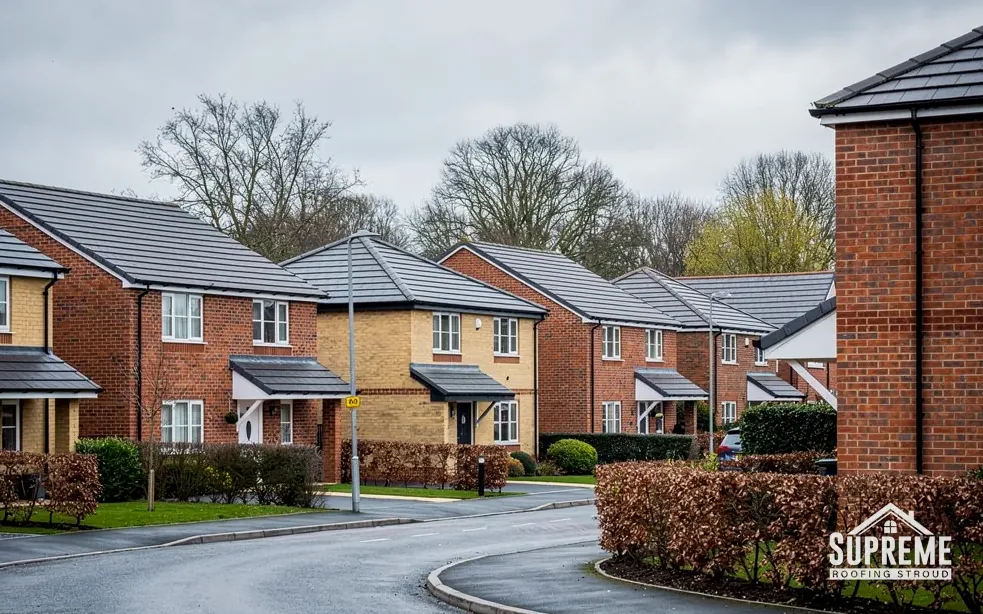
Modern brick housing estate with grey tiled roofs along a curving road 
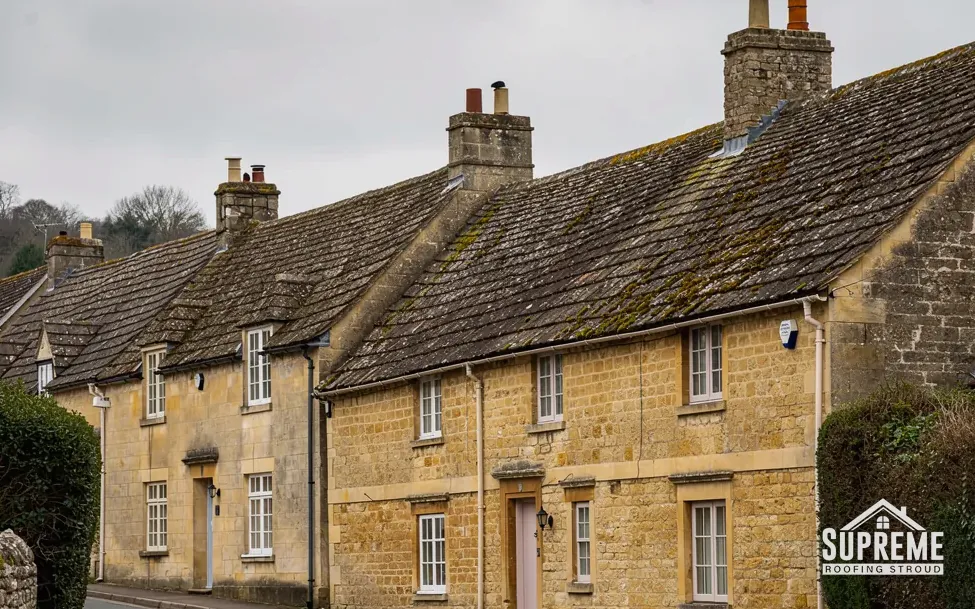
Hillside of stone terraced houses with mossy stone tile roofs and chimneys
Chapter 01
Mill buildings and the valley floor
Large old roofs by the water need a different plan from a cottage on the hill.
Chapter 01In this chapter
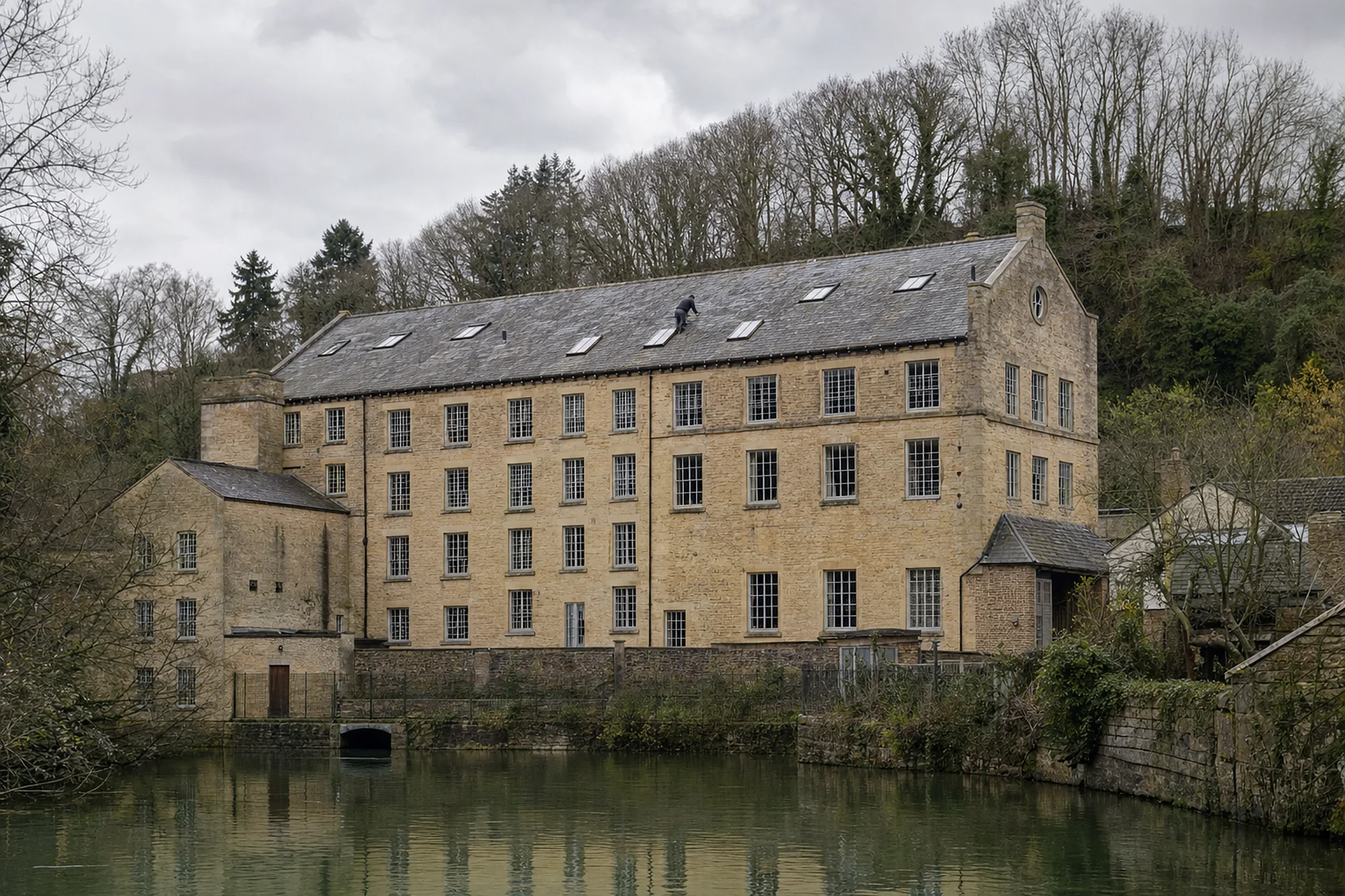
Nailsworth grew as a small mill town and brewing centre, powered by the Nailsworth Stream, and the buildings that came out of that period are some of the biggest roofs in the area. Mill buildings and their offshoots often carry wide spans, long runs of gutter and valleys between ranges that were added over decades. Many have been converted into homes and flats, which brings a mix of owners, a managing agent or freeholder, and roofs that were never designed for domestic use.
In this chapter
On roofs like these, the first job is understanding how water leaves the building. Long valley gutters between ranges, internal gutters behind parapets, and downpipes that run inside the walls are common on older industrial buildings, and they are where leaks start. A blocked outlet on a big roof can put a lot of water in the wrong place very quickly. We survey the drainage first, photograph it, and quote for any work on outlets, gutters and valleys.
Access is the other consideration. Valley-floor buildings often sit tight against the stream, a lane or a neighbouring building, so scaffold has to be designed around what is there. On a converted mill, it may also need agreeing with the freeholder and other owners before work can start. That is normal, and it is why we put the access plan in writing with the quote.
Listed and conservation-area mills
Egypt Mill's Grade II* listing is a reminder that some of the town's industrial buildings carry real heritage protection. On a listed building, changes that affect its character need listed building consent from Stroud District Council, and that includes many roof details. Inside the conservation area, like-for-like repairs are normally straightforward, while changes of material or new roof features need checking with the planning team first. Our commercial roofing page covers larger mill and industrial roofs in more depth.
How the town took shape
The parish itself is younger than its buildings. The County History records that Nailsworth parish was only formed in 1892, carved from parts of Avening, Horsley and Minchinhampton, and that the town's growth followed two transport changes: the Act for the Bath road in 1780 and the railway in 1867. That explains why so much of the valley-floor building is nineteenth-century and why it follows the line of the roads and the stream rather than an older village centre. Roofs from that boom are now well over a century old, and many are on their second covering or due one.

On a mill roof, find where the water goes before anything else.
Chapter 02
Brick terraces, council estates and later houses
Four building periods in one small town, each with its own roof.
Chapter 02In this chapter
The County History traces Nailsworth's growth in clear steps, and the roofs follow them. The brick terraces of Fountain Street, built up in the late nineteenth century, tend to have slate or clay roofs with chimneys shared between neighbours. On roofs of that age, the usual story is fixings and timber rather than the covering itself: nails that have rusted, battens that have softened, and lead or mortar around the stacks that has had a long life.
In this chapter
The council estate at Park Road dates from 1921, and the estate south of Upper Forestgreen from the 1930s. Houses from those decades were built in large numbers and often share a roof design along a whole street. That is useful, because when one roof shows a problem, the cause is often the same across the row, and a repair that works on one house tends to work on the next. It also means a re-roof on one house should be matched to its neighbours so the street still reads as one.
The 1960s and early 1970s houses and bungalows, particularly at Shortwood, are a different job again. They were usually built with concrete interlocking tiles, felt or early plastic underlay, and timber fascias, and many now have flat-roofed garages or extensions added since. Flat roofs from that era are often on their second or third covering, and an old felt garage roof may also be asbestos cement sheeting underneath, which changes how it is removed.
One town, many roofs
For a homeowner, the practical point is to know which group your house belongs to before comparing quotes. A roofer quoting the same method for a Victorian terrace and a 1970s bungalow is not looking closely enough. Our slate roofing page explains what usually fails on older slate roofs, and where the line falls between patching and a full re-slate.
- 1892year Nailsworth parish was formed from parts of Avening, Horsley and Minchinhampton
- 1921council estate built at Park Road
- 1680date carried by Spring Hill Court
Matching along a street
On the interwar estates, where every house along a road was built to the same design, the look of the street depends on roofs staying alike. When one house is re-roofed in a different tile, the change shows from the end of the road. We note what the neighbours have before recommending a covering, and where the original tile is no longer made we look for the closest match in colour and profile rather than whatever happens to be in stock. On the brick terraces, shared chimneys and party walls mean the junction between two roofs needs care, and it often makes sense for neighbours to share a scaffold if both roofs need work.

Chapter 03
Steep lanes and scaffold in Nailsworth
In a town built up the sides of valleys, getting to the roof is part of the job.
Chapter 03In this chapter
Nailsworth is about 4.2 road miles south of Stroud, and the drive down the valley gives a fair idea of what roof access is like here. Streets climb steeply out of the town centre, houses sit above and below the road, and plenty of front doors are reached by steps rather than a path. Roofs that look low from one side can be three storeys up from the garden.
In this chapter
That shapes how a job is planned. On a sloping plot the scaffold is often built to two different heights, stepping down with the ground, and the uphill side may need little more than a working platform. A house that opens straight onto the pavement brings a permit into the timetable, since scaffold on the public footway has to be licensed before it goes up, so we apply for it as soon as a start date is agreed. Houses reached only by a footpath or a flight of steps mean slates, tiles and timber are carried in by hand, and the old covering is carried out the same way; on a full re-roof carrying by hand adds hours to the labour, and the quote shows it. None of that is a reason to avoid a job, but all of it belongs in the quote rather than appearing as an extra on the day.
Every Nailsworth survey includes a look at how we will reach the roof, and the scaffold is allowed for in the quote. For smaller repairs where scaffold would cost more than the work, we will say so and explain the options, from a tower to working from a roof ladder where that is safe and appropriate.
Weather and timing
The town's valleys and beech woods also mean damp, shaded slopes, and moss on the north-facing roofs. Leaves fill gutters every autumn. Those are maintenance jobs rather than emergencies, and they cost least when they are done before winter rather than after a leak. When a roof does need opening up, we plan around dry spells and keep any open section covered at the end of every day. Our roof repairs page explains what we do about leaks and storm damage while the work waits.

The older cottages
The eighteenth-century cottages in the hamlets around the town are where stone roofs and older details are most likely, and where a careful hand matters most. Re-using sound stone or slate, matching the courses, and keeping the original line of the ridge and verges keeps a cottage looking right from the lane. Unsure of your roof covering? Send a picture taken from the lane and we can normally identify it, and our Cotswold stone roofing page explains how stone roofs are repaired.
Myth: Scaffold is a fixed cost you only find out about on the day.
Fact: On a hillside street we plan the access during the survey and allow for its cost in the written quote.
Map showing Nailsworth and the Stroud service radius, with nearby towns we also cover.
Near Nailsworth
Roof work we do here
Egypt Mill and the valley mill conversions
Do the mill conversions in Nailsworth need special roof work?
Often. Converted mills tend to have large roofs with long valley and parapet gutters, and responsibility is usually shared between owners or managed by a freeholder. We survey the drainage first and agree access with whoever manages the building.
My house is in the Nailsworth conservation area. Can I still repair the roof?
Yes. Like-for-like repairs in a conservation area are normally fine. Changing the roof material or adding new features is different, and we check with Stroud District Council's planning team before proposing anything like that.
Will a roof job on a steep Nailsworth street cost more?
It can, because scaffold on a sloping site or over a pavement takes more planning. Scaffold is allowed for in the written quote, and on a hillside street we tell you early if the pavement licence is likely to affect the start date.
Can you deal with an old asbestos garage roof at a 1960s house?
Yes. Intact asbestos cement sheets can usually be removed carefully as non-licensed work under HSE guidance. We assess the sheets first and set out in the quote the removal steps, the disposal route and the new covering.