

Roofers in North Woodchester
Roofs strung along Selsley Road on the western side of the Nailsworth valley, from seventeenth-century cottage pairs to the council estates and the houses built higher up the slope.
North Woodchester at a glance
- Distance
- 2 road miles south-south-west of Stroud
- Council
- Stroud District Council
- Listed
- Church of St Mary, Grade II* (Teulon)
- Setting
- West side of the Nailsworth valley
North Woodchester: one road, one valley side, many roofs
North Woodchester is 2 road miles away on the south-south-west side of Stroud. It sits on the west side of the Nailsworth valley, about 150 ft above the stream. The village follows Selsley Road, which was created as a new east-west road through the village in 1780, and two pairs of seventeenth-century cottages still stand on its south side.
The twentieth century added to that road in two stages. Stroud Rural District Council built an estate of 50 houses in the early part of the century, and a small estate on Selsley Road followed in the 1950s. Since the late nineteenth century, private building on the higher slopes west of the village has produced assorted houses of brick or stone on either side of Selsley Road. The result is a village where neighbouring roofs can differ in age by a century or more.
The parish church of St Mary, designed by Samuel Sanders Teulon, is listed Grade II*, and the chancel arch of the former church survives separately and is listed Grade II. Woodchester's best-known landmark is its Roman villa. North Woodchester itself is not named on Stroud District Council's list of conservation areas, though South Woodchester, a short distance down the valley, is, and in 2008 the Industrial Heritage area took in Southfield Mill.

Hillside terraces of stone houses with slate roofs and chimneys 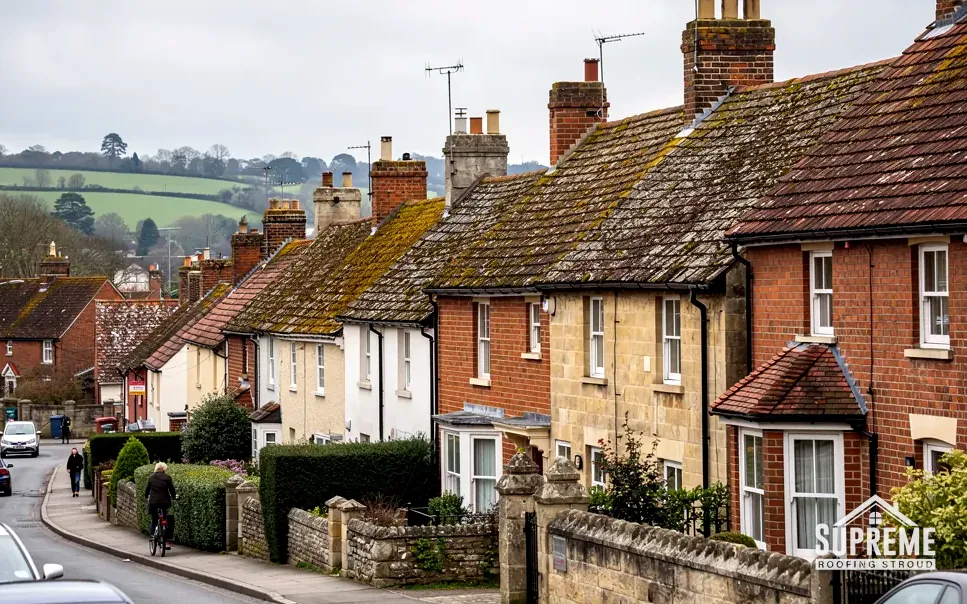
Sloping street of brick and stone terraced houses with mossy tiled roofs
Chapter 01
Selsley Road, laid out in 1780, and the houses along it
A village built along one new road has scaffold, deliveries and neighbours all in the same strip.
Chapter 01In this chapter
The Victoria County History records that Selsley Road was created in 1780 as a new east-west road through North Woodchester, and the village has gathered along it since. That matters to a roofer more than the date does, because almost every job here begins from the same carriageway. Lorries unloading tiles, a skip standing for the waste, and a scaffold on the kerbside all compete for one stretch of road that other people need to use.
In this chapter
Where a house opens straight onto the road, a licence is needed to put scaffold on the public footway, and we plan the application at the same time as the quote. Where a house sits above the road, steps or a bank have to be dealt with, and where it sits below, the roof may be much closer to the ground on one side than the other. A survey here includes a look at how materials get from the lorry to the roof, because on a sloping plot that distance can be a large share of the labour.
The two pairs of seventeenth-century cottages on the south side are among the oldest houses on the road. Each pair is joined by one party wall under a single roof, which turns a repair on one half into a conversation with the owner of the other. We write the boundary of our work into the quote, and photographs of both halves show where the problem lies. At the gable end, the finish along the sloping edge is called the verge, and on a roof a few centuries old that strip is among the first places to loosen.
Chimneys deserve a mention on any road of cottages. An old stack has usually been repointed more than once, and the lead tray where it passes through the roof is a second line of defence. We check the brickwork, the flaunching and the flashings together, because damp on an upstairs wall often starts at one of them.
Houses built one at a time
The assorted brick and stone houses on the higher slopes were put up as private building since the late nineteenth century, so they were not designed as a set. Each has its own pitch, its own covering and its own chimney, and the quote for one cannot simply be copied for the house next door. We identify the covering, count the chimneys and valleys, and measure the slopes at the survey. A valley, the trough formed where two slopes run together, collects water from both, so a cracked lining there announces itself quickly on the ceilings below. Our roof repairs page explains how we find and fix a leak.
On a road built house by house, every roof gets its own survey.
Myth: Two houses built about the same time on one road need the same roof work.
Fact: Houses put up one at a time carry individual coverings and details, so each gets its own survey and its own written quote.
Chapter 02
Fifty council houses and the Selsley Road estate
Houses built together reach a re‑roof together, and the rules change when most of a roof is replaced.
Chapter 02In this chapter
Stroud Rural District Council built an estate of 50 houses in the early twentieth century, and a small estate followed on Selsley Road in the 1950s. Estate houses are laid out to one pattern, so they tend to age in step. When a roof on one street starts to need serious work, the neighbouring roofs are usually not far behind, and a group of owners may find it makes sense to arrange the scaffold together.
In this chapter
A re-roof on a house like these raises the Building Regulations question straight away. Below 25% of the building envelope and 50% of the roof, the work does not normally need approval. Beyond those limits, building control gets involved. Approved Document L sets out what follows: renovate more than 50% of a roof's surface and the whole roof should reach a U-value of 0.16 W/(m²·K), so far as the work is feasible in technical, functional and economic terms. For you, that means a full re-roof can bring a requirement to add insulation. Stroud District's building control is run as the Gloucestershire Building Control Partnership, and we set out the position for you, then deal with the notification when the work calls for one.
Insulation has its own tax treatment. Before 31 March 2027 a homeowner pays no VAT on insulation installed at roof or loft level, while the covering work around it carries the standard rate, and our quote states how VAT applies.
Fascia boards and gutters on estate houses tend to be the same age as the roof, and a full re-roof is the economical moment to renew them while the scaffold is standing. We list that work as its own item so you can decide whether to include it.
Ventilation when a roof is stripped
Stripping a roof is also the time to think about air movement under the covering. Marley's guidance on BS 5250 sets 10 mm of eaves ventilation for roofs pitched above 15 degrees when a non-breathable underlay is used, and more where the roof is long or steep. A roof that was fine for decades with gaps in the old covering can behave differently under a tighter new one, so we check the eaves before the underlay goes on. For a view of the whole job, our roof replacement page sets out the stages from scaffold to clearing the site.
- 50houses in the estate built by Stroud Rural District Council
- 1780year Selsley Road was created through the village
- 150 ftapproximate height of the village above the Nailsworth stream
Matching matters on an estate. When every house in a row wears the same tile and one owner changes colour, the difference shows from the road, so we walk the row before suggesting what should go on yours, and we photograph the neighbouring slopes for the file.

Chapter 03
St Mary's church and the listed arch beside it
Two listed structures, two different routes to consent, and one rule for neighbours: ask before the scaffold goes up.
Chapter 03In this chapter
St Mary's, the parish church, is the work of Samuel Sanders Teulon and carries a Grade II* listing. The chancel arch of the former church of St Mary survives as a separate structure and is listed Grade II. They are the most protected buildings in the village, and they set the tone for anyone planning work close by.
In this chapter
A church in use does not need listed building consent for its own roof. The ecclesiastical exemption applies instead, and the diocese authorises the work by faculty. A former church is a different matter, and so is a converted chapel, where listed building consent from the council normally applies. If you own a building of that kind, ask the council which route applies before you ask anyone for a quote.
The surviving arch has no roof of its own to maintain, but its listing still shapes what happens near it. Scaffold footings, skip positions and deliveries near a protected structure are all matters for the council's conservation officers. Stroud District Council says every listed building is protected whatever its grade, and that it is worth asking about the status of any structure in the grounds. We make that call for you if your house stands close to either structure.
Where an owner is unsure which category their house falls into, a short photograph set from the lane and the garden is all we need to start. We can then say what we expect to find, and the council can say what it needs.
Next door to a listed building
Living near a listed church does not by itself change the rules for your own roof. A house is affected if it is listed itself, or if the work reaches into the grounds of a listed property. Without either, a repair that keeps the same covering is ordinarily outside planning control, and a change that visibly alters the roof deserves a question to the planning team.
No conservation area carries North Woodchester's name on the council's list, yet South Woodchester has one, and the line between the two villages is easy to misjudge on foot. Before assuming that either rule set applies, check the council's mapping for your address. We ask for the postcode early, and our quote is written with the answer in hand. Whichever applies, our written 10-year workmanship guarantee covers what we finish, and the quote already takes in scaffold, covering, labour and waste.
Map showing North Woodchester and the Stroud service radius, with nearby towns we also cover.
Near North Woodchester
Roof work we do here
Selsley Road slope and Teulon's St Mary's
How do you quote a roof on a Selsley Road house built into the slope?
We start with access: how the scaffold stands on uneven ground, and how tiles and rubbish travel between the road and the roof. Each of those is covered, and the covering, chimneys and valleys are measured.
With no conservation area of its own in North Woodchester, can I choose any roof covering I like?
Not always. Replacing like with like does not normally call for planning permission, whereas a covering that changes the look of the roof might. If the house is listed, consent is needed whatever the material. The planning team at Stroud District Council will give a definite answer once it has your address.
I live on the old council estate. Will a full re-roof mean extra insulation?
It can. Once the work reaches 25% of the building envelope or half the roof, Building Regulations approval applies, and Part L may ask for the roof to be upgraded. We check which side of those limits your job sits on at the survey.
Does my roof need special permission because St Mary's church is nearby?
Not by itself. What counts is your own building: whether it is listed, in a conservation area, or inside the grounds of a listed one. That exemption covers the church building and nothing beside it.