

Roofers in Selsley
Stone houses scattered round a Cotswold spur above the Severn Vale, from the hamlet once called Stanley's End to the Bodley church, with each roof surveyed as its own site.
Selsley at a glance
- Distance
- 1.7 road miles south-west of Stroud
- Council
- Stroud District Council
- Grade I listed
- All Saints' Church by G. F. Bodley
- Setting
- Cotswold spur above the Severn Vale, beside Selsley Common
Selsley's roofs, from the common's quarries to the western scarp
Selsley lies 1.7 road miles out from Stroud towards the south-west, on a Cotswold spur whose western scarp falls hundreds of feet to the flat Severn Valley. Some 175 houses are scattered around the western and eastern edge of the spur, so this is a village of separate plots and not of terraces.
The hamlet was known as Stanley's End until the mid 1800s. Stone houses from the closing decades of the 1700s and the opening decades of the 1800s grew up around the eastern triangle of roads, and a chapel and school followed in the 1860s. Quarries on Selsley Common once supplied stone for local building and walling, and most of the village's older housing dates from the eighteenth and nineteenth centuries.
All Saints' Church, built between 1859 and 1862 to designs by G. F. Bodley, carries a Grade I listing, and local stone went into it. Stroud District Council's list of 41 conservation areas has no entry for Selsley, so for most houses the deciding factor is whether the house itself is listed, a point we settle before proposing any change of covering.
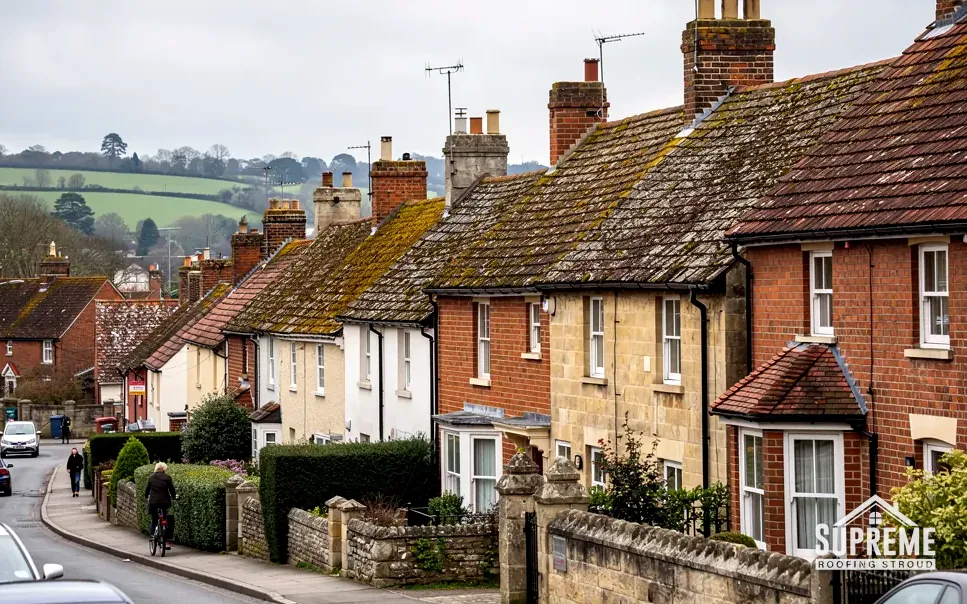
Sloping street of brick and stone terraced houses with mossy tiled roofs 
Victorian terraced houses with slate roofs and chimneys on a hillside
Chapter 01
Houses on the spur: a roof survey for each plot
Where houses stand apart on a hillside edge, nothing about one roof can be assumed from its neighbour.
Chapter 01In this chapter
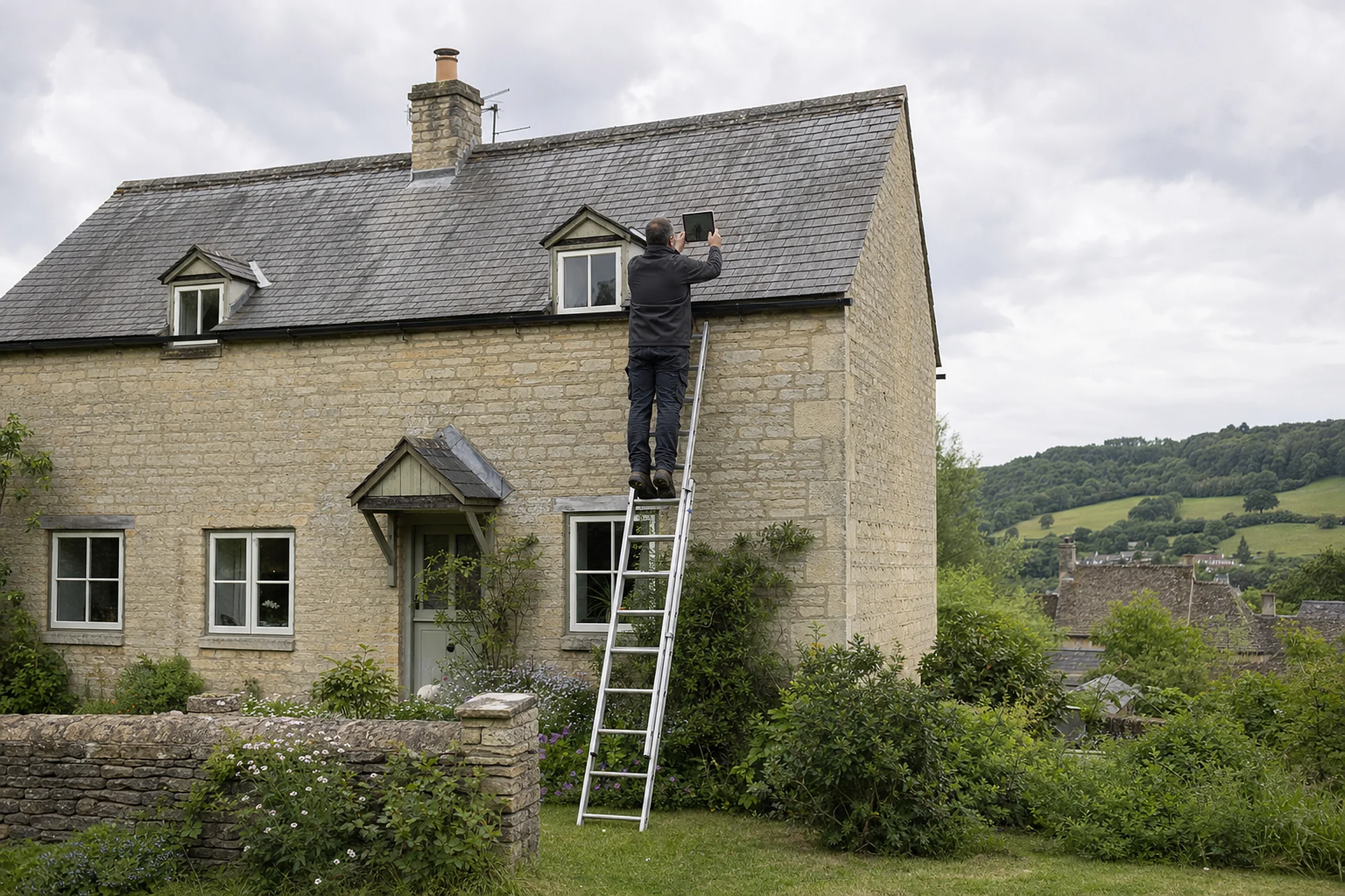
With some 175 houses scattered around the edges of the spur, Selsley is not a place where one visit covers a street. Each house stands in its own ground, with its own drive or path, its own boundary wall and its own relationship to the slope. A roof that looks accessible from the lane can be a long way off the ground on the garden side, particularly where the western scarp falls away behind the plot. We treat every Selsley roof as a separate site and survey it that way.
In this chapter
Working near a drop calls for edge protection. When a house sits on ground that falls steeply, the scaffold is built to deal with the fall as well as the roof, with guard rails along the working platform and boards at the toe so tools and slates stay where they are put. That protection costs money, so it is always properly allowed for in the quote. If the scaffolding bill would exceed the repair bill, we tell you plainly and go through the options, which range from a tower to a roof ladder where one is safe to use.
Deliveries are the other question on a scattered village. A lorry may have to stop on the lane and the stone, tile or timber carried to the site, and we ask about turning space and gates before the survey so that the date works for the neighbours as well as for you.
Gardens in a village like this often hold sheds, greenhouses and old walls close to the house, and they decide where a platform can stand. We note them on the survey sheet and show them on the photographs, so the scaffold plan in the quote matches the ground rather than an idealised drawing.
When a drone helps
For a tall roof, a steep pitch or a slope that cannot be reached safely from a ladder, a drone survey avoids sending anyone onto a doubtful surface. In MyBuilder's 2026 guide a standard inspection runs £150 to £250 and a drone inspection £200 to £400, so the drone is the dearer route and earns its place only where it removes a real risk. The photographs from either route go into the report, and the written quote that follows covers the work needed to put each defect right. Our roof inspections and surveys page describes what the report contains.
Whichever route we take, the list of things we look at is the same: slipped or missing pieces, the condition of the ridge and verges, flashings around chimneys, valleys, and gutters and their fall. A roof can fail in one small place and leak for months before the stain reaches a ceiling, which is why the full set of pictures matters.
In a scattered village, every roof gets its own survey, whichever road it is on.
Chapter 02
All Saints' Church: Grade I stone, Morris glass
The highest grade of listing and some of the finest glass in the area make a church roof a careful job.
Chapter 02In this chapter
All Saints' Church, Selsley, was built between 1859 and 1862 to designs by G. F. Bodley, and the Victoria County History records that local stone was used for the building. The Grade I listing is the highest available, and the windows hold stained glass by Morris & Co. Those details set the standard for anyone planning work near it, and they are the clearest example in the village of how heritage shapes roofing decisions.
In this chapter
Houses go through listed building consent, but a church still holding services is exempt from that process. Roof work is approved instead through a faculty from the diocese, on the advice of its committees. In practice, a roofer on a church works from a specification written by the church's architect, and the architect sets out the stone, the lead, the method and the protection. What we can add as contractors is a plain written price that matches the specification.
Glass is the point that makes a church different from a house in this job. Scaffold poles near a window need padding, or must stand clear of the glazing altogether, and nothing is dropped or swung against it. Stonework that meets a window head, gutters that discharge near the glass and lead trays that run behind it all need planning so water leaves the wall without going where the glass sits. A stained glass window is as much an asset as the roof above it.
Our work on a house rarely needs that level of ceremony, yet the habits are the same: protect what is next to the roof, keep a record, and agree each step before it starts.
Lessons for a house nearby
Hardly anyone is ever asked to roof a Grade I building. The lesson that carries over to a house is that stone roofs and stone walls work as a pair. Stone slates and the courses beneath them are built to shed water out beyond the face of the wall, and gutters and eaves details are part of that system. When a roof is renewed, the eaves, the gutter fixings and the junction with the wall should be reviewed together.
- 1859year building began on All Saints' Church, Selsley
- 1862year the church was finished, in local stone
- Grade Ilisting of the church, with glass by Morris & Co.
Good records help in the same way. The church's history is written down, and the work on your house deserves the same treatment. We photograph your own roof before and after, and the written quote and the guarantee that comes with the finished job, 10 years for workmanship, are yours to keep with the deeds.
Chapter 03
Selsley Common's quarries and the stone of Stanley's End
Local stone built the walls, but a replacement tile for the roof has to match on more than looks.
Chapter 03In this chapter
Quarries on Selsley Common once supplied stone for local building and walling, and the houses around the eastern triangle of roads, from the late 1700s and early 1800s, show what that supply produced. The chapel and school of the 1860s came later. Walls from the common's stone are one story. The roofs over them are another, because Cotswold roof tiles come from particular beds that split into thin sheets, which is not the same as stone quarried for walls.
In this chapter
Cotswold District Council's guidance of 2000 names the two limestones behind Cotswold stone slates as Forest Marble and Stonesfield Slate, both oolitic. English Heritage policy, quoted there, asks for new slates that resemble the old ones in bed, tone, grain, dimensions and depth, and rules out putting sandstone where limestone was. So a Selsley roof is never assumed to carry common stone, and a pale tile that merely looks Cotswold is not treated as an equal. We identify what is up there, then source to match it.
Matching reaches into how the roof is laid. A traditional Cotswold roof turns its valleys with a swept valley: specially cut stones that curve through the angle where two slopes meet. Mitred and open lead valleys cost less to build, yet the guidance judges them less satisfying to the eye than the traditional version and advises against them. On a house where the swept valley is a feature of the roofline, we keep it.
Around the eastern triangle of roads, the chapel, the school and the older stone houses stand close together. A single house re-covered in a poor match stands out against that background for decades, and a good match disappears. This is why we put a sample on the table, in daylight, before the order goes in.
What stone costs
Checkatrade's 2026 slate guide puts stone slate at about £160 to £210 per m², because the origin of the slate, whether it is new or reclaimed, and your location all shift the price. Treat it as a national yardstick, since it is not drawn from the Cotswolds alone. Your own written quote will cover the stone, the labour, the scaffold and the clearance, and the difference between new and reclaimed is something you can compare. The same guidance warns that taking stone from other buildings has stripped old houses elsewhere, and prefers new stone to second-hand. Our Cotswold stone roofing page carries the full detail.
Myth: Any pale Cotswold-style tile is a fair replacement on a stone house.
Fact: A replacement should resemble the original in bed, tone, grain, dimensions and depth, and sandstone must never stand in for limestone.
Map showing Selsley and the Stroud service radius, with nearby towns we also cover.
Near Selsley
Roof work we do here
Bodley's All Saints and the Stanley's End hamlet
How do you reach and inspect a roof on a house at the edge of the spur?
We assess the ground first, then choose a ladder, a tower or a drone survey. Where the land falls steeply behind the house, scaffold with edge protection is the safe way to work on the slope.
All Saints' Church is Grade I listed. Does that affect the roofs of houses around it?
Not by itself. The test is whether your own house is listed, or stands within the curtilage of a listed one, and we check with Stroud District Council before suggesting a change of covering.
My Selsley house is built of stone from the common. Can it be re-covered with any Cotswold stone tile?
No. Wall stone and roof stone are different materials, so a replacement has to resemble what is there in more than colour. The survey establishes what is on the roof before any price is given, and the stone is named on the quote.
Is a drone survey worth the extra cost for a tall roof on the scarp side?
When a ladder cannot be placed safely, yes. A drone inspection typically costs £200 to £400 against £150 to £250 for a standard one, according to MyBuilder in 2026, and it avoids walking an unsafe slope.