
Roofers in Cashes Green
Cashes Green is one of Stroud's western neighbours, just 2.1 road miles away, and it grew from a hillside village into a suburb of terraces, chapels and large housing estates. Its roofs follow that story.
Cashes Green at a glance
- Distance
- 2.1 road miles west of Stroud
- Council
- Stroud District Council
- Conservation area
- None on the council's list
- Setting
- Southern slope of Randwick Hill
Cashes Green's roofs: terrace, chapel and estate
The original village of Cashes Green was on the southern slope of Randwick Hill, in the civil parish of Cainscross. For most of its life it was small. Then, in the second half of the twentieth century, it expanded massively, and it is now contiguous with Ebley, Cainscross and Paganhill. Anyone driving west out of Stroud passes from one to the next without noticing a boundary.
The buildings record that growth in stages. The earliest at Cashes Green were Springfield Terrace, built in 1882. Further housing followed in the late nineteenth century and large house estates in the twentieth. A brick Primitive Methodist Chapel was built in 1901. Over the boundary, Cainscross did not really start to develop until the nineteenth century, and its toll house and the present Cainscross Road date from 1825.
Cashes Green does not appear on Stroud District Council's list of conservation areas. That keeps the planning side simpler than in a conservation area, but it does not make the roofs simple. A suburb that has grown in layers has terraces with shared walls, estates built in batches and extensions bolted on later. Each of those has its own habits when it leaks, and we think of the village in three groups: the terraces, the estates, and the additions to both.

Detached red brick Edwardian house with mock-Tudor gables and a tiled roof 
Stone terraced houses with slate roofs and chimneys stepping up a hill
Chapter 01
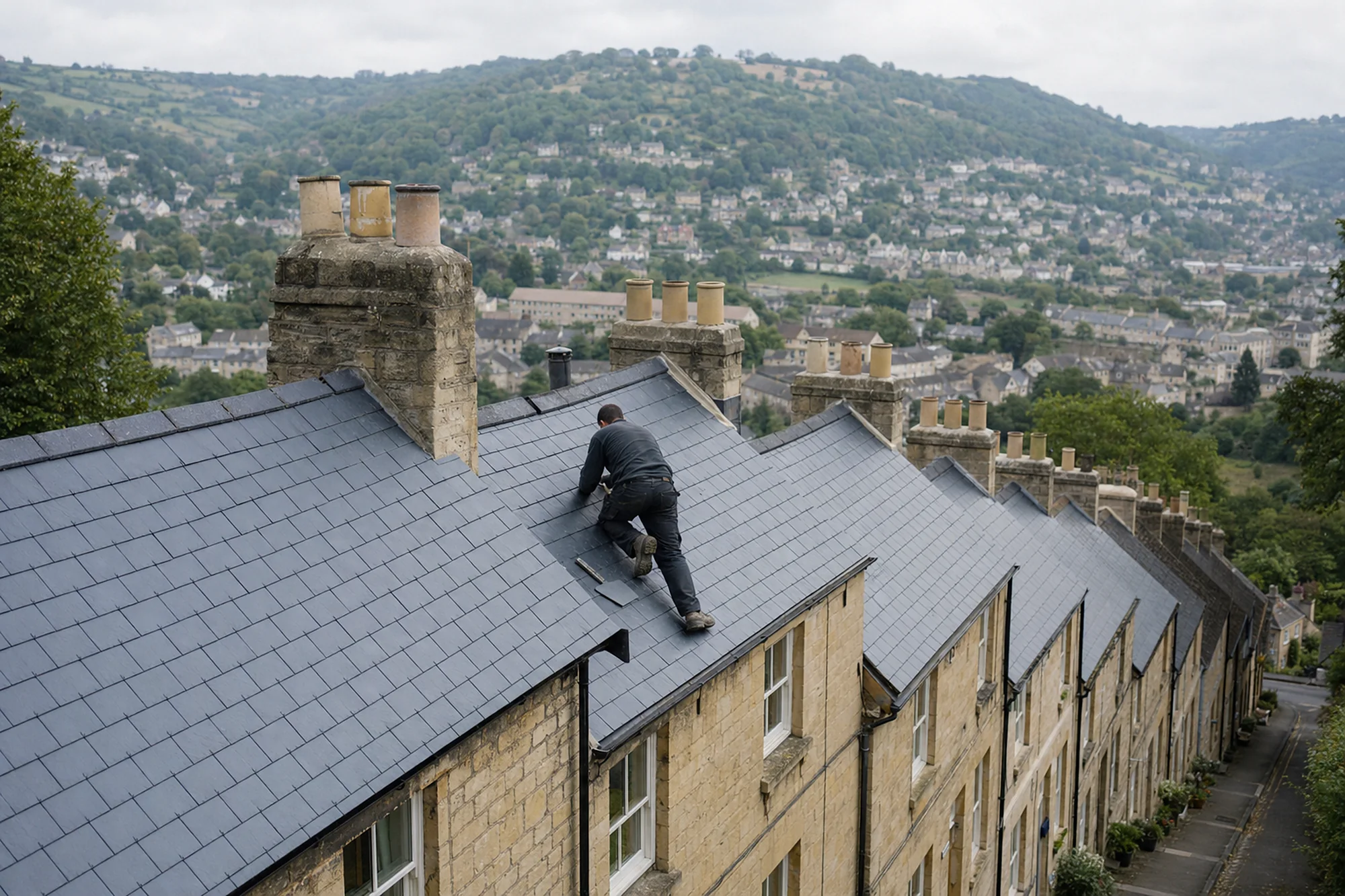
Springfield Terrace and the late Victorian houses around it
A row built in 1882 shares walls, stacks and gutters, so one roof job touches several owners.
Chapter 01In this chapter
Springfield Terrace, built in 1882, is the earliest recorded building at Cashes Green, and further housing followed in the late nineteenth century. A terrace of that kind puts houses side by side, under roofs that continue from one to the next. The covering on any specific house is confirmed at the survey, so this describes how roofs of this type behave. A terrace has party walls between homes, and a single chimney stack frequently sits astride the boundary of two. Water gets in at the junctions: where one roof meets the next, at the base of a shared stack, and along the gutter that runs the length of the row.
In this chapter
A roof laid in the 1880s has passed its hundred-and-forty-year mark. If the original covering survives, the nails that fixed it have usually rusted, the battens beneath may have softened, and the lead around the stacks has long since done its work. Natural slate is typically cited as lasting 80 to 100 years or more, and clay tile 40 to 60 or more, though sources differ and exposure and workmanship change both (MyBuilder, 2026). Those figures describe a covering, not the fixings under it, which are often the first to fail.
On a terrace, speak to the neighbours before you speak to a roofer. When two or more roofs in the row are due work, a single scaffold can run along all of them, the cost is divided, and a single crew can finish the shared junctions in one visit. If your neighbour is not ready, the junction still has to be dealt with carefully, and we photograph it as we leave it. Our roof replacement page walks through a full job, from the scaffold to the clearing of the site at the end.
Stacks that serve two houses
A chimney that serves two houses is, in effect, the responsibility of both. Open pointing, a lifting flashing or cracked flaunching lets water into either house. Where possible we inspect the stack from each side and describe the repair in terms both owners can follow, which keeps a shared job from starting with an argument.
The 1901 chapel
The brick Primitive Methodist Chapel of 1901 is a reminder that Cashes Green also has buildings that were never houses. A chapel still used for worship has its own authorisation route, whereas a converted one is treated like any other building, and we ask which applies before we begin. Some chapel buildings in suburbs like this have become homes, workshops or halls, and each use brings its own owner, its own insurer and its own questions about who looks after the roof. Large single-span roofs with few internal walls are common in chapels, and their gutters and valleys deserve a close look from the top.

On a terrace, the leak is usually at the join between two roofs.
Chapter 02
The twentieth-century estates, their garages and flat-roofed extensions
Houses built in large batches age together, and so do the add-ons that came after.
Chapter 02In this chapter
Cashes Green went through massive expansion after 1950, and large house estates are the result. Each road is different, but the pattern of a large estate still tells us something about the roofs. When a developer builds a hundred houses from a handful of designs, the roofs share a covering, a pitch and a method of construction. They wear out within a similar span of years, and a fault on one house may well appear on another down the street.
In this chapter
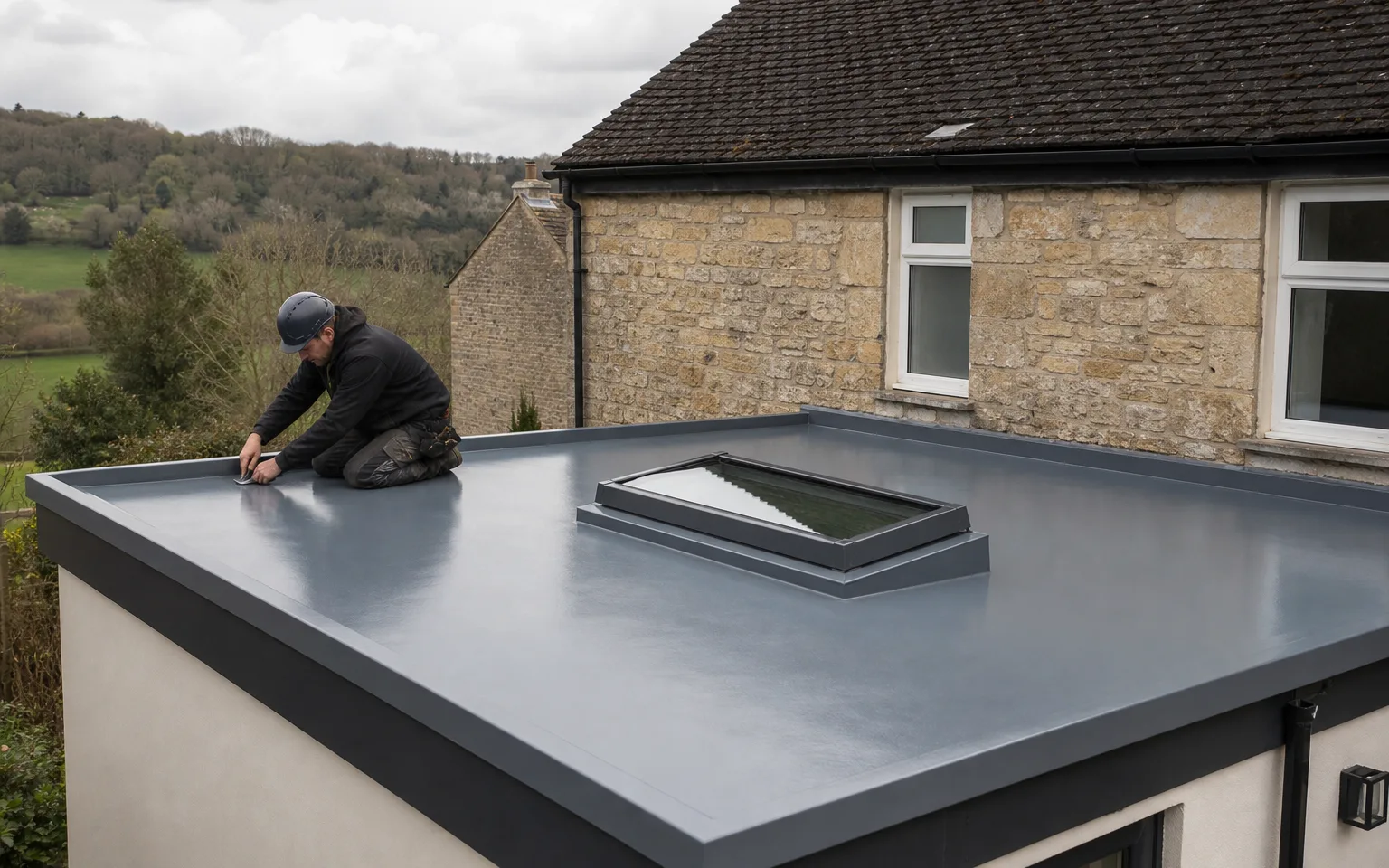
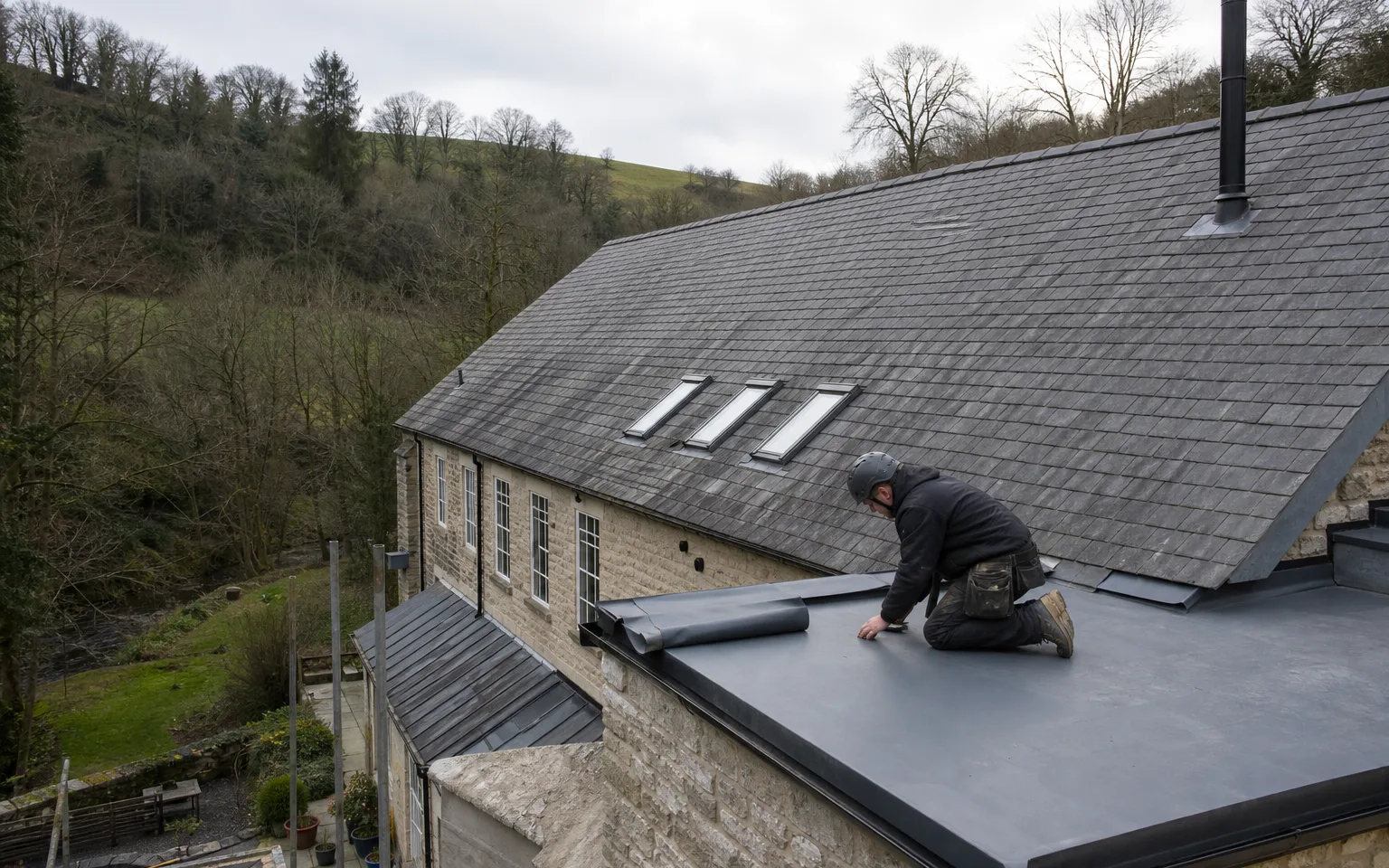
The additions matter just as much as the main roofs, because they are where owners most often meet a problem for the first time. A garage, a rear kitchen or a porch added to an estate house often has a flat or low-pitched roof, and these run on a separate timetable. EPDM and GRP typically last 20 to 30 years or more and 25 to 40 years respectively, and bitumen felt 10 to 20 years (sources include GreenSpec and Less, 2026). A garage roof from the 1970s may therefore be on its second or third covering.
Our garage roof replacement work starts with what is under the covering. Older garages may have cement sheets that could contain asbestos, and we treat them as such until they have been assessed. If the sheet is intact, careful removal is non-licensed work under HSE guidance; if it is substantially broken, the job becomes notifiable. The quote tells you which situation applies and what is included for disposal.
Flat roofs on estate extensions
On extensions and porches, our flat roofing page explains the choices. A flat roof must shed its water, so the deck is laid to a slope. BS 6229 advises designing at 1:40 so that the finished fall still reaches 1:80. A ponded roof on a thirty-year-old extension usually means the deck has sagged or the falls were shallow to begin with. Covering it again without correcting the slope repeats the problem, and a puddle that stays for days will wear any membrane out early. EPDM and GRP both cope with ponding better than felt, but neither is built for it, and a good installer treats standing water as a fault to cure.
Matching the street
Along an estate road roofed in one tile, a single house in a different colour stands out from the far end, and neighbours notice. Before proposing a replacement we note what the neighbours have and whether the original tile is still made.
| Garage roof | Typical UK range |
|---|---|
| Single, flat | £700 to £1,000 |
| Double, flat | £900 to £1,400 |
| Pitched | £2,500 to £4,500 |
Chapter 03
Randwick Hill's southern slope and the joins to Cainscross, Ebley and Paganhill
A suburb with no hard edges: which council map, which road and which slope your roof sits on.
Chapter 03In this chapter
Because Cashes Green now runs into Ebley, Cainscross and Paganhill, an address here can be hard to place. You might say you live in Cashes Green while the property sits just over a line, in a neighbouring area with different rules. Ebley Mills, for example, is a separate conservation area on the council's list, and parts of nearby Westward Road and Cainscross Road sit in the Industrial Heritage area, whereas Cashes Green itself is not on it. Neighbouring addresses can therefore carry rules that yours does not. Your address is checked against the council's records before any price is written, and you are told what turned up.
In this chapter
The slope is the other local fact. The old village stood on the southern slope of Randwick Hill, and the streets that grew over it still climb. Houses sit above or below the road, steps replace paths, and a back garden can lie level with the roof of the house behind. We study this on the first visit, because scaffold that has to follow the ground is built in stages, each stage with its own height to suit the slope. Where a lorry can only stop at the bottom of a road, tiles and timber are carried up on foot and the stripped covering returns by the same route.
At 2.1 road miles from Stroud, Cashes Green is on our doorstep, so a survey is no long trip and a second look at a detail costs little. For a leak after a storm we prioritise the call, and the first step is to make the roof safe before any longer fix is discussed.
A repair, a patch or a new roof
Most roof problems in a suburb are small ones, and they are usually found by a gutter that overflows or a stain on a bedroom ceiling. A slipped tile, a split ridge, a gutter joint that has opened. Our roof repair page sets out typical UK ranges: a minor repair of £100 to £300, a moderate one of £500 to £1,000, and a major one of £2,500 or more, according to MyBuilder (2026). When repairs begin to repeat in different places, replacing the covering is often better value, and the quote spells out that comparison.
Map showing Cashes Green and the Stroud service radius, with nearby towns we also cover.
Near Cashes Green
Roof work we do here
Cashes Green roof questions, from Springfield Terrace to the estates
I live in a late Victorian terrace in Cashes Green. Who deals with the stack we share?
In effect it belongs to both of you. We examine the stack from each side where we can, explain the repair in plain terms and include it in the quote, so each of you can see what is being done and why.
My 1970s garage roof in Cashes Green has cement sheets. Could they contain asbestos?
They might. We treat them as suspect until assessed. HSE guidance classes the careful lifting of undamaged sheets as non-licensed work. Sheets that have already broken up bring in a notification duty. The quote says which case applies.
My flat-roofed extension on a Cashes Green estate has puddles that never clear. Is that a fault?
Standing water usually points to a sagging deck or shallow falls. We check the slope, the outlet and the upstands, since a new covering laid without correcting the fall repeats the problem. The options are explained, with the lowest-cost fix that will last set beside the dearer one that cures the cause, so you can choose with the figures in front of you.
Is my house just over the line into Cainscross or Ebley, and does it matter for the roof?
It can. Ebley Mills is a conservation area on the council's list, and Cashes Green is not. Your address is checked against the council's records before we put a price on it.