

Roofers in Dudbridge
Roof repairs and re-roofing in Dudbridge, 1.2 road miles out from Stroud, bearing west-south-west, where a bridge over the River Frome, a mill site, a canal wharf and a trading estate share a low stretch of the valley.
Dudbridge at a glance
- Distance
- 1.2 road miles west-south-west of Stroud
- Council
- Stroud District Council
- Conservation area
- Stroud Industrial Heritage, covering the Dudbridge Works and Lightpill Trading Estate part (added 2008)
- Setting
- Low in the Stroud Valleys on the River Frome
Dudbridge's roofs beside the Frome
Dudbridge takes its name from the first bridge there, which crossed the River Frome, and it lies low in the Stroud Valleys on the southern edge of Stroud. The river is the reason for most of what stands here. The earliest record of a mill at Dudbridge dates from 1235, and the fast-flowing Frome made the site suited to early industry long before anyone built a house with a view of it.
Industry arrived in layers, and each left a roof. Richard Hawker, a dyer, built Dudbridge House in 1770 close to the river and his works. The Stroudwater Canal opened a wharf at Dudbridge in 1779. Thomas Daniels founded an engineering and foundry business in 1840, and Kimmins Mill was built in 1849 to mill flour. The Stonehouse and Nailsworth Railway opened a station here in 1867, which became a junction when the short branch to Stroud began carrying passengers in 1886, and Hampton cars were assembled here in the late 1920s.
The history here is one of works and trades, so the buildings that matter to a roofer include mill ranges, workshops and yards as well as the older houses that went up beside them. Stroud District Council's 2008 review of the Industrial Heritage Conservation Area, first designated in 1987, added Dudbridge Works and the Lightpill Trading Estate to it. The conservation area does not cover the whole suburb, so we check which side of the line a property falls on before advising.
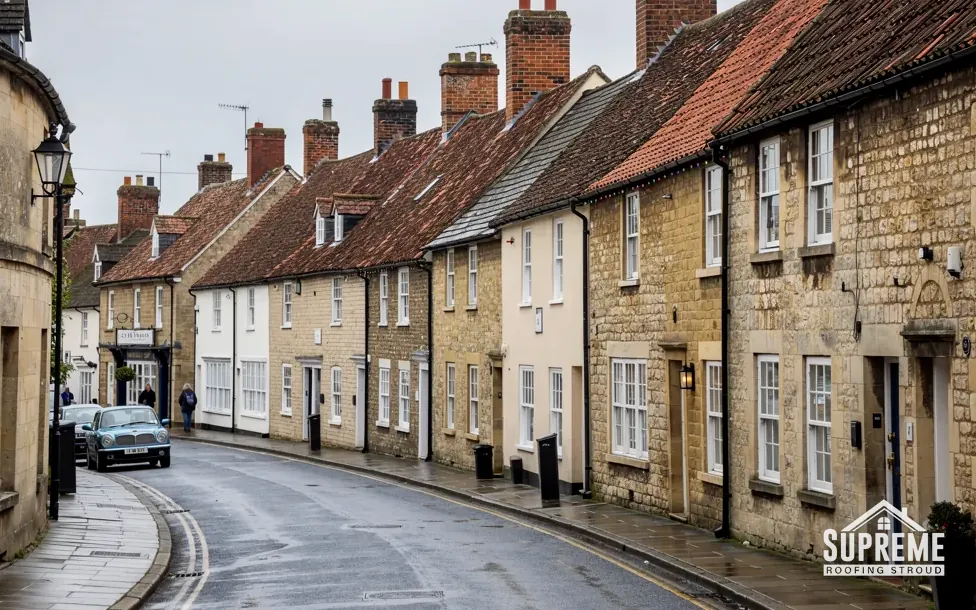
Curving street of stone and rendered terraced houses with tiled roofs 
Detached red brick Edwardian house with mock-Tudor gables and a tiled roof
Chapter 01
Mill sites since 1235 and the big roofs of Kimmins Mill
Industrial roofs are large, long-lived and mostly shaped by what happens inside the building.
Chapter 01In this chapter
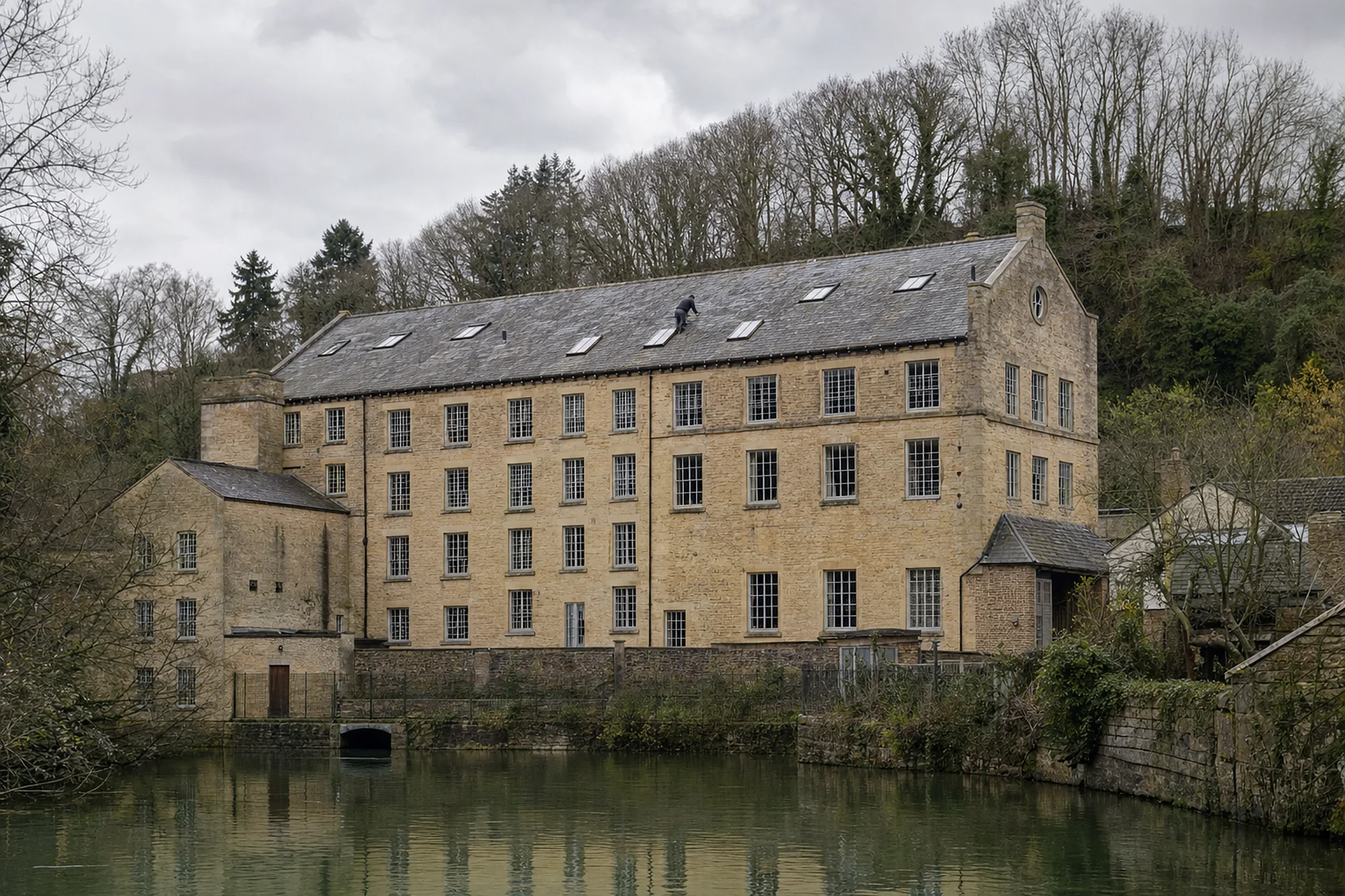
A mill has stood at Dudbridge since at least 1235, and Kimmins Mill, built in 1849 to mill flour, is one of the later chapters of that story. Buildings of this kind share a set of features. The spans are wide, so the roof structure is heavy and the covering is laid over long runs. The valleys and gutters between ranges carry water from a large catchment, and the roof has often been altered to suit new uses. A roof that was once above a flour mill may now cover a workshop, a store or a studio.
In this chapter
That history shows in the way leaks present. Water seldom comes in where you first see the stain. On a big roof it travels along purlins, down a wall and across a floor before it finally drips, which leaves the damp patch and the defect many metres apart. We survey from above, trace each line of flow to an outlet, a lap or a flashing, and photograph it, so the repair can be priced against the real fault and not the mark on the ceiling.
Older industrial units may also carry asbestos cement sheeting, particularly on twentieth-century extensions. Under HSE guidance, lifting intact sheets with care is non-licensed work, whereas sheets that are already broken up fall into the notifiable group. We identify what is there before anyone steps on the roof and write the method into the quote. If a roof here is older than your paperwork, ask before anyone walks on it.
Rooflights deserve a mention too. Mill and workshop roofs often carry them in long strips, and old ones become brittle with age, so they are treated as fragile until proved otherwise. We cover or guard them before anyone works nearby, check the kerbs and flashings around each, and say in the report whether an old light should be repaired, replaced or boarded over.
Pricing a large roof
On a commercial building the quote begins with access: a mobile tower, edge protection or full scaffold, and whether the unit stays in use. Then come the strip, the new covering, the details at valleys and rooflights, the labour and the waste. Each is described in the quote, so a landlord or tenant can see which parts are repairs and which are renewals. Our commercial roofing page explains how larger jobs are phased around a working building.
On a large roof the stain and the fault can be metres apart.
- 1235earliest record of a mill at Dudbridge
- 1849year Kimmins Mill was built to mill flour
- 1867year the Stonehouse and Nailsworth Railway opened its Dudbridge station
Chapter 02
Dudbridge House and the dyer's riverside works
A house built in 1770 beside the water has had more than two centuries of damp to resist.
Chapter 02In this chapter
Richard Hawker built Dudbridge House in 1770 close to the Frome and his dyeing works. A house of that date, set low by a river, shows its age in a particular way. The walls draw moisture up from the ground, the gutters have to be generous to cope with a long roof, and the chimneys stand exposed above the roof on every side. Those three details tell us where to start a survey.
In this chapter
Roof coverings on houses of the later eighteenth century are usually pitched, with a ridge, hips or verges, and often a parapet or a lead-lined valley where two ranges meet. A parapet gutter is a channel set behind a low wall at the roof edge, and it is a typical weak point: lead that has split along a seam, or an outlet that has silted up, lets water into the wall below. We lift the covering around any such detail and show the condition in photographs before we recommend a repair.
Our approach to a house like this is to retain what is sound and replace only what has failed. We re-use slates or tiles where they are good, match any that are not, and hold the ridge and eaves to their existing lines. Where the roof needs re-covering, we quote the like-for-like material, because changing a covering on an old house can alter its weight, its appearance and, in a conservation area, its permissions. Re-roofing with a covering around 15% heavier or more needs Building Regulations approval and a structural check.
Water at the foot of the wall
Because Dudbridge lies low in the valley, the ground around older buildings holds water for longer than on the slopes above. We look at the roofline, but also at the downpipes, the gullies and the drain runs that take water away from the footings. If a gutter spills on the same patch of wall every winter, that wall will be damp, and no amount of repointing will cure it. The order in which we tackle leaks and gutter faults, starting with whatever stops the water fastest, is set out on our roof repairs page.
Chimneys on a house of that age deserve the same scrutiny. A stack that rises above the roof is open to the weather on every face, so we look at the pointing, the flaunching (the mortar bed that holds the pots in place) and the flashings where the stack meets the slope. A hairline crack in a flaunching is an easy fix now and an expensive one after another few winters, and the survey photographs make the difference plain.
The same attention applies to any workshop, office or cottage that has grown alongside an older building. Lean-to roofs and flat additions are where the old and the new meet, and where the oldest leaks usually begin.
Chapter 03
The canal wharf, the foundry and the Lightpill Trading Estate
Commercial roofs inside a conservation area are repaired with the planning team in mind.
Chapter 03In this chapter
The Stroudwater Canal opened a wharf at Dudbridge in 1779, a railway station followed in 1867, and Thomas Daniels set up his engineering and foundry business in 1840. Between them they show a district built around trades and transport. The Dudbridge Works and Lightpill Trading Estate part of the Stroud Industrial Heritage Conservation Area was added in the council's 2008 review, and any commercial roof inside it should be approached with that in mind.
In this chapter
A flat or low-pitched roof is a different craft from a hillside slate roof. Its enemies are ponding water, split laps and blocked outlets, and its remedy is usually a new membrane or a localised repair to the weakest section. Typical national costs for flat roof coverings run in bands, and the figures below are published guide ranges, not Supreme prices. A written quote follows only after we have measured and surveyed the roof itself.
Inside a conservation area, the questions to ask before a commercial re-roof are about appearance. Laying the same kind of covering again seldom causes difficulty. A different profile, colour or material, or new rooflights, deserves an early call to Stroud District Council's planning team, and we would rather make that call at the start than lose a week to it later. The Building Regulations come into it as well. Once a re-roof goes past either the 25% building envelope limit or the 50% roof limit, approval applies and the roof may have to be upgraded for heat loss at the same time.
Working beside a live yard
Our flat roofing page describes the coverings and falls in more detail. On a working site such as a foundry yard or a trading estate, lorries, forklifts and staff are part of the planning. We agree exclusion zones and the hours of work, leave edge protection in place overnight, and keep materials off the working yard so business can carry on. A written 10-year workmanship guarantee covers the finished roof, and the quote covers every stage of the job so that a manager can sign it off without having to ask what is included.
On a commercial roof, the quote should show which parts are repair and which are renewal.
- Bitumen felt, per m²£70 to £100
- EPDM, per m²£90 to £130
- PVC single-ply, per m²£95 to £140
- GRP, per m²£95 to £150
Map showing Dudbridge and the Stroud service radius, with nearby towns we also cover.
Near Dudbridge
Roof work we do here
Frome mill roofs and the Lightpill trading estate
Why does water show up far from the leak on a big Dudbridge mill or workshop roof?
On a wide industrial roof, water runs along timbers and down walls before it drips, so the stain and the defect can be a long way apart. We trace each line of flow from above and photograph the outlet, lap or flashing at fault.
Part of my Dudbridge unit is in the Industrial Heritage Conservation Area. What does that change?
The 2008 review added Dudbridge Works and the Lightpill Trading Estate to the area, but not the whole suburb. Putting back the same covering is rarely an issue. A new material, profile or rooflight is something to raise with the planning officers first.
Could an old Dudbridge garage or workshop roof contain asbestos cement?
Older sheeted roofs can. The HSE position is that carefully removing sound sheets is non-licensed work and that broken sheeting is notifiable. We identify the material first and put the method in writing.
An older house near the Frome keeps getting damp walls. Could the roof be the cause?
It can be. A split parapet lead or a blocked outlet lets water into the wall below. We also check downpipes and drains at the foot of the wall, because water discharged against old masonry causes the same symptoms.