
Roofers in Ebley
Roof repairs and re-roofing in Ebley, 1.6 road miles from the centre of Stroud, lying west-south-west, from the Grade II* mill on the Frome to the ashlar houses, the old chapel and the estate built along Westrip.
Ebley at a glance
- Distance
- 1.6 road miles west-south-west of Stroud
- Council
- Stroud District Council
- Conservation area
- Ebley Mills (no. 22), first designated November 1986
- Listed mill
- Ebley Mill, 1818, Grade II*
Ebley's roofs, from the 1818 mill to the Westrip estate
Ebley sits on the Frome, in the valley that carries the river. It was historically part of Stonehouse parish, and joined Cainscross parish when that was formed in 1894. The place is first recorded in 1287, but most of what a roofer meets was built after 1818, when the Ebley Mill woollen factory went up on the river bank and the village grew to supply its labour.
The Victoria County History describes the houses of the Stonehouse parish, Ebley included, as built of coursed rubble, ashlar and rough-cast, with later brick terraces. Older buildings include Elmfield, an ashlar house of two storeys with roof-space rooms, dated 1702, and Bridge House, an ashlar-faced building of about 1800 with a mansard roof. Ebley Chapel belongs to the Countess of Huntingdon's Connexion and carries a Grade II listing.
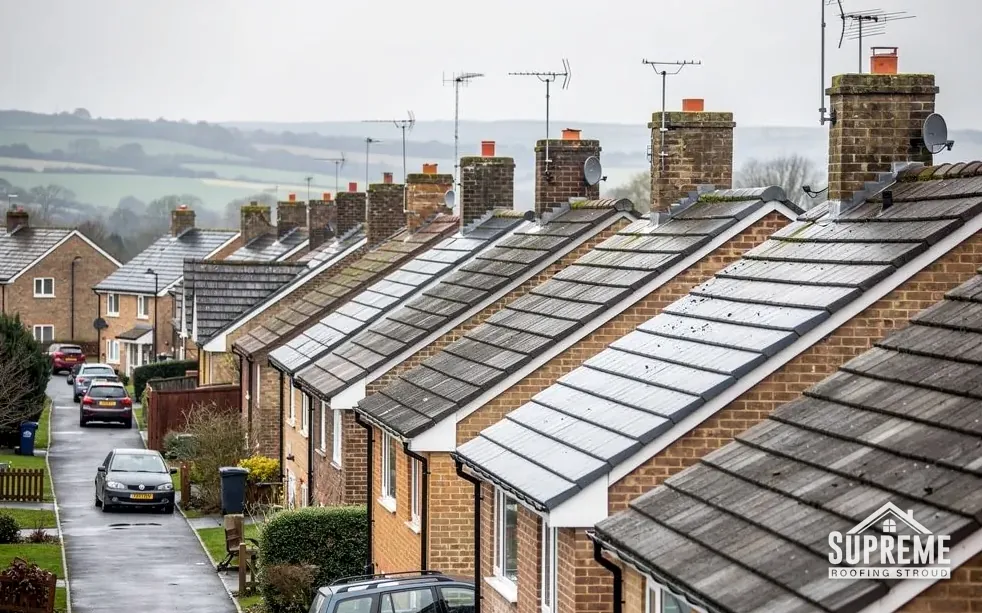
In the mid 20th century the western part of the village was greatly extended along the Westrip road, with a large housing estate west of that road. A roofer working in Ebley therefore meets four different kinds of roof in one parish: a big mill roof, ashlar houses with decorative or unusual roof forms, a listed chapel, and the pitched roofs of a planned estate. Part of the village sits inside the Ebley Mills Conservation Area, and stretches of Westward Road fall in the Industrial Heritage area, so we check each address before advising.

Stone village houses with slate and tile roofs above green fields 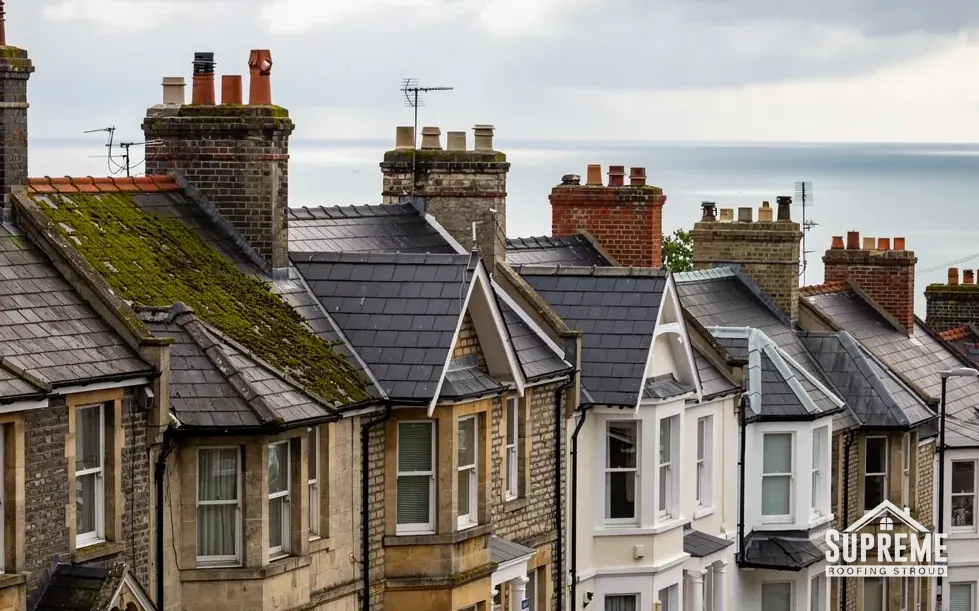
Row of Victorian terraced houses with slate roofs, bay windows and brick chimneys
Chapter 01
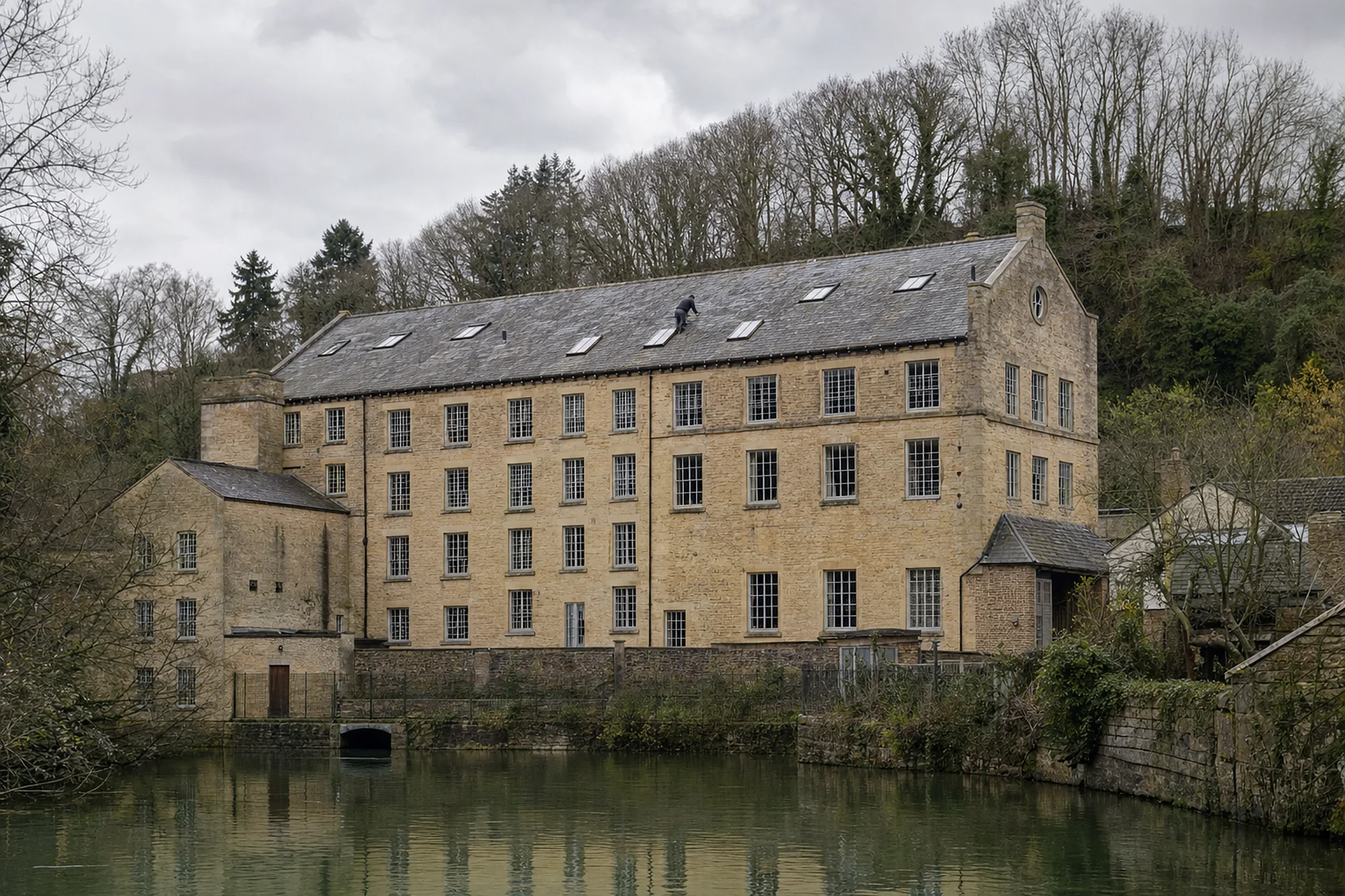
Ebley Mill, the 1818 cloth factory that now houses the council
A Grade II* mill roof in a conservation area is a lesson in doing less and doing it properly.
Chapter 01In this chapter
Ebley Mill is a woollen mill on the banks of the River Frome, built in 1818, and it is listed Grade II*. It now houses the offices of Stroud District Council, which makes the mill an unusual neighbour: the people who decide planning questions work under one of the largest roofs in the parish.
In this chapter
The mill matters to ordinary homeowners because it sets the tone for the Ebley Mills Conservation Area, number 22 on the council's list. The area was first designated in November 1986, and its statement was adopted in November 2008. Houses inside it are not frozen in time, but changes to how they look need thought. Putting back the same covering on a roof generally raises no objection. Anything different from what is there now, such as another colour, another material or an extra roof feature, goes to the planning team before work is priced.
The roofs of a mill, whether still in industrial use or converted, are built to a scale that no house roof matches. Spans are wide, the structure beneath is heavy, and the water from an enormous area funnels into a few valleys and outlets. When one of those fails, the damage is out of proportion to the size of the leak. For that reason our survey of any large roof begins with the drainage and works outwards. We record each outlet, each valley and each lap, then price the work in sections so that an owner or a managing agent can decide what happens now and what waits.
Mills nearby and the wider area
Ebley Mills is one of several mill conservation areas along the Frome. The council's list also names Dunkirk Mills and Watledge, Longfords Mills and Stanley Mills as entries of their own, which tells you how much of the valley's history is industrial. Our pitched roofing page explains how we deal with the large pitched slopes that mill ranges and their converted neighbours typically present.
If you own a flat in a converted mill, the roof is usually the freeholder's responsibility, not yours. Even so, a leak into your home starts with a conversation, and a survey that identifies the source helps that conversation along. We are glad to survey from above and write up what we find in a form a managing agent can act on.
Large roofs fail where the water gathers, and the damp often shows somewhere else.
- 1287year Ebley is first recorded
- 1818year Ebley Mill, a woollen mill on the Frome, was built
- 1894year Ebley joined Cainscross parish when it was formed
Chapter 02
Elmfield, Bridge House and the mansard roof
An ashlar house of 1702 and another of about 1800 each ask for careful leadwork.
Chapter 02In this chapter
Elmfield is an ashlar house of two storeys with roof-space rooms, dated 1702, and Bridge House is an ashlar-faced building of about 1800 with a mansard roof. Ashlar means squared stone laid in smooth courses with fine joints, and it has a formal look that depends on the roof above it staying neat. A mansard is a roof in two stages, with a steep lower slope and a shallower upper one, which makes room for living space beneath it.
In this chapter
The mansard shape brings a particular set of details. The break between the steep and shallow slopes is a line along which water must be shed outwards, and it usually carries lead. Where a dormer window breaks the steep slope, there are cheeks, a flat or low roof and a flashing all in one place. The hips at the corners carry lead rolls or ridge pieces. Each of these is a place where age shows first, and lead that was good for a century can still fail along a seam, at a fixing or where it has been walked on. Our lead roofing page explains lead codes, which describe the thickness of the sheet, and why a flashing is usually Code 4 or 5 rather than something lighter.
A roof like Bridge House's cannot be assessed from the road. We survey from a scaffold lift or a roof ladder, photograph the junctions and test the lead. Where only a section has failed, we repair it and leave the sound lead alone, because dressing new lead beside old needs careful lapping to keep water out. Where a whole slope needs renewing, the covering goes back like for like and the lead goes in at an appropriate code.
Ebley Chapel and the question of consent
Ebley Chapel is a Grade II listed building. Which body consents to roof work on a chapel turns on how the building is used today, and the trustees and the council's conservation team are the ones to settle it. Work waits for that answer, and the quote records it.
Chapter 03
The Westrip road estate and the mid-century village
A large estate added in the mid 20th century brings roofs that tend to age together.
Chapter 03In this chapter
The Victoria County History records that, in the mid 20th century, building along the Westrip road and a large housing estate west of it greatly extended the western part of Ebley. What interests a roofer is the way estates tend to be laid out: a large scheme usually draws on a limited set of house designs, so neighbouring roofs often repeat the same pitch, stack layout and eaves treatment. When one shows a fault, its neighbours are worth checking for the same one.
In this chapter
That helps at survey. Slipped tiles at the verges, tired fascia boards or stained soffits can run along a whole street, and a fix proved on one house is often the right fix for the next. Our roof replacement page describes how a full re-cover is priced, and why a roof of this age is often cheaper to renew as a whole than to patch, once the battens and underlay are taken into account.
Fascias, soffits and gutters are the first things to wear out on estate houses of that era. Timber boards rot at the joints, and gutters sag or split at the brackets. Replacing them is quick work when scaffold is already up for the roof, which is why we quote the two together and pass on the saving. Where a roof is being renewed anyway, it is also a chance to deal with insulation. Insulation fitted to a roof or loft in a house carries no VAT until 31 March 2027, while the other work in a roofing job is standard-rated; your quote states how VAT applies.
Access is something we judge house by house at the survey. A property with a drive is one kind of job. A brick terrace, or a house close to the river, may mean carrying slates and timber by hand along a passage, and that handling time is a real part of the labour, so it is priced where you can see it.
When a re-roof becomes more than a re-roof
The Building Regulations decide whether a roof renewal needs approval. Where a job affects less than 25% of the building envelope and less than 50% of the roof it does not normally need it. Larger jobs do, and Part L may then require extra insulation in the roof. We explain which side of that line your house falls on and, where approval is required, we handle the notification. Finished work comes with a written guarantee of 10 years on workmanship.
Brick terraces, which the history notes among the later buildings of the parish, deserve the same attention. Shared chimneys and party walls turn two roofs into one problem, and neighbours often save money by agreeing to share scaffold.
On a planned estate, one house's fault is often its neighbour's too.
Myth: A small patch repair always works out cheaper than renewing a roof on an estate house.
Fact: Once the battens and underlay are failing, repeated patches cost more than a single re-cover, and the survey photographs show where your own roof stands.
Map showing Ebley and the Stroud service radius, with nearby towns we also cover.
Near Ebley
Roof work we do here
Ebley Mill, Bridge House mansard and Westrip estate
What is different about a mansard roof like the one on Bridge House in Ebley?
The break between the steep and shallow slopes, the dormers and the hips all rely on lead. We survey those junctions first, repair any section that has failed and match new lead to the old, rather than renewing the whole roof when only a seam has gone.
My house is inside the Ebley Mills Conservation Area. Can I put a new covering on it?
Laying the same material again is generally fine. Another colour, another material or an extra roof feature is a matter for Stroud District Council's planning team, and we raise it before we price anything.
Why do roofs on the Westrip road estate so often need work to fascias and gutters?
Houses from the same build tend to age together, and timber boards and gutter brackets are among the first parts to wear. When scaffold is up for the roof, replacing them as well adds little to the cost, and the quote covers it, so the gutters need not wait for a second visit.
I live in a converted mill flat in Ebley. Who is responsible for a roof leak?
Usually the freeholder or managing agent, not the flat owner. We survey the source of the water and write a report that you can pass to them, so the discussion starts from evidence.