

Roofers in Brimscombe
Roof work where the hillside from Minchinhampton common drops to the old canal port, taking in cottages, a Grade II church and a Grade II* wool stove.
Brimscombe at a glance
- Distance
- 2.5 road miles south-east of Stroud
- Council
- Stroud District Council
- Conservation area
- Stroud Industrial Heritage, covering Brimscombe Port
- Listed buildings
- Holy Trinity, Grade II; Bourne Mills wool stove, Grade II*
Brimscombe's roofs, from the common to the Port
Brimscombe sits in the narrow Frome Valley, a stretch also known as the Golden Valley, below Minchinhampton common. It is older than its mills suggest. There were dwellings here by the later twelfth century, and from the late eighteenth century cottages spread down the hill from the common, stimulated by the new road of 1785. The Thames and Severn Canal and Brimscombe Port, opened in 1789, then drew more building into the valley floor.
The river and canal powered a line of cloth mills, among them Bourne, Griffin, Ham and Port Mills. A conservation area, Stroud Industrial Heritage, covers Brimscombe Port, so the heart of the old canal works carries a designation of its own. Two listed buildings are worth knowing: the Church of the Holy Trinity, listed Grade II, and the former wool stove at Bourne Mills, listed Grade II*.
What this adds up to is a settlement built on a slope, with two distinct levels. Up the hill are cottages and houses that arrived with the new road. Down at the water are the buildings of the canal and the mills. Roofs at each level are reached in different ways, belong to different periods, and fall under different rules. Stroud is 2.5 road miles up the valley, and the lower level is the first you meet on the way in.

Hillside terraces of stone houses with slate roofs and chimneys 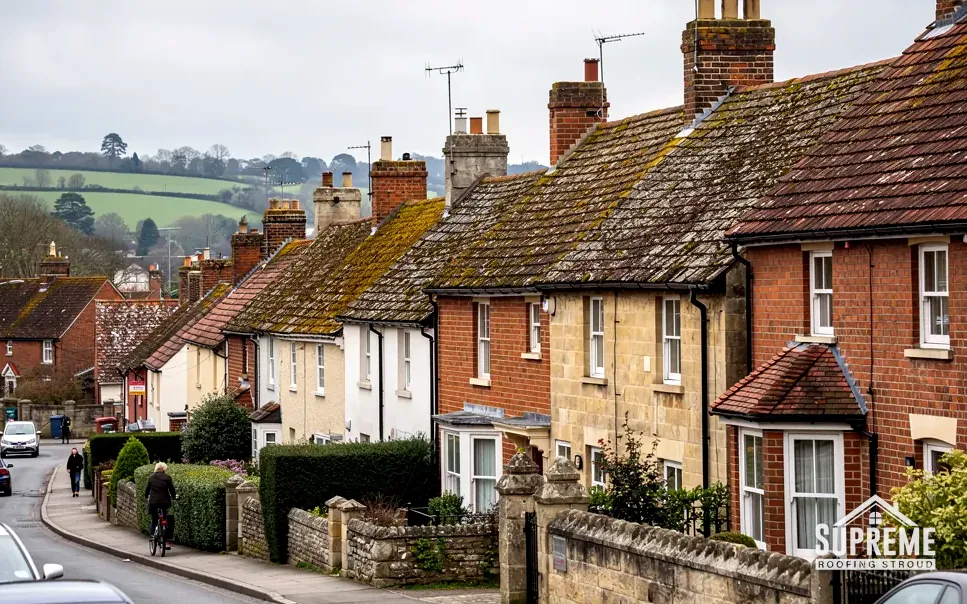
Sloping street of brick and stone terraced houses with mossy tiled roofs
Chapter 01
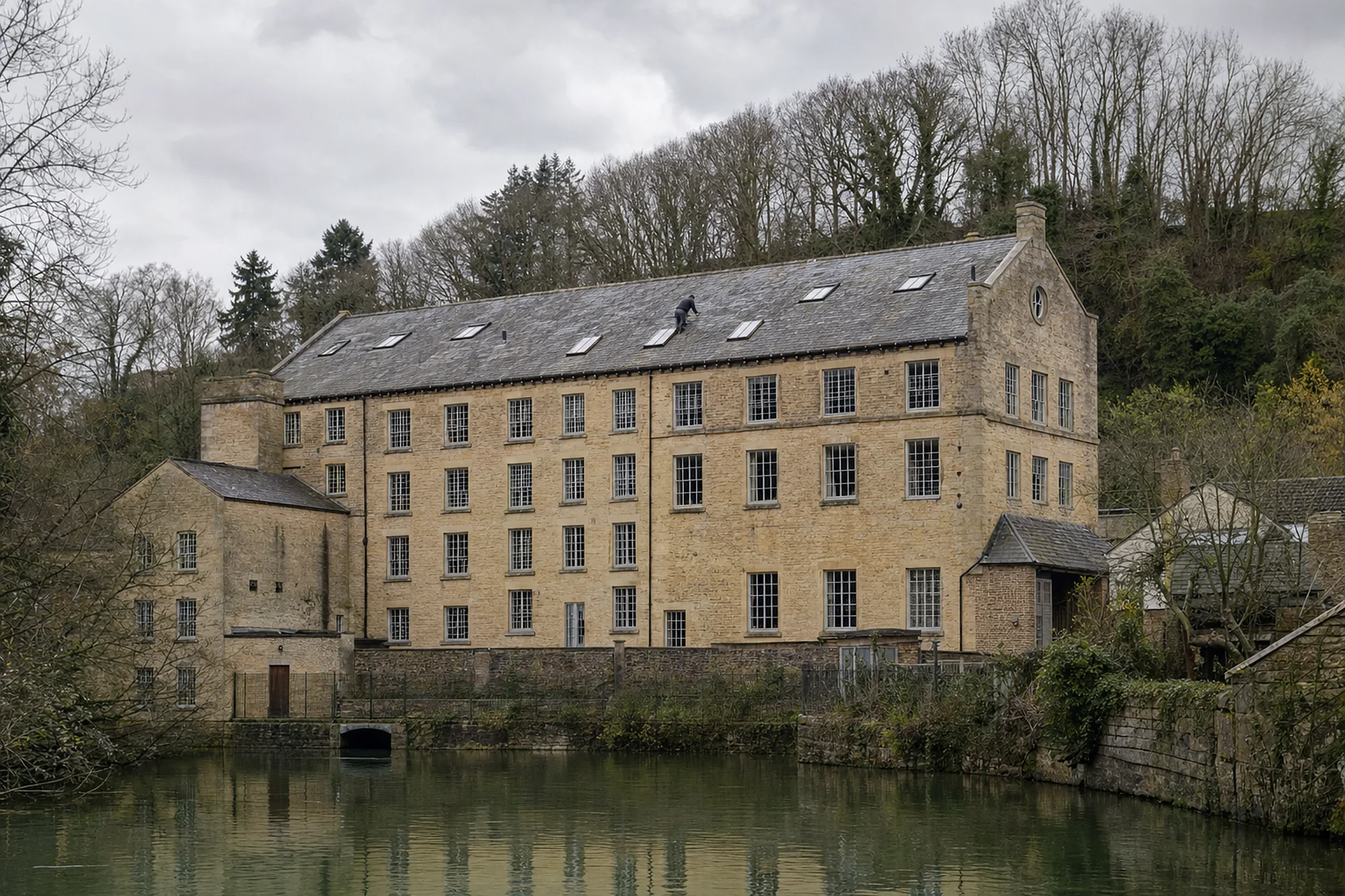
Brimscombe Port and the canal-side roofs
A conservation area on the water brings council oversight to roof decisions.
Chapter 01In this chapter
Brimscombe Port was built with the Thames and Severn Canal in 1789 and led to rapid expansion of the village. Planning data places the Port inside the Stroud Industrial Heritage Conservation Area. The designation follows the valley's canal and mill sites, so an owner near the water, or anyone higher up who is in doubt, should ask the council about their own address and get the answer in writing.
Inside a conservation area, mending a roof in the same material rarely raises questions. Swapping the covering, cutting a new opening or adding a chimney does, and the sensible order is to ask first and quote second. Anything that alters how a roof looks goes to the planning team at Stroud District Council before we write a price. For skylights in particular, the planning position is set out on our skylights page.
Canal-side buildings add practical limits. Space is tight between the building, the water and the towpath. A scaffold close to open water needs a plan for falling objects, and loads that cannot be lifted over a neighbour's roof have to be carried round. We draw the site plan on the survey sheet, then settle the route with the building's managing agent ahead of the final quote.
Working beside open water
The canal and the river make access a safety matter. Scaffold boards next to a water edge need guard rails on the open side, and any material stored near the bank has to be secured so it cannot be pushed or blown into the water. We assess the edge at the survey, note any soft or steeply sloping ground, and include fencing or netting in the access plan where it is needed. None of it is unusual for waterside work, and all of it goes into the written scope so the price already reflects it.
Roofs of the old cloth mills
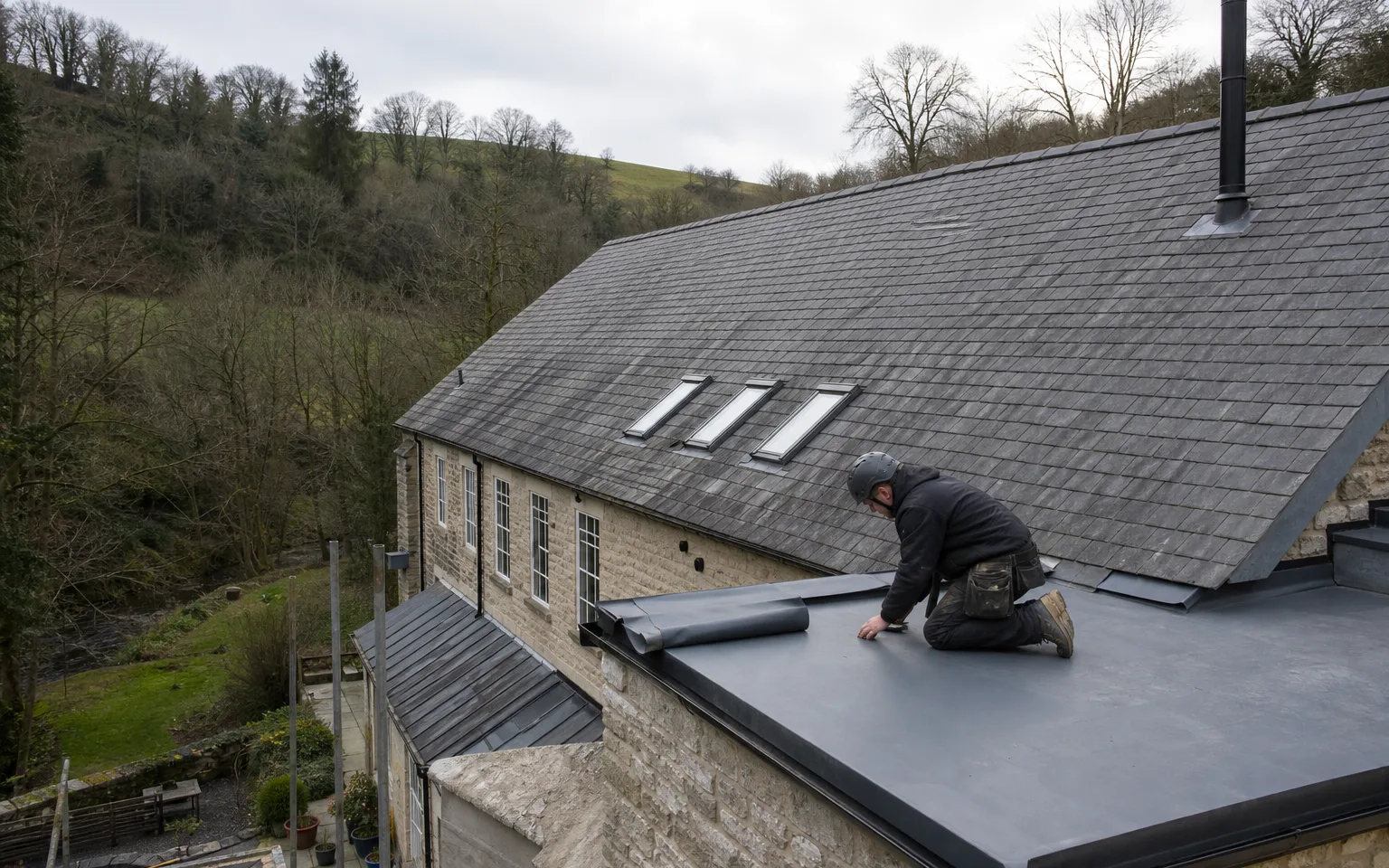
Bourne, Griffin, Ham and Port Mills worked cloth in the valley. Industrial roofs from that world are large in area and often hold a lot of water in valleys and parapet gutters. The first thing we examine is drainage, then the covering, then the fixings. Blocked outlets and cracked gutters cause the damage that gets blamed on the covering. Larger roofs of this kind are covered on our commercial roofing page.
Shared ownership and old sites
An old canal or mill site can have several owners, a management company and a tenant or two. Early on we ask which owner looks after which part of the roof, and whose consent a scaffold needs. The answers decide who signs the quote.
At the Port, the access plan is half the job.

Chapter 02
Cottages that followed the road of 1785 down the hill
Houses built after a new road tell you where the roofs are old and where they are likely to be patched.
Chapter 02In this chapter
Cottages spread down the hill from Minchinhampton common from the late eighteenth century, stimulated by the new road of 1785. Some Brimscombe homes therefore date from that period, and the road explains why so many of them line the slope in groups. We do not assume how any one of them was built, because that is something we confirm from the loft.
With a house this old, the covering may well be younger than the structure under it. Re-covering does not normally replace the old timbers, so age tends to show as sag between rafters, a ridge that dips or eaves that have dropped. We look for those signs from the lane and then check them from the loft.
The slope makes access its own question. Where gardens rise above the road or fall below it and front doors are reached by steps, a lorry may not get close. Scaffolding follows the ground in stages, and materials may be carried in by hand. We plan this at the survey and put the cost of carrying and scaffolding in the quote. If your home is on the steep part of the hillside, say so when you first ask.

Church and school of 1840
A church and school for the area were built in 1840, and the Church of the Holy Trinity, which dates from that year, is listed Grade II. For a church in worship use, a faculty from the diocese is what authorises roof work. Listed building consent takes over only when the church has shut or become a home. Whichever route applies to a building near you, approval comes first and our price follows.
Chimneys on a hillside
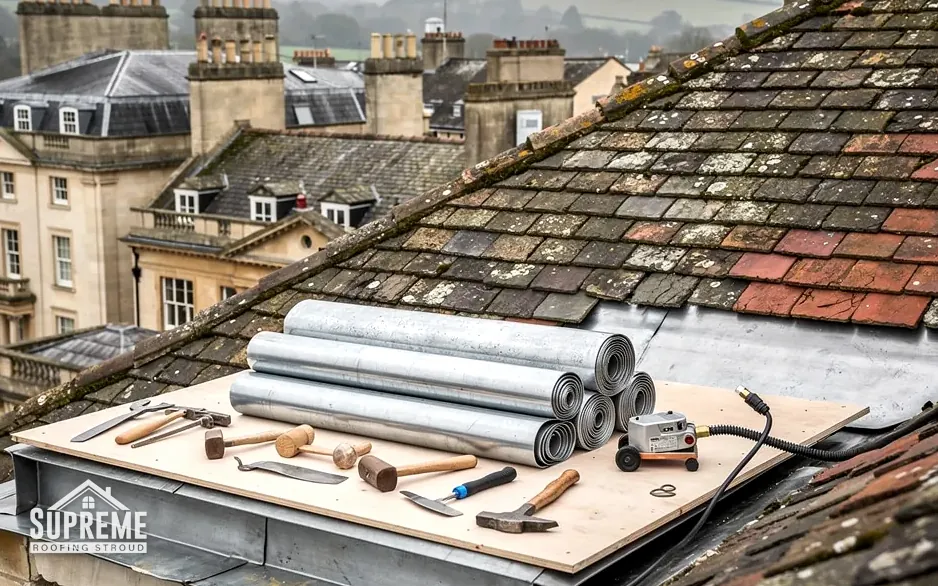
A cottage chimney on a slope is visible from the lane below, and it is exposed on every side. The usual faults are cracked pointing, a loose or broken flaunching and a flashing that has lifted away from the brick. We check each from the roof and photograph it, then recommend the smallest repair that fixes the cause. Our chimney repairs page sets out the options.

Looking after a cottage roof
On older houses we prefer repair to replacement where the structure allows. A handful of slipped tiles, one worn flashing or a renewed section of gutter can extend a roof's life without the expense of stripping it. Our roof repairs page explains how we separate what needs doing now from what can wait.
- 1785year of the new road that drew cottages down from the common
- 1789year of the Thames and Severn Canal and Brimscombe Port
- 1840year a church and school were built for the area
Chapter 03
A Grade II church and a Grade II* wool stove
Two listings, two different levels of protection, and the same rule: check before you price.
Brimscombe's two notable listed buildings sit at different levels of the listing scale. Grade II* ranks above Grade II. Here, the village has one of each: the Church of the Holy Trinity, Grade II, and the former wool stove at Bourne Mills, Grade II*.
In this chapter
Grade does not decide whether a listed building is protected. Stroud District Council explains that protection extends across the entire building, from the outside to the interior and from front to rear. For a roofer, the covering, the structure, the chimneys and even the gutters can all be part of what is protected. Work that affects the building's special character needs consent first, and doing it without consent is an offence.
A wool stove is a mill building, and the one at Bourne Mills is listed at the higher grade. Whatever it is used for now, the roof of such a building is likely to be a significant part of what the listing protects. Anyone managing a building like this should expect to talk to the council before a specification is fixed. A photographed condition survey, with each defect located and described, helps that discussion, and we can supply one.
What counts as a repair
Only the council can say whether a piece of work affects a listed building's character. Replacing a worn element in the same material and form is normally treated differently from changing it, but that is no substitute for asking. A short enquiry with photographs usually settles it, and we help prepare one.
Curtilage buildings
Outbuildings and boundary structures near a listed building can fall within its curtilage, the land and structures that belong with it. The council's advice is to confirm the status of a structure like that with its conservation department before planning any work. A garage roof beside a listed cottage is a good example, since it may need different handling from a garage elsewhere. Our garage roof replacement page covers the work itself.
Myth: A low listing grade means the roof can be changed freely.
Fact: Every grade has full legal protection, so any change that affects character needs consent from the council first.
Why photographs matter on a listed roof
The council can only judge what it can see. Pictures of ridge, verges, eaves and damage, each tied to a marked-up plan, let a conservation officer understand the roof without climbing it. We take them as part of the survey and share them with you so they can go with your enquiry. A clear set often shortens the conversation and avoids a second visit.

Written scope for listed work
For any listed building we write the scope in plain terms: what comes off, what goes back, which materials, and what stays untouched. The written quote follows, covering the whole job, and the finished work is covered by our 10-year workmanship guarantee in writing.
Map showing Brimscombe and the Stroud service radius, with nearby towns we also cover.
Near Brimscombe
Roof work we do here
Brimscombe Port, the wool stove and hillside cottages
Does my house near Brimscombe Port fall inside the Stroud Industrial Heritage Conservation Area?
The Port itself does. The boundary is drawn site by site, so ask Stroud District Council to check your address. We hold off pricing any change of covering until you have its answer.
How do you get materials to a hillside cottage built after the road of 1785?
We look at the lane, the steps and the garden at the survey. Scaffold is stepped to follow the slope, and loads go in by hand where a lorry cannot pass. Carrying time is allowed for in the quote.
Can a Grade II church roof near Brimscombe be repaired without listed building consent?
For a church in worship use, roof work goes through a faculty from the diocese instead. If it has closed, or a chapel has been converted, listed building consent from the council is normally required. Either way, we wait for approval before any price is given.
What do you check first on a large roof at an old mill or canal site?
Drainage. We follow every valley, parapet gutter and downpipe to its outlet, photograph blockages and splits, and report before looking at the covering. Drainage faults often cause the damage that is mistaken for a worn roof.