

Roofers in Bussage
A village named for the edge of a plateau, 5.5 road miles out of Stroud, lying east-south-east of the town, where cottages sit on the high slopes just under the rim and look down on the Toadsmoor and Frome valleys.
Bussage at a glance
- Distance
- 5.5 road miles east-south-east of Stroud
- Council
- Stroud District Council
- Conservation area
- Bussage and Brownshill (no. 40)
- Listed
- Church of St Michael and All Angels, Grade II
Bussage, the village on the rim of the plateau
Bussage was once called Bisridge, and the name comes from the edge of the plateau. The Victoria County History explains that its cottages were usually built on the higher slopes just below the rim of the central plateau, so the village stands on a shoulder of ground between the flat top above and the valleys below. In the geography of the Five Valleys, Bussage looks across to the Toadsmoor and Frome valleys from the upper side.
People have lived here for a long time. Habitation at Bussage is recorded from the mid 13th century. The village is also one of five substantial villages produced by squatter settlement, when weavers and cloth-workers built on the fringes of the commons, and the cottages of that settlement date chiefly from the 18th century. The history notes mullioned windows on them, a sign of their age.
At Bussage, St Michael and All Angels is listed Grade II. Stroud District Council includes Bussage in the conservation area known as Bussage and Brownshill, number 40 on its list of 41.
All of that adds up to a village of small, old houses on sloping ground, with a church and a conservation area to take into account. Our work here starts the same way as anywhere else: we climb up, study the covering and its past repairs, and set out the findings plainly in the report.

Stone terraced houses with slate roofs and chimneys stepping up a hill 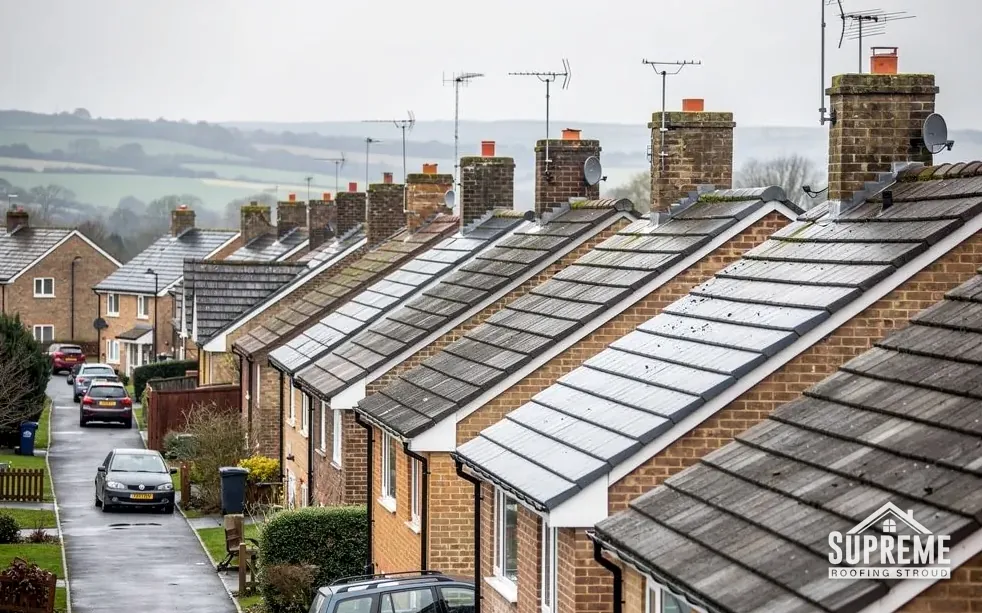
Terraced houses on a hillside street with tiled roofs and brick chimneys
Chapter 01
Living below the rim: eaves, verges and gutters at Bussage
A village named for an edge puts its weight on the edges of its roofs.
Chapter 01In this chapter
Bussage takes its name from the edge of the plateau, and roofs have edges of their own that deserve the same attention. The eaves are the lowest line of the roof, where the covering overhangs the wall and sheds water into the gutter. The verge is the edge at a gable end, where the covering stops. Defects people notice from the lane often begin at one of these two lines, because they are where the roof, the walls and the water all meet.
In this chapter
On a cottage built on a slope, part of the roof edge can usually be seen from the lane or the ground above it. That is useful. A line of slipped tiles at the eaves, a gutter that sags between brackets, or a fascia board that has gone soft shows up from the road. Fascia is the board at the eaves that carries the gutter, and soffit is the underside of the overhang. When either is rotten, water gets into the roof timbers behind it.
Gutters and their falls
Guttering works by a gentle slope towards the outlet. Makers' guidance is a fall of roughly 1:600 to 1:350 towards the outlet, according to the system, with supports spaced no more than 900 mm apart. A run that has settled, so that water stands in the middle, will overflow in heavy rain and stain the wall below. Our guttering, soffits and fascias page gives national price ranges from MyBuilder for the main jobs, and shows what is normally replaced together.
What the roof edge tells us
When we survey, we start at the eaves because they give an early read on the roof as a whole. Tiles that have slipped, battens that have softened and nails that have rusted all show first at the lowest courses. At the verge the question is what holds the covering down. Since BS 5534:2014, ridge, hip and verge fittings are held mechanically as well as with mortar, so an older verge bedded in mortar alone is something we look at closely.
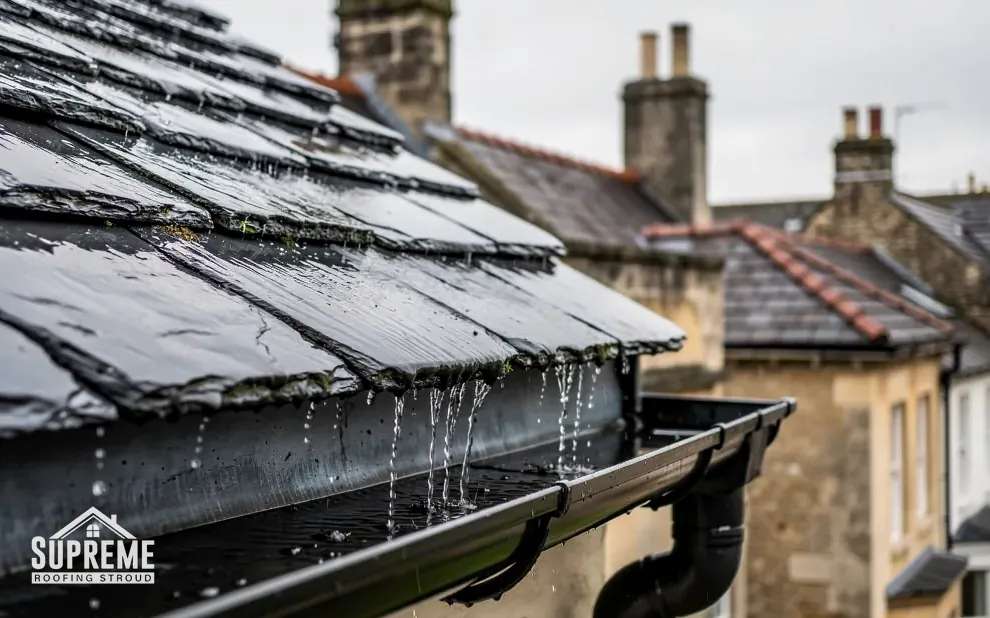
For small repairs, such as re-fixing a few tiles or clearing and re-hanging a length of gutter, roof repairs are quicker and cheaper than a larger job, and the price is set out before any work begins. A typical repair on a pitched roof is listed nationally at £150 to £1,500 on average, according to MyBuilder in 2026, with minor repairs at the lower end. Whether a repair or a larger job is right depends on what the survey finds, not on a standard answer.
Most defects begin where the roof ends.
Chapter 02
Mullioned cottages, c. 18th century: the details around Bussage's openings
Old houses with small windows and thick walls keep their roof problems at the junctions.
Chapter 02In this chapter
The county history records mullioned windows on the commons cottages, and the cottages themselves date chiefly from the 18th century. A mullion is the upright that divides a window into lights. Houses with mullioned windows are usually old, with thick walls and small openings, and the junctions where roof meets wall and chimney meet roof are the places that matter.
In this chapter
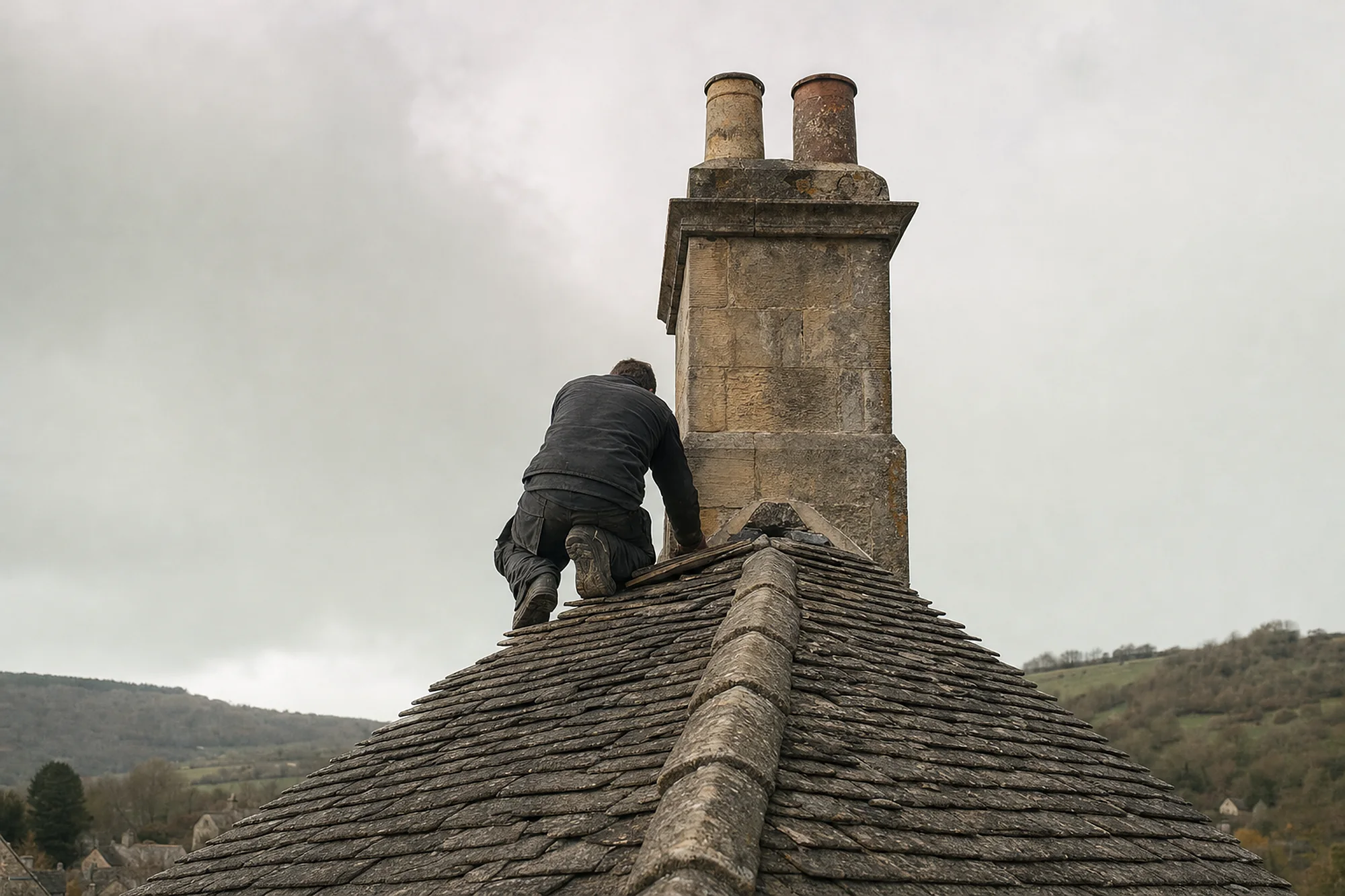
Flashings are the strips of metal, normally lead, that seal those junctions. A stepped flashing follows the slope of a roof where it runs against a wall, and a soaker is a small square of lead set in under each course of slates or tiles. Over time lead cracks, lifts or is pulled away from its groove, and mortar fillets used to seal them fail. We check them from the roof and photograph each one, so the quote reflects what we found.
Chimneys
On a small, old house the chimney stack carries a lot of the character and a lot of the risk. Repointing a stack is a modest job in national terms, averaging about £750 according to MyBuilder in 2026, with a range of £500 to £2,000. A stack with a lean, or one whose mortar has washed out, may need rebuilding. The survey photographs show which.
Windows in the roof
Many owners of small cottages want more light in the loft. A roof window is a different matter from a dormer: a dormer is a built-out structure and is not permitted development in a conservation area, while a roof window has its own rules. Bussage and Brownshill is a conservation area, so any change needs checking with Stroud District Council's planning team. Our skylights section gives the planning guide, and also the glazing standards such windows have to meet.

Thick walls and what they hide
A thick stone wall holds a lot of water. When a gutter overflows or a flashing fails, the wall can absorb that water for a long time before it shows. The first sign is often a patch of damp plaster on the inside, well below the actual fault. We look for the entry point on the roof, not just the stain, and we describe the route the water takes. That matters because mending the stain does nothing for the cause.
Because the village's cottages differ from one another, the report we write is individual too. It names the material we found, shows each fault in a photograph, and covers each repair, leaving you free to pick the repairs that cannot wait and defer the rest.
| Term | What it means |
|---|---|
| Flashing | Metal strip that seals a roof where it abuts masonry |
| Soaker | Small lead piece worked in with each course at an abutment |
| Valley | Inner angle between two sloping surfaces |
| Flaunching | Sloping mortar cap round the chimney pots |
Chapter 03
St Michael and All Angels and the Bussage and Brownshill conservation area
A Grade II church and a numbered conservation area frame what can change on the street.
Chapter 03In this chapter
Historic England's list entry 1091213 records St Michael and All Angels at Bussage as Grade II. While a church is in use, it sits outside the council's consent system, and its roof work needs a faculty from the diocese. That route does not apply to a house, a barn or a converted chapel, which would need listed building consent from the council if they are listed.
In this chapter
Stroud District Council's conservation area for the village is Bussage and Brownshill, number 40, first designated in September 1991 and unchanged in boundary since. Our approach follows from that designation. If a roof is being renewed in the same material and pattern, that is normally straightforward. If you are thinking of a different covering, a chimney alteration or a new roof window, the planning team should hear about it first, and we will wait for their answer.
Listed status next door
Stroud District Council says listing covers an entire building, whatever its grade. A house beside the church does not inherit that; each building has its own status. We look up your address on the register instead of guessing from the neighbours.
Looking after an old roof between visits
Between jobs, there are simple things an owner can do. Glance up at the roof from the lane after a storm for slipped tiles or slates. Check that gutters are clear at the outlets, and look at the loft in daylight for any chinks of light or damp patches. A photograph with a date on it is worth keeping; it shows what has changed and when. If you send us one, through WhatsApp or the enquiry form, we can say whether it needs a visit.
What the written quote contains
After the survey, our written quote covers the whole job, from scaffold and stripping through to waste and making good. We take the waste away and leave the site clear, and nothing is left on the lane or in the garden for you to deal with. The work carries a 10-year workmanship guarantee in writing. Where Building Regulations notification applies, we talk you through it and make the notification ourselves. The Planning Portal sets the thresholds at less than 25 per cent of the building envelope and less than 50 per cent of the roof.

Unsure whether your house lies inside the Bussage and Brownshill boundary? Send the address and we will check it against the council's list before the survey.
Map showing Bussage and the Stroud service radius, with nearby towns we also cover.
Near Bussage
Roof work we do here
Bussage and Brownshill mullioned cottages under the rim
Why do roof edges matter so much on an old Bussage cottage?
The eaves and verge are where water, wall and covering meet, and they fail first. Slipped courses, a soft fascia or an overflowing gutter all show from the lane, which makes the edge a good place to begin a survey.
Is a mullioned cottage in Bussage harder to roof than a plain house?
The roof itself may not be, but the junctions are fussier. Small openings, thick walls and old chimneys mean more flashings and more careful detailing. We photograph each one and quote for the repair.
Can I add a roof window to my cottage in the Bussage and Brownshill conservation area?
Possibly, but check first. Roof windows are treated differently from dormers, which are not permitted development in a conservation area. Our skylights section has the full planning guide, and Stroud District Council's planning team has the final say.
What if my Bussage roof has damp showing well below the actual leak?
Thick walls soak up water and carry it a long way. We trace the entry point on the roof, whether a flashing, a gutter or a stack, and explain the route, so the repair deals with the cause rather than the stain.