
Roofers in Barnwood
Roof work on Gloucester's eastern side, where a Roman road village became a suburb, a hospital's grounds became an arboretum and an office quarter went up, with cost guides published before we call.
Barnwood at a glance
- Distance
- 9.4 road miles north of Stroud
- Council
- Gloucester City Council
- Parish church
- St Lawrence
- Setting
- Eastern Gloucester, on the Roman road towards Cirencester
Barnwood's roofs: a Roman road village, a hospital site and an office quarter
Barnwood lies on the eastern side of Gloucester, 9.4 road miles north of Stroud, and Wikipedia records that it began as a small village on a Roman road linking Gloucester with Hucclecote, Brockworth and Cirencester, and the parish church is dedicated to St Lawrence. The parish was abolished on 1 April 1966, its area passing to Gloucester, Hucclecote and Upton St Leonards, so the council is Gloucester City Council.
Two later changes shaped the ground. Barnwood House Hospital closed in 1968 and was demolished in 2000, and Barnwood Arboretum now occupies its grounds. In the early 1970s the Central Electricity Generating Board's Generation Design and Construction Division moved to Barnwood and became the centre of a new office development, which later housed Nuclear Electric and British Energy.
That mix gives the suburb three roofing questions that you would not ask in a purely residential estate: how an old village centre and its church are treated, how trees near a roof change the maintenance, and how a commercial office roof of the 1970s is surveyed and replaced. Which designations apply in Barnwood is for the council to confirm. If you are unsure whether your own street is protected, ask the council's planning team before any change of material, because we would rather you hear it from them than from us.

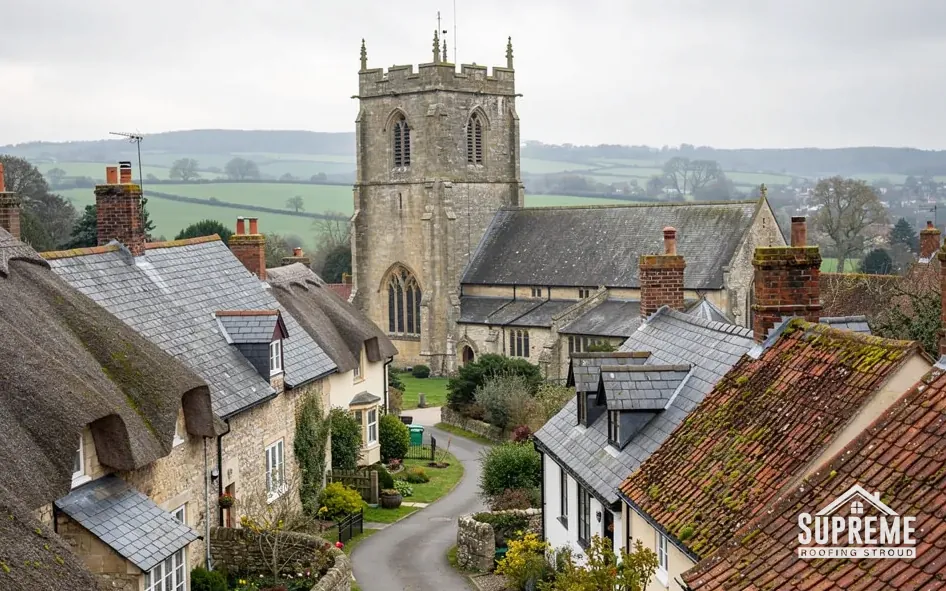
Street of stone terraced houses with slate and clay tile roofs 
Row of stone cottages with mossy clay tile roofs along a quiet lane

Chapter 01
The Roman road village and the roof of St Lawrence
A parish church has its own permission route, and an old village has older roofs.
Chapter 01In this chapter
A settlement that began beside a Roman road has been rebuilt many times, and Barnwood's village centre will hold buildings from several periods. We do not know which individual houses are old, and we do not assume it; the roof tells us when we look at it. What an old village generally brings is a mix: an early building with a heavy roof frame, a Victorian extension on one side, a flat-roofed addition from the last fifty years on the other. Each section needs its own judgement, and we assess them in turn. A flat addition against an old wall needs its own flashing and its own falls, while the older roof beside it may need no more than re-pegging, re-fixing or local repair. Seeing the whole house, front to back and loft to eaves, is what makes a quote reliable.
In this chapter
The parish church is dedicated to St Lawrence, and Barnwood's parish itself was abolished in the twentieth century, with its land passing to three places. Historic England lists it at Grade II*: a twelfth-century nave, a thirteenth-century chancel and north aisle, and a sixteenth-century tower, restored in the late nineteenth century. How permission works for churches in general is clearer. Where a church still holds services, the ecclesiastical exemption applies and it sits outside the council's listed building consent system; a faculty from the diocese authorises its roof work instead. Once services stop, or a chapel is converted to another use, the exemption goes, and the council's own consent is what you would normally apply for.
Whoever is responsible for the church, the sequence we suggest is the same. Ask the diocese what is needed. Have the roof surveyed, with photographs of the gutters, valleys, lead and stonework, so that the faculty application has evidence behind it. Then collect written quotes, which makes the comparison honest: scaffold, covering, lead, labour and waste should all be covered.
Old buildings along the road
For ordinary houses on the old road frontage, the rule is simple. If the house is listed, ask the council before changing the roof covering. If it is not, a like-for-like re-roof seldom needs planning permission, though the Building Regulations still apply: approval is not normally needed under 25% of the building envelope and 50% of the roof, and a covering that is 15% or more heavier needs a structural check.
Where a roof has been altered several times, we try to find the line of the original, which means the ridge height, the verge and the eaves. Our roof repairs page explains what we repair and where a repair stops being sensible.
For a church in use the permission comes from the diocese; for a closed one it comes from the council.
Chapter 02
Barnwood Arboretum, mature trees and the maintenance they bring
Barnwood House Hospital's grounds are now an arboretum, and trees near roofs mean seasonal work.
Chapter 02In this chapter
Barnwood House Hospital closed in 1968 and was demolished in 2000. Barnwood Arboretum now occupies its grounds. We do not claim that any particular street is shaded by it. The general point is one every roofer knows: a house near large trees needs a different maintenance routine from a house in open ground.
In this chapter
Leaves are the main one, and in autumn they arrive faster than most owners expect. They collect in gutters, block outlets and pile up in valleys, and a gutter that cannot drain will overflow down the wall or back up under the lowest tiles. A blocked gutter is a common cause of damp on an outside wall, and clearing it costs far less than the repair that follows. Moss is the second: a roof in shade stays damp longer, and moss holds water against the covering. Branches that overhang can rub on tiles or drop debris, and a tree that has outgrown its place is a matter for the owner and the council's tree officer, not for us.
MyBuilder (updated 21 August 2026) puts roof cleaning for a pitched roof at £450 to £850, a slate roof at £500 to £1,000 and a tile roof at £400 to £750. Manual scraping costs £5 to £10 per m², soft wash £15 to £20 and pressure wash £10 to £15, and the same guide cautions that pressure washing can harm delicate tiles. Our own preference on an older roof is to scrape or soft wash first and look at the covering underneath before deciding anything else.
Gutters and fascias close to trees
Gutter makers recommend a slight slope towards the outlet, somewhere from about 1:600 to 1:350 depending on which system is fitted. The brackets also have to be set close enough to carry the extra weight of wet leaves, which is easy to forget when a gutter is first hung. On a house with leaf fall, a gutter guard can help, but it is no substitute for a look from a ladder once or twice a year. Our roof cleaning and moss removal page explains when cleaning is worthwhile and when it only delays a repair.
If you live near the arboretum, an annual check of gutters after leaf fall is the least costly roof upkeep there is. A gutter that overflows all winter without anyone noticing is how a small job becomes a larger one.
For a house under trees, the least costly upkeep is a gutter check each year after leaf fall.
- Tile roof clean£400 to £750
- Pitched roof clean£450 to £850
- Slate roof clean£500 to £1,000
- Manual scraping, per m²£5 to £10
Chapter 03
The early-1970s office quarter and its flat roofs
A commercial roof from that decade is a survey, a specification and a programme, not a quick repair.
Chapter 03In this chapter
In the early 1970s the CEGB's Generation Design and Construction Division moved to Barnwood and became the centre of a new office development, later housing Nuclear Electric and British Energy. Some of those buildings may since have changed use or been re-covered. We mention them because offices of that generation commonly have flat or shallow roofs over wide floors, and the owners and managing agents of such buildings need a different approach from a homeowner.
In this chapter
Fifty years is longer than any flat roof covering is quoted to last. Flat roofs generally last 15 to 30 years (MyBuilder). EPDM is put at 20 to 30 years or more, GRP at 25 to 40 and built-up felt at 10 to 20, with the sources disagreeing at the margins. A roof of that age has therefore been re-covered at least once or is overdue, and the work often meets old layers: insulation that has absorbed water, upstands that have been patched, and outlets that were not designed for today's coverings.
The survey comes first. We look at the deck, the falls (a flat roof is designed for 1:40 under BS 6229, to give a finished fall of 1:80), the outlets and the edges. Where a roof dates from the early 1970s, asbestos cement or other older materials may be present, so a survey comes before anyone disturbs them, and the findings are written down for the building's owner and for whoever manages the site. On a commercial roof the records matter as much as the repair, because the next contractor will want to know what lies under the covering. Whole sheets of asbestos cement can be taken down with care as non-licensed work under HSE guidance, while broken-up material is a matter for notification to the enforcing authority.
What a flat roof costs per square metre
MyBuilder's national per m² ranges are set out in the table. A commercial quote adds scaffold, access, insulation to the standard in Part L, and sometimes work out of hours, so the total depends on the building. Our commercial roofing page describes the survey and quoting of a larger roof, and our flat roofing page covers the coverings in detail.
If you manage an office or a unit in Barnwood, give us the building's address and a photo of the roof edge, and we will say what needs surveying first.
| Flat covering | Typical cost per m² |
|---|---|
| Bitumen felt | £70 to £100 |
| EPDM | £90 to £130 |
| GRP | £95 to £150 |
| PVC single-ply | £95 to £140 |
Map showing Barnwood and the Stroud service radius, with nearby towns we also cover.
Near Barnwood
Roof work we do here
St Lawrence, the arboretum and Barnwood offices
St Lawrence is Barnwood's parish church. Who would sign off work on a church roof like that?
For a church that holds services, the diocese through a faculty, because the ecclesiastical exemption takes it outside the council's listed building consent. A closed or converted building is treated differently and normally needs the council's consent. St Lawrence is a Grade II* Church of England parish church, so its roof work goes through the Diocese of Gloucester.
My Barnwood house has big trees nearby and moss on the roof. Should I scrape it off?
Scraping or soft washing is usually gentler than pressure washing, which may damage delicate tiles. We look at the covering first, because moss can be hiding loose or cracked tiles. A gutter clear-out after leaf fall is the more urgent task.
Does a 1970s office building in Barnwood need a survey before a new flat roof?
Yes. We check the deck, the falls, the outlets and the insulation, and we look for older materials such as asbestos cement before anything is disturbed. The quote then covers every layer and the access it needs.
Is Barnwood in Gloucester City or somewhere else for building control?
Gloucester City Council. Its building control is delivered with Stroud District through the Gloucestershire Building Control Partnership, and a registered building control approver is the private route.