

Roofers in Upton St Leonards
A village at the foot of the Cotswold edge, 7.5 road miles north of Stroud and a mile north of the A46, where Victorian benefactions, a former hall estate and a 21st-century development sit within the same parish.
Upton St Leonards at a glance
- Distance
- 7.5 road miles north of Stroud
- Council
- Stroud District Council
- Setting
- Foot of the Cotswold edge, north of the A46
- Conservation area
- Not on Stroud District Council's list
Upton St Leonards: Lady Downe's school, the Birchalls' hall and Coopers Edge
Upton St Leonards lies a mile or so north of the A46 road between Stroud and Cheltenham, at the foot of the Cotswold edge on the south-east side of Gloucester. It is a sizeable village, with 3,174 people at the 2021 count.
The parish council dates the settlement to probably the late 10th century, and says the Church of St Leonard dates from 1190 and has been modified considerably since. A church that has been modified over eight centuries has a roof history of its own, though nothing here is advice on that church.
Two names stand out in the village's later story. The Old School, funded by Lady Downe, was built in 1845 of local stone. The Birchall family lived at Bowden Hall until 1925, building the Birchall Memorial Institute in 1898 and the Village Hall in 1920. Bowden Hall is now a hotel. These are the larger, community-scale buildings of the village, and they come with larger, more complicated roofs than a cottage does. Each has an owner or a committee to answer to, so the written report counts for nearly as much as the repair.
Newest of all is Coopers Edge, built from 2006 on the former Gloster Aircraft Company factory and airfield at Brockworth, which forms part of the village's 21st-century development, with parts of it falling within Upton. So in a single parish we have a medieval church, Victorian and Edwardian public buildings, and modern housing, and each needs a different kind of attention.
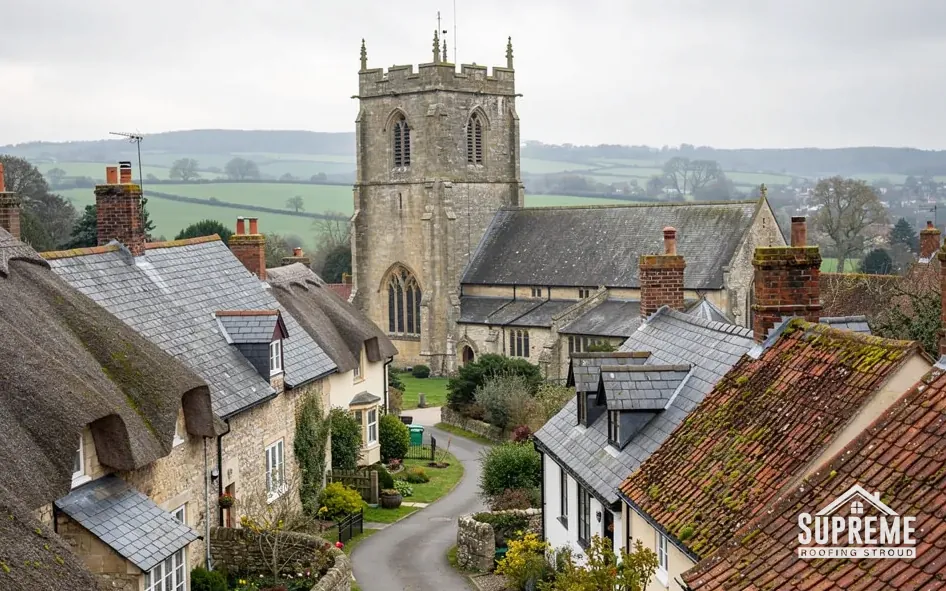
Village of thatched and tiled cottages around a stone church tower 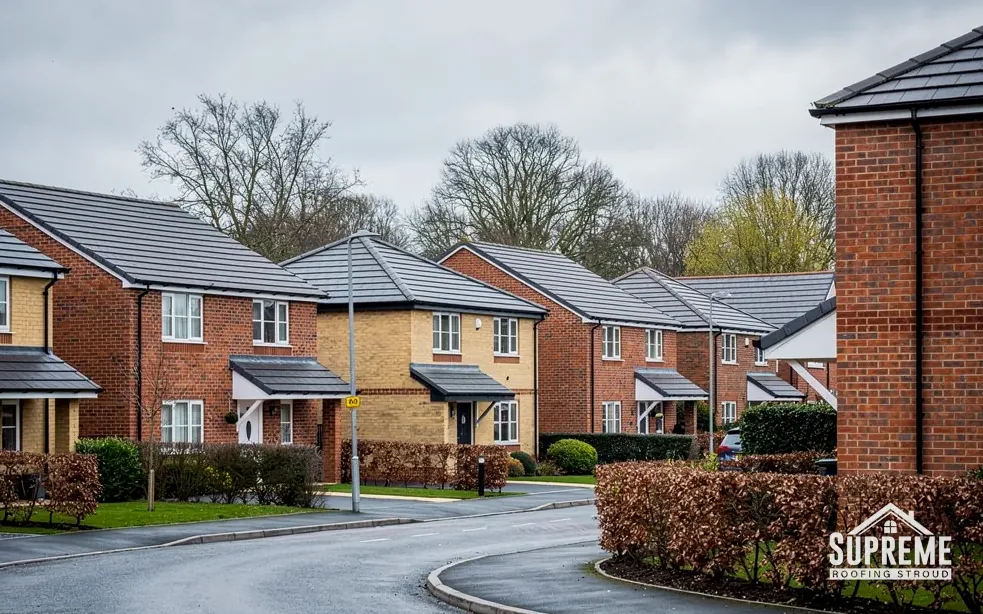
Modern brick housing estate with grey tiled roofs along a curving road

Chapter 01
Bowden Hall, the Birchall Institute and the village hall roofs
Public and hospitality buildings carry bigger spans, flat sections and more people underneath.
Chapter 01In this chapter
The Birchall family left a visible mark on Upton St Leonards. They lived at Bowden Hall until 1925, built the Birchall Memorial Institute in 1898 and the Village Hall in 1920, and the hall itself is now a hotel. That gives the village a set of buildings that are not houses. A village hall, an institute and a hotel share a few roofing characteristics: larger spans, more rainwater to carry, more valleys and a more complicated drainage layout than a typical home.
In this chapter
A building like that often combines several roof types. A pitched main roof may run into a flat-topped kitchen, a porch or a link block, and every part ages at its own rate. A flat roof covered in EPDM, a synthetic rubber sheet, typically lasts 20 to 30 years or more, according to GreenSpec, while built-up felt may last 10 to 20 years (Less). Those are typical ranges, not promises, and the best guide to a particular roof is the survey. Our flat roofing page lists the main coverings, with their typical costs from national guides and the sources named.
Working above people
Where the room below is occupied, the sequence of work is arranged around whoever is inside. We agree access, the timing of noisy work and where the scaffold and its walkways will stand, and we make the roof watertight at the end of each day. That makes the job a planning exercise as much as a roofing one. Our commercial roofing page explains how we handle larger and public buildings.
Gutters and valleys on big roofs
A large roof gathers a lot of water and delivers it to a few points. Valley gutters, parapet gutters and the downpipes beneath them are where failures start, and a blocked outlet can send a surprising amount of water in the wrong direction. A survey begins by following each drain down from the roof and photographing every outlet. If the drainage is sound, that is reported too. For a committee or a hotel manager, a clear photographic record is useful when deciding what to do first, and it can be passed to trustees, an insurer or a surveyor without anyone needing to climb up to check.

The same record helps with budgeting. A trustee looking after a hall can see which repairs are urgent, which can wait a season, and which are best bundled with other work so the scaffold is paid for once.
The bigger the roof, the fewer places the water can go.
- 1898year the Birchall Memorial Institute was built
- 1920year the Village Hall was built
- 1925year the Birchall family's time at Bowden Hall ended
Chapter 02
Coopers Edge: newer roofs on the old Gloster airfield
Modern houses have their own roof questions, and age is not the only one.
Chapter 02In this chapter
Coopers Edge stands on the old Gloster Aircraft Company site, where about 1,900 homes were planned across Brockworth, Upton St Leonards and Hucclecote parishes, and the parish council describes it as part of the village's 21st-century development, with parts of it falling within Upton. A roof on a house built in the last few decades is a different subject from a 200-year-old cottage roof. It is lighter, built to a modern specification, and covered in whatever the developer specified, which we confirm on the roof rather than assume.
In this chapter
That does not mean it needs no attention. On a newer roof we begin with the fixings. Since BS 5534:2014, ridge, hip and verge tiles have been fixed mechanically as well as bedded, and BS 8612 covers the testing of dry-fix systems. A house built before those standards may have ridge tiles held by mortar alone, and mortar cracks as the roof moves with the seasons. Re-bedding a ridge, or replacing it with a dry-fix system, is a common maintenance job. National guides put dry ridge at £40 to £60 per metre (MyBuilder, 2026). Our ridge, verge and dry-fix page describes both approaches and their costs.
Underlay, valleys and small details
Under the covering sits the underlay, the waterproof sheet that catches what gets past the tiles. On a modern roof it is normally a breathable membrane, and it can tear where it is poorly lapped or damaged. Valleys are lined with lead or GRP, glass-reinforced plastic, and a modern roof can have several where one wing of the house joins another, each needing its own lining and edge detail. A small tear or a lifted flashing is a repair, not a reason to re-roof, and we price it that way.
Fascias, soffits and the plastic parts
The fascia, soffit and gutters on a newer house may well be uPVC. MyBuilder's 2026 guide has uPVC fascias and soffits typically replaced after 10 to 20 years, with an inspection every five, though other sources give longer lives. Much of the cost of replacing them is scaffold and labour, so replacing the whole run at once is usually better value than doing it a section at a time.
Myth: A roof built this century can be left alone.
Fact: Modern roofs have small weak points of their own: ridge fixings, underlay laps, valley liners and plastic edge boards. A survey checks each of them.
The question of warranties
A newer roof may still be covered by a builder's warranty or a manufacturer guarantee. We cannot judge your cover from here, so it is worth checking before work begins. Our own work carries a 10-year workmanship guarantee in writing.
Chapter 03
The 1845 Old School, St Leonard's church and a village outside any conservation area
Local stone, a 1190 church and no conservation area: the rules here are lighter, but not absent.
Chapter 03In this chapter
The Old School at Upton St Leonards was funded by Lady Downe and built in 1845 of local stone, according to the parish council. It is one of the village's clearest links with the Victorian period. The Church of St Leonard, which the parish dates to 1190 and which has been modified considerably since, is older by six centuries.
In this chapter
Stroud District Council's list of conservation areas does not include Upton St Leonards. That makes planning a little more straightforward than in some of the district's villages, because the extra layer of control that a conservation area brings does not apply. Putting the same material back on a roof is usually outside planning control, as the building looks just as it did. A listed building is a different matter, wherever it stands: listing protects the whole building, and alterations touching its special character need consent. We check the status of your address rather than assume. The church follows its own route, because a church still in use gets its roof work approved by a faculty from the diocese.

What stone means for a roof
Stone walls like the Old School's are thick, and at the junction with a roof they need good flashings. Lead is the usual material. Its thickness is given by a code, and Code 4 is the common choice for general flashing, according to Leadworx. A typical national price for lead flashing repairs is £50 to £70 per metre, Code 5, excluding VAT (Checkatrade, 2026). Our lead roofing page gives the codes and costs.
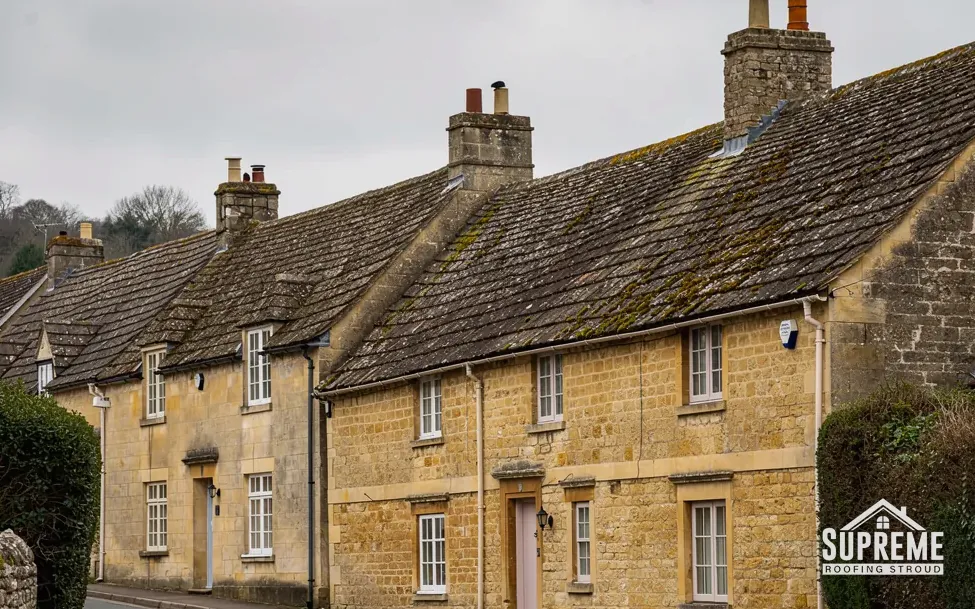
A village that keeps itself tidy
Upton St Leonards has won the Bledisloe Cup for Best Kept Village in Gloucestershire, large village category, more than 20 times. A roofing job in a place that takes pride in its appearance has to leave the street as it found it. We cover the scaffold properly, keep skips and deliveries tidy, remove the waste and leave the ground clear when we finish.
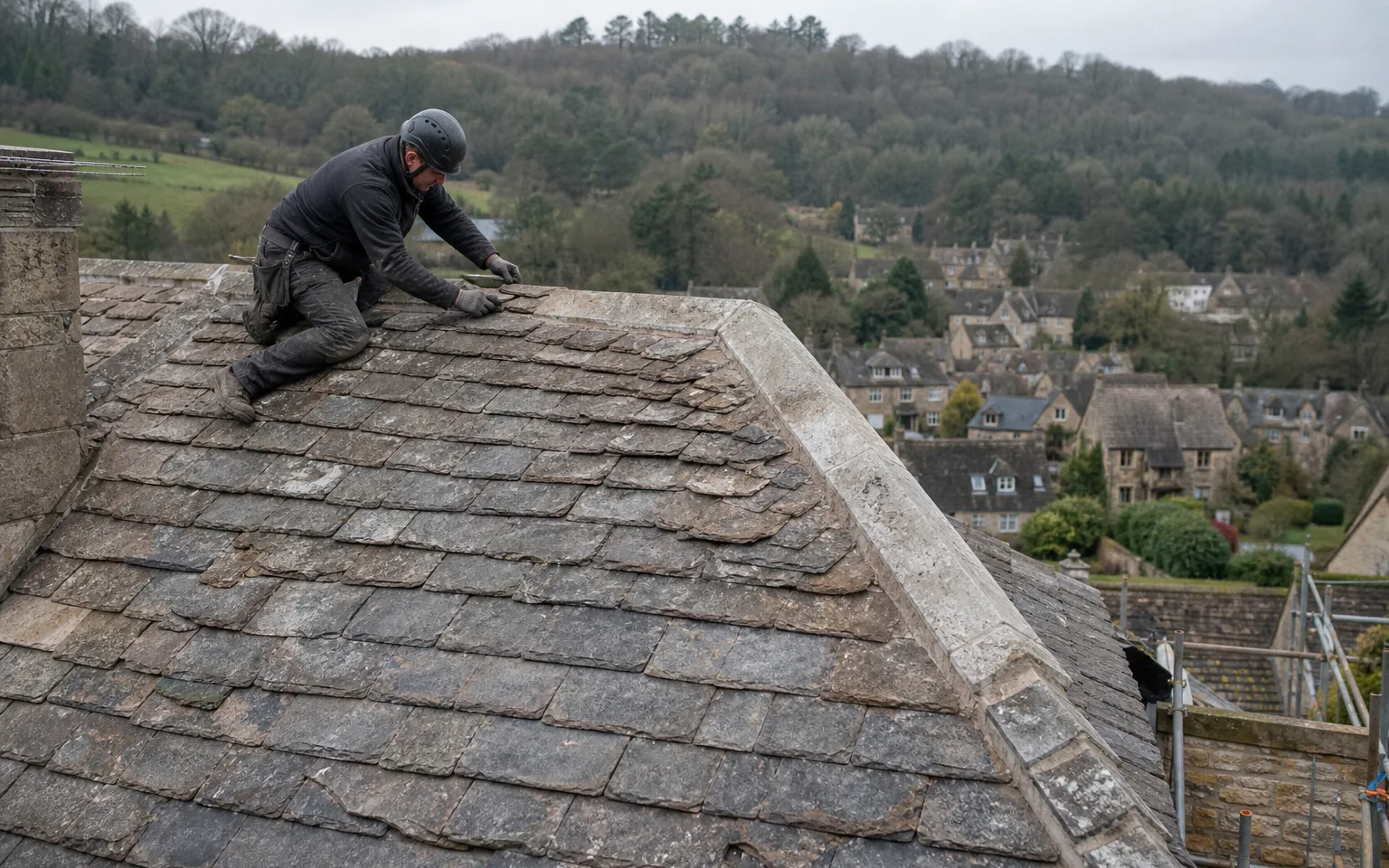
Putting your own roof on the table
If you are in Upton St Leonards and want a view on your roof, send photographs of it from the ground by WhatsApp or the enquiry form. Say whether it is a house, a hall or an outbuilding, and tell us anything you know about previous repairs. You will hear what the pictures show and what must be checked on site, and a photographed survey comes ahead of any quote.
Map showing Upton St Leonards and the Stroud service radius, with nearby towns we also cover.
Near Upton St Leonards
Roof work we do here
Roofs from Coopers Edge to the village hall
Our village hall roof has a flat section joined to a pitched main roof. How is the junction repaired?
We look at the abutment first: the flashing, the upstand of the flat covering and the gutter beneath. A failed junction is usually repaired in place, with new lead or membrane upstands, rather than by renewing either roof.
Why would the ridge need attention on a newer house at Coopers Edge?
A ridge on a newer house can look sound and still be held by little more than old mortar. Looking at the bedding and the fixings takes little time, and a loose ridge is cheaper to fix than a fallen one.
Upton St Leonards has no conservation area. Does that mean I can change my roof freely?
Not entirely. Like-for-like work is normally straightforward, but a listed building still needs consent, and changes to the appearance of a roof can need permission. Ask Stroud District Council's planning team before anything beyond a repair in kind.
Does a hotel or hall roof need a different survey from a house?
Our method does not change, but the scope grows: more outlets, more junctions and an access plan that has to fit around the people using the building. We tell you what we looked at and how we reached it.