
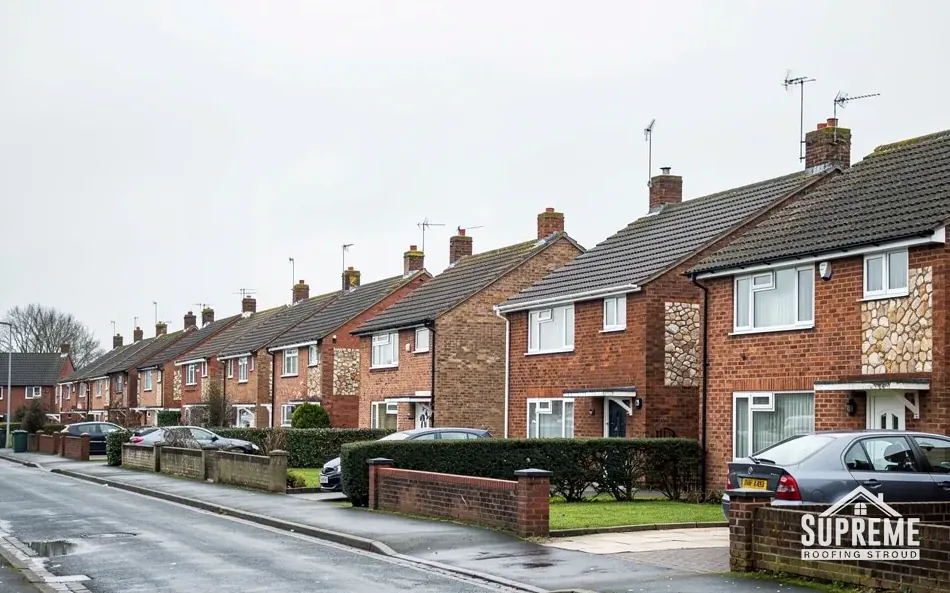
Roofers in Shurdington
Roofing for Shurdington, a small parish on the A46 south of Cheltenham, with a Grade II* church and an edge that has moved more than once. The drive from Stroud is 10.5 road miles, heading north-north-east.
Shurdington at a glance
- Distance
- 10.5 road miles north-north-east of Stroud
- Council
- Tewkesbury Borough Council
- Listed
- Church of St Paul, Grade II*
- Setting
- South of Cheltenham on the A46
Shurdington's roofs: a chapelry, a church and a moving boundary
Shurdington lies south of Cheltenham on the A46. For much of its recorded past it hung off the ancient parish of Badgeworth as a chapelry, a small place with its own chapel but a larger parish behind it. The 1870-72 Imperial Gazetteer, quoted by the Parishmouse family history guide, gave it 164 people living in 37 houses and described its church as 'early English'. Today the Church of St Paul is listed Grade II*, and it is the one building here that history has marked out for particular care.
The edge of the parish has shifted too. Up Hatherley used to be a hamlet in Shurdington parish, and when it joined Cheltenham in 1991, part of its parish was transferred to Shurdington. For a roof that matters in a very ordinary way: two councils sit close together here, and the answer to a planning question depends on which side of the line the house falls.
What covers the roofs in Shurdington varies from house to house, so the survey starts by reading the covering on your own roof rather than assuming one. What the record does give us is a village with a small and old core, a historic church, and later building around it. That is a mix we meet often in the villages north of Stroud, and it is why the same street can need three different methods. So the first job on any Shurdington survey is to establish the age and the covering of the roof in front of us, from the loft and from photographs, and only then to recommend a repair or a replacement.
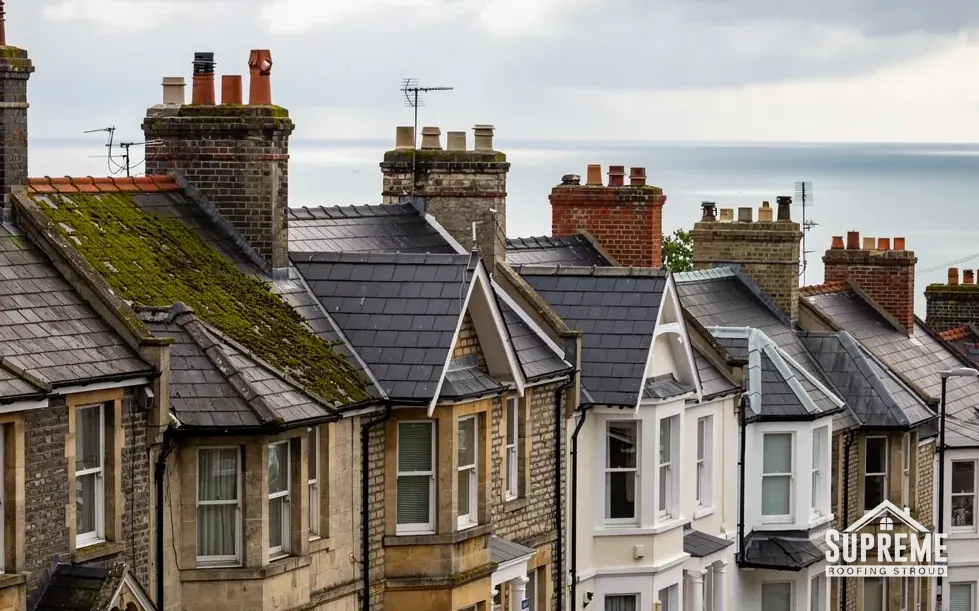
Row of Victorian terraced houses with slate roofs, bay windows and brick chimneys 
Street of stone terraced houses with slate and clay tile roofs

Chapter 01
Thirty-seven houses and the problem of dating a roof
In a village with thin records, the roof has to tell us its own story.
Chapter 01In this chapter
When the Imperial Gazetteer counted Shurdington in 1870-72, it found 37 houses. Any of those homes still standing are more than a hundred years old, and other buildings arrived around them later. How any given Shurdington house is roofed varies, so we read the covering on site and assume nothing. A good survey establishes the facts from the building itself.
In this chapter
The loft is where the evidence is. We look at the rafters and the battens for signs of an earlier covering, at the nails and fixings for rust, at the underlay, if there is one, and at the timber for dampness or old beetle damage. A roof that has been stripped and re-covered before often shows two generations of battens, and that history tells us how much sound timber is left to reuse. From outside we photograph each slope, the ridge, the gable edges and the joins with chimneys, and the same pictures travel with the written quote.
Photographs matter because a roof is hard to judge from the ground. Standing in the lane, you cannot see the state of the battens, and neighbouring houses can hide quite different faults beneath similar-looking slopes. Anyone reading a written quote should be able to see for themselves what it covers. Our roof inspections and surveys page describes what the report contains. Standard inspections run at £150 to £250 nationally, according to MyBuilder's 2026 price guide, and we explain what a visit will cost before it is booked.
Why age changes the repair
An older roof is not automatically a worse one. A roof that is well over a century old may need only new fixings, a few replaced units and sound flashings, while a younger roof with poor workmanship may need much more. What matters is how the original was built and what has happened since. Swapping to a covering around 15 per cent heavier or more brings in building control approval and a structural check, which is one more reason to identify the existing covering before an order goes in.
Keeping the village roofline
Where neighbouring roofs share a material, we try to keep the street looking as it does now. On older houses we begin from the principle of like for like, and the covering that comes off is the covering that goes back. Changing the material is your decision to make once the quote sets the options side by side, never a side effect of what happened to be on the lorry.

From the lane, two roofs can match and still hide different problems.
- 164people recorded in Shurdington in the 1870-72 Imperial Gazetteer
- 37houses recorded in the same entry
- 1991year part of Up Hatherley's parish was transferred to Shurdington
Chapter 02
St Paul's and the permission a church roof needs
A Grade II* church in use follows the diocese's rules, not the council's.
Chapter 02In this chapter
The Church of St Paul is listed Grade II*, and the Gazetteer called it 'early English', a style of medieval building. Historic England's list entry dates it to the early fourteenth and fifteenth centuries, restored and extended in 1852, and it stands in a familiar position: a church at the centre of a small parish, whose roof has to stay watertight week after week for services, weddings and funerals, and whose gutters and downpipes have to carry water well clear of old walls.
In this chapter
Because St Paul's remains in use for worship, it sits under the ecclesiastical exemption, and as a Church of England building it needs a faculty, not listed building consent. The permission comes from the diocese's own court. A diocesan committee advises on each application, and the Chancellor is the one who grants it. In practical terms, a roofer working on a church roof prepares a specification that can be read by that committee, with photographs, the extent of the work and the materials, and does not start until the permission is in place.
Church roofs often involve lead. It is used at the valleys between roofs, the parapets, the gutters behind them, and the flashings where a tower or porch meets the main roof. Lead is sold in codes that describe thickness, and the code chosen depends on the job. Leadworx calls Code 4 the usual pick for everyday flashings, while heavier codes go where the lead faces more weather or foot traffic. Two terms are worth knowing. Flashing is the metal strip that closes the joint between roof and wall, and a soaker is a short lead piece worked into the courses beside a chimney or wall. If you manage a church, our lead roofing page explains the codes in more detail.
Specifying a church roof
The sensible order for a parish is to have the roof surveyed, ask for the findings in writing, and take that report to the diocese. We can prepare a schedule that names each defect and each proposed repair, so that the committee and the parochial church council see the same findings.
Scaffold and access
A church roof is usually high and steep, and a tower may need its own access. Scaffold is a major share of the cost on that kind of job, so we allow for it and say what it covers. Where a lower level of access can do the work safely, we tell you that as well.
| Code | Thickness | Common use |
|---|---|---|
| Code 3 | 1.32 mm | Soakers |
| Code 4 | 1.80 mm | General flashing work |
| Code 5 | 2.24 mm | Flashings and pitched valley gutters |
| Code 6 | 2.65 mm | Larger roofs |
Chapter 03
The A46 frontage and the Cheltenham line
Houses by a main road need a plan for the pavement, and the parish edge decides who to ask.
Chapter 03In this chapter
Shurdington's setting is simple to describe: it lies south of Cheltenham on the A46. For a roof, the main road matters before a single tile is lifted. A house that fronts a main route has traffic going by, pavement users beneath the scaffold, and limited room for a delivery. If the scaffold will occupy the pavement, the highway authority must issue a licence first, and we apply as soon as you and we have agreed a start date. We also plan deliveries around the road, not just the roof, and we put the access arrangement in writing with the quote.
The second local point is the boundary. When Up Hatherley joined Cheltenham in 1991, part of its parish passed to Shurdington. That means houses that look like part of the same suburb can answer to different councils. Shurdington is in Tewkesbury Borough, and Cheltenham Borough Council is next door. Both are served by Cheltenham and Tewkesbury Building Control, so a Building Regulations notification goes the same way on either side of the line, but planning questions go to whichever council covers the address. We check before we advise, and we tell you who to ask.
If your house is listed, the rules are tighter again. Listed building consent is a matter for the council that covers the property, and the grade does not change that. The Planning Portal gives the starting thresholds for a re-roof that does not need building control approval: less than 25 per cent of the building envelope and less than 50 per cent of the roof. Go beyond either figure and approval applies, and the roof may then need a thermal upgrade as well.
Small jobs near a busy road
For a slipped tile or a failed section of flashing, scaffold may cost more than the repair. In those cases we look at a tower, a roof ladder, or a platform from the garden side. Our roof repairs page explains how we treat leaks, storm damage and small defects. If water is coming in, the first visit stops that, and the lasting repair is planned once the roof is dry.
Gutters and the wet side of a road
A frontage that faces a main road gets spray and dirt from traffic, and gutters and fascias there tend to collect it. A yearly clear of the gutters, with a look at the joints and brackets, is cheaper than the damp it prevents. Brackets on straight runs are normally spaced at no more than 500 mm for the small-building system FloPlast describes, and we check that nothing has sagged.
Myth: If the house is on the Cheltenham side of the line, Cheltenham Borough Council handles every roof question.
Fact: Planning follows the address, so we check which council covers the house; Cheltenham and Tewkesbury Building Control serves both.
Map showing Shurdington and the Stroud service radius, with nearby towns we also cover.
Near Shurdington
Roof work we do here
St Paul's, the A46 and the Up Hatherley boundary
How do you decide what covers a Shurdington roof when nothing records it?
We read the roof itself. The loft shows the battens, fixings and timber, the slopes show the covering, and photographs of both are attached to the quote, so everything in it points at something you can see.
St Paul's is Grade II*. Who authorises roof work on it?
While it is a place of worship, St Paul's is exempt from listed building consent, and the permission is a faculty from the diocese. We can supply a written specification and photographs for the diocesan committee.
My house is near Up Hatherley. Does Tewkesbury or Cheltenham decide planning?
It depends on the address, because part of Up Hatherley's old parish passed to Shurdington in 1991. Building control is shared, so that side is simple, and we point you to the right planning team.
Can scaffold go up on a house fronting the A46?
Yes, with planning. Scaffold over the pavement needs a licence, deliveries are scheduled around the road, and the quote allows for the scaffold.