
Roofers in Cheltenham
A spa town on the River Chelt, below the Cotswold edge, where Regency terraces, listed civic buildings and seven conservation areas shape what can be done to a roof.
Cheltenham at a glance
- Distance
- 14 road miles north-north-east of Stroud
- Council
- Cheltenham Borough Council
- Conservation areas
- Seven, including Central and Swindon Village
- Setting
- Edge of the Cotswolds, on the River Chelt
Cheltenham's roofs, from spa terraces to Pittville
Cheltenham lies just inside the edge of the Cotswolds, with the small River Chelt flowing under and through the town. Mineral springs were discovered here in 1716, and the town grew into a spa. It is known for its Regency architecture and is described as the most complete Regency town in England. For a roofer, the phrase carries weight, because a town built largely in one period tends to be protected as a whole.
Pittville is a good example. Joseph Pitt's extension of the town began with a foundation stone laid on 4 May 1825, and the Pittville Pump Room, built between 1825 and 1830 to designs by John Forbes, is listed Grade I. Much later, in 1902, Cheltenham Town Hall was built, and it is listed Grade II. Between and around those landmarks sit terraces, villas and later houses of every age, each with a roof that has its own history of repairs.
Behind the parapets and cornices, the coverings vary from street to street and have been renewed many times, so we find out on each survey, by looking, and we price what we see. What the town does give us in writing is its planning structure: seven conservation areas, a borough council that manages them, and a long-running habit among owners of asking before they alter a roofline. We work to that habit rather than against it.
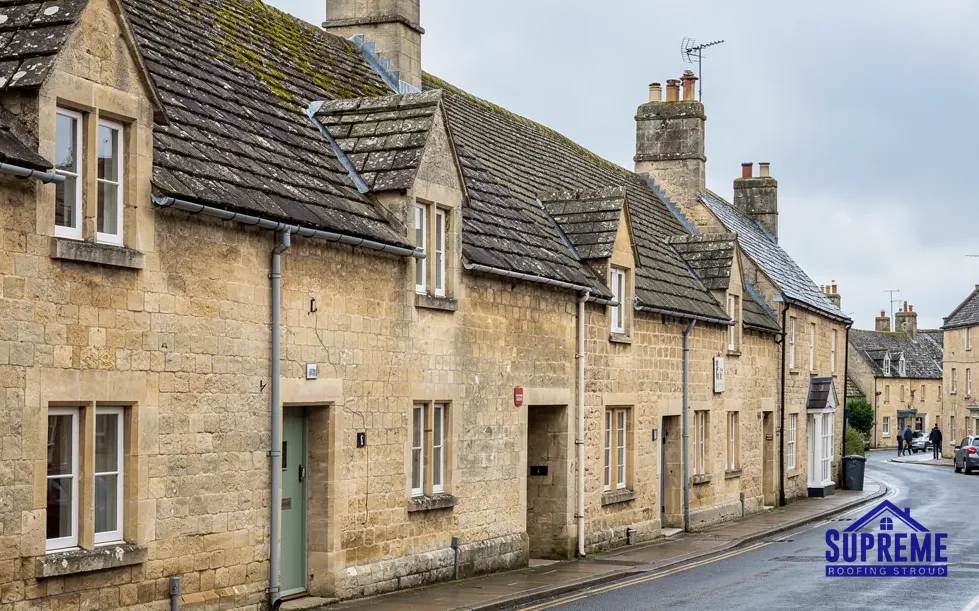
Terrace of stone cottages with dormer windows and stone tile roofs 
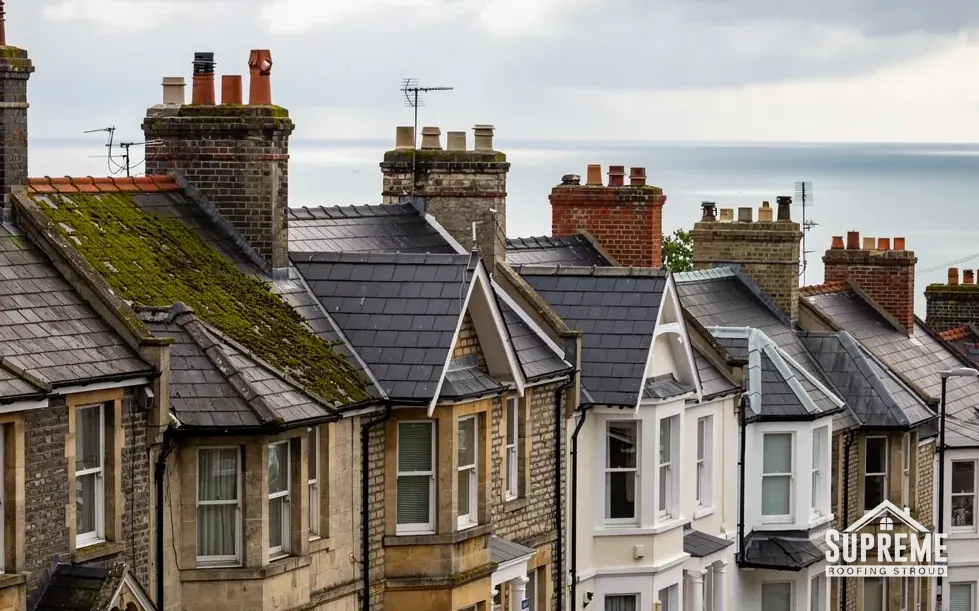
Hillside terraces of stone houses with slate roofs and chimneys

Chapter 01
Seven conservation areas, one borough council
Where a Cheltenham roof sits on the map decides which questions come first.
Chapter 01In this chapter
Cheltenham Borough Council lists seven conservation areas: Central, Cudnall Street, Bafford, Poets (St Mark's), Prestbury, Swindon Village and St Mary's. The Central Conservation Area is the largest. Gloucestershire County Council designated it in May 1973, Cheltenham Borough Council extended it on 14 August 1987, and it covers around 599 hectares. A house in that area, or in any of the other six, is subject to extra planning care.
In this chapter
What does that mean for a roof? Swapping a worn covering for the same covering generally falls outside planning control, since the building looks no different afterwards. That rule has two catches. The first is a listing: the Pittville Pump Room is Grade I and the Town Hall Grade II, and a listed house of any grade needs consent for works that alter its character. The second is an Article 4 direction or a planning condition, which can withdraw permitted development rights in a defined area. Whether a direction or condition touches roofs depends on the street and the property, so we say plainly: ask Cheltenham Borough Council's planning team before work that changes materials, ridge lines or chimney heights.
What we do before pricing
At the survey we photograph the roof and write down what it is made of, because the quote has to match it. If the roof is natural slate, our price is for slate; if it is clay, it is clay. Like for like is a cost matter as well as a planning matter, since a conservation officer who is shown a faithful repair has little to argue with.
Why the survey comes before the specification
A town with this many designations rewards patience. We would rather spend an extra half hour on the first visit, looking at the ridge, the verges, the chimney heads and the rainwater goods, than propose a specification that has to be redrawn when the planning team replies. Our quote covers the covering, the underlay, the battens, the lead and the scaffold, so that if the council asks for a different ridge tile or a matching slate, we can tell you the effect on the price.
Building control is separate
Planning is only half the picture. In Cheltenham, building control is delivered through Cheltenham and Tewkesbury Building Control, or through a registered building control approver. Building Regulations approval is not normally needed where under 25 per cent of the building envelope and under 50 per cent of the roof is affected. Beyond those limits approval applies, and a thermal upgrade may follow. Once we have surveyed, we say whether your job is notifiable, and if it is the paperwork is ours to deal with.
In a conservation area, a faithful repair is the easiest repair to agree.
| Subject | What is on record |
|---|---|
| Conservation areas | Seven: Central, Cudnall Street, Bafford, Poets (St Mark's), Prestbury, Swindon Village and St Mary's |
| Central area | Designated May 1973, extended 14 August 1987, around 599 hectares |
| Pittville Pump Room | Built 1825 to 1830, Grade I listed |
| Cheltenham Town Hall | Built 1902, Grade II listed |
Chapter 02
Listed landmarks and what they tell us about older roofs
Grade I and Grade II buildings set the standard that neighbouring roofs are judged against.
Chapter 02In this chapter
The Pittville Pump Room was built between 1825 and 1830, so it is nearly two centuries old, and it is a Grade I building. The Town Hall of 1902 is Grade II. Roofs on buildings of this kind are maintained with great care, and the habits of that care are worth borrowing for ordinary houses nearby. Slipped slates are dealt with early, lead is inspected whenever the roof is visited, and gutters are cleared before the autumn rather than after the first stain.
For a house on a Regency street, the same approach gives a sensible maintenance order. Start with the water goods, because failed guttering damages the wall and the eaves and gets blamed on the roof. Next, the flashings and valleys, which are lead on many older roofs and the usual source of leaks at a chimney or a party wall. Then the covering itself. Our lead roofing page explains lead codes: Code 4 is the usual choice for general flashing, and the heavier codes are kept for valley gutters and parapets. Typical UK figures put lead flashing life at over 80 years when correctly installed (MyJobQuote, 2026), though that depends on the code and the detailing.
Reading a roof from the pavement
You can learn a surprising amount before anyone climbs a ladder. Look along the ridge for a dip, which suggests a timber has moved. Look at the slope for tiles or slates that sit proud or have slid, and at the chimney for a lean or a pale crust of salts. Binoculars from the opposite pavement work well. Send us what you see and we will say which items are worth a closer look.
Terraces and party walls
Regency terraces share walls, and often share a roof line. That means a leak at a party-wall flashing can show up in a neighbour's house before it shows in yours. We tell you what we have found and photograph it, and where a repair needs the neighbour's cooperation, we describe the access in the quote so that the conversation with them starts from facts. A shared scaffold across a terrace is common and sensible, though each owner still receives a written quote of their own.
Chimneys
Terraces and villas have chimney stacks, often a row of them along a ridge. Pointing and flaunching, the mortar that holds the pots, are the first parts to go, followed by the lead tray or flashing at the base. Typical UK repointing costs average about £750, within a range of £500 to £2,000 (MyBuilder, 2026), while a stack rebuild is a larger job that starts around £2,000 and can pass £10,000. Our chimney repairs page sets out how we decide between repair and rebuild.
- 1716year Cheltenham's mineral springs were discovered
- 1825year the first stone of Joseph Pitt's Pittville extension was laid
- 1902year Cheltenham Town Hall was built
Chapter 03
Drainage, gutters and a river that runs under the town
In a town built around a small river, keeping rainwater moving matters as much as the roof covering.
Chapter 03In this chapter
The River Chelt flows under and through Cheltenham, and the town's spa history shows how much its builders cared about water. Roofs are where that water starts its journey, and the gutters and downpipes that carry it away are rarely the first thing an owner looks at. We start there. On most surveys we begin at the kerb, walk round the house and check each outlet, then look up.
In this chapter
Gutters need a gentle fall to the outlet. Manufacturers typically recommend between about 1:600 and 1:350, depending on the system, with brackets no more than about 900 mm apart. A sagging run, a joint that weeps and a downpipe that spills over a wall are all signs of a system that has outlived its fixings. On a Regency terrace the gutter may sit behind a parapet or a cornice, which turns a simple job into a specialist one. We look at those details before we promise a price.
Flat roofs and later additions
Between the terraces, Cheltenham has plenty of flat-roofed rear extensions, porches and garages. A flat roof lasts about 15 to 30 years according to typical guides (MyBuilder, 2026), and the covering matters: EPDM, GRP, felt and lead each have their own range. Our flat roofing page compares them. For the survey, the question is always the same: does water leave the roof, or does it sit? A fall of 1 in 80 once finished is the recommended minimum under BS 6229.
Scaffold in a town street
Terraces and villas on busy streets raise a practical question: where does the scaffold stand? Where it would occupy the public footway, a licence is required from the highway authority, and we build that into the timetable. Where there is a basement area or railings in front, the scaffold may be designed to span them. A narrow side passage might mean materials are carried through the house. These details go in the written quote alongside the scaffold, and we raise them at the survey rather than leaving them for the day.

If you live in one of the town's villas or terraces and are not sure what your roof is made of, send a clear photograph from the street and we will describe what the picture shows before anyone visits.
Map showing Cheltenham and the Stroud service radius, with nearby towns we also cover.
Near Cheltenham
Roof work we do here
Regency terraces, Pittville and the Town Hall in Cheltenham
My Cheltenham terrace is in the Central Conservation Area. Do I need permission to re-roof?
A like-for-like swap is usually outside planning control, but a listing or an Article 4 direction can change that. Whether a direction covers roofs depends on your street, so check with Cheltenham Borough Council's planning team before changing materials.
How do party-wall leaks work on a Regency terrace?
Water can enter at a flashing on a shared wall and appear in a neighbour's ceiling first. We photograph the flashing and explain what a repair needs, including any access through the next house.
Does the Grade II listing of Cheltenham Town Hall mean nearby houses are protected too?
No. Listing applies to the building named in the list entry. Houses nearby may be in a conservation area, which brings its own planning care, but only a listed house needs listed building consent.
Will you replace a lead valley with a different material?
Only if the council and you agree. On older roofs we stay with the same metal, usually lead, and size the code to the job. Replacing it with something else is a change the planning team would want to see first.