

Roofers in Leckhampton
Roof work at the foot of Leckhampton Hill on the south side of Cheltenham, where a medieval manor, a quarried hillside and a long run of later housing meet.
Leckhampton at a glance
- Distance
- 12.3 road miles north-north-east of Stroud
- Council
- Cheltenham Borough Council
- Conservation area
- Leckhampton character area
- Setting
- Foot of Leckhampton Hill
Leckhampton's roofs below the quarried hill
The old village of Leckhampton sits at the foot of Leckhampton Hill on the south side of Cheltenham. Residential development spread towards Cheltenham during the nineteenth and twentieth centuries, so the old core and the newer streets now run together. Behind them, the hill itself carries the marks of its working past: recorded quarrying ran for about 150 years from the late eighteenth century to the mid-1920s, producing Cotswold stone of varying quality.
The older buildings are well documented. Leckhampton Court is a medieval manor house dating from about 1320, built by the Giffard family of Brimpsfield, and it is now a Sue Ryder hospice. St Peter's is the oldest church in Leckhampton and the medieval parish church. Four large limekilns were built part way up the hill in the early 1920s, the scheme had closed by 1927, and by 1929 the hillside was in the hands of Cheltenham's council and open to the public.
Leckhampton is one of the 19 character areas of Cheltenham's Central Conservation Area, with a Leckhampton Character Appraisal and Management Plan dated July 2008. That plan is the council's own reference for the area. Each house gets its covering identified at the survey, along with what lies beneath it: underlay, battens and fixings, and we price what we find.

Stone terraced houses with slate roofs and chimneys stepping up a hill 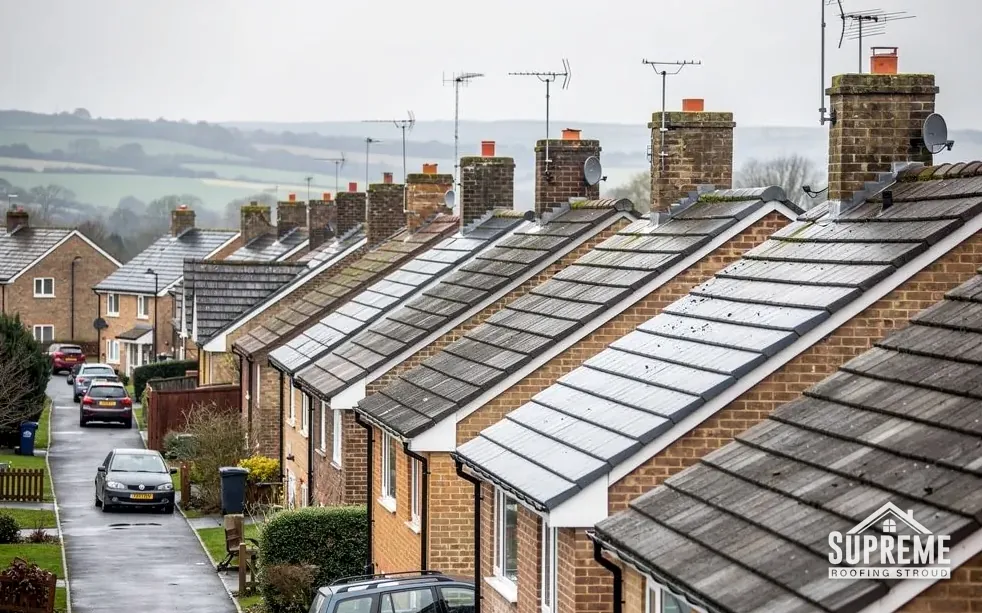
Terraced houses on a hillside street with tiled roofs and brick chimneys

Chapter 01
Quarry, limekilns and the stone of Leckhampton Hill
A hillside that supplied Cotswold stone for 150 years is a good place to talk about stone roofs.
Chapter 01In this chapter
Quarrying on Leckhampton Hill is recorded over about 150 years, from the late eighteenth century to the mid-1920s. The Friends of Leckhampton Hill describe the output as Cotswold stone of varying quality, with the best used for interior carving, for example at Cheltenham College Chapel. Four large limekilns followed in the early 1920s and the scheme had closed by 1927. For an owner, the point is not the history but what it says about the stone: it was a local resource, and it was not all of the same grade.
In this chapter
Cotswold stone has a long record as a roofing material across the region. According to Cotswold District Council's 2000 technical guidance, traditional roofs are often pitched at 47° to 55° and are very heavy, about 1,000 kg per 10 sq m. The stone breaks naturally into more small slates than large ones, which is why a stone roof is laid with the largest pieces at the eaves and tapers to the smallest at the top, a method known as diminishing courses. Reading those courses from the ground tells us a good deal about the roof. Each slate hangs from a wooden peg over a batten, usually cleft oak. Whether a particular Leckhampton roof is stone is confirmed at the survey, but where it is, those details apply.
Stone roofs last a long time when they are looked after. The same guidance says a Cotswold roof can easily last 100 years with regular maintenance, and could last 200 or 300 years. It adds that a stripped roof commonly turns out to have about 50% of its slates perished. That is the point of a careful survey: finding out how much of the covering is sound before deciding between repair and replacement.
New stone and old
If slates must be replaced, English Heritage policy, as reproduced in that guidance, favours new stone slates over second-hand and says substitutes such as concrete tiles are inappropriate on historic buildings. Matching the originals means the same geology, colour, texture, size and thickness. Cost guides give stone slate at roughly £160 to £210 per m², but Checkatrade's figure is not specific to the Cotswolds, so the quote after the survey is the figure that counts. Our Cotswold stone roofing page covers the material in detail.
Stone roofs outlast most coverings, but only if the pegs, battens and valleys beneath are sound.
- 150years of recorded quarrying on Leckhampton Hill, from the late 18th century to the mid-1920s
- 1927year the limekiln scheme had closed
- 1929year the hillside opened to the public in council ownership
Chapter 02
Leckhampton Court, St Peter's and the oldest buildings
A manor from about 1320 and a medieval church show how roofs are repaired on buildings that have been altered for centuries.
Chapter 02In this chapter
Leckhampton Court dates from about 1320 and was built by the Giffard family of Brimpsfield. It is now a Sue Ryder hospice, which is a reminder that old buildings are put to new uses and that roofs have to change with them. St Peter's, the medieval parish church, is the oldest church in Leckhampton. Roofs on buildings that old are the result of many repairs, and a survey can read the history: a patch of different stone, a lead flashing of a different age, a rafter that has been sistered.
In this chapter
The first question for an old building is who has the right to authorise the work. A church in use follows the faculty route through the diocese. Other old buildings, if listed, need listed building consent from Cheltenham Borough Council, and the council's own conservation pages are the place to check. Many houses in the village are neither, but sit in the Leckhampton character area, where the council's appraisal of July 2008 guides decisions. Legal advice is not ours to give, though we can describe what we would put to the council and why.
The second question is how the roof is built. Older roofs often have timbers that are irregular, with rafters at uneven spacing, bowed purlins or ridges that have settled. A modern covering laid on that frame needs packing and levelling, and that adds to the cost. Underlay and ventilation matter too: BS 5250 guidance, as set out by Marley, says a roof with non-breathable underlay and a cold loft needs a 25 mm eaves vent along its length at pitches of 15° or less, and 10 mm above that. We check whether an old roof has any way for air to move through it before we propose a new covering. Our pitched roofing page explains how a covering, underlay and battens fit together.
Insulation is the other thing a re-roof reopens. If the covering is stripped back to the rafters across more than half the roof, the thermal element is being renovated and Part L may call for an upgrade. Until 31 March 2027, putting insulation into a home's roof or loft carries no VAT, while general roofing work is charged at the standard rate. The VAT on your quote will show where each applies.
Lead, valleys and repairs
On older stone roofs the weak points are valleys, abutments and chimneys, where lead or mortar has been patched. The traditional answer is the swept valley, formed from specially cut slates. The council guidance calls mitred and open lead valleys cheaper to construct but less satisfactory in appearance. We note which kind a roof has and repeat it unless the council directs otherwise. A repair that quietly changes the valley changes how water leaves the roof, and the neighbours' roofs may show it.
Chapter 03
Living at the foot of the hill: access, drainage and the character area
A hillside behind and a town in front put a Leckhampton roof between two very different settings.
Chapter 03In this chapter
Leckhampton lies on the south side of Cheltenham, with the hill behind it. Residential development spread towards the town during the nineteenth and twentieth centuries, so the village now has an old core and long runs of later streets. A roof near the hill and a roof near the town can look quite different, and so can the job: one may need scaffold on a sloping garden, the other on a flat suburban plot with a neighbour on each side.
The conservation framework is clear on one point. Leckhampton is a character area of Cheltenham's Central Conservation Area, not a separate conservation area on its own, and the council's Character Appraisal and Management Plan dates from July 2008. The Central Conservation Area itself was designated by Gloucestershire County Council in May 1973 and extended by Cheltenham Borough Council in August 1987. So the first step is to ask the council whether your own address is inside it. Putting back the same covering is seldom development in planning terms. Altering how the roof looks can be, and dormers lose their permitted development rights on conservation land.
Building control follows the usual pattern. A small repair needs no application. A larger re-roof may cross the Building Regulations thresholds, and in Cheltenham the route is Cheltenham and Tewkesbury Building Control, or a registered building control approver of your choice. We explain consent and, where the work is notifiable, we deal with the notification.
Access on a sloping plot
Houses nearer the hill often sit on sloping ground. Scaffold on a slope needs level bases and sometimes steps in its lifts, and materials have further to travel. For a small repair, a tower or a roof ladder may be cheaper than a full scaffold, and we say which is sensible. Every plot is photographed at the survey, so the access plan and its cost are on the written quote, not a surprise on the day. If a neighbour's land is needed for the scaffold, we tell you early, so that you can ask permission before a start date is fixed.
Checking the roof before you buy or sell
Leckhampton has housing of many ages, and a buyer will want to know the state of a roof before committing, which a written survey answers. A roof inspection and report gives photographs, findings and a list of work. MyBuilder's 2026 guide puts a standard survey at £150 to £250, a drone survey at £200 to £400 and a thermal survey at £300 to £500. Our roof inspections and surveys page explains what each finds.
Map showing Leckhampton and the Stroud service radius, with nearby towns we also cover.
Near Leckhampton
Roof work we do here
The quarried hill and Leckhampton's character appraisal
Could my Leckhampton roof be Cotswold stone, and how would I tell?
Stone slates are thick, uneven and hung from pegs, and the slates shrink in size from eaves to ridge. A picture from the road is usually enough for us to say whether it looks like stone. A survey confirms it from the loft and the ladder.
Is Leckhampton in its own conservation area?
It is a character area of Cheltenham's Central Conservation Area, with an appraisal dated July 2008. The character area may not cover the whole village, so ask Cheltenham Borough Council about your own address.
Why would a medieval building need a different roof survey?
Its frame has been altered over centuries, with irregular rafters, patched stone and old lead. We read all of that and report it, because the repair has to suit the structure underneath, not just the covering on top.
Do I need a roof survey before buying a house near the hill?
It is a sensible step. MyBuilder's 2026 guide gives £150 to £250 for a standard roof survey. The report shows the condition of the covering, flashings and gutters, with photographs, so any work can be priced before you exchange.