
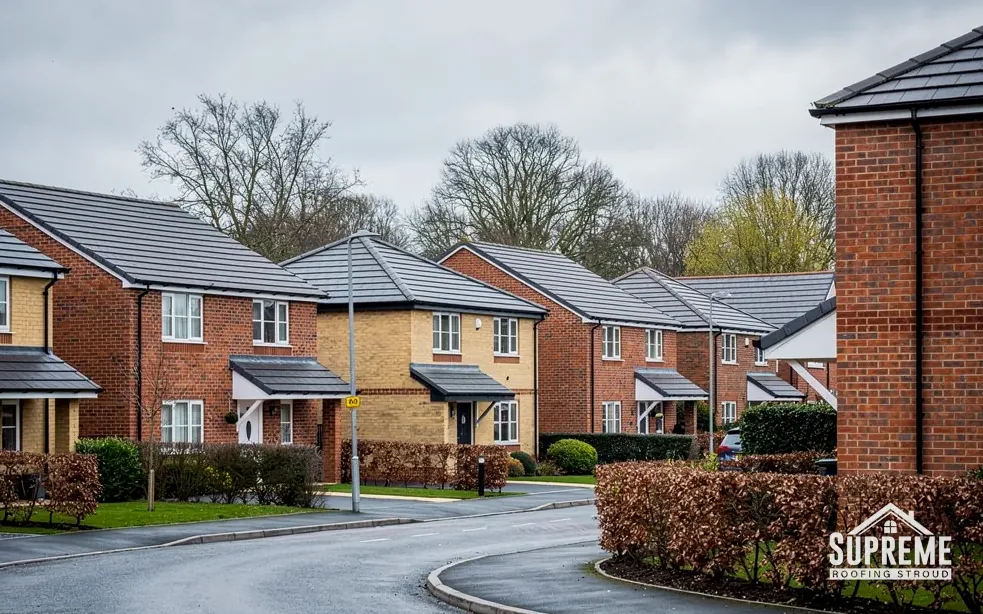
Roofers in Charlton Kings
Roof work in the western foothills of the Cotswolds beside Cheltenham, where the River Chelt enters from the east and the Cotswold Way marks the boundary.
Charlton Kings at a glance
- Distance
- 14 road miles north-east of Stroud
- Council
- Cheltenham Borough Council
- Conservation area
- Cudnall Street
- Population
- 12,021 (2021)
Charlton Kings' roofs on the River Chelt
Charlton Kings adjoins Cheltenham in the western foothills of the Cotswolds. The River Chelt enters from the east, and the Cotswold Way runs along the eastern boundary. With 12,021 people at the 2021 count, this is a big place, and the housing around its core runs on in every direction rather than clustering round a green.
The place has been lived in for a very long time. Middle Iron Age evidence was found beneath a Roman villa discovered in 1980. St Mary's Church was dedicated in 1190 by William de Vere, Bishop of Hereford, and is the oldest church in the village. Then came the nineteenth and twentieth centuries: the railway station opened in 1881, electric trams ran between 1903 and 1930, and the Cheltenham to Banbury line closed on 15 October 1962. Charlton House is now the headquarters of the engineering company Spirax Sarco.
No single covering defines the village, because a long period of growth means a wide range of building ages, and each age brings its own roof. We read what is on each house at the survey, and the council that decides planning questions is Cheltenham Borough Council.

Row of stone cottages with mossy clay tile roofs along a quiet lane 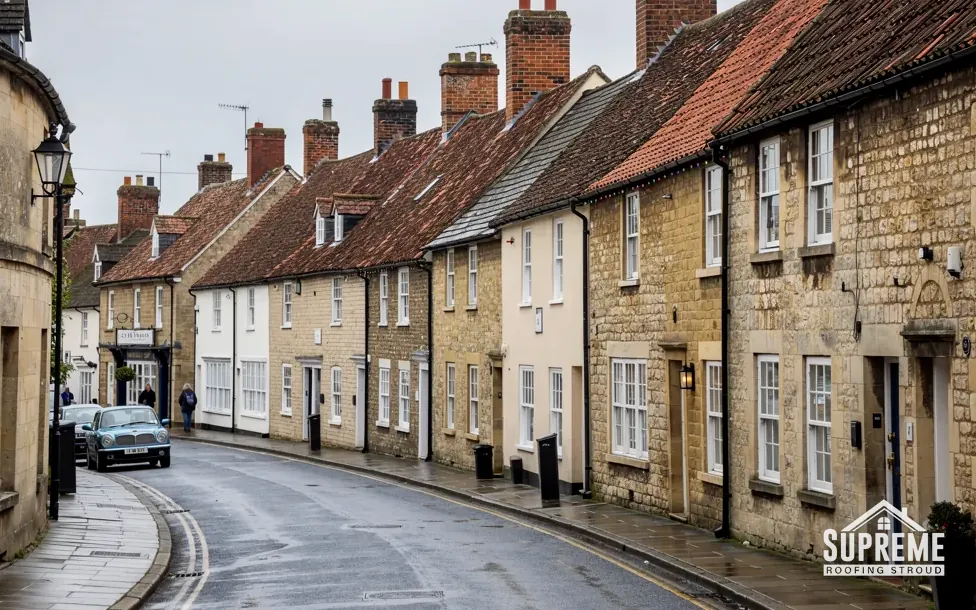
Curving street of stone and rendered terraced houses with tiled roofs
Chapter 01
Roofs along the River Chelt and under the Cotswold Way
Houses between a river and a ridge need drainage and ridge fixings checked before anything else.
Chapter 01In this chapter
The Chelt runs through the village from the east, and the Cotswold Way follows the eastern boundary along the top of the foothills. Between them lies a long strip of housing in the foothills, with the ground lifting towards the Cotswold Way. That is a more forgiving landscape for a roofer than a steep valley, but it still brings its own concerns. Trees along a river bank drop leaves into gutters, and houses higher up the rise look out over open ground, so their ridges and verges are easy to see from the lane.
In this chapter
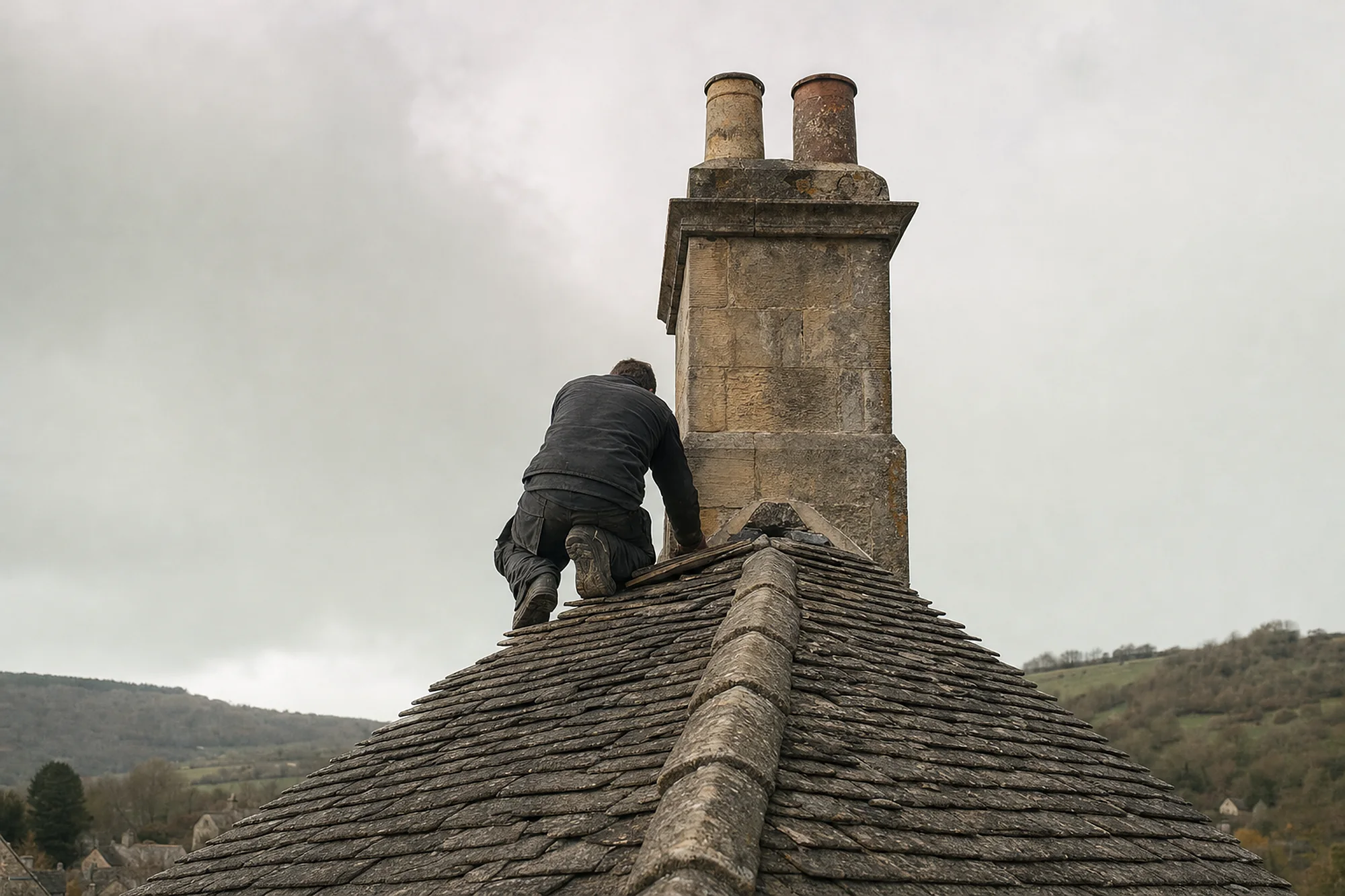
For that reason we check the ridge and verge on a Charlton Kings roof as closely as the covering. A ridge is the line of tiles along the top of the roof where two slopes meet, and the verge is the finish along a gable, where the slope ends. Both were traditionally bedded in mortar. BS 5534:2014 changed the position: ridge and hip tiles are now fixed mechanically too, with the bedding mortar no longer expected to hold them by itself. A dry-fix system, which clips the tiles in place without a full bed of mortar, is one way to do that, and BS 8612 covers it. Our ridge, verge and dry-fix page explains how each method works and what it costs nationally.
National cost guides give a sense of the figures. MyBuilder's 2026 guide gives re-bedding or replacing ridge tiles as £300 to £600 and dry ridge as £40 to £60 per metre, and Checkatrade's 2026 figures are £50 to £70 per metre for dry ridge, ex VAT. Those are typical UK ranges, not Supreme prices. The written quote that follows a survey shows the figure for your own roof, with ridge work, scaffold and waste included.
The ridge is also where a roof shows its age. Cracked bedding, open joints between tiles and ridge tiles that sit out of line are all signs that the fixings have loosened. A loose tile can come away in a gale and land on a path or a car, so it is worth having a look from the ground each spring and autumn. Binoculars are enough to spot a gap or a slipped tile from the pavement.
Trees, leaves and gutters beside the Chelt
Gutters on a house near a river or a line of trees fill with leaves, and a gutter that is full is a gutter that overflows. Water then runs down the wall, stains the render or brickwork and, in time, gets into the wall head. We clear and check gutters as part of a repair visit where the ladder is already up, and we replace sections that have sagged or split. Manufacturers typically recommend a gentle fall towards the outlet, between about 1:600 and 1:350 depending on the system, and we set new runs to that.
Mortar alone no longer holds a ridge; a modern fix uses a mechanical fixing too.
Chapter 02
Station, trams and the houses that followed them
A village that grew with the railway in 1881 and the trams in 1903 has roofs from several building booms.
Chapter 02In this chapter
Charlton Kings station opened in 1881. Electric trams ran from 1903 to 1930, and the Cheltenham to Banbury line closed on 15 October 1962. Transport changes like those usually bring houses with them, and the village grew along the lines that connected it to its neighbour. An address alone is a poor guide to a roof's age, because streets filled in over many decades and houses have been re-roofed since. What the dates do tell us is that the village has houses from the late nineteenth century, the early twentieth and the decades after the trams stopped.
In this chapter
Each of those periods brings its own weak points. On a house of the first of those periods, the covering may be a replacement for the original, and the timbers under it need checking as soon as the old tiles come off. Interwar and later houses were built with newer materials, and may carry concrete tiles, which have a shorter typical life than slate. Sources disagree on how long: MyBuilder gives 30 to 50 years, Marley says around 60 years but explicitly not as a guarantee, and CORC says 50 or more. The only reliable answer is a survey of the tiles themselves. Our roof repairs page shows how we separate a repair from a replacement.
Flat roofs turn up on extensions, garages and porches, wherever a house has grown outwards. These roofs age differently from pitched ones. Flat roofs generally last between 15 and 30 years according to MyBuilder, and the covering matters: EPDM is quoted at 20 to 30 years or more, GRP at 25 to 40 and felt at 10 to 20. Flat roofs need a fall of at least 1:80 to drain, and BS 6229 advises designing for 1:40. Where an old flat roof ponds, the cause is often the fall rather than the covering, which is why we measure it. Our flat roofing page shows how.
Matching an older street
When one house on a row is re-roofed, the neighbours notice. We note the colour, texture and size of the existing tiles and look for the closest match in the same material, so the row still reads as one. Where neighbours have already changed their roofs, we say what we can match and what we cannot, and the quote records the choice you make. A tile that is close but not identical is usually acceptable on a detached house, and less so on a terrace where the roofline is shared.
- 1881year Charlton Kings railway station opened
- 1903 to 1930years electric trams ran through the village
- 1962year the Cheltenham to Banbury line closed
Chapter 03
Cudnall Street conservation area and St Mary's
A conservation area, an old church and a council decision in Cheltenham shape work around the village centre.
Chapter 03In this chapter
The Cudnall Street conservation area is run by Cheltenham Borough Council. The council designated it on 2 October 1989 and revised its boundary on 15 November 2001, and its character appraisal and management plan was adopted in June 2009. The appraisal notes a varied mix of building types, ages and roof lines along what was once the London Road. What matters for an owner is the rule: inside a conservation area, like-for-like repairs to a roof are not usually development, but changes to the appearance of the building are, and the council can ask for an application.
In this chapter
St Mary's Church, dedicated in 1190 by William de Vere, Bishop of Hereford, is the oldest church in the village. It is listed Grade II*, its tower and south aisle were added around 1390 to 1400, and John Middleton restored and extended it in 1877 and 1878. Church roofs in current use follow a separate path through the diocese's faculty system. A former church that has stopped holding services would normally go through the council for listed building consent instead.
For a house near the centre, the practical steps are simple. Find out whether it is listed, and whether it is in the conservation area. If it is neither, the Building Regulations are the main control. Small repairs stay under the limits of 25 per cent of the building envelope and 50 per cent of the roof; larger work does not, and then a thermal upgrade may follow. In Cheltenham, the building control body is Cheltenham and Tewkesbury Building Control, or you can choose a registered building control approver. We explain which applies at the survey.
Charlton House and larger buildings
Charlton House, now the headquarters of an engineering company, is a reminder that the village has larger buildings with larger roofs. Offices, workshops and commercial units bring flat roofs, rooflights and gutters on a different scale from a house. A survey for a building like that records the outlets, the falls, the penetrations and the state of the joints, and the quote covers the drainage as well as the covering.
Ridge and verge details on older houses in the centre are inspected too. If a roof has lost its ridge fixings, the repair is quick and the cost is modest compared with the damage a loose tile can do on a windy day. What we find goes into the survey report with a photograph taken from the ladder, so the repair we propose and the cost of it can be checked against the picture.
Myth: A conservation area means you cannot touch your roof.
Fact: Repairs and like-for-like re-roofing are normally fine; it is changes to a building's appearance that need the council's view.
Map showing Charlton Kings and the Stroud service radius, with nearby towns we also cover.
Near Charlton Kings
Roof work we do here
Cudnall Street and the Chelt at Charlton Kings
My Charlton Kings house is on a row with identical roofs. Do I have to match my neighbours?
There is no rule outside a conservation area or a listed building, but a mismatched tile shows from the road. We note what the neighbouring roofs use and try for the closest match in colour, size and texture.
Does the Cudnall Street conservation area need planning permission for a new roof?
Not for a like-for-like re-roof, which is not normally development. Changes to the appearance of the roof are different, so put the question to the borough's planning team before materials are ordered.
Which building control body handles a re-roof in Charlton Kings?
Cheltenham and Tewkesbury Building Control, or a registered building control approver of your choice. Neither is needed for a small repair, but a large re-roof may cross the thresholds.
How do I know whether my extension's flat roof is ponding?
Look for a stain or a dark patch where water has lain after rain. We check the fall with a level at the survey, because the cure may be a tapered insulation layer or new falls rather than a whole new covering. The quote shows which it is, and what each choice would add.