

Roofers in Slad
Cottages on the slopes of the Slad Valley, built up from the old Steanbridge crossing of the brook, 2.1 miles north-east of Stroud.
Slad at a glance
- Distance
- 2.1 road miles north-east of Stroud
- Council
- Stroud District Council
- Setting
- Slad Valley, on the slopes above the Slad Brook
- Listed
- Holy Trinity Church, Grade II
Slad's slopes above the brook, from Steanbridge to Rosebank
Slad lies in a valley of its own, with the Slad Brook running along the bottom before it joins the River Frome. The village grew out of Steanbridge, an important crossing of that brook recorded in 1353, and its oldest part sits on the slopes south of the bridge. Those slopes explain a great deal about how the buildings stand: cottages perch above the water, gardens fall away behind them, and the lanes follow the contours rather than a plan.
The Victoria County History picks out two houses. Steanbridge House is a gabled clothier's house of the sixteenth or early seventeenth century, and Rosebank is an L-shaped rubble house formed from three seventeenth-century cottages, with wooden and stone mullioned windows. Many other cottages were rebuilt as weavers' cottages in the eighteenth or nineteenth century. Later layers followed the Stroud to Cheltenham road of 1800, which encouraged building, then the church and school at the south end of the village in the 1830s, and scattered houses along the main road from the late nineteenth century.
The result is a small place with long memory in its roofs: gables, low eaves, thick rubble walls and chimneys that have been repaired several times. Slad does not appear on Stroud District Council's list of conservation areas, though Holy Trinity Church is Grade II listed, so we check the status of a building before proposing any change. We start with a survey, photograph your roof and match the covering already there. If you only need a leak found, a roof repairs visit is the place to begin.
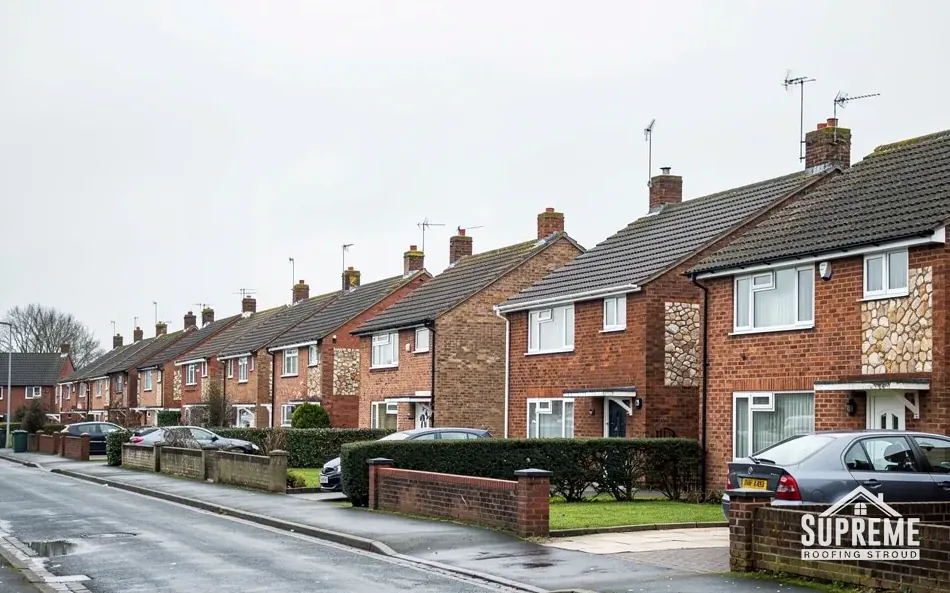
Street of red brick terraced and semi-detached houses with parked cars 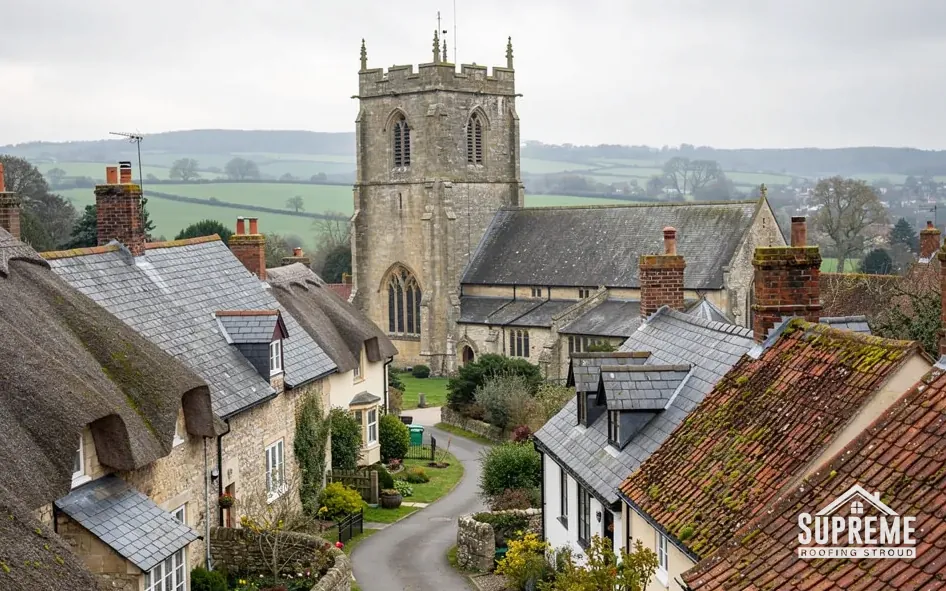
Village of thatched and tiled cottages around a stone church tower

Chapter 01
Water on the slope: the Slad Brook, downpipes and damp walls
On a valley side, rain has to leave the roof and the plot, and a blocked route on either causes similar-looking damp.
Chapter 01In this chapter
A house on the slopes above a brook has water arriving from two directions. Rain falls on the roof and runs to the gutters, while ground water moves down the hillside towards the valley floor. Where the two meet at the foot of a wall, it is easy to blame the wrong one. A damp patch on a rubble wall might be a roof leak running down inside the stonework, a failed gutter splashing the wall, or soil banked against the base on the uphill side. Rubble walls are thick and dry slowly, so the mark can show up well away from the real cause and months after it began.
Our survey for a Slad cottage therefore separates the jobs. We follow the water from the top: the covering, the valley (the inside corner formed by two slopes), the gutters, the downpipes and finally the gully or drain they discharge into. On steep sites, a downpipe that empties onto a path or a bank can soak the foot of the wall more than any leak above. Cast iron, aluminium or uPVC, the material matters less than where it discharges, and we advise on which suits an old stone wall when we quote. We photograph each stage so you can see what is happening, and the quote covers guttering and downpipe work as well as the covering.
Older cottages here also tend to have small roofs and short gutter runs, with eaves close to the ground at the back where the slope rises behind the house. That can make the back of the roof easy to reach from the hillside, and it can also hide a slipped slate or tile that never shows from the lane. We look at both elevations from the ground, then from a ladder or scaffold where safe. Where the hill rises directly behind a cottage, a covering at the back may sit close enough to touch from the garden, so a small repair there needs no more than a ladder and a morning.
Drainage jobs on a slope also affect neighbours downhill. If a gully is moved or a new run of pipe is laid, we plan where the water goes next, because sending it onto the next plot is a poor solution and an expensive one to reverse. The survey notes who and what lies downhill from each outlet.
A roof inspection and survey costs a national typical £150 to £250 for a standard visit, according to MyBuilder in 2026, and it gives you a written record of the covering, the chimneys and the drainage before any decision is made.
On a valley side, water arrives from above and from the hill.
| Where the mark is | First thing we check |
|---|---|
| High on a gable wall | Verge, flashing and chimney stack above it |
| Below an eaves gutter | Joints, brackets and any overflow from a blocked outlet |
| At the foot of the wall | Downpipe discharge and soil banked on the uphill side |
| Around a chimney breast | Flashing, pot flaunching and stack pointing |
Chapter 02
Weavers' cottages, mullioned windows and gable ends
Small, thick-walled, much-repaired: the roofs of Slad's old cottages reward careful reading.
Chapter 02In this chapter
Much of what the VCH calls the rebuilding of Slad's cottages as weavers' cottages happened in the eighteenth and nineteenth centuries. The building type is plain to see: modest footprints, steep gables, stone walls thick enough to give deep window reveals, and eaves that sit low over upstairs rooms. Rosebank, formed from three seventeenth-century cottages, shows the rubble construction and the mullioned windows that define the older core. Nothing about the date of a house tells us what is on its roof today: coverings get replaced, and a single slope can carry old and newer material side by side.
Where the covering is stone, the work follows the traditional pattern of courses that shrink up the slope, each course shorter than the one below, so the heaviest stone sits low and the lightest at the top. Cotswold District Council's technical guidance of 2000 describes the largest slates at about 600 mm long, doubled along the eaves, with the smallest at the crown measuring a quarter of that. Traditional pitches run at 47 to 55 degrees. When a few pieces slip, a repair swaps in matching stone and fixes it the way the roof was made. If a covering has failed across a whole slope, the question becomes whether to re-lay the sound stone and replace the rest with like for like, which our Cotswold stone roofing page covers in more depth.
With gable ends, the verge is where we look hardest. The verge is the line of the roof's end at a gable wall, and on a small cottage it takes the run-off from the whole slope. Wind lifts mortar there first, and a loose verge lets water behind the end stones. We check how it is bedded and fixed before saying anything about cost. An old verge may have been pointed in mortar so many times that the original detail has disappeared. We note what is there, explain what a proper repair involves and include it in the quote.
Chimneys on cottages like these often rise through the ridge or sit on a gable. Pot flaunching, pointing and flashings are the first things to wear. We photograph the stack from a ladder or scaffold, mark the weak points and quote the repair along with the covering. The work we carry out comes with a 10-year workmanship guarantee in writing.
Chapter 03
The 1800 road, the 1830s church and the houses that followed it
Newer building along the main route needs a different kind of survey from a cottage on the hillside.
Chapter 03In this chapter
The Stroud to Cheltenham road of 1800 changed how Slad was built. It encouraged building along its line, and the VCH records the church and school going up at the south end of the village in the 1830s, then scattered houses along the main road from the late nineteenth century. Holy Trinity Church, Slad's small parish church, is Grade II listed. For a roofer that adds up to a village in at least three layers: the slopes south of Steanbridge, the 1800 road and its buildings, and later houses strung along it.
Roads shape how we work. A house close to a through road needs a scaffold that keeps footpaths clear, deliveries timed so lorries do not block the carriageway, and a plan for where skips and materials stand. On a hillside lane with no room to turn, we may use a smaller vehicle and carry materials further by hand. We settle these points during the survey, so access appears as a line you can read before you agree, and does not arrive as news on the day.
Houses from the late nineteenth century onwards sit in a different position from the old cottages. Their roofs often face the road, which means moss and debris show first on the elevation everyone sees. Gutters on road-side elevations collect leaves and road dust, and a gutter that is never cleared from a ladder tends to be found only when it overflows in heavy rain. We check outlets and joints along the whole run, not just the stretch nearest the door. If a gutter has stood for years with a pooling joint, the fascia behind it may be the first thing to rot. Our roof repairs team deals with those separately from the roof covering.
You may know the village from Laurie Lee's Cider with Rosie, published in 1959, which describes growing up here from his arrival at the age of three in 1917. A book can describe a village, but it cannot tell us what is on a particular roof today, so we read the roof itself. Not sure whether your building is listed, or stands in the grounds of one that is? Put the question to Stroud District Council's conservation team before work starts.
Slad has three layers of building, read one at a time.
Map showing Slad and the Stroud service radius, with nearby towns we also cover.
Near Slad
Roof work we do here
Steanbridge House, Rosebank and the brook in Slad
The gable wall of my Slad cottage is damp. Is it the roof or the ground?
It can be either, and a thick rubble wall hides the difference for months. We start at the verge, flashing and stack above the mark, then check gutters, where the downpipe empties and any soil banked against the foot of the wall. The survey photographs show you where the water is coming from.
How long does a stone roof on an old Slad cottage last?
Cotswold District Council's 2000 technical guidance says a Cotswold roof with regular maintenance can easily last 100 years, and could last longer. How a given roof fares depends on workmanship, upkeep and its position, so treat that as a typical range, not a promise.
Is my house in Slad in a conservation area?
Slad is not on Stroud District Council's list of 41 conservation areas, but Holy Trinity Church is Grade II listed. If you think your house or an outbuilding is listed, ask the council's conservation team first.
Our lane near the brook is narrow and steep. How do you plan scaffold there?
We walk the lane during the survey, measure the room for scaffold and deliveries and put the access plan in the written quote. On a steep site the scaffold is a real cost, and we allow for it in the quote.