
Roofers in Oaksey
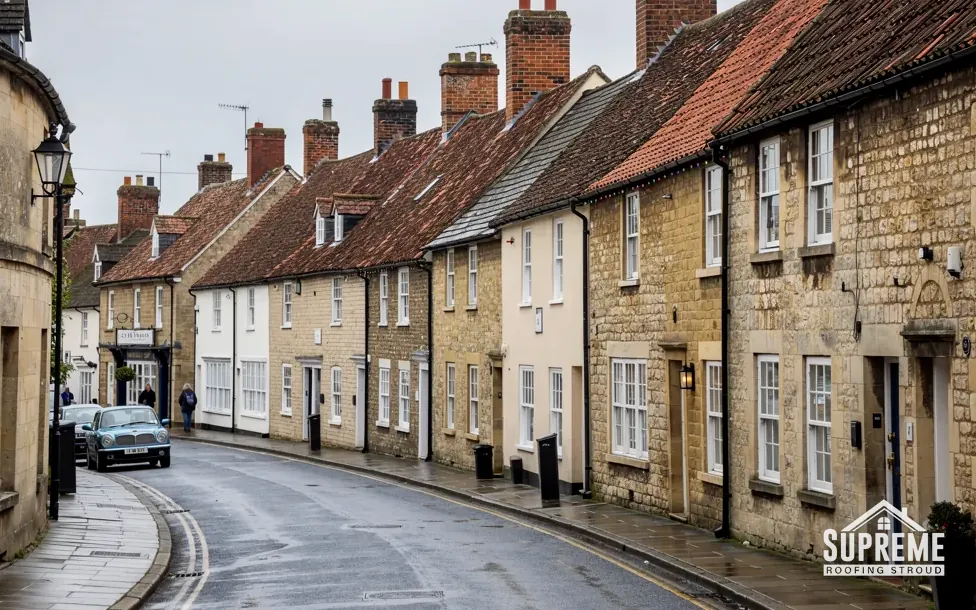
Roof work along Oaksey's ridge street, 14.8 road miles south-east of Stroud, covering stone and rubble cottages under Cotswold stone roofs and the council housing built around them.
Oaksey at a glance
- Distance
- 14.8 road miles south-east of Stroud
- Council
- Wiltshire Council
- Conservation area
- Oaksey, designated, Wiltshire Council
- Setting
- Kellaways Clay ridge on the Wiltshire-Gloucestershire border
Oaksey's roofs along a ridge of Kellaways Clay
Oaksey belongs to the upper Thames country, yet the village itself stands on an east-west ridge of Kellaways Clay, over 107 m. The Victoria County History calls it a street village on a ridge, a form of settlement which suggests that it originated early, and that long, thin plan is what shapes the practical side of working here. Houses line one road, and almost every job begins and ends at that road.
The same history says the village's older buildings are of stone and rubble and many have Cotswold stone roofs. That gives us the oldest group of roofs to look after: heavy stone slates over thick rubble walls, on cottages whose roofs have been repaired for generations. Alongside them stand roofs from later building campaigns. Wick Road received four pairs of council houses in 1931, the 46-house Bendybow estate was built at Oaksey Green between 1946 and 1965, and further houses followed along Oaksey Street in the 1970s and 1980s.
All Saints Church is listed Grade I and is known for 15th- or early-16th-century wall paintings, including St Christopher with a mermaid. Oaksey also has a designated conservation area, administered by Wiltshire Council, whose planning team can confirm whether a given house falls inside it.
What this means in practice is that a roofer in Oaksey is asked to handle very old and very ordinary roofs on the same street. We approach them differently. For stone, the question is how to keep it. For the later estates, the question is what has aged and what can be repaired. The survey photographs settle what each roof is covered with. Where an old stone-slated roof sits next to a roof from the 1930s or 1980s, the two are never priced as a pair, since each has its own needs and its own timescale.

Victorian terraced houses with slate roofs and chimneys on a hillside 
Flint and brick cottage with a clay tile roof beside a road

Chapter 01
A street village on a ridge: working along Oaksey Street
One long road means one access route, so the order and timing of a job matter more than usual.
Chapter 01In this chapter
When a village is laid out along a single ridge road, the road is both front door and delivery route. A lorry with slate, stone or timber has to stop where it can, and the scaffold goes up on whatever frontage the house has. Where a cottage sits tight to the road, the scaffold may stand on the public footway and need a licence, and where it sits back, the questions are about the garden and the gate. We walk the frontage at the survey and note both, so the quote allows for the access. Where the verge in front of a house is soft or the gateway is narrow, the report records it, because a plan that suits a wide drive will not suit a cottage with a gate you can barely get a ladder through.
In this chapter
Because the street is the village, neighbours are close. A job that blocks the road for a morning is noticed by the whole village, so we plan deliveries in one go, tell the next-door houses what is happening and when, and keep the lane clear of waste. Every evening the road is swept and the materials are stacked away from the carriageway, so the next morning starts from a clean position. Where a rubbish skip has to stand on the highway, that too needs a permit, and it goes in the written costs rather than appearing as a surprise.
The ridge underfoot
The ridge is Kellaways Clay, and clay moves. How far it moves under any one house is a question for the survey, not a general claim. What we do know is that old walls built on clay can crack and settle over centuries, and that cracks at the top of a wall can open a path for water just where the roof meets the masonry. A survey in Oaksey therefore looks at the wall head and the line of the eaves as carefully as it looks at the covering, and notes any cracking in photographs.
The church and the conservation area
All Saints is listed Grade I, and its 15th- or early-16th-century wall paintings are exactly the kind of interior a leak would harm. While it is in use, the church does not go to the council for listed building consent: the ecclesiastical exemption applies, and roof work there is authorised by a faculty from the diocese. For houses in the conservation area, repair in matching materials is normal practice, while changes of shape or material go to Wiltshire Council's planning team first.

On a one-street village, the lane is part of the specification.

Chapter 02
Stone and rubble walls under Cotswold stone roofs
A heavy stone roof, a thick rubble wall and the joint between them: where Oaksey's older cottages leak first.
Chapter 02In this chapter
The Victoria County History describes Oaksey's older buildings as stone and rubble, and many have Cotswold stone roofs. The pairing is old and sensible. A rubble wall is thick, irregular and built of stone of mixed sizes, which is why it can carry the weight of a roof covered in stone slates, themselves among the heavier coverings you can put on a house. The pairing also has a weakness: if water gets into a rubble wall through the top, it can travel down inside the thickness before it ever shows on a face, and damp that appears at skirting level may start at the gutter.
In this chapter
That is why we look first at the places where roof and wall meet. At the eaves, a stone slate roof overhangs the wall and throws water clear, so a displaced slate or a blocked gutter sends water straight where it should not go. At a gable, the verge is where the last course of slates is bedded in mortar over the wall, and mortar there weathers and cracks. At a chimney, lead flashings and stone flaunching do the same job of keeping water out of a joint. Each of those junctions fails slowly and visibly if you know where to look, which is why a rubble-walled cottage deserves a close look at the roof edges every few years, from a ladder or a tower rather than from the ground.
What a stone roof costs to look after
Checkatrade's cost guide, updated in 2026, puts stone slate generally at about £160 to £210 per m², the spread depending on new or reclaimed stone and on your location. That is a national figure for stone slate, not a Cotswold one, and it covers a full re-roof, not a repair. Repairs are priced by the slate and the hour. Our written quote follows the survey, covering scaffold, stripping, the stone itself, labour, waste and making good. For a closer look at the junctions, our guide to stone roof abutments explains what we examine.
Myth: A stone roof is so heavy and so old that it is cheaper to replace it with something modern.
Fact: A lighter covering means a different look and a structural question, and in a conservation area the change goes to the planners first.
Like for like, always
Where a stone roof is old, we stay with stone. Substituting a different material changes how the building looks and how it carries load, and in a conservation area it is a question for the council. Our Cotswold stone roofing service describes how repairs and re-lays are carried out.
Chapter 03
Wick Road, Bendybow and the later houses
Three building campaigns across five decades, each with its own sort of roof to inspect.
Chapter 03In this chapter
The Victoria County History tells the story of Oaksey's growth beyond the old street. In 1931 Wick Road saw four pairs of council houses go up. The 46-house Bendybow council estate followed at Oaksey Green, built over the years 1946 to 1965. Further houses went up along Oaksey Street in the 1970s and 1980s. A roofer sees those dates as three different problems.
The Wick Road pairs are the oldest of the estates. A semi-detached pair shares a party wall and often shares a roof, so work on one half has to respect the other. If one owner re-roofs and the neighbour does not, the join at the party wall is where a leak will start, and we look at it carefully. We also write down which of the pair has already been re-covered, since a surveyed history is more use than a guess.
Bendybow, built over nearly twenty years
An estate that took from 1946 to 1965 to complete was not built all at once, so Bendybow's houses do not necessarily share a single age or a single specification. We therefore treat every roof as its own survey. Two neighbours may need different work even if their houses look alike from the road. A flat-roofed porch or garage added later is a particular point of attention, because small flat roofs are where felt, GRP or EPDM coverings reach the end of their lives first, and the sheeting on an older garage may turn out to be asbestos cement, which HSE guidance says must be handled with care.
The 1970s and 1980s along Oaksey Street
Houses of that period are the youngest group, but they are not exempt from age. Ridge tiles bedded in mortar may have cracked, verges may have lost their pointing, and the felt beneath the tiles may have hardened. Our roof repairs service covers the usual causes of leaks, and our garage roof replacement service covers the flat roofs that so often sit beside them. Our workmanship carries a written 10-year guarantee, and every job ends with the site cleared.
Two houses that look alike from the road can still need different work.
- 1931year Wick Road received its four pairs of council houses
- 46houses on the Bendybow council estate at Oaksey Green
- 1946 to 1965years in which Bendybow was built
Map showing Oaksey and the Stroud service radius, with nearby towns we also cover.
Near Oaksey
Roof work we do here
Kellaways Clay ridge, Wick Road pairs and Bendybow
Why would damp on an Oaksey cottage wall start at the roof?
Thick rubble walls can carry water down inside their thickness, so a blocked gutter, a slipped slate or a failed flashing at the top may show up as damp low on the wall months later. We start at the eaves and the junctions before touching the covering.
Can a pair of Wick Road houses be re-roofed one half at a time?
Yes, but the party wall junction needs careful treatment so the new half and the old half meet cleanly. We survey both sides of the join, and the quote covers the work along it.
Bendybow took until 1965 to finish. Do its roofs differ house to house?
They may, because an estate built over nearly twenty years does not necessarily share one specification. We treat each roof as its own survey and quote what that roof needs.
The village is on a single street. How do you plan scaffold and skips?
We note the frontage at the survey, apply for a highway licence where scaffold or a skip must stand on the road or footway, and group deliveries so the lane is not blocked for long. Those costs are covered in the written quote.