
Roofers in South Cerney
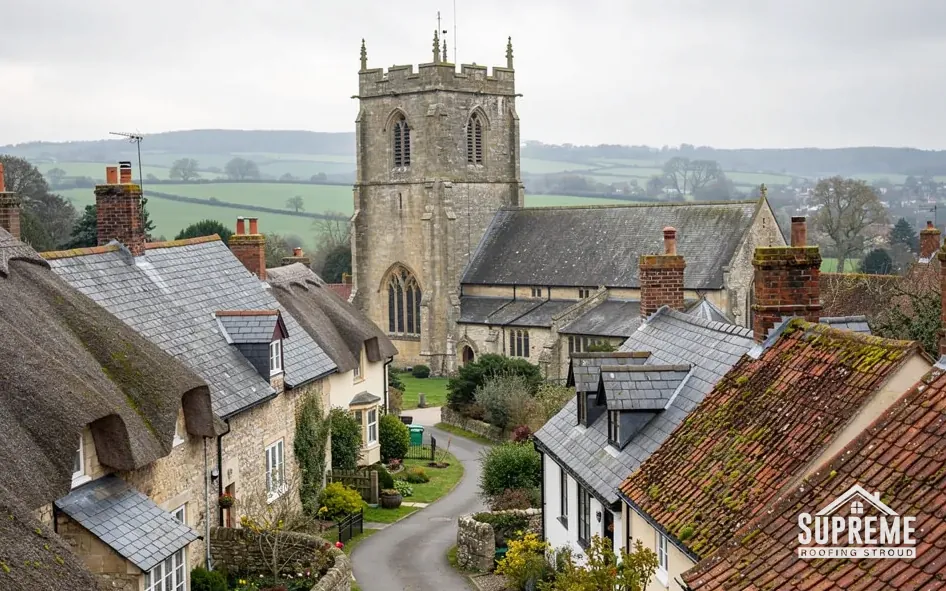
Roof work in South Cerney, where the River Churn meets the gravel lakes of the Cotswold Water Park and a Grade I church stands at the heart of the village.
South Cerney at a glance
- Distance
- 16.5 road miles east-south-east of Stroud
- Council
- Cotswold District Council
- Conservation area
- South Cerney, first designated 1970
- Listed landmark
- Church of All Hallows, Grade I
South Cerney's roofs beside the Churn and the lakes
South Cerney stands on the River Churn, and the name itself means the river: "South" was added later to tell it apart from North Cerney. It is 16.5 road miles from Stroud, on a bearing of east-south-east, and it lies within the Cotswold Water Park, which has over 140 lakes, most of them formed by gravel extraction. For anyone planning roof work, the useful point is how much water is around. Houses here sit close to a river and a lot of open water, so damp, algae on north-facing slopes and overflowing gutters are things we look for on a survey, though we confirm each cause on the roof itself rather than assuming it.
It is a sizeable village, and its civil parish had a population of 3,998 at the 2021 count. A bigger place means more kinds of roof: a historic core around the church, later housing, outbuildings, garages and extensions with flat roofs. All Hallows church is listed at Grade I, and the village conservation area was first designated in November 1970, with boundary changes in 1990, 1993 and 1999.
The covering on a South Cerney house depends on its age and any past repairs, so the survey identifies it on your own roof. We look at the roof, record it in photographs and write down exactly what covers it before we price the job.

Street of stone terraced houses with slate and clay tile roofs 
Row of stone cottages with mossy clay tile roofs along a quiet lane
Chapter 01
Gravel lakes, the Churn and a roof that has to shed water
Living beside more than 140 lakes puts gutters and drainage first.
Chapter 01In this chapter
The Cotswold Water Park around South Cerney holds over 140 lakes, and nearly all of them began as gravel pits. That landscape is a pleasant thing to live beside, and it gives a roofer one clear priority: water management. A roof beside open water and a river meadow gets its share of damp air, leaf litter and moss, and a house with poor drainage shows it first at the gutters and the lower courses of the roof.
In this chapter
The lowest few courses of a slope, just above the gutter, are where the effects of a blocked gutter turn up. Water backs up behind the gutter, soaks the timber fascia and the ends of the rafters, and runs down the wall. On an older house the rafter feet and the wall plate are the parts that cost money when they rot, so the survey takes in the loft side of the eaves too, not only the view from the scaffold, and anything soft is photographed.
Moss and algae
Moss holds moisture against a covering and lifts it at the edges, so it is worth removing. Where it has grown thickly, it can also hide slipped or cracked pieces, which is another reason to scrape it off before judging the roof underneath. MyBuilder's 2026 guide puts manual scraping at £5 to £10 per m² and soft washing at £15 to £20 per m², and adds a caution about pressure washing on fragile tiles. Those are national ranges, not our prices. Our roof cleaning and moss removal page explains which method suits which covering, and why removing moss from a roof in poor condition can expose problems you then need to repair.
Gutters that keep up
A river village needs gutters that can cope with a heavy shower, not just a drizzle. We check the fall, the number of downpipes and whether the outlets are big enough for the roof area that drains into them. Sometimes the answer is simply another downpipe, and a half-day job saves a wall from a long soaking. Water should also be taken away from the base of the wall, not left to sit beside it, so we look at where the downpipes discharge as well. Where the ground has little fall that can mean a soakaway or a connection to a drain, and if it does, the survey notes record it and the quote covers that work as well as the roof.
Beside open water, the gutter does as much work as the roof.
- 140+lakes in the Cotswold Water Park, most formed by gravel extraction
- 3,998people in the South Cerney civil parish at the 2021 count
- 1970year South Cerney's conservation area was first designated
Chapter 02
All Hallows, the hidden crucifix and what a wall can conceal
A Grade I church and a find inside a wall of 1915 make the case for looking before cutting.
Chapter 02In this chapter
The Church of All Hallows is Grade I listed, the highest of the three listing grades. In 1915, two twelfth-century fragments of a carved wooden crucifix were found hidden in a wall of the church, and the British Museum bought them in 1994. Nobody sets out to find something like that when they go to repair a roof, but old buildings do hide things, and the story is a fair argument for taking time before cutting into old fabric.
On an old roof, what we most often find hidden is damage that nobody could see from the ground: rot in a wall plate, a patch of timber eaten by beetle, or an old repair done in the wrong material. On a historic building, any opening-up should be recorded. We photograph each stage, keep reusable materials aside and tell you what we have found before deciding anything.
The permission route for a church
Whether a church needs listed building consent depends on its use. One still in use for worship falls under the ecclesiastical exemption, so repairs go through a faculty from the diocese. Once worship has stopped, the council's listed building consent normally applies. We survey and price the roof, then your parish takes the document through its process.
The roof above a church aisle
A church roof is a different build from a house roof. Spans are long, timbers are heavy, and the covering has to be carried on a structure that was designed centuries ago. Valleys between nave and aisle, lead gutters behind parapets and stone copings are the first places to check. Water that finds its way into a church wall can run down inside the stonework for a long way before it shows, so the survey includes the inside face of the wall as well as the roof itself.
Myth: A listed church roof can only be fixed by a specialist who has never worked on anything else.
Fact: The approvals are specialist, but the roof work itself rests on a good survey, matching materials and careful recording.
Houses near the church
Being inside a conservation area matters even for a house without a listing. Like-for-like repairs are not normally development. A change in covering, a new opening or an extension is where planning enters. Ask Cotswold District Council's planning team, and if you are thinking about roof windows, our guide to roof windows in a conservation area sets out the position.
A listed house is different again, because the listing applies to the whole structure, roof included. For listed buildings the first call is to the conservation officer, and we can supply photographs and a written description of the roof to support it.

Chapter 03
Barracks, estates and the flat roofs of a larger village
A parish of about 4,000 people has plenty of flat roofs, garages and extensions.
Chapter 03In this chapter
The Duke of Gloucester Barracks occupies the site of the former RAF South Cerney, about a mile from the village. That is a military site and not our work, but it sits in a parish of nearly 4,000 people, and a parish that size has houses, garages and outbuildings of every age, with extensions added to many of them over the years.
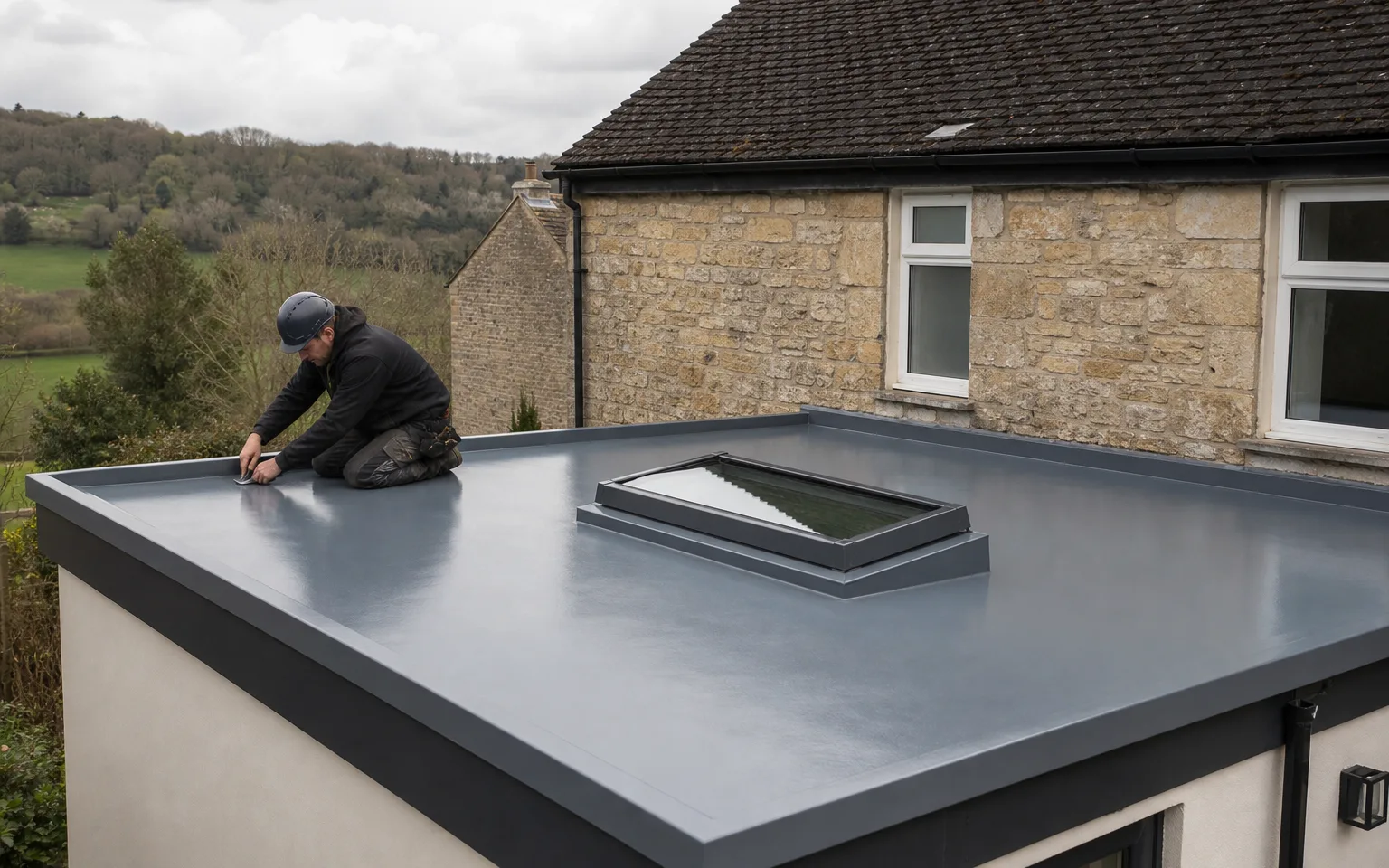
On many houses the flat roof is a garage, a kitchen extension or a porch, and it is the part we are asked to look at because it leaks. MyBuilder's 2026 flat roof guide gives typical replacement costs of £2,800 to £7,500 for a flat roof, averaging about £75 per m². EPDM runs £90 to £130 per m², GRP £95 to £150 and bitumen felt £70 to £100. Those are national ranges that depend on the size of the roof and the access.
Choosing between the coverings
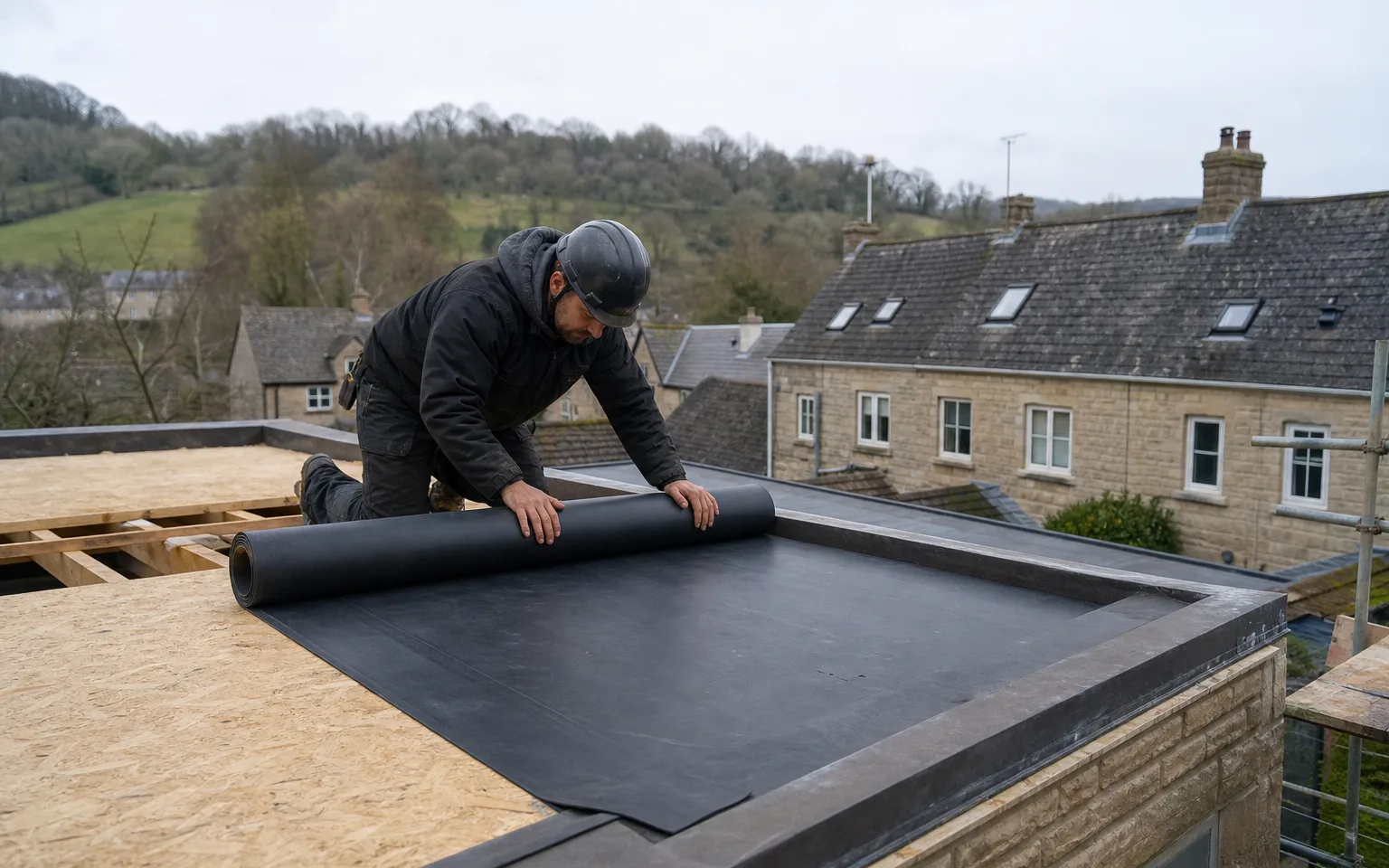
EPDM is a rubber membrane that arrives in a single sheet, so a small roof has few or no seams. GRP, glass-reinforced plastic, is laid wet and cures to a hard shell. Felt comes in layers. For each, typical lifespans vary widely: EPDM 20 to 30 years or more, GRP 25 to 40, and built-up felt 10 to 20, and workmanship matters as much as the material. Our flat roofing page compares them.
Falls and ponding
A flat roof is not flat. BS 6229 recommends designing for a fall of 1:40 to give a finished fall of 1:80. If water stands on an old roof for more than a day after rain, the fall has been lost or the deck has sagged. On a survey we check where the water sits, then measure how much it would take to correct it, and the quote covers the tapered insulation or the new deck.
With open water nearby, a flat roof deserves a drainage check at least once a year. Gather leaves from the outlet in autumn and look at the upstands where the membrane meets the wall.
Garages and outbuildings
Many garages in a village of this size have a pitched roof over a single skin, with no insulation and no underlay under old tiles. If a garage roof sheet is asbestos cement, careful removal of intact sheets is non-licensed work under HSE guidance, and substantial breakage makes it notifiable. We look at the sheets before anything else, then set out how they would come off, where they would go and what would replace them.
| Flat roof covering | Price per m² (typical) |
|---|---|
| Bitumen felt | £70 to £100 |
| EPDM | £90 to £130 |
| GRP | £95 to £150 |
| PVC single-ply | £95 to £140 |
Map showing South Cerney and the Stroud service radius, with nearby towns we also cover.
Near South Cerney
Roof work we do here
All Hallows and the Water Park lakes
Does living beside the Cotswold Water Park lakes change how my roof should be looked after?
It makes drainage the priority. With open water and a river close by, we look hardest at gutters, downpipes, moss on shaded slopes and the lower courses of the roof, then confirm each cause on the roof before recommending work.
Can a Grade I church like All Hallows be re-roofed in a different material?
That would be a question for the church's approvals, not for us. A church in use goes through a faculty from the diocese, and like-for-like is the principle that carries weight with listed buildings. We survey, photograph and price, and the parish decides the route.
Our South Cerney garage roof is flat and ponds after every shower. Is that normal?
It is common, but it is a sign. Standing water means the fall is lost or the deck has sagged. We measure where it sits and quote the repair or a tapered replacement, and the written quote shows what the correction costs.
Is my house inside the South Cerney conservation area, and does it matter for a repair?
The conservation area was first designated in November 1970 and its boundary was last changed in 1999; the council's maps show where it runs. A like-for-like repair is not normally development, so it rarely matters. If you plan a change of material, check with Cotswold District Council first.