
Roofers in Down Ampney
Roof work in Down Ampney, a village whose church dates from 1265 and whose big house was home to the Hungerfords, north of Cricklade and a long drive from Stroud.
Down Ampney at a glance
- Distance
- 19 road miles east-south-east of Stroud
- Council
- Cotswold District Council
- Conservation area
- Down Ampney, designated 1991
- Listed landmarks
- All Saints and Down Ampney House, both Grade I
Down Ampney's roofs, from a 13th-century church to the old vicarage
Down Ampney is 19 road miles from Stroud, east-south-east across the Cotswold District, and the drive ends in a village of only 572 people at the 2021 count. Two Grade I buildings in a parish that size shape the way roof work is done here. Both All Saints' Church and Down Ampney House are listed at the top grade, and the Down Ampney Conservation Area was designated by Cotswold District Council on 18 July 1991.
The village sits about three miles north of Cricklade, and the lie of each roof is assessed on the day of the survey. What the record does show is a mix of grand and modest buildings: a church consecrated in 1265, a country house with a long ownership history, and the ordinary houses, farm buildings and outbuildings of a small parish.
Ralph Vaughan Williams was born at the Old Vicarage in 1872. A former vicarage can be a sizeable house, and a roof on a building like that may have several pitches and chimneys, with a good deal of its cost in access. We survey every roof from the outside and the loft, photograph it, and name what covers it before pricing.

Stone village houses with slate and tile roofs above green fields 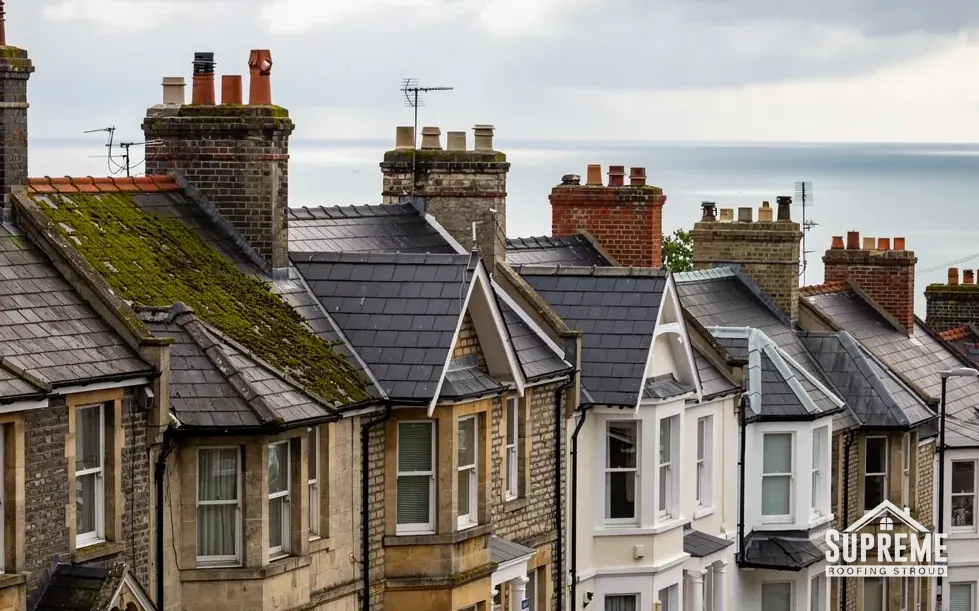
Row of Victorian terraced houses with slate roofs, bay windows and brick chimneys

Chapter 01
All Saints, a church consecrated in 1265
Eight centuries of repairs have left All Saints with a roof that rewards close attention.
Chapter 01In this chapter
All Saints' Church was consecrated in 1265 and carries a Grade I listing. A building that old has been mended, re-covered and altered many times, so its roofs are layered histories, with later repairs on top of earlier work. Our job on a roof like that is to read those layers before touching them: which part is original timber, which part is a later patch, and where the real source of a leak lies.
In this chapter
That reading is done from the inside as much as the outside. In the roof void we look at the timbers for old water staining, for the pale dust of beetle and for signs that a patch has been fixed with the wrong nail or the wrong bedding. Outside, we look for slipped or cracked pieces, failed pointing along the verges and tired flashings. Each finding is photographed and numbered so that the written quote can refer to it.
Why the grade matters to a repair
Every listed building is protected by law as a whole, whatever its grade, inside and out. Changes that affect its character need consent, and a repair that looks small, such as a different tile or a modern mortar, can count. The sensible approach is simple: keep to the same material, the same method and the same appearance, and ask before changing any of them. We are happy to work alongside a conservation officer or architect where one is involved.
Smaller buildings nearby
Not everything near a Grade I church is itself listed, but it can still sit inside the conservation area, where the same principle of like-for-like repair holds. A boundary wall, a barn or a village hall roof in the conservation area calls for a covering that matches what was there, not whatever the supplier has in stock. If the first covering has gone out of production, we hunt for a near match in colour, size and texture, and samples come to you before an order is placed.
For leadwork on a tower, parapet or valley, our lead roofing page explains how the codes differ and why lead details are the first thing to look at on an old building.
On a roof this old, the repairs tell you as much as the original build.
Chapter 02
A Grade I house, the Hungerfords and the Earls of St Germans
Down Ampney House passed through great families, and its roofs carry a great deal of lead and stack.
Chapter 02In this chapter
Down Ampney House is listed Grade I. The estate was once a seat of the Hungerford family and later passed to the Earls of St Germans. A big house of that kind has a roof that is closer to a group of roofs: ranges at different heights, valleys between them, parapets, chimney stacks and lead gutters hidden from the ground. Leaks in such a building often start at the details rather than on the main slopes, so the details are where a survey does its work.
Lead sheet is the usual answer for valleys, flashings and parapet gutters, and its codes matter. Leadworx calls code 4 the standard for everyday flashings, code 5 suits more demanding details, and heavier codes are chosen for gutters and larger flat areas. MyJobQuote says lead flashing can last over 80 years when installed correctly, and over 100 years in the higher codes. Those are typical figures, not promises, because the life of any lead detail depends on how well it has been fixed and whether it can move as it heats and cools.
Chimney stacks on big roofs
A large house usually has several tall stacks. A chimney that is exposed on all sides is a long way from the next solid wall and gets little shelter. Pointing washes out and flaunching cracks, and a worn flashing around the foot of the stack lets water into the wall below. Repointing a chimney by house type is priced nationally at a few hundred to over a thousand pounds, MyBuilder 2026, and a full stack rebuild at £2,000 to £10,000 or more. The wide range reflects height, access and how much of the stack is sound. Our chimney repairs page sets out the options in order, from repointing to rebuild.
Planning a large job
On a historic estate house, we price access first, because scaffold across several ranges is a major cost. We recommend phasing work so the most urgent areas, valleys, gutters and stacks, are dealt with first, with the quieter slopes following when the budget allows. Each phase is quoted in writing, so you can see what the work involves. If a Grade I or conservation area building needs consent for any of the work, the programme allows time for that before a start date is fixed, so the scaffold is not standing idle while paperwork is decided.
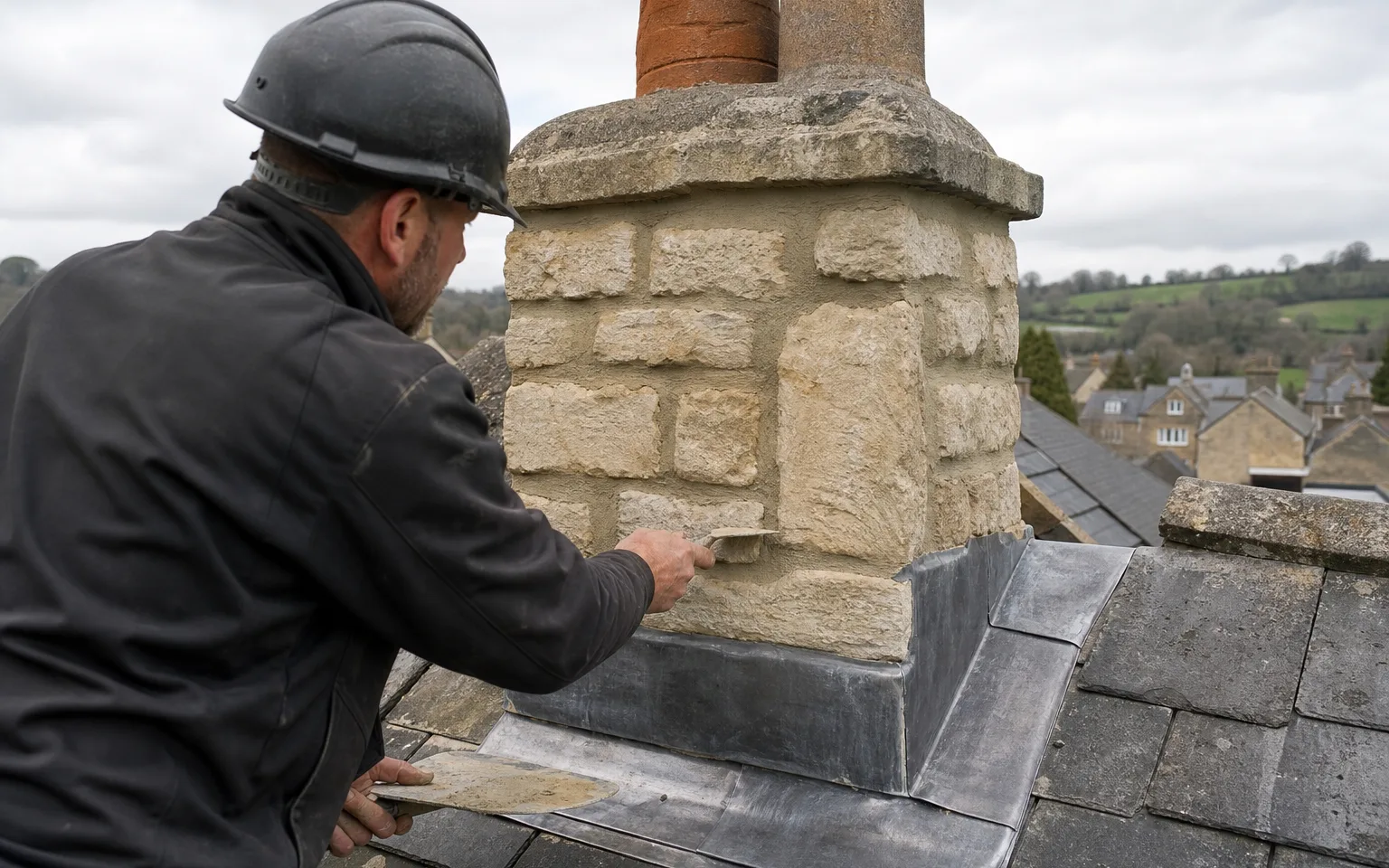
Looking at the roof from above
Where a roof is too steep or too fragile to walk, a survey from the scaffold or a tower is safer than a ladder against the gutter. We note the line of the ridge, any dip in the slopes and the condition of every valley, and we check the inside of the roof for daylight, staining and damp timber. If the roof is a candidate for a drone survey on a very large building, the survey report will mention it, with the typical national range for it, £200 to £400 per MyBuilder 2026, before you decide.
| Code | Thickness | Typical use |
|---|---|---|
| Code 3 | 1.32 mm | Soakers, light duty |
| Code 4 | 1.80 mm | General flashing work |
| Code 5 | 2.24 mm | Flashings, pitched valley gutters |
| Code 6 | 2.65 mm | Larger roofs |
Chapter 03
The wartime airfield, Arnhem and the Old Vicarage
From Dakotas in 1944 to a composer's birthplace in 1872, the village has recent and distant history in the same parish.
Chapter 03In this chapter
The wartime airfield at Down Ampney was a Dakota base that played a part in the Battle of Arnhem in 1944. That is a lot of history for a village of 572 people, and it makes local buildings matter to the people who own them. If you own a building tied to the airfield, or a house built after the war, the roof will be a different job from the church or the great house, and we treat it that way. A single estate cottage and a former airfield outbuilding may share a postcode and share very little else, so each roof is surveyed on its own merits.
In this chapter
If your building dates from the middle of the twentieth century, the timbers may be lighter and the covering may be a type that was cheap at the time. We check the rafters, the felt or underlay and the fixings carefully, because those are the parts that age. Flat-roofed outbuildings and garages from that period may carry a sheet material that needs identifying before it is touched, so we do not guess. HSE guidance treats careful removal of intact asbestos cement sheet as non-licensed work, while heavy breakage moves it into the notifiable category.
The Old Vicarage and houses like it
Ralph Vaughan Williams was born at the Old Vicarage in 1872, and in 1906 he named his hymn tune for "Come Down, O Love Divine" after the village. A former vicarage can be a big house, and its roof may have tall stacks, a hipped or double-pitched shape and a long run of gutter. Maintenance on a house like that is a matter of keeping up, not rushing: a gutter cleared before winter, a slipped slate replaced within the month, a stack looked at every few years. A yearly walk round with binoculars, from the garden or the lane, catches most things early, and a photograph taken each time gives you something to compare against.
Myth: A small leak in an old house can wait until the roof is due a full replacement.
Fact: Water spreads along timbers and walls and does damage out of sight, so a prompt repair is usually cheaper than waiting.
What a repair is worth
MyBuilder's 2026 repair guide puts minor roof repairs at £100 to £300 and moderate repairs at £500 to £1,000 nationally. Our roof repairs page explains how we tell a patch from a replacement, and why a small repair done promptly usually costs less than the same repair after the leak has spread into the ceiling.

Map showing Down Ampney and the Stroud service radius, with nearby towns we also cover.
Near Down Ampney
Roof work we do here
All Saints, Down Ampney House and the old vicarage
I live near All Saints' Church in Down Ampney. Do the Grade I listings affect my own roof?
Only if your own building is listed or sits within the conservation area designated in 1991. The church and Down Ampney House are listed, but a neighbour's listing does not protect your house. We photograph your roof and check the position with Cotswold District Council's conservation team before planning any change.
How do you approach lead valleys and parapet gutters on a large old house?
We trace each gutter from the outlet upwards, looking for splits, lifted laps and blocked outlets, and photograph every length. The quote covers each valley or gutter, with the lead code stated, so you see which sections need work and which can be left.
Can a chimney stack on a big roof be repaired without a full rebuild?
Often it can. Repointing, new flaunching and a replaced flashing deal with most leaks, and a rebuild is for stacks that lean, bulge or have lost their bricks. The survey says which, and the quote covers each stack, whether it needs a repair or a rebuild.
My house is a former vicarage with several chimneys. How is the scaffold priced?
Scaffold across several chimneys and pitches is allowed for in the quote, based on the survey measurements. If work can be phased to spread cost, we show the scaffold for each phase so you can compare.