

Roofers in Meysey Hampton
A practical guide for owners of Meysey Hampton roofs, from the slate-roofed church of St Mary the Virgin to Villars Farmhouse, in a village inside its own conservation area near the Wiltshire border.
Meysey Hampton at a glance
- Distance
- 20.8 road miles east of Stroud
- Council
- Cotswold District Council
- Conservation area
- Meysey Hampton Conservation Area
- Notable building
- Church of St Mary the Virgin, Grade II*
Meysey Hampton's roofs: a church in slate and a village under a conservation area
Meysey Hampton lies in the south Cotswolds, close to Fairford and the Wiltshire border, and the village has its own conservation area. That designation, administered through Cotswold District Council, is the first thing to know before planning any visible change to a roof here. Mending a roof with the same material it already has seldom raises a question. Swapping the covering, cutting in a rooflight or altering a chimney does, and it merits a word with the planners at Cotswold District Council before any stock is bought.
The best-recorded roof in the village is the church. The Church of St Mary the Virgin was consecrated in 1269, is thought to have been paid for by the Knights Templar, and was restored between 1872 and 1874 by the London architect James Brooks. It is built of rubble masonry with slate roofs, and it is listed Grade II*. Slate on a rubble-walled building is a useful reminder that the Cotswolds are not all stone-slate country, and that a slate roof has its own checklist: headlap, fixings, the condition of the nails and the flashings where roof meets wall.
Villars Farmhouse in the village is also listed Grade II*, so the church is not the only protected roof here. The Imperial Gazetteer of 1870 to 1872 counted 352 people in 80 houses in the parish, which gives a picture of a small parish. Roof work today sits on top of that older pattern, and a farmhouse range, an outbuilding and a later addition each need their own approach.

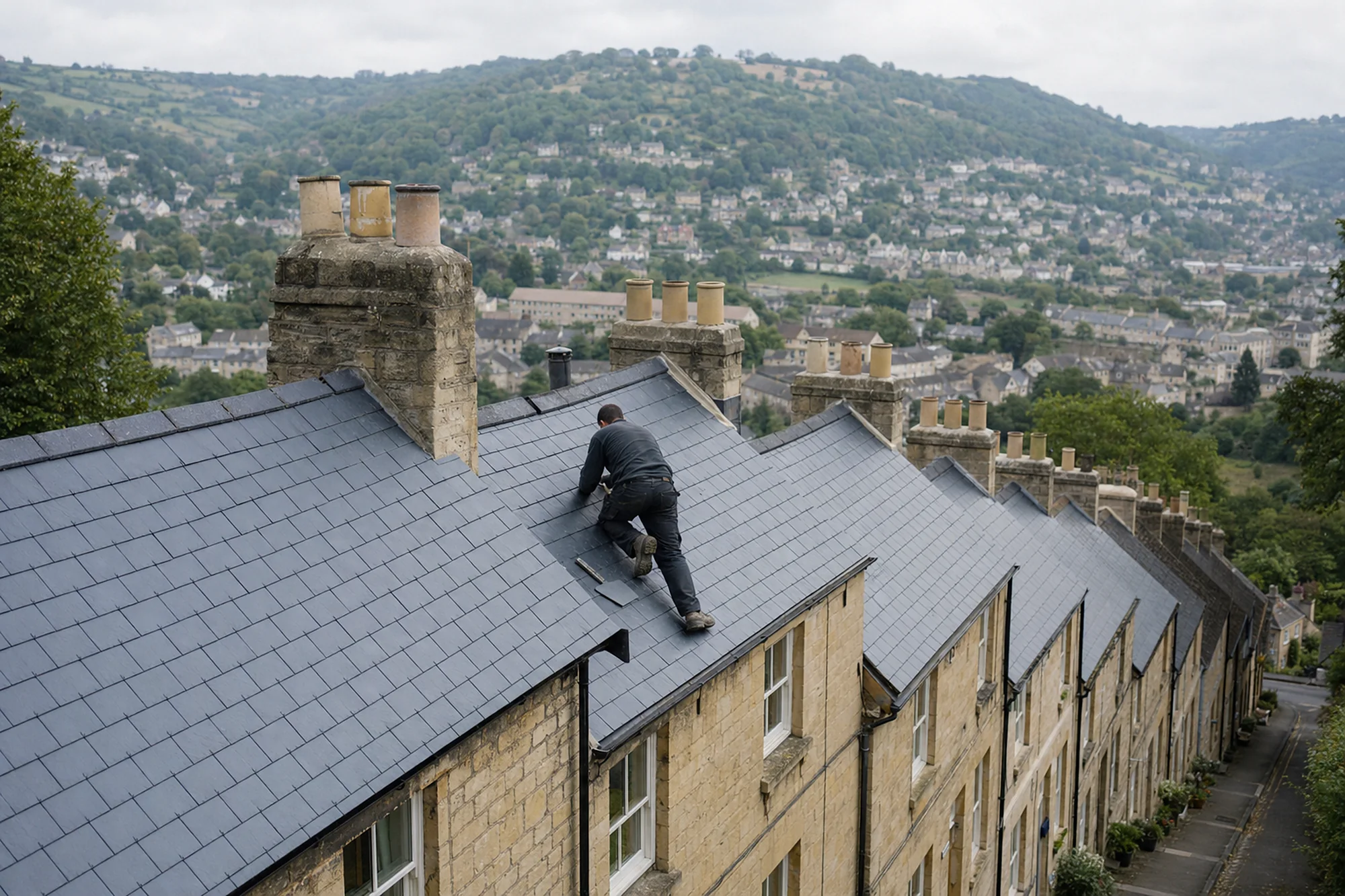
Hillside terraces of stone houses with slate roofs and chimneys 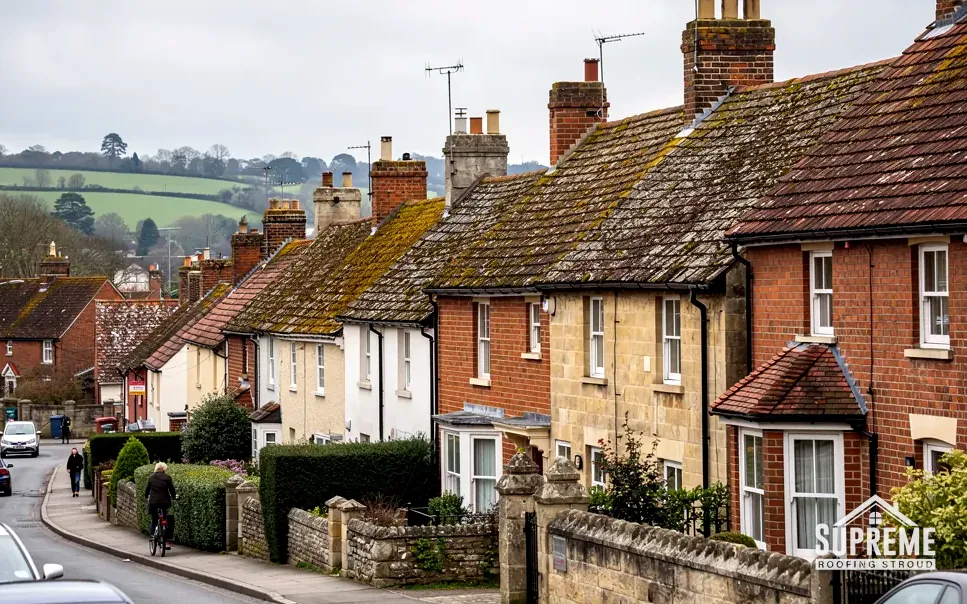
Sloping street of brick and stone terraced houses with mossy tiled roofs
Chapter 01
Slate on St Mary's and what a slate roof needs
A rubble church under slate shows what to check on any slate roof in the village.
Chapter 01In this chapter
St Mary the Virgin is described as built of rubble masonry with slate roofs, and that makes it a handy teaching case. A slate roof is a series of overlapping layers. Each slate is held by nails or hooks and shielded from the rain by the slate above it. The overlap between one course and the second one up is the headlap, the margin that stops wind-driven rain from creeping under the slate to the batten. Where a pitch is shallow, the headlap has to be larger. BS 5534 indicates a minimum pitch of 20 degrees for natural slate in moderate exposure, using a 500 mm slate with a 115 mm headlap, and the roofer should check the maker's data for the slate actually in use.
In this chapter
Age is the other question. MyBuilder puts natural slate at 80 to 100 years or more, and Welsh slate often passes a century. Fixings usually go before the slate does. Iron nails rust, and a slate that has dropped by an inch shows the nail has let go, even though the stone is sound. That is why we count slipped slates and look at the nail line before recommending anything. A cluster of slips in one area often points to a local fixing failure that can be mended slate by slate, which can be repaired with new fixings and matching slate. Widespread slipping across a slope points to a strip and re-slate, with the good slates kept for reuse.
Flashings and the junctions
A church has more junctions than a house. Wherever slope meets a tower, a parapet or a higher wall, lead flashings and soakers carry the water out over the slate. Those are the parts we look at before the slates themselves. Lead has its own lifespan, and a well-fitted flashing can last well beyond the slates it protects, but it can split along folds or lift at the wall. Our slate roofing page explains how we tell a repair from a re-slate on older roofs.
Matching slate to slate
If a slate roof on an older building needs partial work, we match like for like: the same material, the same size where it can be found, and a colour and texture that settle in with what is there. Mixing sizes or sources on one slope shows from the road, and inside a conservation area that is the kind of thing a planning officer notices. A small stock of the original slate, kept from earlier strips of the same roof, is often the best match available. We ask whether any was saved in an outbuilding or loft before we order anything new.
A slipped slate usually means a failed nail.
| Roof pitch | Headlap |
|---|---|
| 20 degrees | 115 mm |
| 22.5 degrees | 105 mm |
| 25 degrees | 95 mm |
Chapter 02
Consecrated in 1269, restored by Brooks in 1872 to 1874
Roofs that have been repaired for centuries carry layers of work that a survey has to read.
Chapter 02In this chapter
The church history in Meysey Hampton runs in two main steps. It was consecrated in 1269, with the Knights Templar thought to have financed it, and then restored in 1872 to 1874 by James Brooks. The Imperial Gazetteer entry for the parish calls the church ancient and cruciform. A cruciform plan has a nave, transepts and chancel meeting at a crossing, so the roofs meet at angles and valleys, and each meeting point is a place where water collects and flashings do their hardest work.
In this chapter
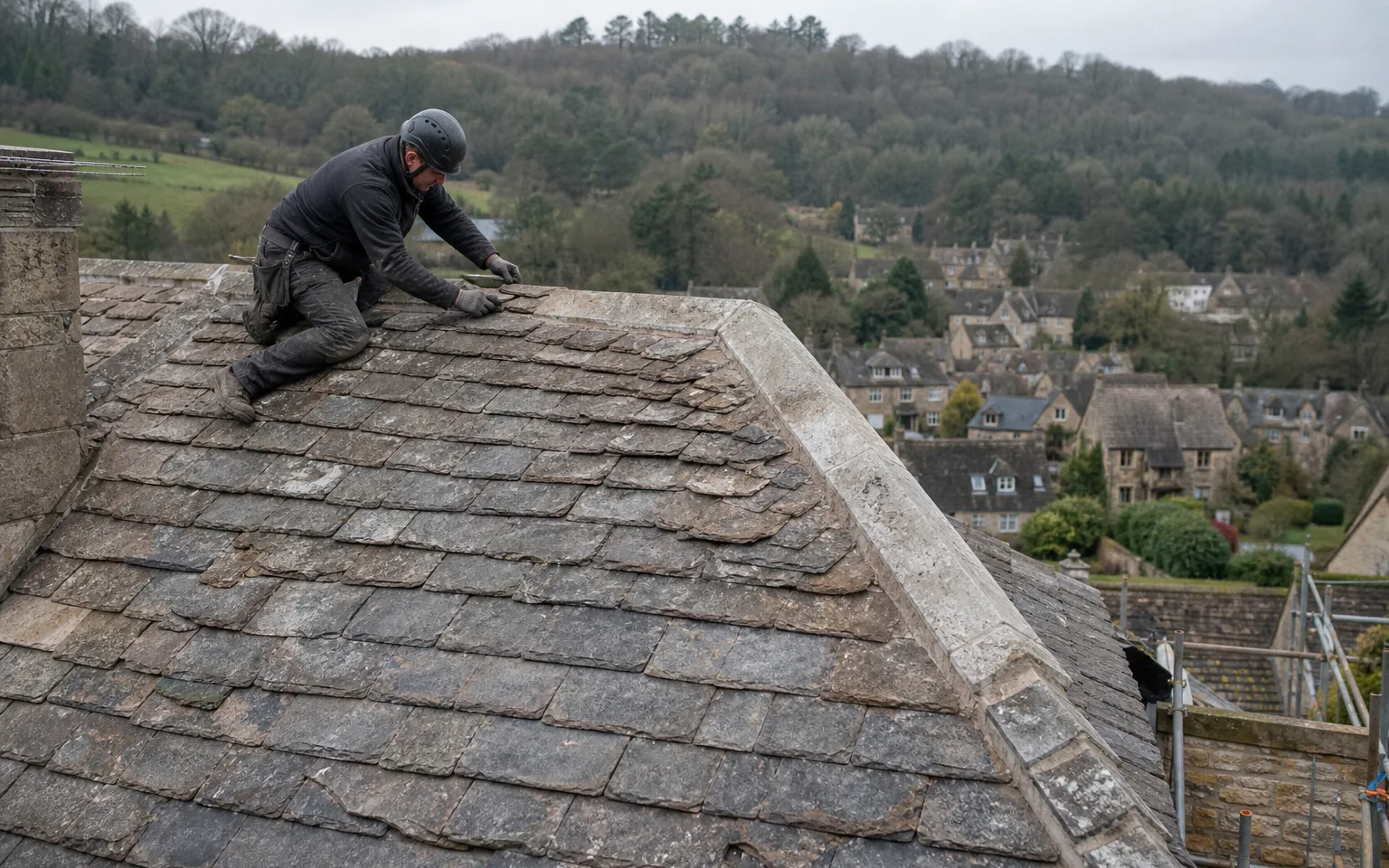
For a roofer, a building restored in the 1870s offers a lesson in layered repairs. Work from one period sits alongside work from another: timbers of different ages, coverings that have been patched, lead that was relaid in one campaign and mended in another. A survey has to separate the sound from the worn, rather than treat the whole roof as one age. We photograph each slope, the valleys, the abutments and the timber we can see from the loft, and we record where earlier repairs have been made so the next person has a map.

Valleys on older roofs
A valley is where two slopes meet and water from both runs into a channel. It may be lined with lead, or formed from specially cut slates in a swept form. The Cotswold District guidance describes the traditional swept valley as built from specially cut stone slates, and it advises against close-mitred or open lead alternatives on those roofs. On a slate roof, a lead-lined valley is common practice, and its condition governs how a whole slope drains. A leaf-choked valley can overflow into the wall below it, and the stain looks like a roof leak.
Parish buildings and ownership
Not every old building in a village is a church. Village halls, former schools and farm buildings may have trustees, committees or a landlord as the decision-maker, and a roof job often waits on a meeting. We write the quote so a committee can read it in one sitting: the whole job explained, with photographs beside it, and the contractor's questions answered in advance. Treasurers tend to ask what is certain and what is an allowance, so the quote marks which parts are firm and which depend on what is found once the covering comes off. Where a building is listed, a committee does well to have the evidence and the council's view in hand before money is spent, and our roof repairs page shows how a repair quote is laid out.
- 1269year the Church of St Mary the Virgin was consecrated
- 1872-74years of the restoration by the London architect James Brooks
- 352people living in 80 houses in the parish, according to the 1870-72 Imperial Gazetteer
Chapter 03
Villars Farmhouse, the conservation area and farm roofs near Fairford
In a village on the Wiltshire edge, listed farmhouses and outbuildings shape how work is planned.
Chapter 03In this chapter
Villars Farmhouse is listed Grade II*, and the village has its own conservation area. With both in play, the practical rule is simple: find out the status of your building before you ask for a price. Listed building consent for roof work comes from Cotswold District Council. The council also decides whether a proposed change in a conservation area needs planning permission, and a straight swap of worn slate for the same slate normally leaves the appearance of the building unchanged, so it is rarely the sticking point.
In this chapter
The edge of a farm is a different roofing problem from the house. Farm buildings tend to have long, plain roofs on wide spans, with gutters that run for many metres and few places to hide a leak. They are also where we are most likely to meet an old garage or lean-to roofed in asbestos cement sheet. Whole, undamaged cement sheet can be lifted off without a licence if it is handled with care, in line with HSE guidance, but a roof that has broken up badly becomes notifiable work. We assess the sheets before pricing. Cracks, crazing and old repairs tell us how they will behave when lifted, and the quote sets out how the material is handled and taken away.
Distance and logistics
Meysey Hampton is 20.8 road miles east of Stroud. For anything beyond a small repair we plan the delivery of materials and the position of scaffold from photographs and a survey, so that the day itself runs to a written plan. Where a lane is narrow or a farm track is soft, we say what is practical in advance, from where a delivery lorry can stand to whether a telehandler can reach the building at all. That information goes on the access page of the quote, so nobody is surprised on the day.
Bats and farm buildings
Older farm buildings are good habitat for bats and nesting birds, which are protected, so we look for signs of them before disturbing a roof space. Our pitched roofing page walks through the layers of a pitched roof from rafter to covering, which is useful if you are trying to understand a quote for an outbuilding.

Map showing Meysey Hampton and the Stroud service radius, with nearby towns we also cover.
Near Meysey Hampton
Roof work we do here
Villars Farmhouse and St Mary's slate roofs
St Mary's in Meysey Hampton has slate roofs on rubble walls. What goes wrong with slate in that setting?
Fixings usually fail before the slate does: rusted nails let slates slip, and flashings at the wall junctions can lift or split. We look at the nail line and the abutments first, and we match any replacement slate to the old.
Villars Farmhouse is listed Grade II*. Does that affect a neighbour's roof?
Only the listed building is directly protected, but the village has its own conservation area, so visible changes to roofs inside it are worth raising with Cotswold District Council. Repairs in the same material are the easy case.
My Meysey Hampton outbuilding has an old cement-sheet roof. What happens to it?
We assess the sheets first. Sound asbestos cement sheet can be taken off without a licence when handled carefully, while a badly broken roof must be notified to the enforcing authority first. The quote sets out removal, disposal and the new covering.
Can a committee or trustees get a quote they can act on?
Yes. We write the quote to cover each stage and supply survey photographs, so a committee can see what is proposed and why before it makes a decision.