

Roofers in Fairford
Roof work in Fairford, the market town on the River Coln where a wool merchant's church, interwar council housing and postwar estates sit within a conservation area 22.8 road miles east of Stroud.
Fairford at a glance
- Distance
- 22.8 road miles east of Stroud
- Council
- Cotswold District Council
- Conservation area
- Fairford Conservation Area
- Setting
- River Coln, six miles east of Cirencester
Fairford's roofs: a wool-trade church, a market street and a growing town
Fairford grew where a ford crossed the River Coln, which is where the name comes from. Per the Victoria County History, the river valley lies on the Great Oolite and Forest Marble, with Oxford Clay to the south overlaid in places by gravel beds, though large-scale excavation did not start until 1944. By the twelfth century it was a market town and borough in an important wool-growing region, and that trade left its mark on the best building in the town.
St Mary's Church was mostly rebuilt in ashlar in the late fifteenth century at the expense of the wool merchant John Tame, keeping the lower part of the fourteenth-century tower. It houses what is described as the most complete set of medieval stained glass windows in the country, and it is listed Grade I. For anyone planning roof work nearby, the church is a useful marker: fine-jointed ashlar and glass of that value mean that scaffold and falling debris in the churchyard are never casual matters.
The rest of the town grew in steps. Victory Villas, finished in 1921, started the council housing. Private houses followed at Westend Gardens by 1959, with more in the 1960s, and the population reached 2,439 in 1951, after the airfield was built in neighbouring Kempsford parish in 1944 and a refugee camp opened in Fairford Park. Fairford has its own conservation area, which Cotswold District Council administers. A roof in the historic core, a villa from the 1920s and a house from the 1960s each ask for a different survey, and we treat them that way.

Stone terraced houses with slate roofs and chimneys stepping up a hill 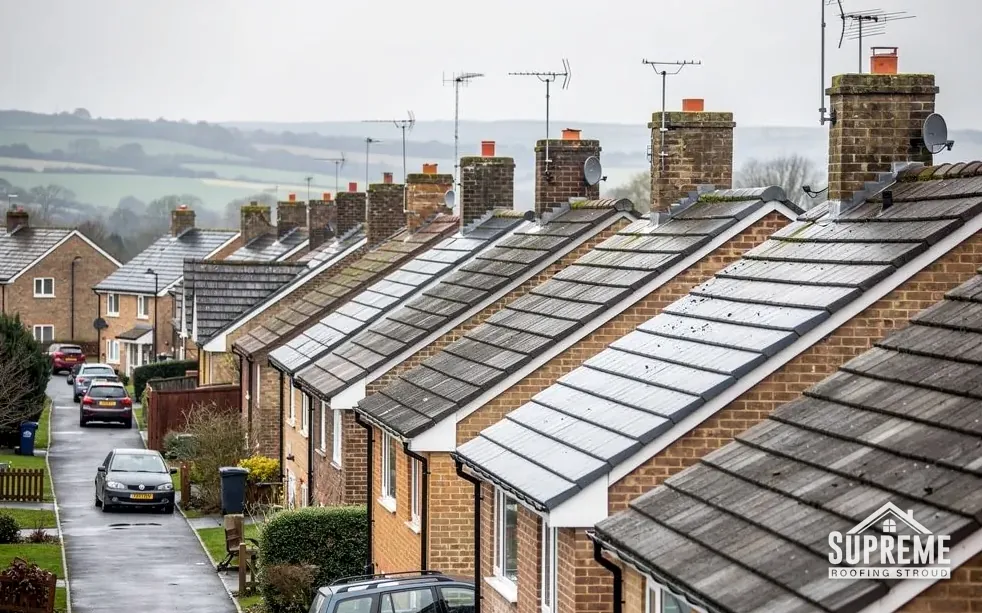
Terraced houses on a hillside street with tiled roofs and brick chimneys

Chapter 01
John Tame's ashlar church and the high roofs of a wool town
A late medieval church rebuilt for a wool merchant sets the standard for care in the centre of Fairford.
Chapter 01In this chapter
When Fairford's church was rebuilt in the late fifteenth century, the money came from a wool merchant, John Tame. Wool had made the town prosperous, and the new building was done in ashlar, which is cut and dressed stone laid in fine joints. Ashlar parapets and tall walls shape the roof work that follows. Behind a parapet a gutter often runs along the foot of the slope, lined in lead, and when that lining cracks, water goes into the wall instead of out through a downpipe.
In this chapter
We look at these hidden gutters before almost anything else. A parapet gutter that has lost its fall holds a little water after every shower, and over the years that water finds a joint. The cost of a leak found early is a lead repair. The cost of one found late is stonework, plaster and timber. Lead can outlast several coverings if the right code was used, yet it needs looking at from time to time, because an unchecked fold is how small splits begin.
Glass, scaffold and the churchyard
Fairford's windows are what people travel to see, and anyone planning scaffold near the church has to think about them. Boards, tubes and tools are kept clear of glazing, and a netted or sheeted scaffold protects the windows from falling debris. That planning is normal for a building of this importance, and it belongs in the written quote, not in a surprise charge. Even for a house a street away, we ask whether stone window surrounds, glazed porches or hanging signs sit close to where boards will go, because it is far cheaper to move a ladder in advance than to repair a pane afterwards.
Permissions for church and town
St Mary's, being in use, falls under the ecclesiastical exemption, and faculty from the diocese governs its roof in place of any council consent. The buildings around the market place are different. If one is listed, Cotswold District Council is the body that grants consent, and the conservation area adds a layer for visible changes. Our roof replacement page sets out what a full strip and re-cover involves, which is useful background if you are comparing a repair with a larger job.

Why the junctions get the attention
On an old building in the centre, the weak spots are the joins: where slope meets wall, where a stack rises through the ridge, where one range butts against another. Our surveys count those junctions and photograph them, so the quote reflects the real number of details and not a guess at an average house.
A parapet gutter that holds water will eventually find a way into the wall.
Chapter 02
From Victory Villas to Westend Gardens: a century of housing
Three building campaigns in one town give three sets of roofs to survey.
Chapter 02In this chapter
The County History records how Fairford grew in the twentieth century. Council housing began with Victory Villas, completed in 1921. Private building followed at Westend Gardens by 1959, with more through the 1960s. In between, the airfield built in 1944 just over the parish boundary and a refugee camp in Fairford Park lifted the population to 2,439 in 1951, before it fell back to 1,602 by 1961. That is the shape of the town's housing: a handful of interwar council houses, a wave of postwar building, and an older core that came before all of it.
A roof of the 1920s may still carry its first covering, which would put it past the range that sources give for most materials. MyBuilder gives natural slate 80 to 100 years or more, but clay tiles at 40 to 60, concrete tiles at 30 to 50 and felt flat roofs at 15 to 30, so the material tells you what to expect. When one house in a row needs work, the others in the same campaign often share the same age and the same weak points. That is useful information for a neighbour deciding whether to repair now. It also helps with timing: two or three owners who need work in the same year can share a scaffold and a skip, which brings down the access cost for each, and we are glad to price a pair of roofs together on that basis.
Postwar houses and bungalows
The houses at Westend Gardens and the 1960s additions are a later generation. We approach them with questions about fascias, soffits, the ventilation of the roof void and the age of any extension. A cold roof needs ventilation at the eaves, and Marley's note on BS 5250, gives 10 mm along the eaves for pitches above 15 degrees with a non-breathable underlay. If the original eaves vents have been blocked by insulation pushed too far, condensation can drip off the felt and look like a roof leak.
Replacing a covering on a street of similar houses
Where a whole road went up to one design, an odd replacement tile shows from the far end. We look at what the neighbours have, then choose the closest colour and profile available. In the conservation area, the council may take an interest in a change of material. Our guttering, soffits and fascias page covers the timber and plastic at the edge of these roofs, which on mid-century houses often needs renewing at the same time as the roof.
- 1921year Victory Villas, Fairford's first council housing, was completed
- 1959year by which private building had reached Westend Gardens
- 2,439population in 1951, after the airfield opened nearby in 1944
Chapter 03
The Coln ford, the gravel beds and flat roofs on later extensions
In the Coln valley, the extensions and garages added over the decades are where water pools.
Chapter 03In this chapter
Fairford is 22.8 road miles east of Stroud, in a parish where gravel overlies clay in places. The ground matters less to a roofer than the buildings on it, but it is a reminder that Fairford was built in a river valley, and the flat roofs we meet on rear extensions, garages and porches are where drainage matters most.
In this chapter
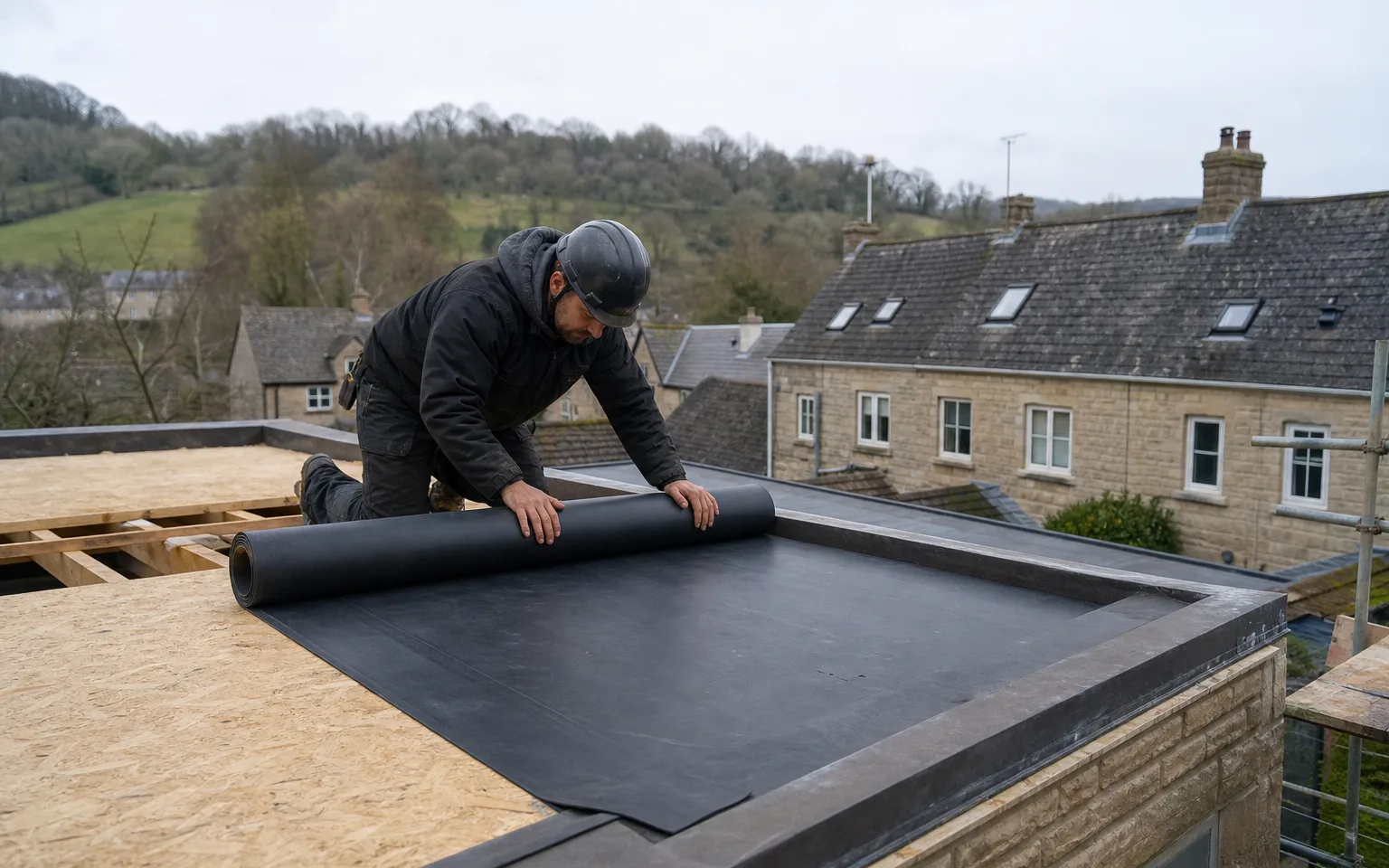
A flat roof is only flat in name. BS 6229 asks for a design fall of 1:40 so that the finished roof drains at 1:80 or better, as IKO and Rockwool both explain. A roof laid dead level, or one that has sagged, holds water, and standing water finds every pinhole in the membrane. EPDM is typically quoted at 20 to 30 years or more, GRP at 25 to 40 years and built-up felt at 10 to 20, and those figures only hold where the drainage is right. When we survey a flat roof, we measure the fall as well as looking at the surface.
What the survey records
On an extension roof we check the upstand where the roof meets the house wall, the edge trim, the outlet, and the state of the deck beneath. A soft deck means a strip back to timber, and we show what we find in a photograph before the quote is written. The photograph also helps if the work is held up for an owner or a managing agent to agree, since the evidence travels with the quote and nobody has to take our word for it. Should the covering prove sound and an outlet be blocked, the report says exactly that. Our flat roofing page lists the coverings we fit and what each costs, using published national ranges.
Gutters at the edge of a flat roof
Makers of rainwater systems ask for a slight tilt towards the outlet, roughly 1:600 to 1:350 depending on the product, with brackets at set spacings. On older extensions the fall has often drifted, and a gutter that holds water becomes the first place for moss and leaves to gather. A sagging run also strains its brackets, which are meant to sit at regular spacing along a straight length, so a re-set is a chance to replace any bracket that has bent or rusted. We re-set the fall at the same visit as the roof repair, because the two jobs share a scaffold or a ladder position and it makes no sense to pay twice for access.
Map showing Fairford and the Stroud service radius, with nearby towns we also cover.
Near Fairford
Roof work we do here
Fairford's wool church, Victory Villas and flat extensions
Fairford's church was rebuilt in ashlar. Why does that matter for the roof?
Ashlar has fine joints and tall parapets, and behind a parapet there is usually a lead-lined gutter. If that lining fails, water enters the wall instead of reaching a downpipe, so we inspect those gutters first.
My house is one of the Victory Villas era. Is the roof likely to be original?
It could be, which would make it older than the usual lifespan quoted for most coverings. We examine the covering, the fixings and the timbers, then explain whether repair or a full re-cover is the better route.
Do flat roofs on a Fairford extension need a minimum fall?
Yes. BS 6229 recommends a design fall of 1:40 to give a finished fall of 1:80 or better. A roof that ponds is a drainage problem, so we measure the fall at survey.
Does Fairford's conservation area stop a roof being replaced?
No, but visible changes are worth raising with Cotswold District Council. A replacement in the same material is straightforward, while a different covering or an added roof feature needs the planning team's view first.