

Roofers in Quenington
Roof guidance for Quenington, the village on the slopes of the Coln valley with a 12th-century church, a Hospitaller past and old mill sites, 24.6 road miles east of Stroud inside its own conservation area.
Quenington at a glance
- Distance
- 24.6 road miles east of Stroud
- Council
- Cotswold District Council
- Conservation area
- Quenington Conservation Area
- Setting
- Slopes of the Coln valley
Quenington's roofs: a Hospitaller village on the rising ground above the Coln
Quenington lies in the Coln valley, where the valley floor is at over 91 metres and the village grew up on the rising ground to the north. That slope is the first thing to know about its roofs. Houses sit above and below one another, some are looked down on from the lane above, and the view across a roofscape from the lane above is as important as the view from the street. Quenington has its own conservation area, and Cotswold District Council is the body to ask about any visible change.
The village has a long record. The Knights Hospitallers established a preceptory here around 1193. The church of St Swithin is built of limestone rubble and ashlar, with the lower nave and chancel walls substantially of the later twelfth century and two richly decorated twelfth-century doorways, and it is listed Grade I. Water has a long history in Quenington too: the two manorial mills of 1086 presumably stood on the sites of the water-mill and fulling-mill recorded in 1338, and the fulling-mill later became a paper-mill.
The twentieth century added its own layer. Fourteen semi-detached houses were built east of the Fairford road in 1929, and council estates and bungalows followed. So the village holds a twelfth-century church, mill sites, interwar semis and later estate housing, and the right advice for each is different. We start every survey by sorting your building into its period, then ask what that period tends to need. A twelfth-century church, a mill site, a 1929 semi and a postwar bungalow share a valley, but not a repair method. Matching the approach to the age of the building is how a quote stays accurate, and it is why the survey photographs go into the written quote.
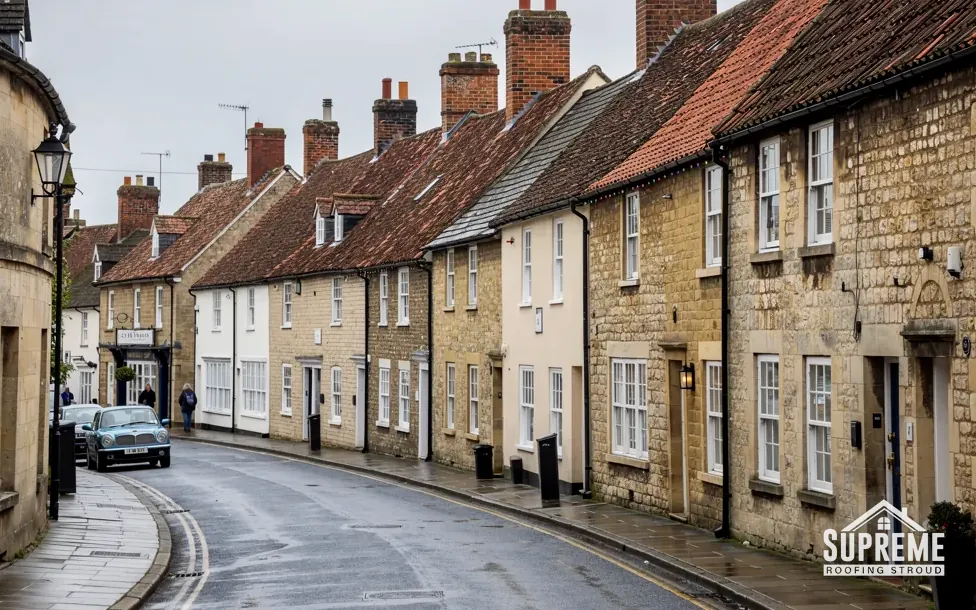
Curving street of stone and rendered terraced houses with tiled roofs 
Detached red brick Edwardian house with mock-Tudor gables and a tiled roof

Chapter 01
St Swithin's carved doorways and the Hospitaller churchyard
A Grade I church with twelfth-century stonework shows why the roof edge matters as much as the covering.
Chapter 01In this chapter
The church of St Swithin is known for two richly decorated twelfth-century doorways, set in walls of limestone rubble and ashlar. Carved stone of that age is soft in places and unforgiving of damp. What shields a doorway is rarely the main slope; it is the detail around it: the porch roof, the verge, the gutter and downpipe that stop water streaming down the face of the wall above. When we look at a historic building with carved openings, we look at what carries water away from them before we look at the covering overhead. A porch or a canopy that has lost its flashing, or a downpipe that discharges onto the wall base, will do more harm over a decade than a few missing slates would.
In this chapter
A verge is the edge of a roof at the gable, where the covering finishes and meets the wall. On old buildings it may be sealed with mortar or pointing, and when that fails, rain gets behind the edge slates and soaks the top of the wall. A gutter that overflows at a corner will leave a pale stain down the stone below. Those are the first signs we see, and they are cheap to correct if they are caught before the stone itself begins to decay.
Preceptory ground and old plots
The Knights Hospitallers set up a preceptory at Quenington around 1193, and a village with that depth of history is likely to have outbuildings as well as houses. Sheds, stores and lean-tos are often overlooked by owners who concentrate on the main house, yet their roofs fail in the same ways, and a failed lean-to roof can let water into the wall of the building it leans against.
Church roofs and who decides
Work on the roof of St Swithin itself is a matter for the parish and the diocese, because a church in use follows the faculty system. Another old building in the village, a hall for instance, or a chapel that has stopped holding services, may sit under different rules, and the council's conservation officer is the right first call. Our roof repairs page shows what a repair quote contains and the order we work in once water is coming in.
Before blaming old stone, check where the roof sends its water.
Myth: If carved stonework is crumbling beside a doorway, the stone is simply old and nothing can be done.
Fact: Much of the damage comes from water running down the wall, so repairing the verge, gutter or downpipe above often slows the decay more than any work on the stone.
Chapter 02
The fulling-mill, the paper-mill and Quenington's water sites
Buildings with a working past tend to have bigger roofs and more awkward drainage.
Chapter 02In this chapter
The County History says the two manorial mills of 1086 presumably occupied the sites of the water-mill and fulling-mill recorded in 1338, and that the fulling-mill later became a paper-mill. Fulling is the cleaning and thickening of woven cloth, a process that needed running water and space to work. Buildings that grew from mill uses, whether they are still industrial or have been turned into homes or workshops, tend to share some features: wide roofs, long gutters and a layout that spreads across several levels.
In this chapter
A roofer meeting a building like that asks where the water goes. Long gutters collect a lot of rain, and a blocked outlet or a gutter that has pulled away at a joint can pour water into walls. The rule is to survey the drainage first and then the covering. Our commercial roofing page covers the larger roofs, including the flat and low-pitch types found on workshops and agricultural sheds, and the way they are priced.
Converted buildings
A building that was a mill and is now a home has a roof that was not designed for the new use. If a loft is being insulated or a room made in the roof space, the Building Regulations thermal rules may apply. The Part L tables set 0.16 W/m²K as the improved roof U-value, and they apply once over half the roof surface is renovated, though a lesser standard may suit where headroom is tight. On a converted building we work out which side of that line a job falls, then deal with the building control notification if one is due.
Planning near the water
Where a building stands beside a watercourse, access can be tight and ground can be soft. A scaffold needs a firm base, and a lorry for delivery may not be able to come close. Our quote allows for access, and we describe how materials will reach the roof, so there is no surprise on the day. If the only way in is a narrow track, we say whether materials will be hand-carried, how long that adds, and what it does to the labour.
- 1086year the Domesday record shows two manorial mills in Quenington
- 1338year the water-mill and fulling-mill were recorded
- c.1193approximate year the Knights Hospitallers established a preceptory
Chapter 03
The 1929 semis east of the Fairford road, estates and bungalows
Interwar pairs and later bungalows each carry the weak points of their own decade.
Chapter 03In this chapter
Fourteen semi-detached houses were built east of the Fairford road in 1929, and council estates and bungalows came later, according to the County History. Those 1929 pairs are now a century old, or close to it. That is a good age to check the covering and the structure, because the first covering may long since have been replaced, and the replacement may itself be nearing the end of its life. A look from inside the loft shows how the rafters and battens are holding up, and photographs of the underside of the covering often reveal daylight, rusted nail heads or stained timber that never show from the garden.
In this chapter
MyBuilder gives natural slate 80 to 100 years or more, clay tiles 40 to 60, and concrete tiles 30 to 50, which is why the first question about a house of that age is what it actually has on it. Semi-detached houses share a party wall and often a roof line, so repairs next door affect you. A chimney stack on the party wall usually serves both houses, and the stack is the second thing we study closely after the covering. MyBuilder puts repointing a chimney at about £750 on average, within a range of £500 to £2,000, and rebuilding a stack at £2,000 to £10,000 or more, so catching a failing joint early pays.
Estates and bungalows
The council estates and bungalows that followed share another trait: many are one design repeated along a road. When a roof on one needs attention, the cause is often common to the row. Bungalows bring a big roof area for the size of the home, with a low eaves line that is easy to reach, but a gable-end verge or a flat-roofed extension can still hide trouble. Because the roof is so large relative to the rooms below, a small defect can wet a long length of ceiling before it is noticed, and the stain often appears far from the actual entry point. We follow it back along the rafters rather than guess from the spot where it shows. We check every junction, and we compare the covering with the neighbours so a repair stays in step with the street.
Your next step
Send us a photograph from the lane and a note of the house type, and we will say what we would look at first. The chimney repairs page describes a stack check in full. After the survey you receive a written quote covering the job, backed by a 10-year workmanship guarantee in writing. Once the job is finished the site is left clear and the waste is gone.
| Covering | Typical life |
|---|---|
| Natural slate | 80 to 100 years or more |
| Clay tiles | 40 to 60 years |
| Concrete tiles | 30 to 50 years |
| Flat roofs generally | 15 to 30 years |
Map showing Quenington and the Stroud service radius, with nearby towns we also cover.
Near Quenington
Roof work we do here
Hospitaller village, St Swithin and the old mills
Why does water damage carved stone at a church like St Swithin?
Because rain running down a wall wears away soft stone over time. Verges, gutters and downpipes that fail above a doorway send water over it, so those details are the first thing we check on an old church or hall.
My Quenington house was once part of a mill complex. What should I know?
Mill buildings tend to have large roofs and long gutters, so we survey the drainage first. If a conversion has changed the use, Part L may apply to roof work, and we explain it and handle the building control notification.
I live in one of the 1929 semis east of the Fairford road. Is the roof likely to be the original one?
Possibly, though a roof of that age has often been re-covered at least once. At survey we study the covering, its fixings and the party-wall chimney, and then recommend between repair and re-cover.
Does the Quenington conservation area affect a bungalow roof?
It can if the change is visible. Like-for-like repairs are normally simple, but a different material or a new rooflight is worth raising with Cotswold District Council before an order is placed.