
Roofers in Ampney Crucis
A roofer's view of Ampney Crucis, the Cotswold village on the Ampney Brook east of Cirencester, where a Grade I church, a listed manor house and 17.4 road miles from Stroud shape how a roof job is planned.
Ampney Crucis at a glance
- Distance
- 17.4 road miles east of Stroud
- Council
- Cotswold District Council
- Listed landmark
- Church of the Holy Rood, Grade I
- Setting
- On the Ampney Brook, east of Cirencester
Ampney Crucis roofs, from Holy Rood to Ampney Park
Ampney Crucis is a Cotswold village on the Ampney Brook, a tributary of the Thames, and its history is written into the buildings a roofer is most likely to be asked about. The parish church of the Holy Rood has a Saxon foundation with some Norman work, and it is listed Grade I. In the churchyard stands a cross dated to the late fourteenth or early fifteenth century, also Grade I; its head was found in the church tower in 1860 and put back. A short way off, Ampney Park is a manor house of the late 1500s with a large 18th-century extension and 19th-century additions, first listed at Grade II in 1952.
The village takes its name from the brook and from that churchyard cross, and the Domesday Book of 1086 records it as Omenie. For anyone with a roof here, the useful reading of that history is plain: the village contains old, protected buildings, and a listing changes the rules for what can be done on a roof. A listing protects a building as a whole, so the question is never only about the front slope. Cotswold District Council is the authority for listed building consent, and its conservation team is the right first call before any change to the covering, the pitch or the roof details of a listed property.
A like-for-like repair is a different conversation from a change of material, and the way to find out which one you are having is to ask before work starts. Whether your own house sits inside any designation is a question we put to the council before we plan anything, rather than assume. Our survey records the roof in photographs so that question has something real to rest on.

Row of stone cottages with mossy clay tile roofs along a quiet lane 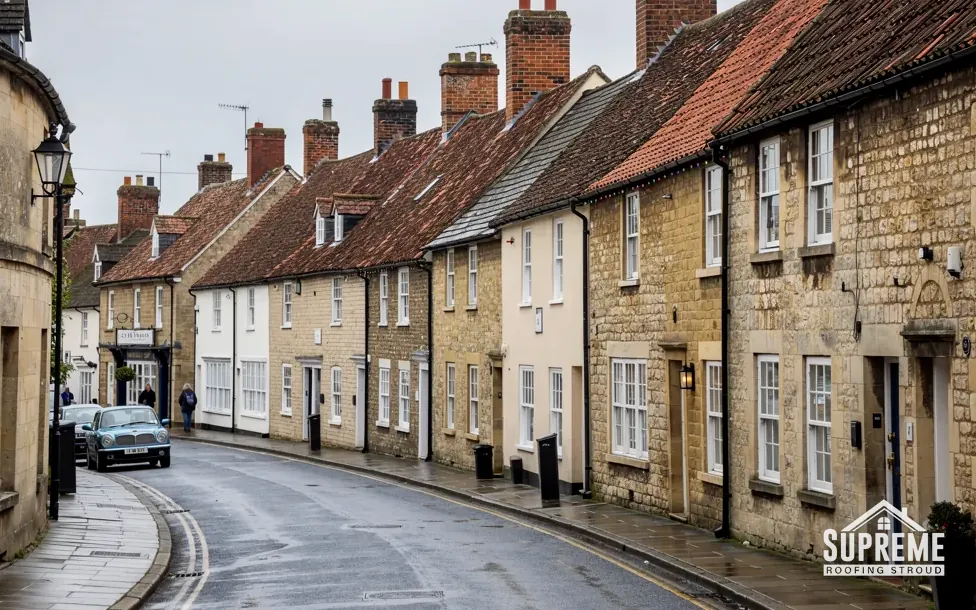
Curving street of stone and rendered terraced houses with tiled roofs

Chapter 01
Holy Rood and the faculty route for a church roof
A church still in use follows its own permission system, and the roof survey has to serve that process.
Chapter 01In this chapter
Churches in use sit outside the ordinary listed building consent system. The ecclesiastical exemption means that roof work on a church still used for worship goes through the diocese, which grants a faculty in place of consent. That applies to the Holy Rood, a Grade I church with Saxon and Norman fabric, and it means the people who decide what happens to its roof are the parish, its architect and the diocese. Not us, and not the district council. Our part, if we are asked to price or carry out work, is to look closely at the roof, describe what we find in plain terms and cost it, so the parish has something solid to put in front of the church's advisers.
In this chapter
A church roof asks for a particular kind of survey. The nave and chancel roofs, the tower, the gutters between ranges and the flashings where a roof meets a wall each tell their own story. Lead is the covering at many of those junctions, and a lead flashing that has split or lifted lets water in at the wall head, where it can run down inside the masonry for a long time before anyone sees a stain. We look at fixings, laps and the state of the gutters first, because moving water away from a Grade I wall is the least costly protection it has.
Scaffold in a churchyard
A churchyard brings constraints of its own. Graves, a listed cross and sometimes a narrow path from the lane mean access has to be planned around what must not be touched. Scaffold bases, board stacking and the route for removed material all go into a written access plan before a start date is set, and what that planning costs is allowed for in the quote. High tower work usually calls for a specialist access plan, and we raise that early rather than finding out on site. A cross, a path and a row of graves each get marked on the plan, so the crew knows where boards, ladders and skips can and cannot go.
The buildings beside the church
Only the church itself enjoys the exemption. A house, barn or outbuilding next to it, however old, falls back on the usual route. If it is listed, altering its character means applying to Cotswold District Council, and the same council deals with a former chapel once worship there has ended. If you are unsure which route applies, ask before you ask anyone for a price. Our lead roofing page explains lead codes and where each one is used.
On a Grade I church, keeping water off the walls comes before any talk of new coverings.
Chapter 02
Ampney Park and the roof of a late-1500s manor house
A Grade II house of that age asks for slow, matched repairs, not a quick strip and replace.
Chapter 02In this chapter
Ampney Park dates from the late 1500s, and the house is listed Grade II. Nobody should guess what covers a roof of that age. If it carries Cotswold stone slate, the traditional rules from Cotswold District Council's technical guidance apply: the stone slates are laid in diminishing courses, with the largest at the eaves and the smallest near the ridge, and they hang on wooden pegs, usually cleft oak, through a hole near the head of each slate. The traditional pitch for a straight Cotswold roof is given as 47 to 55 degrees, which is a description of old practice and not a minimum.
In this chapter
Weight matters on these roofs. The guidance gives about 1,000 kg per 10 square metres for stone slate, so swapping a lighter covering for stone, or stone for something lighter, raises a structural question and can bring Building Regulations into play where the new covering is around 15% heavier. We check the timbers before talking about coverings. The same guidance reports that around 50% of the slates have commonly perished by the time a roof is stripped, which is a good reason to survey from the inside as well as the outside before anyone commits to a figure.
Reclaimed stone and matching
When slates are lost, the policy quoted in the council's guidance prefers newly cut stone to second-hand pieces, and asks that replacements agree with the old in rock type, tone, surface and size. Salvaged slates belong back on their original roof. That is how we approach any stone repair: keep what is sound, set it back in its own courses, and make good with a true match rather than a substitute.
What the quote shows
On a listed house, the written quote covers the scaffold, the strip, the stone, the carpentry and the making good, and it notes which work depends on the council's view. A roof like this is the reason we put our Cotswold stone roofing information in front of customers before they ever call. The survey photographs show each slope so the listing officer and the owner are looking at the same thing.
- 1086Domesday Book entry for the village, recorded as Omenie
- 1860year the head of the churchyard cross, found in the church tower, was reinstalled
- Late 1500sdate of Ampney Park, listed Grade II
Chapter 03
The Ampney Brook and the road east from Stroud
Getting a crew, scaffold and stone to a village on a brook is part of the planning.
Chapter 03In this chapter
Ampney Crucis is 17.4 road miles east of Stroud, on the Ampney Brook, which runs through the village on its way to the Thames. The brook is a reminder of something every roof in the village has to deal with: rainwater needs somewhere to go. On an old house the line from roof to ground runs through gutters, hoppers and downpipes, and then through whatever drain or soakaway takes it away from the walls. When that line fails, damp shows up in the stonework long before it shows in the loft, and it is easy to blame the roof covering for something the gutter is doing.
In this chapter
For that reason a survey here starts at the eaves. We photograph the gutters, check the joints and the fall, and note where the downpipes discharge. It costs little to confirm, and it keeps a repair job honest. A hopper head clogged with moss, a downpipe shoe that has dropped away from the wall, or a joint that weeps in a downpour are all quick to spot from a ladder and quick to put right. If the covering is sound and the gutter is the culprit, the quote says so and does not suggest a re-roof.
Planning a run from Stroud
A job at this distance is planned as a single piece of work. Materials are ordered to arrive together, the access plan is agreed in advance, and the written quote covers every stage, from scaffold through to making good. Where Building Regulations notification applies, for example when a roof is re-covered above the thresholds or a heavier covering is proposed, we explain consent and handle the notification. At the finish we leave the site clear, take every bag of waste with us and hand over a written 10-year guarantee on our workmanship.
Myth: A damp patch inside an old stone house always means the roof covering has failed.
Fact: Water from a blocked gutter or a split downpipe can soak a wall for a long time, so we trace the rainwater path from eaves to ground before blaming the slates.
Starting with a conversation
If you live in Ampney Crucis and are not sure whether a leak is the roof, the gutter or the flashing at a chimney, send us photographs or ring 01453 933613, or message us on WhatsApp or through the enquiry form. Leaks jump the queue: water is stopped before anything else is planned. For a general check, our roof inspections and surveys page explains what the report covers. Before any repair on a listed or protected building, we would rather you spoke to Cotswold District Council than found out later that a detail needed approval.

Map showing Ampney Crucis and the Stroud service radius, with nearby towns we also cover.
Near Ampney Crucis
Roof work we do here
Holy Rood and Ampney Park beside the brook
Who authorises roof repairs on the Holy Rood church at Ampney Crucis?
While a church is in use for worship, the exemption applies and a faculty from the diocese stands in for the council's consent. The parish and its architect lead that process, and we can supply a photographed survey and a written price to support it.
Does a Grade II listing, like Ampney Park's, stop me from repairing my roof?
No. It means any change touching the character of the building goes to Cotswold District Council for listed building consent. Like-for-like repairs are a different matter, and we ask the council before proposing anything that changes the material or the details.
If my Ampney Crucis house has an old stone roof, can lighter slates replace it?
Possibly, but not casually. Stone slate is heavy, and any change of covering raises a loading question; a new covering 15% or more heavier than the old one needs Building Regulations approval, and a listed house needs consent before the material changes. We would survey the timbers and check with the council first.
Why do you look at the gutters before the roof covering on an older cottage by the brook?
Because blocked or leaking rainwater goods often cause damp that looks like a roof fault. Checking the eaves, joints and downpipes first stops you paying for a re-roof when the cure is a gutter repair.