

Roofers in Wotton-under-Edge
Wotton-under-Edge has held a market since 1252, and the drive from Stroud is 12.8 road miles to the south-west. Its conservation area, listed inns and hillside streets all change how a roof job is planned.
Wotton-under-Edge at a glance
- Distance
- 12.8 road miles south-west of Stroud
- Council
- Stroud District Council
- Conservation area
- Wotton Under Edge, no. 1, with adopted statement
- Setting
- Foot of the Cotswold Edge escarpment
Wotton's roofs under the Edge, from medieval church to cloth mills
The Edge in the town's name is the limestone escarpment of the Cotswold Edge, flanked by Wotton Hill and Tor Hill. The streets run along the foot of that slope, so gardens and lanes climb behind the main roads and rooflines step up the hillside one behind another.
The town is old. It was first recorded in an AD 940 charter of King Edmund I, was burnt in King John's reign and was rebuilt in 1252, when Johanna de Berkeley received a charter for a market. Wotton's parish church was consecrated in 1283 and is listed Grade I; it is named for the Virgin Mary. The Ancient Ram Inn and the Royal Oak are among the town's Grade II* listed buildings.
Industry came later. New Mills, founded in 1810, supplied cloth to both sides in the Napoleonic Wars and was acquired by Renishaw plc in 1981. That gives the town medieval market streets, inns, a great church and an industrial site, all close together.
For roofs, the planning status is what sets Wotton apart. Wotton-under-Edge heads the council's list of Stroud conservation areas and has an adopted conservation area statement. It is also one of five conservation areas where the council has made an Article 4 Direction.
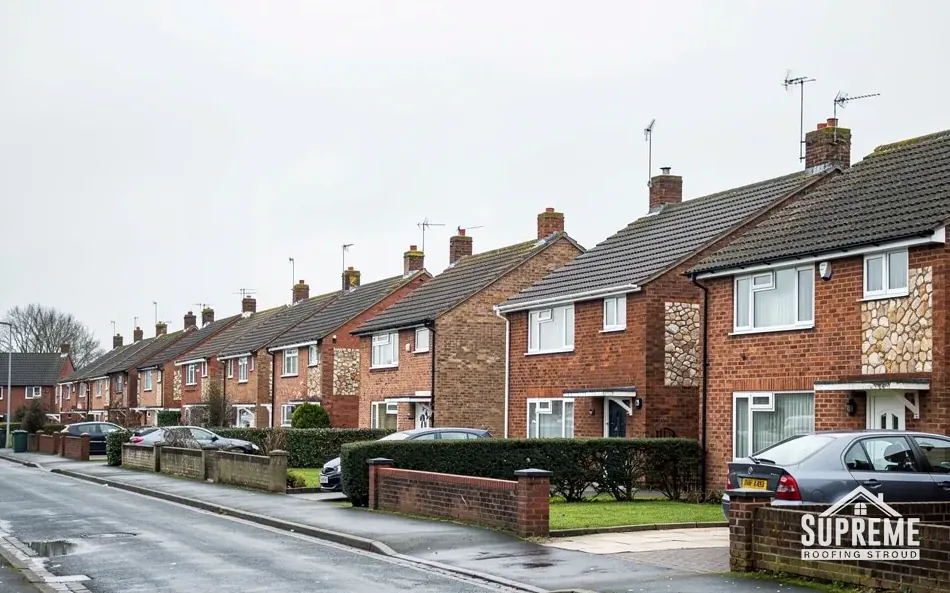
Street of red brick terraced and semi-detached houses with parked cars 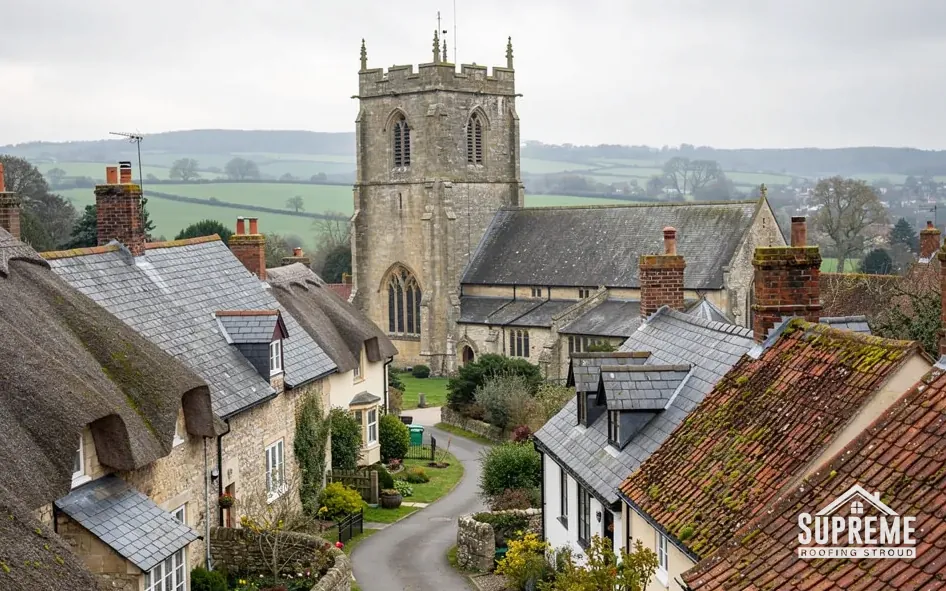
Village of thatched and tiled cottages around a stone church tower

Chapter 01
Conservation area no. 1: the statement and the Article 4 Direction
In Wotton, ask the planning team before you assume a roof change is allowed.
Chapter 01In this chapter
Stroud District has 41 conservation areas, and Wotton Under Edge comes first on the council's list. It is also one of five where an Article 4 Direction applies, alongside Bisley, Frampton on Severn and the Top of Town and Town Centre areas of Stroud. A direction takes away certain permitted development rights, the freedoms that let homeowners make some changes without applying for permission. Wotton's was issued on 2 April 1993 and applies to a named list of houses in streets such as Long Street, Church Street, Haw Street and The Chipping, rather than to every building in the area.
In this chapter
For those houses the direction reaches the roof directly: an addition or alteration to the roof, and any other alteration to the roof of the house, needs a planning application. The council's advice is to check with the planning department, and we take that literally. Anything that would change what the street sees of a roof gets a written description and photographs, and goes to Stroud District Council before we put a figure on it. The reply goes on file before any materials are ordered.
Wotton also has an adopted conservation area statement, a document the council uses when it judges applications. If you are planning a change of covering or a visible new feature, reading it is worthwhile, and the planning team can point you to the relevant section. Straight repair work is a different matter. Fitting back the same slate, tile or stone normally falls outside the definition of development, because the building looks the same afterwards. That is a general principle and no guarantee for your address, which is why the council check comes first.
A survey that doubles as evidence
Our roof inspection and survey produces photographs of the slopes, ridges, valleys and stacks, plus notes on materials. If the council wants to see the existing roof, you already have the pictures. For the sale or purchase of an old house in the centre of town, the same survey tells a buyer what the roof is likely to need in the next few years.
Roof windows are a change owners often raise in conservation areas. The rules for them are set out on our skylights pages rather than repeated here, and the same photographs from your survey can go to the council with that application too, which saves a second visit to the roof.
Wotton's direction brings roof alterations on the houses it names under planning control, so we ask first.
Chapter 02
The Ancient Ram, the Royal Oak and the stacks of the old centre
Old inns and houses in a market street put chimneys and joins in the front line.
Chapter 02In this chapter
The Ancient Ram Inn and the Royal Oak, both Grade II* and so among the more significant listed buildings in the town, show what the middle of Wotton is made of: old buildings in continuous streets, with roofs that have been mended many times. Grade II* sits just below the top grade, and its protection covers the whole building. Every roof among them is different. What follows is the pattern an old inn or house presents to anyone arranging work, and the reason a careful first visit matters so much on buildings of that age. A roof that has been patched many times needs reading carefully, because each earlier repair may have used a different mortar, lead or tile.
In this chapter
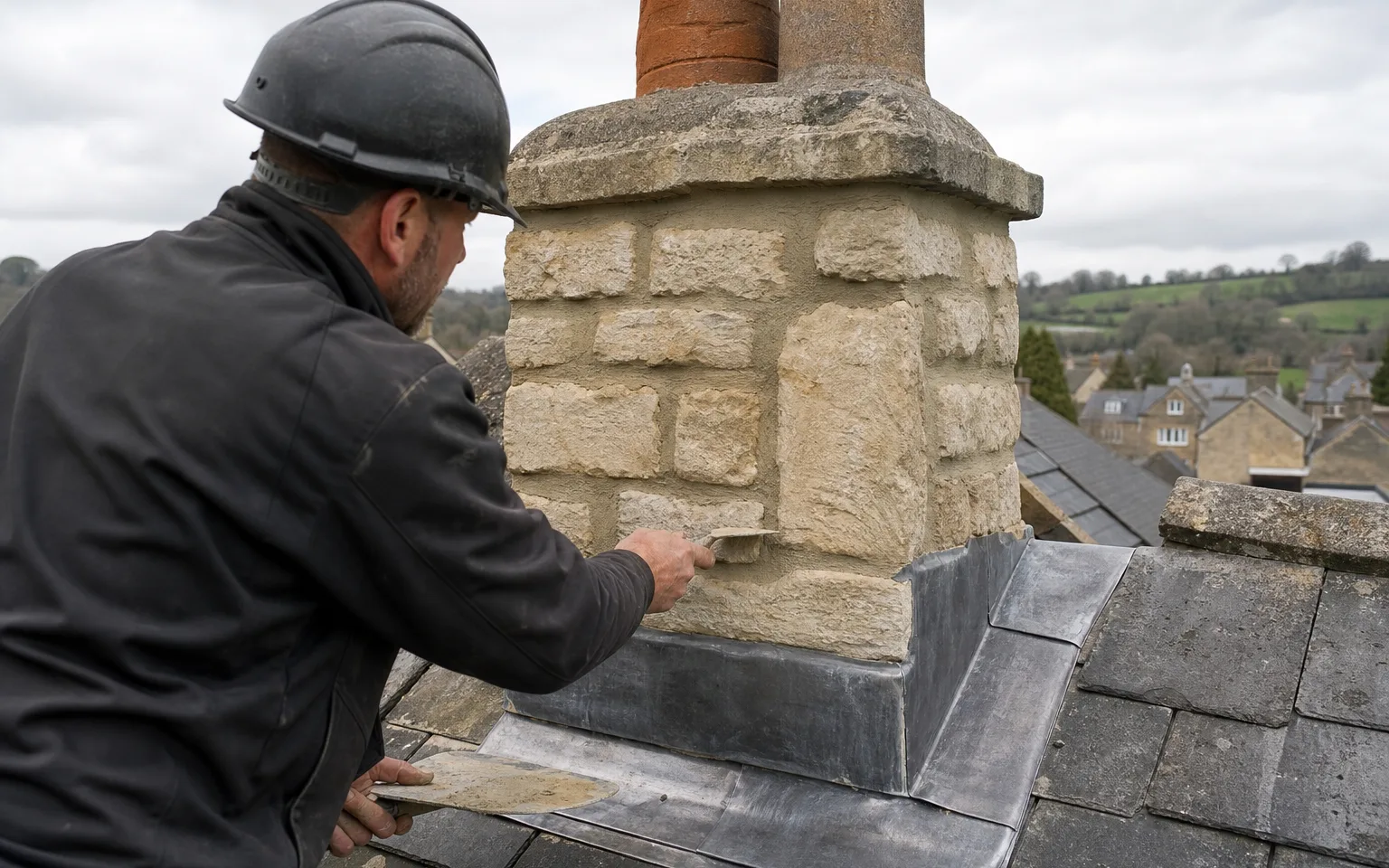
On buildings of this kind we begin with the chimney stacks. A stack takes weather on four faces, it is cut through by a flashing where it meets the roof, and its mortar joints open with age. Water that gets in around a stack runs down the flue wall and appears as a stain on a bedroom ceiling, some way from where it came in. Our chimney repair work starts from the top: pots, flaunching, pointing, flashing and then the stack below the roofline.
MyBuilder's chimney guide gives typical UK figures, which we quote as a guide and not as our price: repointing averages about £750, within a range of £500 to £2,000, flashing repair costs £250 to £1,200, and a rebuilt stack £2,000 to £10,000 or more (2026). The spread reflects height, access and the amount of stonework that has to be taken down. The height of the stack and the way the scaffold has to be built can separate the low and high ends of those ranges all on their own, which is why we give you the access figure alongside the stonework.
St Mary's and church roofs
The parish church, consecrated in 1283 and listed Grade I, is the oldest landmark in the centre. While it is used for worship, roof repairs there are authorised through the diocese, which issues a faculty. That is the route for any church in use, and it is separate from council consent. Smaller church halls and former chapels are not always treated the same way, so we ask about status before doing anything.
Joins between old roofs
Where a medieval plot meets its neighbour there is usually a shared wall and a gutter or a lead-lined channel between two roofs. These are the details that fail without anyone noticing, because neither neighbour can see them from the street. Each one is checked from the roof and photographed, so you and the owner next door can both look at what was found.
Chapter 03
Wotton Hill, Tor Hill and the mills below them
Houses on a slope and mill buildings on the flat need different plans.
Chapter 03In this chapter
With Wotton Hill and Tor Hill on either side, the town's streets are rarely level. A house at the top of a lane may have a ridge well above the road, while one below it looks down on a neighbour's roof. For us that means thinking about the scaffold before anything else. Platforms have to be built to the fall of the ground, a lorry may not be able to reach the door, and slates or tiles can be carried in by hand if the lane is steep or narrow.
In this chapter
All of this has a cost, and the quote allows for it. The alternative, a rate that hides access inside the price per square metre, makes two quotes impossible to compare. A typical UK scaffold figure for a house re-roof is about £1,125 (MyBuilder, 2026), but a stepped plot can push that up, and we would rather give you a figure that matches your own plot.
Natural slate is a common covering on older houses across the area, and if yours is slate, the first signs of trouble are slipped slates, rusted nails and exposed battens. Our slate roofing page explains the difference between replacing a few slates and relaying a slope, and how headlap, the overlap between courses, depends on the pitch. A single slate repair runs at £60 to £120, and five to ten slates cost £150 to £350, according to MyBuilder.

The mill site at New Mills
New Mills, founded in 1810, belongs to a different part of Wotton's history. It supplied cloth to both sides in the Napoleonic Wars and was acquired by Renishaw plc in 1981. Whatever its present buildings carry, the lesson applies to any industrial or former mill roof in or around a cloth town: large spans, valley gutters and parapets need a drainage-first survey, and the quote should treat each rainwater route separately.

Between the two hills
Sitting low on the Edge also affects what you find inside a house. Surface water running off the slope can leave damp walls that look like roof leaks, and a leak that looks like a wall problem may start at a flashing. Checking both before spending money is the cheaper course. Damp patches on an upper floor deserve a look at gutters and downpipes too, since an overflowing gutter wets the wall from the outside.
Myth: A hillside house costs the same to re-roof as a house on level ground.
Fact: Scaffold, carrying and delivery all change with the slope, so the survey measures them and the written quote allows for each.
Map showing Wotton-under-Edge and the Stroud service radius, with nearby towns we also cover.
Near Wotton-under-Edge
Roof work we do here
Wotton-under-Edge roof questions, from Article 4 to hillside lanes
My house is in Wotton's conservation area. Does the Article 4 Direction stop me re-roofing?
For the houses named in Wotton's 1993 direction, alterations to the roof need a planning application, so check whether your address is on the list with the planning team. A like-for-like repair is generally lower risk than a change of material. Like-for-like repair does not normally count as development, but we send photographs and a description to the council before pricing anything that changes the roof's appearance.
The chimney stack on my old Wotton house is stained below the roofline. Is the roof leaking?
The stack is the first suspect. Open joints, a failed flashing or a cracked flaunching let water run down the flue wall and show up as a stain further down. We check pots, flaunching, pointing and flashing before pricing any roof work.
Can a roof on one of Wotton's steep lanes be reached safely?
Yes. Scaffold is built to follow the fall of the ground, and if a lorry cannot get near, materials are carried up by hand. The survey records how the roof will be reached, and the quote allows for the scaffold and the carrying.
Is a Grade II* listed building in Wotton treated differently from an unlisted one?
Yes. Protection extends to the entire building, so alterations that change its character need authorisation first. We ask for earlier consent paperwork before measuring and keep to the materials the council has already approved.