Roofers in Charfield
Roof work in Charfield, from the listed buildings at Churchend and the mills to the houses put up in 2018 and 2019, surveyed first and quoted in writing.
Charfield at a glance
- Distance
- 15.2 road miles south-west of Stroud
- Council
- South Gloucestershire Council
- Setting
- Near the Little Avon River, with the hamlet of Churchend
- Listed buildings
- Church of St James (Grade I), Charfield Mills (Grade II)
Charfield's roofs, from Churchend to the Renishaw side
Charfield is a village 15.2 road miles south-west of Stroud, and it lies south-west of Wotton-under-Edge near the Little Avon River. The hamlet of Churchend is part of it, and the council is South Gloucestershire Council. The village has an unusually wide spread of dates for its size, and one week's roofing here can take in a medieval church, a mill range and a street finished in the last decade.
The oldest building is the Church of St James at Churchend, which goes back to the 13th century and carries a Grade I listing. The Parish Church of St John is Grade II. Down in the village, the main building and the former bone mill at Charfield Mills are Grade II listed, according to Historic England's list entries. At the other end of the timeline, Wikipedia records new housing at St James Mews and at Charfield Village, near the Renishaw site, built in 2018 and 2019.
That gives three kinds of roof work to plan for. There are churches, where the route depends on whether services are still held; listed mill buildings, where another does; and young houses with roofs that are less than ten years old and have their own questions. Ordinary houses in between need an ordinary survey. The national planning dataset shows no conservation area in Charfield, though listing protects the individual buildings above in the same way wherever they stand.
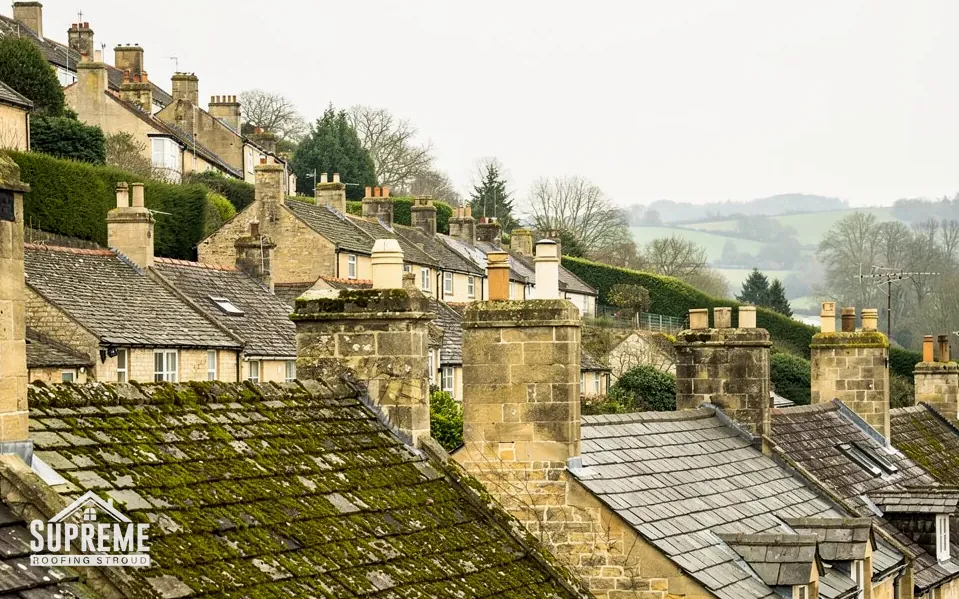
Hillside of stone terraced houses with mossy stone tile roofs and chimneys 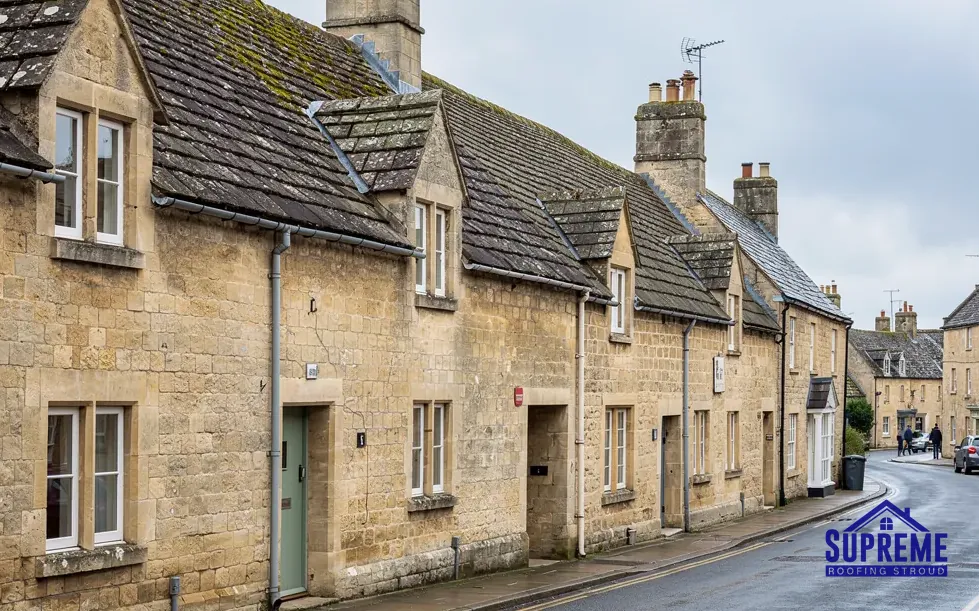
Terrace of stone cottages with dormer windows and stone tile roofs
Chapter 01
Charfield Mills and the long industrial roof
Listed buildings with big roofs: the survey starts with where the water goes.
Chapter 01In this chapter
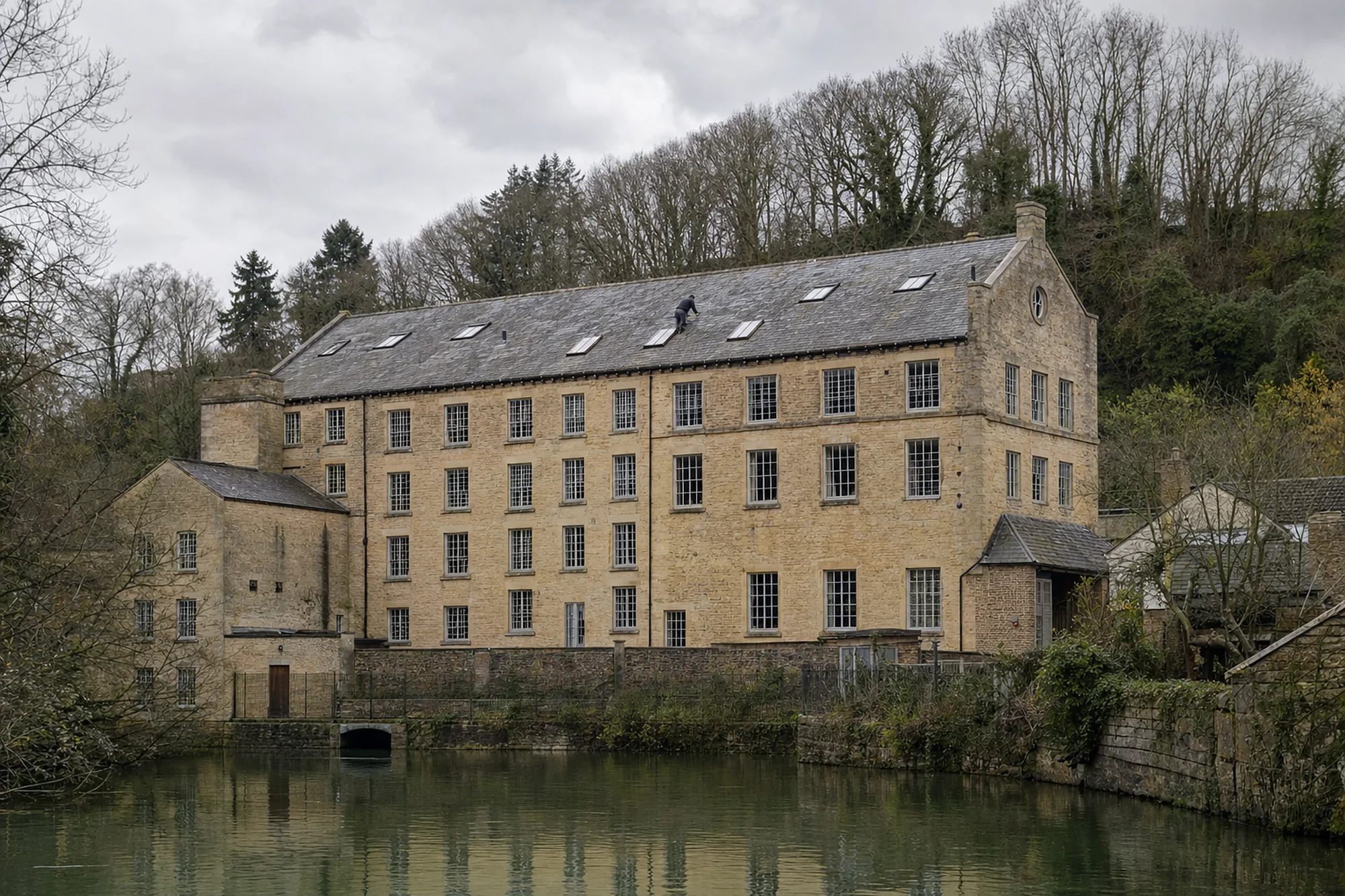
The main building and the former bone mill at Charfield Mills are both Grade II listed. A mill building has a roof that is nothing like a house roof: long ranges, wide spans, gutters stretching for many metres and valleys where one range meets another. The size alone changes how a job is planned, and the listing changes who has to agree to it.
Listed building consent is needed for works affecting a listed building's special interest, and Stroud District Council's guidance makes the same point about every grade: the whole building is protected, inside and out. At Charfield the authority is South Gloucestershire Council, so the call about a given roof detail goes there. We do not guess where a repair stops and a change begins. We photograph the existing covering, note its type and its fixings, and ask the conservation officer before pricing anything that might count as a change.
On a large industrial roof the commonest trouble is drainage. Internal and parapet gutters take in a lot of water, and one blocked outlet puts that water into the building within minutes of a downpour. Lead-lined gutters and flashings along the walls deserve a close look, since lead lasts for many decades when it is correctly installed. MyJobQuote gives over 80 years for flashing and over 100 for the higher codes, but that depends on the code, the detailing and whether the lead has been allowed to move freely. Our commercial roofing page covers how we survey and price roofs of this scale.
Access to a roof of this size
A long range often means a long scaffold, and the length is a large share of the cost. The quote allows for it with the girth and the number of lifts, so that you can compare it with another firm's figure on the same basis. If a safe edge can be made with a tower, a mobile platform or a roof ladder for a small repair, we recommend that and price it instead. The method we choose is the one that is safe first and cheaper second.
Whatever the building is used for now
We do not assume a use for these buildings. Whether the roof is over workshops, storage, offices or homes, the questions are the same: who owns each part, who must approve the work, and what the existing covering is. On any shared building, one owner's repair can send water into another's space, and we would rather see the whole roof once than patch one corner of it three times.
A listed mill roof is a drainage problem first and a covering problem second.
Chapter 02
St James at Churchend, St John and two different routes
One church still holds services and one does not, and that decides who authorises the roof work.
Chapter 02In this chapter
Charfield has two churches on the national list: St James at Churchend, Grade I and from the 13th century, and the Parish Church of St John, Grade II. St John's is the church in use, so it sits outside the usual listing controls through the ecclesiastical exemption, and a faculty from the diocese covers its roof work. A council application is the wrong door there. St James is now redundant and looked after by the Churches Conservation Trust, so the exemption no longer covers it, and roof work on it needs listed building consent from South Gloucestershire Council, just as the listed mill buildings do. People are often surprised that the Grade II church skips the council while the Grade I church does not.
In this chapter
The Ecclesiastical Exemption Order 2010 keeps the exemption for church buildings in the Church of England's faculty jurisdiction and for certain other denominations. The Diocese of Norwich describes a faculty as permission granted by the Consistory Court, with the Diocesan Advisory Committee giving formal advice to the Chancellor, who grants it. We do not run that process, and the parish and its architect lead on it, but we can supply a roof survey, photographs and a written quote that a church can attach to an application.
A church roof tends to be tall, and it is reached by a scaffold that the building has to be able to carry. Lead appears at valleys, parapets and along the abutments, and old lead can crack where it has been bent back and forth by the sun. The simplest fault, a slipped covering above a nave, can let in water that stains walls and decoration long before anyone sees it from outside, which is why the survey includes the roof void when we are given access.
What decides the price
Height, the length of scaffold, the type and weight of the lead, and the care needed near stonework all move the figure. Sheet lead comes in codes, from Code 3 at 1.32 mm up to Code 8 at 3.55 mm, and Leadworx names Code 4 as the usual pick for flashings. For how the codes map to jobs, see our lead roofing page.
When a church is no longer a church
The exemption applies only while a building is used for worship. Once worship stops, a church or chapel is treated like any other listed building and normally needs listed building consent from the council. If you own a former chapel in or near Charfield, ask the council which route applies before you plan the work.
| Building | Route |
|---|---|
| Church in use for worship | Faculty from the diocese |
| Listed mill building | Listed building consent from the council |
| Former church or chapel, no longer in worship use | Listed building consent from the council |
| Unlisted house, like-for-like re-roof | Usually none; Building Regulations thresholds still apply |
Chapter 03
St James Mews and Charfield Village: roofs under ten years old
A young roof has different questions from an old one, and the first is who is still responsible.
Chapter 03In this chapter
New housing at St James Mews and at Charfield Village near the Renishaw site was built in 2018 and 2019. Roofs from that period are young, and the work they need is a different matter from the re-roofs and ridge repairs that older houses call for. If a roof leaks or a tile slips in the first years, the first call should go to the builder or the developer, because a defect in new construction may still be their responsibility. We are happy to survey and write down what we see, which gives you evidence to take to them, and we do not step in front of a claim that someone else ought to deal with.
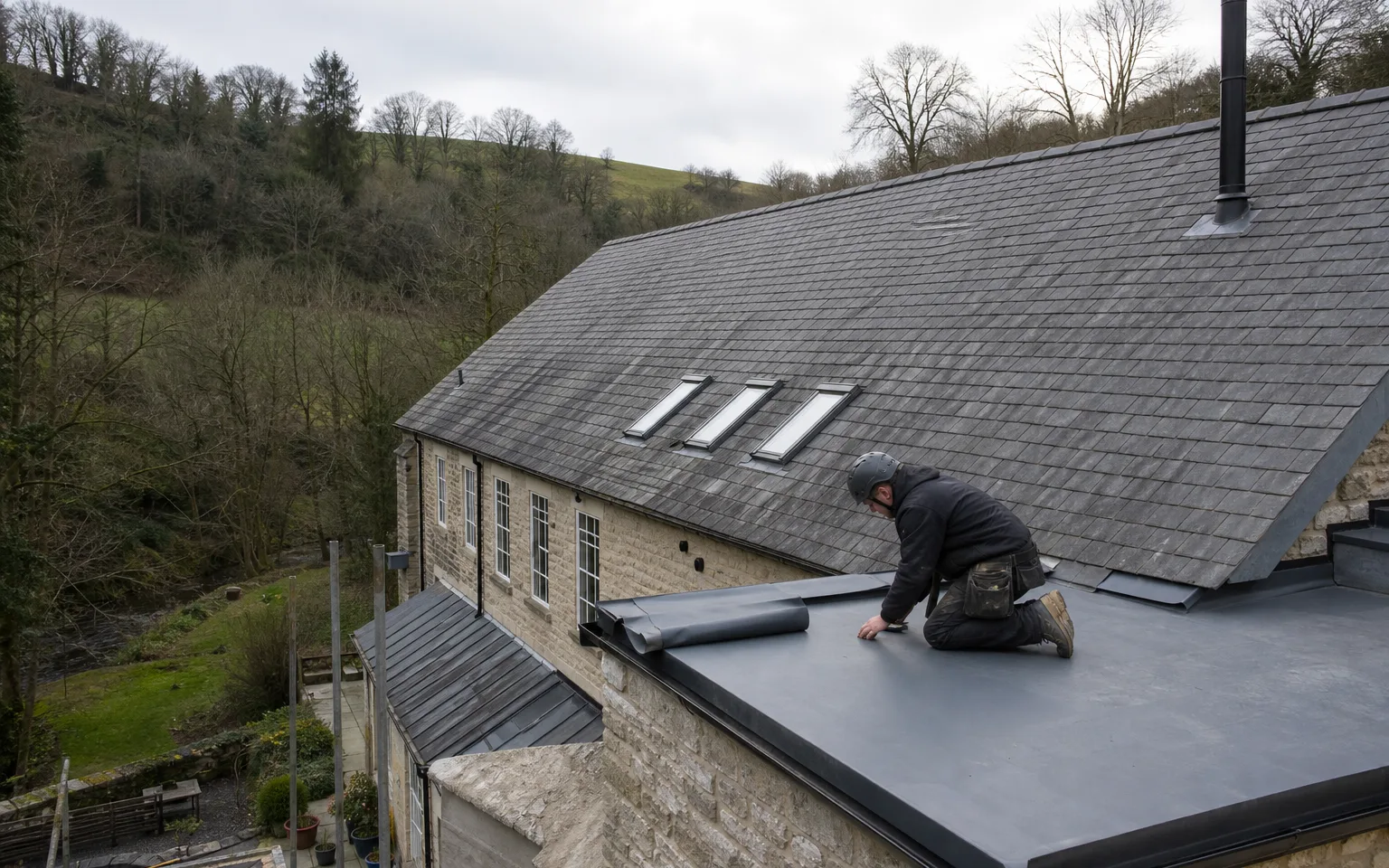
When a young roof does give trouble, the cause is usually in the detail. Lead flashings against a wall, the junction where a roof meets a neighbouring house, and the mortar or fixings at ridge and verge are where early faults appear. Since the 2014 revision of BS 5534, ridges and verges should be fixed mechanically as well as bedded, so a roof from 2018 or 2019 ought to have clips or a dry-fix system in place. If we find only mortar, the survey photographs show it plainly. Our roof inspection and survey page explains what a report contains and what it costs.
MyBuilder puts a standard roof inspection at £150 to £250, and a drone survey at £200 to £400, as typical UK figures from its 2026 guide. A drone shows the ridge, the valleys and a high chimney without a ladder, which is useful on a row of identical roofs where one fault may repeat along the street. We would tell you which kind of survey suits your roof before you pay for either.
Looking after a new roof
A new roof needs less than an old one but not nothing. Gutters fill with leaf litter and grit from the nearest tree, and a blocked outlet overflows down a wall that was never meant to take water. Looking at gutters twice a year, and checking from the ground for slipped or cracked tiles after a storm, catches most of the early trouble. Loft ventilation matters too: BS 5250 sets the ventilation expected at eaves and ridge, and a loft stuffed with stored boxes up to the eaves can block it.
Solar panels, aerials and roof windows
Fittings added to a young roof can break its watertight detail if the work is rushed. A roof window, for instance, needs a proper flashing kit and a gutter at the head, and the planning side is explained on our skylights page. Whoever does that work should leave the surrounding covering as they found it.
Map showing Charfield and the Stroud service radius, with nearby towns we also cover.
Near Charfield
Roof work we do here
Charfield's mill-village roofs, answered
Charfield Mills has Grade II listed buildings. What consent does a roof repair there need?
Under the 1990 Act, consent is required for works that alter what makes a listed building special, so any change to the covering or its detailing goes to South Gloucestershire Council. A repair that copies the existing detail is a smaller conversation, but we ask the conservation officer before pricing it.
Who authorises work to the church roofs at Churchend and in the village?
St John's holds services, so it falls within the ecclesiastical exemption and a faculty from the diocese takes the place of council consent; the parish leads that application. St James at Churchend is redundant and in the care of the Churches Conservation Trust, so its roof work needs listed building consent from South Gloucestershire Council. We can provide a survey and a written quote for either.
Houses at St James Mews were built in 2018 and 2019. Should the roofs need work yet?
Not as a rule, and a defect in a roof that young may still be the builder's to put right, so tell them first. A survey from us records what is wrong, with photographs, whichever way it goes.
Does Charfield have a conservation area that limits my roof work?
Planning Data (the national register) has no conservation area in Charfield. Individual buildings are still protected by their listing, so if your home is listed, check with South Gloucestershire Council before changing the covering.