

Roofers in Falfield
Roof repairs and replacements in Falfield, the village strung out along the A38 beside M5 junction 14, planned from a survey and with good and fair prices.
Falfield at a glance
- Distance
- 16.2 road miles south-west of Stroud
- Council
- South Gloucestershire Council
- Setting
- Linear village on the A38, by M5 junction 14
- Listed buildings
- St George's, Heneage Court, Falfield Mill (all Grade II)
Falfield's roofs along the A38 and beside the old mill
Falfield is a linear village: one road, the A38 Gloucester Road, with houses lined up along it just west of M5 junction 14. It is 16.2 road miles south-west of Stroud, in South Gloucestershire, and its local authority is South Gloucestershire. Wikipedia places the village on mudstone bedrock of the Tortworth Beds, which is ground rather than roof, but it is the first thing a scaffold meets, and we check what each base will stand on.
The village has a long paper trail. It shows on maps from 1577 as Fayleffeld, and a 1608 record says most of its men were weavers. Three buildings are Grade II listed: St George's Church, consecrated in 1860 on land given by the Jenkinson family of the Eastwood Park estate, Heneage Court, which dates from the 17th century, and the remains of Falfield Mill, a corn mill built in 1797. The ecclesiastical parish followed the church in 1863 and the civil parish came in 1896.
A roofer working here is therefore dealing with a village of one street, three listed buildings spread across more than two centuries of building, and a main road that sets the terms for every delivery. No conservation area is recorded for Falfield. We do not assume what covers any particular house, because the survey and the photographs settle that, and the quote follows from them.
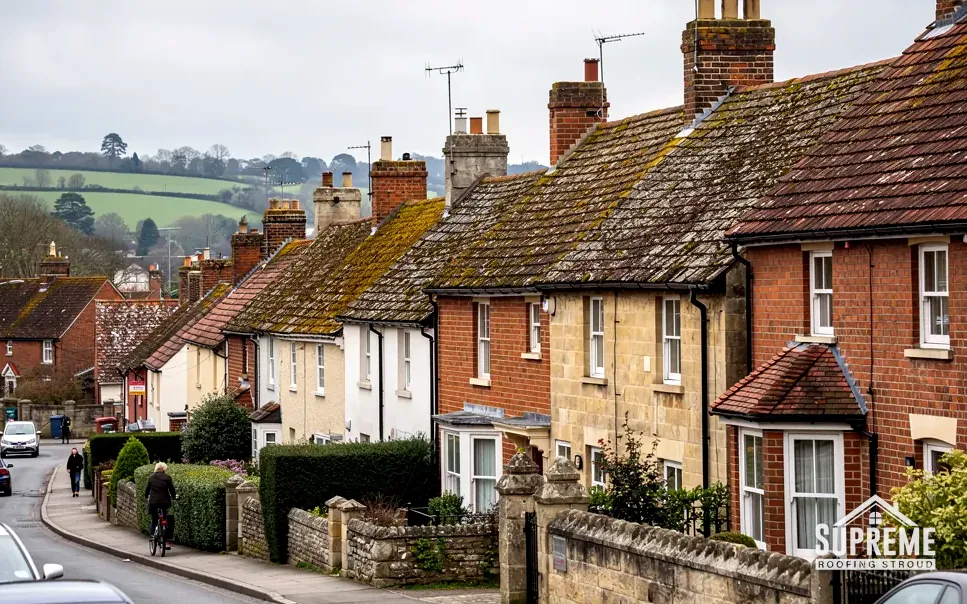
Sloping street of brick and stone terraced houses with mossy tiled roofs 
Victorian terraced houses with slate roofs and chimneys on a hillside

Chapter 01
Strung along the A38: planning a job on a one-street village
A village built along one road puts every house on the same pavement, the same verge and the same delivery problem.
Chapter 01In this chapter
Because Falfield is one long street, the roof you are paying for is almost always reached from the A38 side, or from a narrow rear plot with no vehicle access at all. That is the first fact we settle at the survey. Where a house fronts the road, we look at the pavement, the verge and any lay-by, because they decide where a lorry unloads and where a skip stands. Where the plot runs a long way back, we measure the carry from the front gate to the ridge, since every extra metre of walking costs labour.
In this chapter
Beside a busy main road, gutters and valleys can gather grit and road dirt as well as leaves, so they are worth checking on both sides of the house. If water is overshooting a blocked gutter and soaking the wall below, damp appears inside long before the roof itself looks wrong. Our guttering, soffits and fascias page sets out what we look at on the gutter run: slope, supports and joints.
Gutter falls are a good example of figures that vary. Makers' guidance on gutter falls runs from about 1:600 to 1:350 depending on the system, and bracket spacing differs too: no more than 900 mm in one set of instructions, 500 mm in another for a small-building system. We read the maker's instructions for the gutter in front of us rather than rely on one number.
Scaffold on a main road frontage
A scaffold on the pavement beside the A38 is a bigger undertaking than one on a cul-de-sac. Pedestrians still need a safe way past, and traffic is close. We would plan to set the scaffold within your boundary where the plot allows it, and to ask the council about any use of the public footway before a start date is promised. The quote allows for the scaffold, with the reason for its position written beside it.
Working beside the junction
Noise and dust from the road do not stop work, but they affect how we protect the open roof. Any open section is closed before we leave each evening, and a stripped slope is never left uncovered overnight. If rain is forecast we reduce the area opened to what can be made watertight before we leave, even if it makes the job take a little longer.

In a village of one street, the road decides the job before the roof does.
Chapter 02
Heneage Court and Falfield Mill: two listed roofs
A 17th-century house and an 18th-century corn mill, both Grade II, both needing the council's consent for anything that changes them.
Chapter 02In this chapter
Heneage Court dates from the 17th century, and the existing remains of Falfield Mill, a corn mill, were built in 1797. Both are Grade II listed, as is St George's Church. Stroud District Council's guidance describes listing as protecting the whole building, inside and out, whatever the grade, and the same law applies in Falfield under South Gloucestershire. It means that a roof repair that changes the covering, the line of the ridge or the look of the verge is not a decision for the owner alone.
In this chapter
We split roof work on a listed building into two kinds. The first is a repair that restores the existing arrangement: the same type of covering, the same pattern of laying, the same detail at the verge and eaves. The second is a change, such as a different material or a new opening, and that needs listed building consent from the council before work starts. We photograph the roof at survey stage and describe the covering as we find it, so that the question of whether something is a repair or a change can be answered from the record and not from memory.
Age shows in the timbers more than in the covering. A roof frame that has stood since the 17th century will have been altered, patched and propped over the centuries, and its condition decides what can safely be loaded on it. Approved Document A treats a rise of more than 15 per cent in roof loading as significant, and the Planning Portal says a covering 15 per cent heavier or more needs Building Regulations approval, so a heavier replacement is checked before it is ordered. That is why like-for-like matters on old frames. Our roof replacement page explains how we compare coverings by weight.
What remains of a mill
The word in the record is that the existing remains of the mill were built in 1797, which suggests that what survives is partial. A building that is partly ruined or converted can have roofs of several types and several owners. Before we price anything, we ask who owns which section, what the current use is, and what the listing covers, because the answers decide who must sign off and what the work may touch.
- 1608year of a record saying most of Falfield's men were weavers
- 1797year the existing remains of Falfield Mill were built
- 1860year St George's Church was built
Keeping the record
On listed buildings we keep a dated set of photographs of every stage, from the first survey to the finished roof, and give you the set. If the council or a future buyer asks what was done, the pictures answer it. It costs us little and it protects the owner.
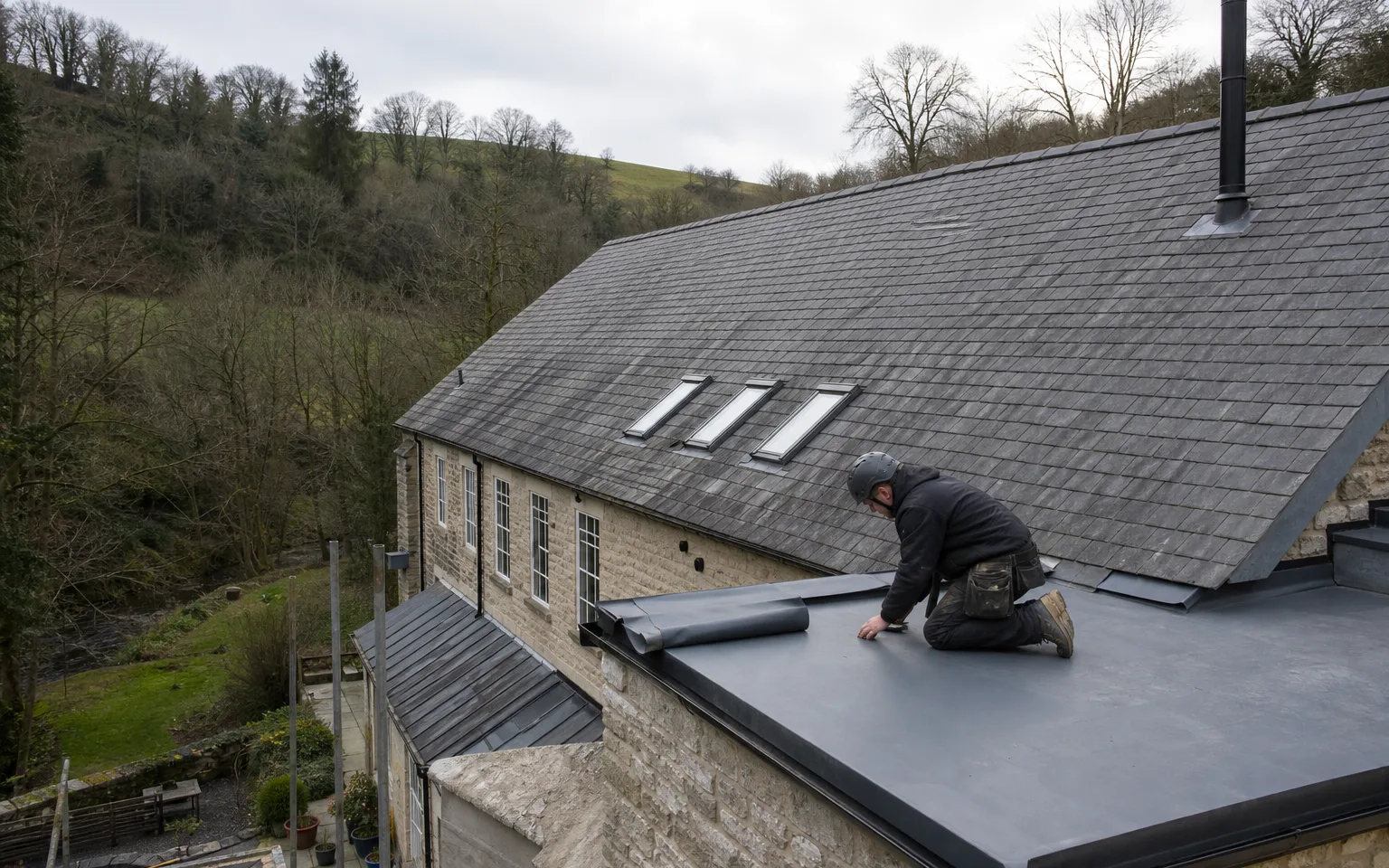
Chapter 03
What a repair costs on the Falfield stretch
Typical UK ranges for the common faults, set out before anyone climbs a ladder.
Chapter 03In this chapter
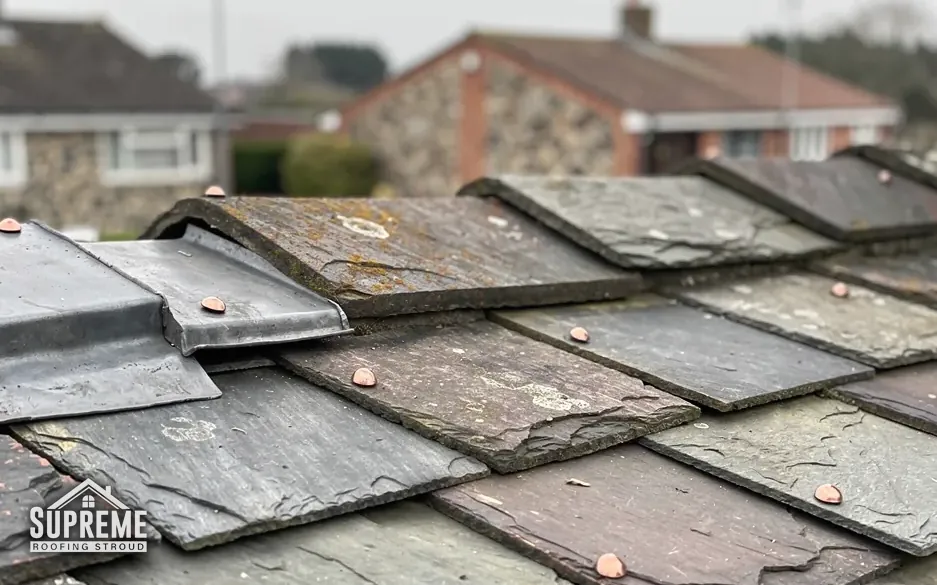
The roof faults we meet on a house like those along the A38 fall into a short list: slipped or cracked tiles, a ridge that has lost its bedding, lead flashings that have lifted, and gutters that have failed. Each has a typical national price range, and we publish them so that you can judge a figure before you invite us round. They are not Supreme prices; our own figure is the one we write once we have been on your roof.
In this chapter
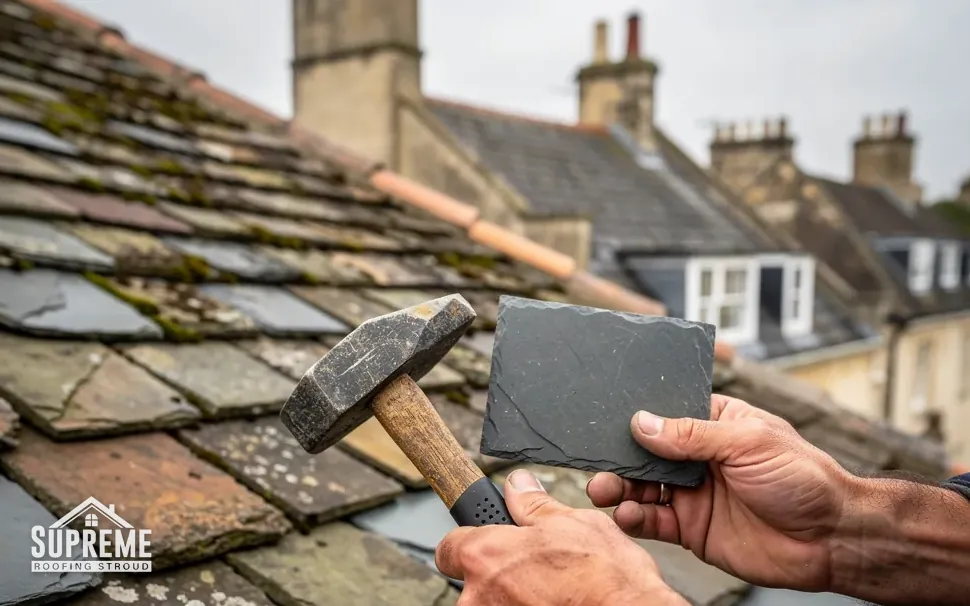
MyBuilder's 2026 guide puts the whole range for roof repair at £150 to £1,500 on average, with a minor repair at £100 to £300, a moderate one at £500 to £1,000, and a major one £2,500 or more. Storm damage fixes are put at £500 to £1,500. For ridges, re-bedding or replacing ridge tiles is £300 to £600, and repointing a ridge or hip at £200 to £400. A single slate costs £60 to £120 to replace, and five to ten slates £150 to £350.
Lead flashing is part of the job. MyJobQuote puts a chimney flashing patch at £150 to £250 and a full replacement at an average of £570. Chimney repointing averages around £750, in a range of £500 to £2,000, MyBuilder says. If the stack is the problem and the roof is sound, the answer is a stack repair, not a roof job, and the invoice should show that.
What moves a price up or down
Access is the usual driver, and on this road it means scaffold, which MyBuilder puts at about £1,125 for a full house, and the carry from the road. Roof pitch, the height of the eaves and the number of separate faults change the time on site. A repair that needs the scaffold costs far more than one done from a ladder, and the survey sets out which kind you have.
Leaks first
Leaks and storm damage jump the queue with us, and a roof that is letting water in is made safe ahead of everything else. That may mean a temporary covering while the lasting repair is arranged, and the quote makes clear which is which. Our roof repairs page covers the line between a repair and a re-roof, and the point where patching stops making sense.
Where a roof has several faults, the least costly route is rarely to repair them one at a time over several visits, since each visit may need its own access. We list every fault we find in a single report, with a photograph, so you can choose to do them together or in stages.
- Minor repair£100 to £300
- Moderate repair£500 to £1,000
- Storm damage fix£500 to £1,500
- Re-bed ridge tiles£300 to £600
Map showing Falfield and the Stroud service radius, with nearby towns we also cover.
Near Falfield
Roof work we do here
Heneage Court, the old mill and the A38 frontage
Heneage Court and the old mill are Grade II listed. Can I re-cover a roof in the same way?
Putting back the same covering and detail is the simpler case, but a change of material needs listed building consent from the council. We photograph the roof first so the repair-or-change question is answered from the record.
My Falfield house is on the A38. Where does the scaffold go?
Within your boundary if the plot allows it. If the public footway has to be used, the highway authority must agree first, and the quote allows for the scaffold.
Does Heneage Court, the old mill or the A38 frontage put any Falfield house in a conservation area?
The national planning dataset records none for Falfield. Listing still protects Heneage Court and the mill remains, so their owners should ask South Gloucestershire's planning team before changing a covering. St George's still holds services, so its roof work goes through a faculty from the Diocese of Gloucester instead.
The ground at Falfield is mudstone. Does that matter for roof work?
Only for the scaffold, whose base plates need firm, level support. We check what each base will stand on at the survey and say if boards or extra spreading are needed.