
Roofers in Cromhall
Roof, chimney and outbuilding work in Cromhall, a village a mile long on the B4058, with typical prices published and a written quote once we have surveyed your roof.
Cromhall at a glance
- Distance
- 18.1 road miles south-west of Stroud
- Council
- South Gloucestershire Council
- Setting
- Linear village on the B4058, bordering Leyhill
- Listed buildings
- St Andrew's (Grade I), the Old Rectory (Grade II)
Cromhall's roofs along the B4058 and on Rectory Lane
Cromhall is a village roughly a mile long on the B4058, between Bagstone and Charfield, and it borders Leyhill. By road it is 18.1 miles from Stroud, to the south-west, and it sits under South Gloucestershire Council. A village that stretches a mile along one road has no centre in the usual sense, and its roofs are spread out too: a house at one end can be a long way from the one at the other, which is something to plan for rather than a complication.
The village has more history than its size suggests. Coal was mined at Cromhall: the Old Engine works ran from 1774 to 1795, and a new colliery started around 1827 had closed by 1854, and its engine house remains. St Andrew's Church on Rectory Lane is Grade I listed, listed in 1960, and the Old Rectory is Grade II.
The age and covering of Cromhall's ordinary houses are established by the survey on every job. We name the covering on site, photograph the ridge, the valleys and the flashings, and then write the quote. Cromhall is not one of South Gloucestershire's conservation areas, so for an older house the question that matters is listing status, which the council confirms address by address.

Detached red brick Edwardian house with mock-Tudor gables and a tiled roof 
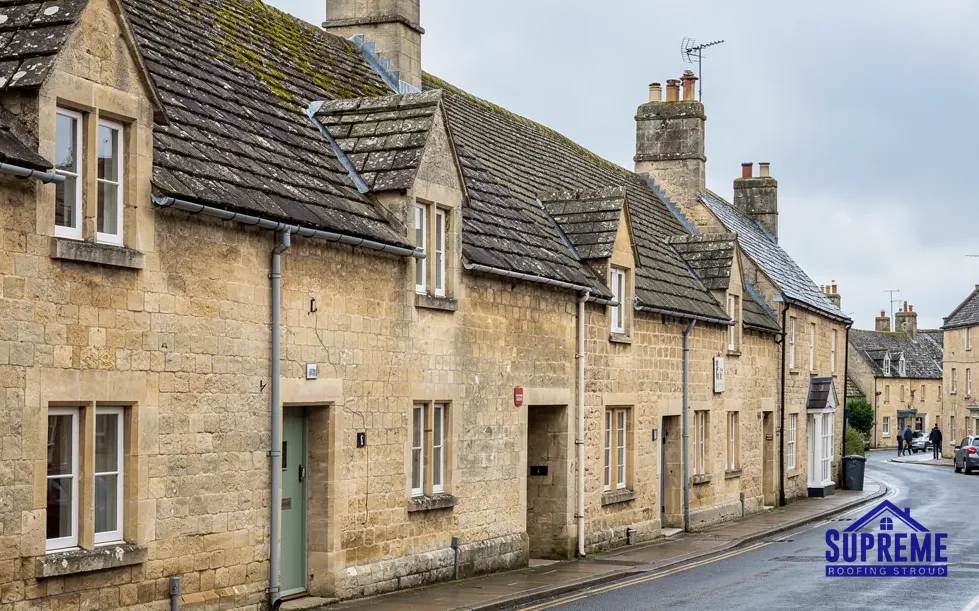
Stone terraced houses with slate roofs and chimneys stepping up a hill

Chapter 01
A mile of village: planning visits along the B4058
When the houses are strung out, the time between jobs matters as much as the time on them.
Chapter 01In this chapter
Roofing in Cromhall means working along the B4058, from the Bagstone end towards Charfield. A mile-long village is a different kind of planning problem from a compact one. Neighbouring roofs are not neighbours in any useful sense, so there is little to gain from sharing a scaffold with the house next door, and a delivery that is a short walk in one village is a longer carry here, because properties often sit back from the road behind their own plots.
In this chapter
We cover that at the survey by asking three plain questions. Where will the materials be unloaded? How far is it from there to the roof? And is there anywhere safe to stand the scaffold within your boundary? A house with a long drive and room for a lorry is quick to supply. One reached by a narrow track means materials are carried or barrowed, and the figure for that goes onto the quote beside the scaffold, so that the cost of access is visible and not folded into the labour.
If you want a second view, send us photographs from the lane and from the garden. From those we can usually say whether the roof needs a full survey, a short visit for a repair, or only a clear-out of the gutters. A repair that only needs a ladder does not need a scaffold, and you hear that from us before a date is booked. Our roof repairs page explains how we separate a quick fix from a roof that needs more.
Fixing leaks before they spread
Photographs from a phone help here: a picture of the ceiling stain, one of the roof slope from the garden and one of the gutter above the stain tell us a great deal before we arrive.
On a long, spread-out village the temptation is to wait and bundle several jobs into one visit. With a leak that is a mistake. Water finds its way into insulation and timbers, and the damage spreads faster than the paperwork. A leak goes to the front of the queue for us: we stop the water first, then arrange the lasting repair and quote for it.
One survey for the whole roof
The report lists every fault in the order of urgency, with a photograph, so that a leak can be dealt with at once and the remaining items scheduled when it suits you.

Even for a small fault, we look at the whole roof. A slipped tile in one corner is often a sign that the battens or the fixings are tired elsewhere, and finding that on the first visit saves a second journey down the lane later.
Carrying materials from the lane up to the roof is labour like any other, and a long village prices it as such.
Chapter 02
The colliery engine house and old outbuildings
Cromhall's coal-mining past is a reminder that not every roof is a house roof.
Chapter 02In this chapter
Cromhall's record includes the Old Engine works, which ran from 1774 to 1795, and a later colliery that began around 1827 and had closed by 1854. Its engine house remains. What the mining history does remind us of is that a village with working buildings in its past tends to have more than houses in its present: barns, stores, workshops and garages, each with a roof of its own.
In this chapter
Outbuilding roofs get less attention than house roofs, and they fail for simple reasons. A single-skin sheet roof leaks at its fixings and laps, a felt roof splits at the upstand, and a timber deck beneath either one rots from the inside once water has found a way in. MyBuilder gives a single flat garage roof at £700 to £1,000 and a double at £900 to £1,400, while a pitched garage roof costs £2,500 to £4,500, as typical UK ranges from its 2026 guide. These are not Supreme prices, and the figure for your building follows our survey. Our garage roof replacement page sets out the options.
Old sheeting and asbestos
Corrugated sheets on older outbuildings can be asbestos cement, and that changes how they are removed. HSE guidance classes careful removal of asbestos cement that stays whole as non-licensed work. Material that is badly damaged, or that would be smashed in taking it off (dropping a whole roof, for example), moves into notifiable non-licensed work: notify first, arrange medical examinations, and keep a register. We identify the sheeting first, explain which category your roof falls in, and plan the removal accordingly.
- 1774year the Old Engine works at Cromhall began
- 1795year the Old Engine works finished
- 1854year by which the colliery begun around 1827 had closed
MyBuilder puts asbestos removal at about £2,000 on average, with a single garage roof removal at £350 to £1,295 and a double at £650 to £1,800. A basic survey starts at £50, and a fuller one is £200 to £245. Disposal and the replacement covering are both covered by our quote.
If your building has a history
Should you own anything linked to the colliery, or any other structure that might be listed, ask South Gloucestershire Council what status it has before any roof work is planned. The engine house's status is a matter for the council, and we would confirm it with them before any work. A listed outbuilding or a curtilage structure is protected in the same way as a house, and the answer decides whether consent is needed.
Chapter 03
The Old Rectory, St Andrew's and the chimney stacks of Rectory Lane
Bigger old houses carry more chimney, and chimneys fail in predictable places.
Chapter 03In this chapter
The Old Rectory is Grade II listed, and St Andrew's Church, on Rectory Lane, is Grade I, listed in 1960. A house of that size and age usually has several chimney stacks, and the stack is where much of the roof's trouble starts. The mortar between the bricks or stones weathers, the flaunching on the pots cracks, and the lead flashing around the base lifts. Water gets in at any of those, and often the first warning indoors is a stain on a chimney breast or bedroom wall.
Flaunching is the mortar collar that holds the pot in the top of the stack and sheds water away from it. If it cracks, rain runs down the flue. We check it, the pointing, the flashings and the pots from the roof, with photographs of each, and we price repairs in that order. MyBuilder gives chimney repointing at about £750 on average, with a range of £500 to £2,000, flashing repair at £250 to £1,200, and a full stack rebuild at £2,000 to £10,000 or more. By house type, a semi with a side chimney is £600 to £900 and a detached house £700 to £900. Our chimney repairs page explains the choice between repointing and rebuilding.
Listed houses and stacks
On a listed house the stack is part of what is protected. Rebuilding one in a different brick, or lowering it, is a change that needs listed building consent from the council. Repointing in the right mortar is normally a repair, but the mix matters, since a hard cement can damage soft old masonry. We ask what the stack is made of before pricing the repair, and we say what we do not know.
St Andrew's and the faculty
For St Andrew's, Grade I and in use as a church, a faculty from the diocese authorises roof work, in place of consent from the council. We do not manage that process, but we can supply the survey and a written quote for the parish to use. If the church ever stopped being used for worship, the council would become the authority instead.
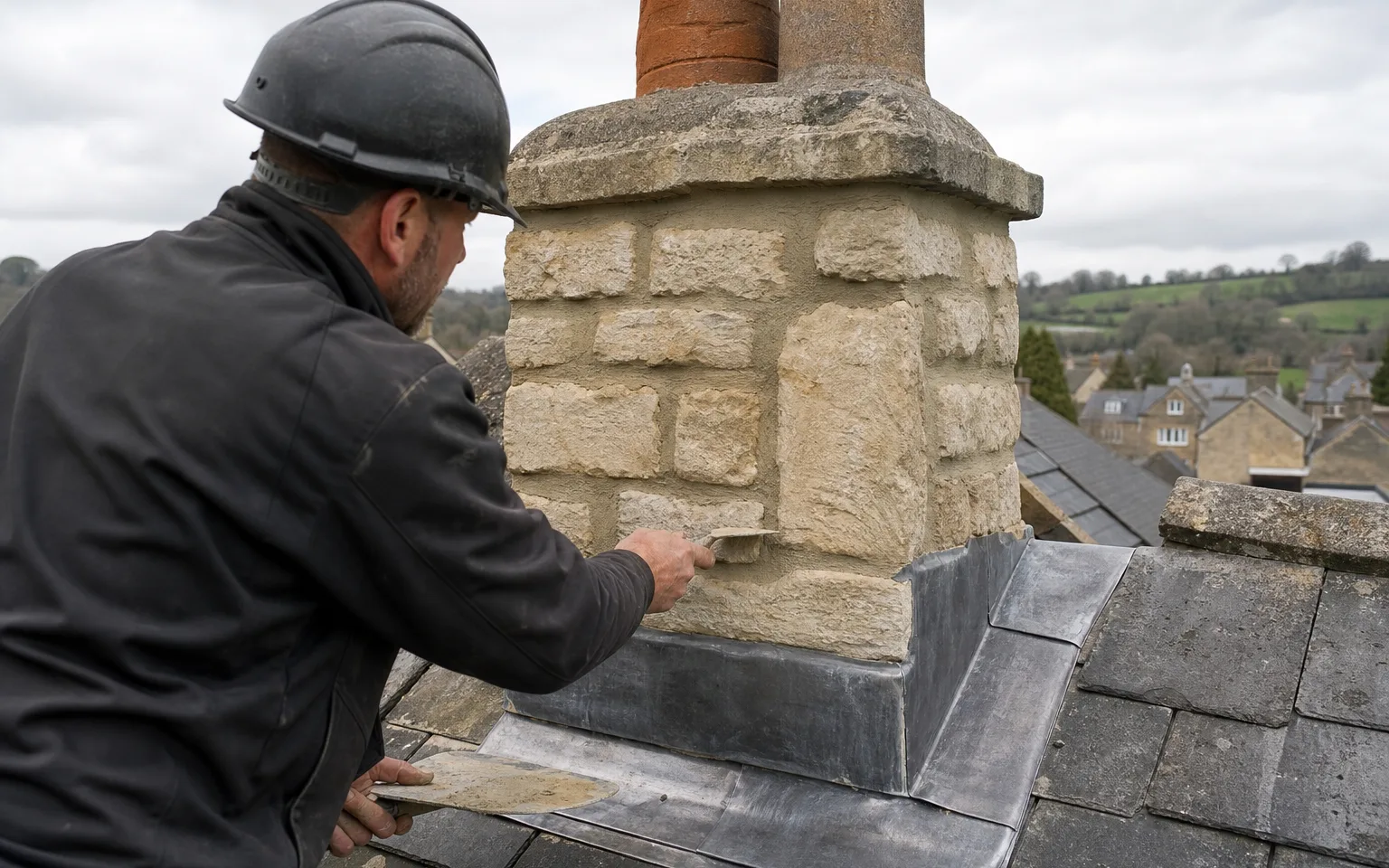
The lead round the base
Where a stack comes through the slope, lead flashing seals the gap. MyJobQuote puts a patch to a chimney flashing at £150 to £250 and an average full replacement at £570, and says lead flashing can last more than 80 years when correctly installed. Which of those suits your stack depends on how much of the lead has lifted, and the photographs from the roof show it.
- Repointing, average£750
- Repointing, range£500 to £2,000
- Flashing repair£250 to £1,200
- Stack rebuild£2,000 to £10,000+
Map showing Cromhall and the Stroud service radius, with nearby towns we also cover.
Near Cromhall
Roof work we do here
Rectory Lane, St Andrew's and B4058 outbuildings
My Cromhall house is on Rectory Lane near the Grade I church. Does that listing affect my roof?
Listing protects the listed building itself. Whether your own house is listed is a separate question that South Gloucestershire Council can answer for your address. If it is not listed, a repair in matching materials is a simple matter.
Does any part of Cromhall's mile-long length, from Rectory Lane to the far end, lie in a conservation area?
No. Cromhall is not among South Gloucestershire's designated conservation areas. A listed house is a separate matter, so ask the council's planning team about your address before you change a material.
The sheeting on my Cromhall outbuilding is old and corrugated. Could it be asbestos cement?
It could. We identify it on site. HSE guidance treats sheets lifted off whole as non-licensed work, whereas heavy breakage makes the job notifiable, so the method we propose follows the condition of the sheets.
How do you plan a job at the far end of a mile-long village?
We look at the lane, the plot and the distance from where a lorry can stop to the roof, then allow for the carry and the scaffold. A short repair from a ladder may not need a scaffold at all.