
Roofers in Kingswood, near Wotton-under-Edge
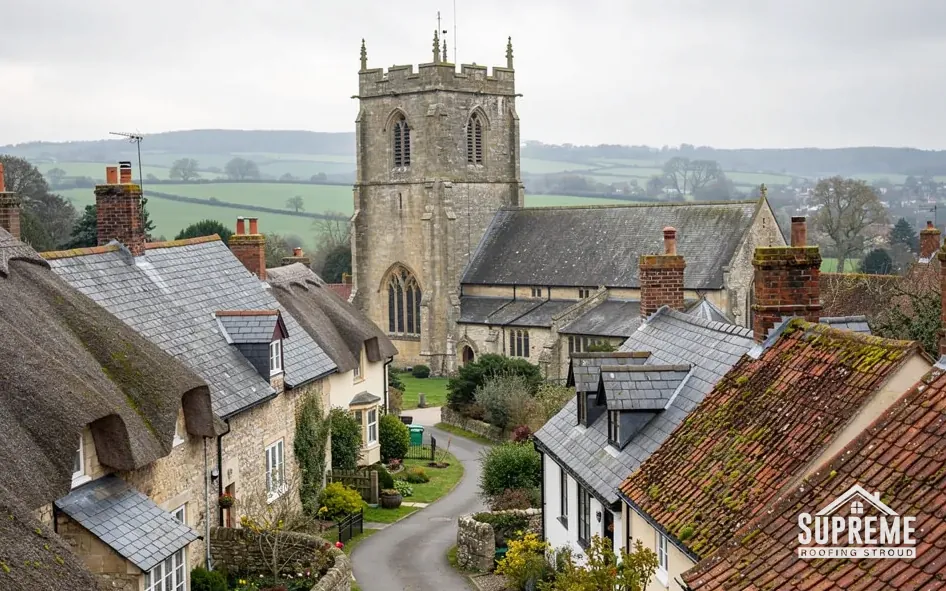
Kingswood is a village near Wotton-under-Edge, 13.9 road miles from Stroud towards the south-west, with a Grade I abbey gatehouse, an eighteenth-century stone church and a former mill. This is how we approach roofs in a parish with that much to protect.
Kingswood, near Wotton-under-Edge at a glance
- Distance
- 13.9 road miles south-west of Stroud
- Council
- Stroud District Council
- Conservation area
- Kingswood, no. 8, with adopted statement
- Listed
- Abbey Gatehouse (Grade I), Langford Mill (Grade II)
Kingswood's roofs: an abbey that vanished and what stayed
Kingswood Abbey was founded in 1139 by William of Berkeley and colonised from Tintern. It was demolished at the Dissolution, and its precise site is unknown. What survives is the abbey gatehouse, which dates to the early sixteenth century, is listed Grade I and is in the care of English Heritage.
The village church is newer. St Mary's was erected in 1723, built of stone and restored in 1906. Until 1844 Kingswood was a detached parish of Wiltshire, and it was transferred to Gloucestershire in that year, which is why it sits in Stroud District today.
Langford Mill, a former mill in the village, is listed Grade II. The village is a designated conservation area, number 8 on the council's list, with an adopted conservation area statement. Between them, the listings and the designation cover most of what a roof owner in Kingswood needs to know before work begins.
Every house here has its own slope, exposure and stone, so the useful advice is practical and applies to your address. A village with a Grade I monument, a conservation area, a stone church and a listed mill has several ways for a simple roof job to need extra checks. Before we price one, we find out which of those apply to your address. That means asking the owner or agent for any listing details, looking at the conservation area statement, and contacting Stroud District Council's planning team where the answer is not clear from the paperwork.

Street of stone terraced houses with slate and clay tile roofs 
Row of stone cottages with mossy clay tile roofs along a quiet lane
Chapter 01
The abbey gatehouse and living beside a Grade I monument
What a sixteenth-century survivor tells an owner about stone, ridges and weight.
Chapter 01In this chapter
The abbey itself is gone, but its gatehouse teaches a lesson that holds for each old building in the village. Stone outlasts almost anything when the roof over it keeps water out, and it deteriorates quickly when the roof does not. Cotswold District Council's 2000 guidance on stone slate roofing puts a well-kept Cotswold roof at 100 years easily, and possibly 200 or 300. It also records that stripping a roof frequently reveals that about 50% of the slates have perished. Read together, the two statements show that upkeep counts for more than age.
In this chapter
Neighbours of a Grade I building have extra things to think about. We do not claim any authority over the gatehouse, which is in the care of English Heritage, but a roof close to a monument can attract more attention from the council when you change its appearance. If your house, barn or outbuilding sits near it, the planning team is the right first call.
One detail from the old stone roofs is worth knowing about. The guide describes traditional ridges as dressed stone cut to a plain angle, and says the biggest slates sat at the eaves with the sizes shrinking towards the ridge. Those are called diminishing courses. If you see a ridge held with cement fillets on an older roof, it is likely to be a later repair. Since BS 5534 was revised in 2014, ridge and hip tiles are expected to be held mechanically as well as bedded in mortar, and dry-fix systems tested to BS 8612 are one way to do that. Our ridge, verge and dry-fix page explains the choices, and which ones suit a roof of stone and which a roof of tile.
Weight, and why it matters on stone
Stone slate roofs are heavy, at about 1,000 kg for every 10 m² in the Cotswold District Council guide. Putting a heavier covering where a light one used to be loads the rafters further. A rise of 15% or more triggers approval and a structural check, which is why the timbers get looked at before a quote is written.
Stone lasts as long as the roof above it keeps the water out.
Chapter 02
St Mary's of 1723, restored 1906, and roofs that carry old repairs
A stone church, a county-line history and what an Edwardian repair leaves behind.
Chapter 02In this chapter
St Mary's was put up in 1723 in stone and restored in 1906. Those two dates give a useful picture: a roof built in the early Georgian period, then reworked in the Edwardian years. Anything last repaired in 1906 has had well over a century to wear, and the repairs themselves can be the weak points. Mortar fillets crack, old lead thins, and nails of that period rust through.
In this chapter
St Mary's is listed Grade II. So long as it serves as a church, roof work goes through a faculty from the diocese, which is a different route from the one a house follows. Owners of other old village buildings, a former chapel or a hall for example, sometimes assume the same rules cover theirs. They may not, so we confirm the status first.
Kingswood has another feature of its past that is quieter. It was a detached parish of Wiltshire until it was transferred to Gloucestershire in 1844. That kind of history can matter to owners in a practical way: old deeds, survey records and insurance paperwork sometimes refer to earlier boundaries and names. When you hand us a title plan or a previous survey, we read it for roof details such as what was done and when, and we ask about anything that does not match what we see on the roof.
Reading a roof that has been mended before
A roof that shows several repair campaigns is common in villages of this age. A stretch of newer slate, a patch of different mortar, flashings in two different metals: none of it means the roof is failing, but each makes us slow down at the survey. We make a note of each change in material and where it sits, and mark it on the photographs we send you afterwards. The question is whether the repairs are sound and whether they can be tied into one coherent roof when the time comes.
- 1723year St Mary's church was erected, built of stone
- 1906year the church was restored
- 1844year Kingswood was transferred from Wiltshire to Gloucestershire
For a house with a mixed history we often recommend a roof repair to the worst slope first, so you can see what happens before committing to more.
Chapter 03
Langford Mill and the big roofs of a conserved village
Listed mills and conservation rules mean a re‑roof starts with paperwork and a plan.
Chapter 03In this chapter
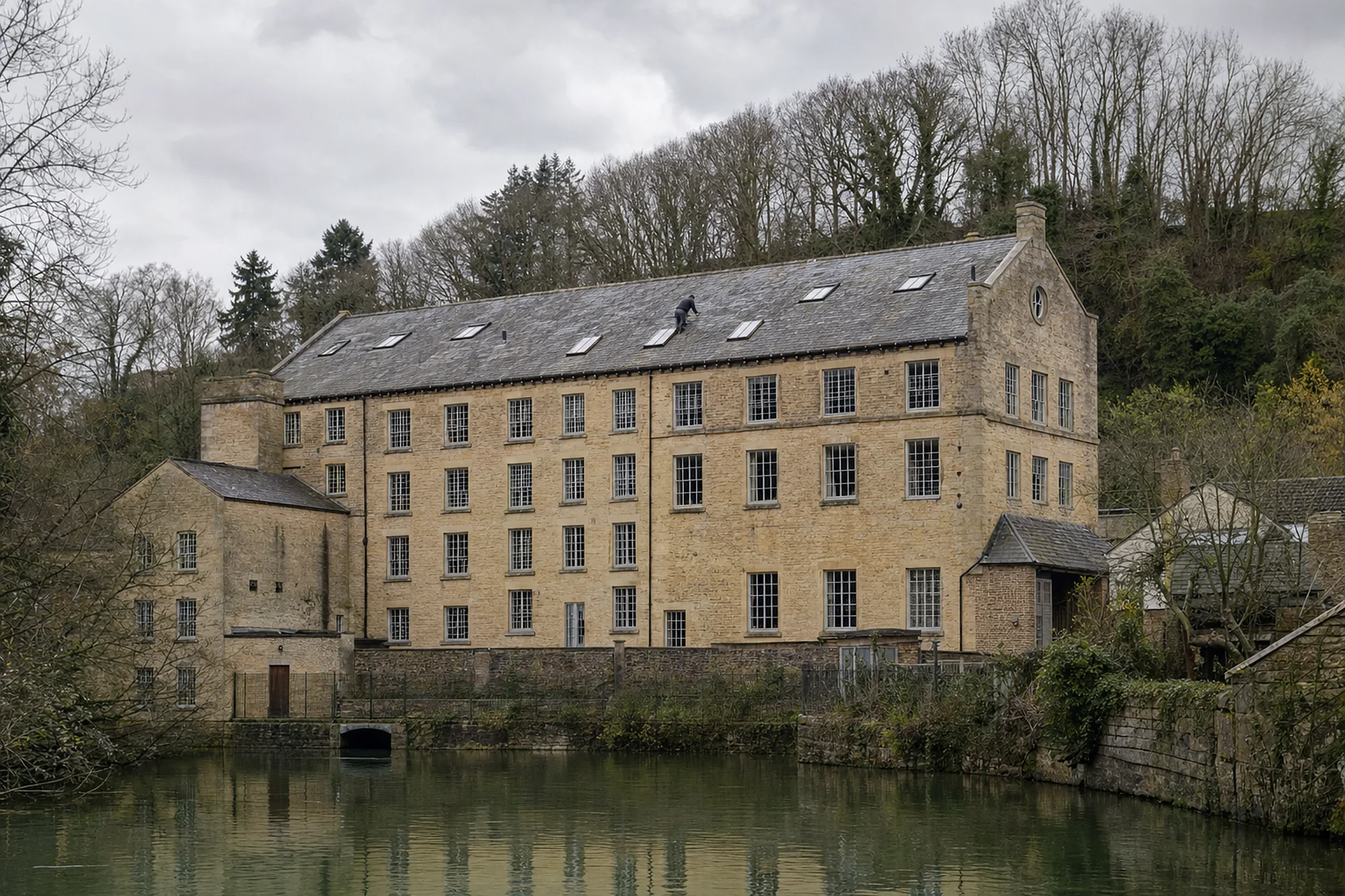
Langford Mill is a former mill in the village, listed Grade II, with a dated iron plaque of 1822 on its south-east front and a cast iron column structure inside. Mills carry some of the largest roofs in any settlement, with long spans, rainwater routes that run through the building and valley gutters that can be hard to reach. A building that has been turned into homes or workspaces also has several owners or tenants, which complicates who pays and who signs off the work. A roof is a shared asset in that case, and a repair to one section can protect or expose the rest. Leaks that appear in one flat may begin over another, so the survey follows the water back to its source before anyone is asked to contribute.
For a project of this size we write the plan before the price. It covers how the roof is reached, who has to agree to the scaffold, which sections are opened first, and how the building stays dry between visits. Because the mill is listed, any change to materials, or any new feature on the roof, needs consent from the council. A replacement in the same covering is more straightforward, but the council still has to be told what the original was, and a photograph of the existing roof helps it decide quickly.
If your property is not a mill but a stone house in the conservation area, you can expect the same questions on a smaller scale. Kingswood has an adopted conservation area statement. That means the council has recorded what it thinks gives the village its character, and officers use it when they look at proposals. Reading it before choosing a covering is time well spent.

What a re-roof costs, and what drives it
For a typical UK house, a full re-roof is cited at £5,000 to £12,000, with labour at £50 to £130 per m² and scaffold about £1,125 (MyBuilder, 2026). A listed or mill-scale roof is outside those averages. The covering, the consent work and the access all change the figure, so we survey first. Our roof replacement page lists the stages of a full strip and recover, from scaffold and waste to making good.
Our own workmanship is guaranteed for 10 years, in writing.

Paperwork worth gathering first
Four things speed up any Kingswood roof job: the listing details if your building has them, the conservation area statement, any earlier consent for work to the roof, and a set of photographs from the ground. With those in hand we can tell you which approvals apply, and the council has what it needs to answer without sending the request back to you. If you have none of them, we start with the survey and build the file from there, then pass you copies to keep with the deeds. A tidy roof file also helps at sale, when a buyer's surveyor asks what has been done to the roof and when.
Map showing Kingswood, near Wotton-under-Edge and the Stroud service radius, with nearby towns we also cover.
Near Kingswood, near Wotton-under-Edge
Roof work we do here
Kingswood roof questions, from the gatehouse to Langford Mill
My Kingswood house is built of stone and sits near the abbey gatehouse. Which approvals should I look into before re-roofing?
Find out whether your building is listed or inside the conservation area, then talk to Stroud District Council's planning team. The statement for the conservation area is on the council's site. We survey the roof, record the stone and course sizes, and send photographs so that any decision about materials is based on the real roof.
St Mary's in Kingswood was restored in 1906. Does a roof that old need special care?
Any roof last restored over a century ago can carry cracked mortar, thin lead and rusted fixings from that work. We survey slowly, photograph each repair campaign and tell you which parts are sound and which are the next to fail.
My flat is in a converted mill building near Kingswood. Who agrees to roof work?
Usually the freeholder or managing agent, together with the other owners who share the roof. We ask early who holds responsibility for each section, because that answer settles who signs the quote and who allows the scaffold. A roof shared between several households needs one clear set of decisions, and we are happy to explain the quote to all of them.
Kingswood was once in Wiltshire. Does that affect my roof paperwork?
Not for the work itself, which comes under Stroud District Council today. Older deeds and surveys may refer to former boundaries, so we read them for roof history and ask about any detail that does not match what we see.